Mobile reports and market data
Documents

Oakever Games shenanigans, King and the Xbox cuts, Hipster Whale, One State, Monopoly Go, more
The mobile games industry is currently navigating a period of significant structural change, legal scrutiny, and strategic consolidation.
- Oakever Games is facing multiple copyright infringement lawsuits, including a loss to Hungry Studio regarding the game Qblock, amid allegations that the company systematically clones successful titles and uses aggressive user acquisition to drown out competitors.
- Xbox’s latest restructuring resulted in 268 job cuts across its first-party studios, though the mobile-focused King division appears largely unaffected, despite looming strike actions in its Stockholm and Malmo offices.
- Hipster Whale, following its acquisition by Atari for $29.3 million, has gained access to Atari’s deep IP archive and plans to develop modern takes on classic titles like Pong, Breakout, and Centipede for mobile.

Puzzle Monthly #6: Disney Solitaire's Big Win, Playtika's Earn-Out Trap and Solitaire vs Puzzle
Disney Solitaire has established itself as a significant market success by successfully adapting modern puzzle-game mechanics to the solitaire genre.
- Disney Solitaire has successfully modernized the solitaire genre by adopting high-frequency live-ops, gacha mechanics, and progression systems similar to top-tier match-three titles like Royal Match.
- Playtika is currently restricting user acquisition spending due to significant debt obligations and the financial pressure of a substantial earn-out agreement with developer SuperPlay.
- Solitaire games are shifting away from traditional, ad-reliant revenue models toward social casino economies and complex meta-layers to improve unit economics.
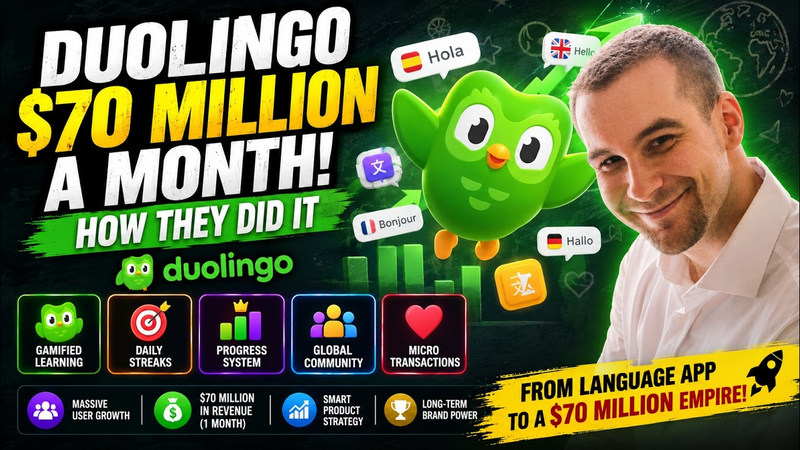
🦉Making $70 Mil. a month ? How Duolingo is plundering all the game mechanics 👀
Duolingo has successfully transitioned from a traditional language-learning tool into a highly gamified application, achieving record-breaking performance with approximately $70 million in monthly revenue, 20 million monthly downloads, and 90 million daily active users.
- Duolingo has achieved $70 million in monthly revenue, 20 million monthly downloads, and 90 million daily active users by integrating sophisticated mobile game mechanics into an educational utility app.
- The platform utilizes a progression-based 'saga' map and an energy system that replaces restrictive life mechanics to drive consistent daily engagement.
- Retention is bolstered by reward structures modeled after titles like Brawl Stars, including daily quest systems, chest-based rewards, and collectible virtual item albums.
Mobile App Trends 2026: Downloads & Revenue by Category and Country
The mobile app market is currently defined by a stark concentration of wealth, where the top ten non-gaming applications on Google Play capture 39% of total revenue.
- The mobile app market is experiencing a high-risk, high-reward environment where top-tier apps, such as TikTok, ChatGPT, and Gemini, account for 39% of total non-gaming revenue.
- New app submissions to Google Play and iOS surged by approximately 100% over a 15-month period, rising from 46,000 new apps per month in March 2025 to 110,000 by July 2026, largely driven by the rise of 'vibe coding'.
- Growth in the non-gaming sector is increasingly driven by maximizing the lifetime value of existing users rather than expanding the total user base, as evidenced by a widening gap between download volume and revenue growth.
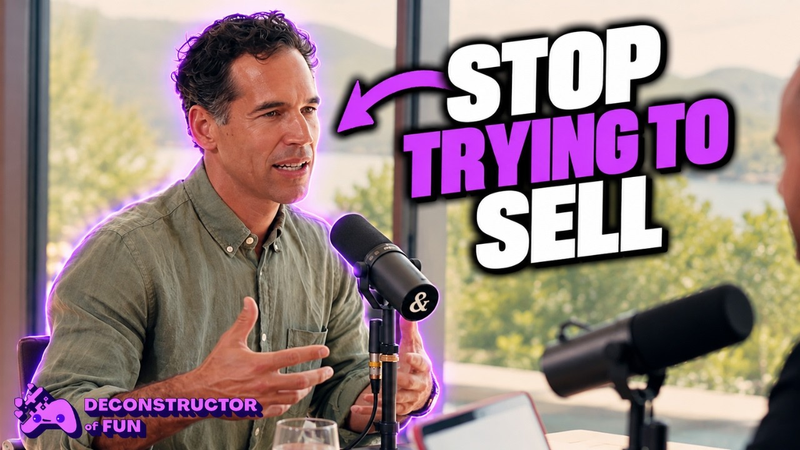
How 15 People Built a $50M Mobile Studio After a Failed Sale | Michael Martinez, FunCraft
FunCraft demonstrates that a lean, high-output mobile studio can achieve significant financial scale by prioritizing operational efficiency and rapid iteration over traditional development cycles.
- FunCraft achieved a $50 million annual revenue run rate with a lean team of only 15 people, resulting in $2.4 million in revenue per employee.
- The studio utilizes a proprietary HTML5 engine to maintain a rapid development cycle, allowing for the launch of new titles in as little as six weeks.
- The business model relies on a portfolio-based strategy that aggregates revenue across multiple turn-based titles rather than depending on a single hit franchise.
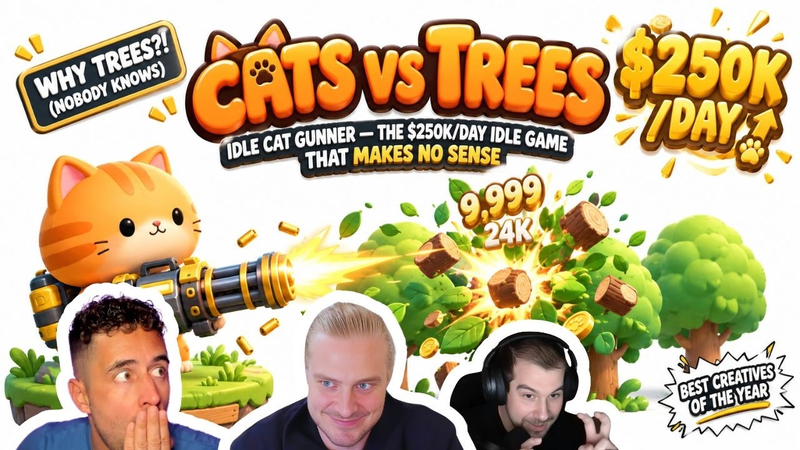
🐱 A Cat Shooting Trees: Idle Cat Gunner & the best creatives of the Year
Idle Cat Gunner has emerged as a dominant force in the mobile idle gaming sector, currently securing the number two position for in-app purchase revenue within its category.
- Idle Cat Gunner currently generates between $200,000 and $250,000 in daily revenue, securing the number two position for in-app purchase revenue in the mobile idle gaming category.
- The game utilizes a minimalist design that removes complex mechanics like enemy AI and defensive requirements, focusing instead on a simplified merge-weaponry progression loop.
- Monetization is driven by a multi-faceted architecture that includes battle passes, auto-upgrade packages, tiered offers, rewarded ads, and offer walls.

Why Rewarded UA Is Built for Indie Studios
Rewarded user acquisition (UA) has emerged as a critical growth strategy for indie and small mobile game studios, offering a viable alternative to the high-cost, long-payback environments of traditional performance networks.
- Rewarded user acquisition (UA) offers indie studios a competitive advantage over traditional performance networks by providing lower breakeven points and faster paths to ROI, which is critical for studios with limited cash flow.
- Rewarded users should be segmented separately from organic or video-network users because they exhibit higher retention rates and a greater tolerance for ad exposure due to their incentivized nature.
- Standard 7- or 14-day segmentation models are ineffective for rewarded traffic, as the majority of user behavior and monetization occurs within the first 1 to 3 months.
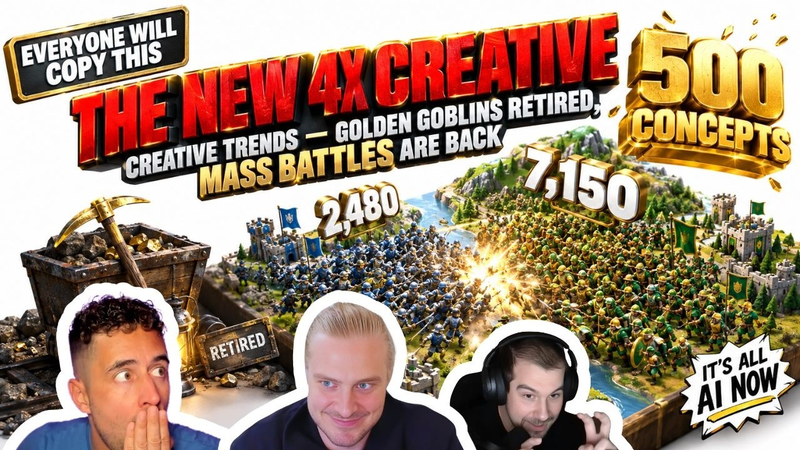
🧠 New CREATIVE Trend Everybody will COPY in 3..2..1
The mobile gaming industry is undergoing a fundamental transformation in user acquisition, moving away from traditional 4X strategy templates toward high-frequency, AI-driven creative production.
- Mobile game user acquisition is shifting from traditional 4X strategy templates to high-frequency, AI-driven creative production models.
- Successful titles like Top Force are scaling by using AI to rapidly iterate through hundreds of unique visual variations to identify high-performing mechanics.
- Legacy creative tropes, such as the 'hunting bears' style, are no longer effective due to market saturation and consumer fatigue.

That EA-Scopely supergroup, Reform's mobile game, King strikes, Mattel, Roblox, Mizuguchi, more
The mobile games industry is currently navigating significant shifts in corporate consolidation, regulatory pressure, and platform evolution.
- Bloomberg reports that Saudi Arabia’s Public Investment Fund is considering a merger of its gaming assets, including Savvy Games Group, EA, Scopely, and Moonton, to create a unified gaming supergroup.
- King faces potential strikes at its Stockholm and Malmo offices on September 25th following a year-long dispute over a collective bargaining agreement that the company rejected in June.
- Roblox announced new technology allowing creators to export games as standalone native titles for mobile, PC, and console, alongside a new 'Roblox Wallet' for daily real-currency creator payouts.
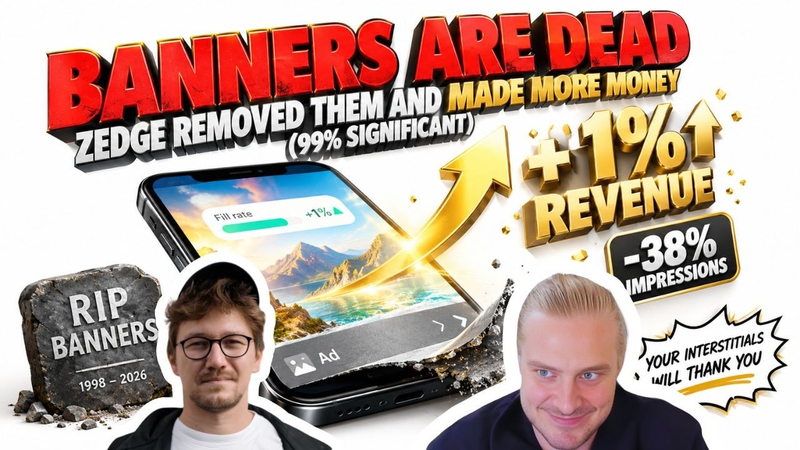
🪦 Are Banners Dead? Zedge Removed Them, Cut 38% of Impressions, and Made MORE Money
A recent experiment conducted by Zedge, a personalization app with 721 million installs, challenges the long-standing industry assumption that banner advertisements are a necessary component of mobile monetization.
- Zedge removed all banner advertisements from its app, resulting in a 38% reduction in total ad impressions while simultaneously increasing overall revenue by 1%.
- The removal of banners led to a 1.77% improvement in primary user engagement metrics, suggesting that banner-free environments foster better user retention.
- Eliminating banners consolidated ad demand into higher-value formats like interstitial and rewarded video ads, which saw significant gains in fill rates and performance.

S07, E33: An oral history of mobile user acquisition (with Nebojsa Radovic)
The evolution of mobile user acquisition has undergone a fundamental transformation, moving from the labor-intensive, manual operations of the mid-2010s to a lean, AI-driven landscape.
- Mobile user acquisition has shifted from manual, high-headcount operations—where competitive advantage relied on custom reporting and publisher-level targeting—to automated, AI-driven environments where success depends on creative volume and signal engineering.
- Algorithmic platforms like Google's UAC have democratized access to global audiences, making it easier for developers to launch games but significantly increasing competition and making profitable growth harder to achieve.
- Modern UA performance is heavily dependent on 'signal engineering,' which requires feeding high-quality data (such as 20+ daily purchases per campaign) into algorithms to exit learning phases and optimize LTV.

🎮 Playables Are Now 40-60% of Creative Spend: Here's what's working ńow
Playable advertisements have emerged as a dominant force in digital marketing, currently accounting for 40% to 60% of total creative spend across the gaming and non-gaming sectors.
- Playable advertisements now represent 40% to 60% of total creative spend across both gaming and non-gaming sectors.
- The industry is shifting toward 'Frankenstein playables,' which synthesize multiple proven, high-engagement mechanics like yarn puzzles and rescue scenarios into a single ad unit.
- Non-gaming sectors, including finance and social apps, are adopting gamified elements like obstacle-avoidance and item-catching to drive user engagement through low-friction interactions.