VideoTwo & a Half Gamers
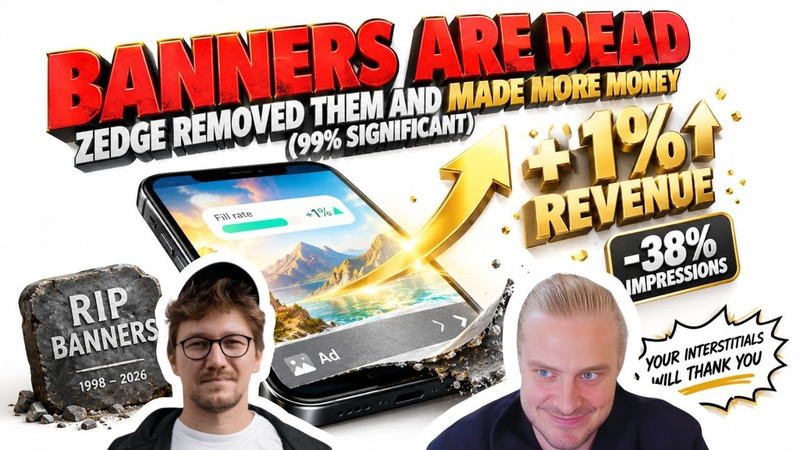
🪦 Are Banners Dead? Zedge Removed Them, Cut 38% of Impressions, and Made MORE Money
16 Sept 202624 min video
So in the end of the day, we were surprised by the result. We couldn't believe that we're seeing an increase in engagement, increase in Northstar, almost 2% in Northstar, 1.77% increase in Northstar by removing a banner, something that doesn't seem to be impacting UX in a negative way at all. So these results were incredibly surprising to us. [music] Knowledge made of golden eyes. Failix with ads making those coins rise. Jack up designs worlds chasing the sky. [music] We're the two and a half gamers. The midnight crew talking UA advers and game design too. M feeling shak bringing the insight. [music] We're rocking those vibes till the early daylight master eyes on the prize. Tracking data through the cyerspace skies. Felix stacks colors like a wizard [music] in disguise. Jack lift us to the high. Two and a half gamers talking smack. Slow hockey sick got your back. Ads are beautiful. They like the way. Click it fast. Don't delay. Uh-huh.
[music] Aha. Aha. Okay. Real talk before we start. This episode is brought to you by Potencus. And if you're a mobile game publisher tired of leaving money on the table, listen up. Potencus is a premium ad network built by people who have actually been on both sides of this industry. Game publishers, agencies, successful exits. So, they get it. Here's the thing. Potencus has direct deals with Amazon, Apple, Coca-Cola, Vodafon. It's not programmatic. It's direct. Those budgets land in your game at premium CPMs. No middlemanex. And they handle everything with their in-house team in terms of the critics. Plus, they've partnered with playable maker ving wing. So, they will take brands YouTube videos or static images
and actually turned into a playable ad or reverted video proper interactive format built for gaming inventory. Brands getting a gaming native creative publishers are getting a higher CPMs. Everyone wins. Head to potensus.com to get started or check their creative portfolio in the link in the show notes. Thank you very much Potencus for sponsoring this episode.
Hello everyone and welcome to an extra special episode of the Two and a Half Gamers podcast. Today it's just me here alone doing a Admon focused interview with a very interesting person and we're going to be talking about banners and is like are and are banners actually debt as an ad format. So without further ado, I want to introduce my guest. You can introduce yourself. You're quite known in the industry as well. Maybe you can introduce yourself in your role.
Hello everybody. I'm Ignas Daniels. I'm from Lithuania. I'm 39 years old. I'm roughly 1 m 93 cm. I think I'm under 100 kilos, but recently I went above and
nevertheless um I'm doing ad monetization at Zedge. I've been with the company for 7 and 1/2 years. I manage a team of four. I'm responsible for all ads served on Android, iOS, and web. And of course I want to do a shout out to the team without whom um this test like these wouldn't be possible. Thanks guys. It's a pleasure working with you. And of course I value the process, the jokes and the honesty. I would like to introduce Zesh. Zed is a personalization company. Our biggest app is on Android. We have 721 million installs with 4.7 rating in Google Play and um 17 million reviews. We've been around for quite a while. um and wallpapers and ringtones isn't everything that we're doing. Uh we have a few other um companies that we acquired or businesses that we started recently. So to name a few, we also own emojipedia which is like a Wikipedia for emojis. We recently acquired Guru shots which is a photography game. Uh doesn't
have ads unfortunately. and and one thing I want to stress is that there is a new business that we started which is called data seats which provides training data sets to improve AI model performance across images, video and audio for the gaming industry which is I guess a bit more relevant here. Uh this can include anything from character consistency data sets to audio transcription translation into multiple languages and stuff like that. If you would like to hear more about data seeds, reach out and I'll point you to the person internally.
Cool. So before we get into this very interesting research case study that you published I think in late April which basically showed that banners are dead. Before that, it would be very interesting for me basically just if you could give a brief overview cuz you guys serve interstitials rewarded ads and according to sensor tower you have about a this is sensor towers data right you have about a million and a half dau so you're quite big admon player in Europe
right so quite interesting to see I would just love to hear overall how you think admon is doing and basically what you're seeing trends across interstitials rewarded and then We'll get to the banners later, right? But would be super interesting to hear it from you.
So ad monetization these days for me. Um the old school way was waterfalls. Incredibly difficult setups. Um then this moved to bidding mostly. Ironically, we're going back to waterfalls. We're going to user value segmentation and unique waterfalls by user value segment. We're running, as you mentioned, all ad types. We do interstitials. We used to do banners. We do native banners still native medium units rewarded and app open ADM mob template to be very specific apping app open template is not what I'm referencing. Sounds cool man. So what have you kind of noticed I guess about banners in particular since I don't know
since five or seven years ago you started right. So what have you actually noticed about the banners ecpms trending from then to now? So ironically once I joined the company banners were driving majority of the revenue. These were we were known as an app that serves a lot of banners but moving forward players like a appeared who did very well on interstitials and in the end of the day you know it seemed that interstitials and rewarded formats were improving much faster than the banner. So in the end of the day uh you focus on what makes you more money and that's how you come to the conclusion and well of course if we come back to the banners Felix yourself uh our conversation next to the swimming pool in Barcelona was also an influencing factor because you know internally we were looking at banners and like we couldn't understand what's happening why why are they losing traction why can't uh can't we push the CPM a little bit
higher for banners is it it sort of felt stale.
My theory here and you can give your input on it is basically the banner. The only stepful meaningful change that I think has happened in the last seven years is they can also load native banners in the normal banner slot. Right.
Well, also the adaptive banners that exactly stream. So,
you know, I do agree with you. The innovation here seems to be primitive to non-existent. It's functional.
Yeah. But you compare that to essentially what's happening on the interstitial and rewarded side. So a banner is pretty much the same as it was when it was invented in the late '9s. Whereas interstitials and rewarded ads on mobile have been going through an absolute arms race when it turns uh when it basically comes to conversion. they have been getting longer and longer and harder and harder to click out of and even with redirects, right? So, the
conversion rates on video ads has improved greatly, whereas banners probably has stayed the same, right? So, as a ad unit, basically what's driving your per your performance as an ad network is going to be video, meaning you're happier to pay more for those type of ad units and banners just haven't been able to compete there, right?
Well, it is kind of ironic. I did see video inside those tiny strips of pixels, [laughter] but that was like almost funny. Like I mean you can't see anything what's happening inside that little video, but well people tried. But nevertheless, another important point to mention I believe is that interstitials they they are much more dynamic than banners. Uh the first impression for an interstitial is by far higher than let's say impression number 10. Whereas for banners, there is not so much dynamic. You know, the first impression, the second, the third impression, it's more or less flat. Of course, the first one is a bit more expensive, but there's
it's the difference isn't as big as with interstitials, per se.
And uh do you see basically I guess where can we take that, right? Like I I guess like where do you see which networks right now are still performing on banners? And I think then we can go to your actual study to talk about it. But basically, yeah, banners are losing their oomph.
Yeah, exactly. So, the banner networks, we tried many. Um, I do believe these are the best ones. Maybe I'm missing somebody, but my list is as follows. It's Google, Liftoff, Appi, Malocco, Verb, and Amazon.
Cool. And what type of refresh rates were you running before you start decided to run this test? Right. Because that's also one of the things that's made banners less valuable per unit of banner because we're showing refresh rates that used to be 30 seconds is now 10 or 5 seconds in some cases.
Exactly. And as you pointed out, you know, the industry is moving towards conversion and less towards gambling
because in the end of the day, you know, a 5-second refresh, imagine even if you see an ad that you really like, for the first two seconds, you're still reading. you you're you're thinking what's happening there and the moment you would like to click it refreshed a different ad. So in the end of the day, you know, 5-second refresh is great for a publisher, but not for the advertiser. And ironically, if a publisher sees more revenue at 5 seconds, it will adopt. And this can literally kill the ecosystem and kill the format completely cuz if many start refreshing at 5 seconds, banner becomes low converting unit and people start thinking why should we invest in banners where we can measure so much with interstitials. we see great conversions and I mean what's the point of even developing the creative for the banner and spending your design resources?
Yeah, I guess uh what you're also kind of alluding to is like that the amount of misclicks on banners like it's quite a lot right.
a lot of misclicks. On top of that, we also had some redirect problems from banners and the moment we stopped it, we couldn't identify it. And I know that many companies, very big companies bigger than us, tried to solve it and couldn't. So removing the format solves the problem as well. I guess that's a really nice tea up for basically what you were saying before. Interstitials rewarded ads, ecm improving year-over-year. banners eCPM decreasing decreasing which finds you in November I guess when you were want to design this test to actually see how valuable banners are. What was the test and what was kind of the thinking behind it and how did you run the test? Let me just pull up some numbers here. So basically the moment we designed the test we were running an ad server testing uh different ad servers and seeing if we can make more money by using a different ad server on banners. But what we noticed is that the moment we started running this test, we use internal experiment tool for tests like these and we observe impact to all
formats. So the moment we started running the test, we started noticing that other formats are impacted by us running a dual mediation on this uh on on the banner per se. So we thought like maybe we should experiment with different refreshes. So we tried every single refresh rate possible and the biggest irony was that we were expecting that going from 15-second refresh to 30 second refresh for example by cutting impressions increasing advertiser value we would see less cannibalization across other formats but we didn't see it we saw it only if we remove the banner completely which is peculiar I cannot explain it why but you know essentially it's not the volume How long did you keep uh the test live when you're running the refresh rates, right? Because you know, if you've been running a 10-second refresh rate on banners, you're labeled as a low quality ads source and then you just change it for 2 days, that's not really going to impact eCPMs at all, right?
Yeah, we uh we usually do banner refresh tests. Uh we used to do banner refresh tests every year. We would make the change and keep it for at least 2 weeks or so, then revert it. One important thing to note as you pointed out if you revert the refresh from 15 to 30. So basically if you go from 30 seconds to 15 seconds impressions go up pretty fast CPM doesn't decay as fast but the moment you go from 15 to 30 CPM doesn't bounce back instantly and impress but impressions do. So it's important to factor that in when running banner refresh tests. And in the end of the day, every time we run a test, we replace the whole infrastructure, all ids to make sure that there are no past learnings under those specific IDs and the test, the new test is not impacted by the previous test results. In other words, so basically you saw that removing banners started to increase your revenue on interstitials and rewarded ads by a bigger factor than
they were actually earning you guys, right? or was this when you guys wanted to relaunch the test or how did that thinking go? [snorts]
So, basically we did a few variations with the 15-second banner refresh, I believe, 20 second banner refresh, 30 second banner refresh, and for for a joke, we removed the banner completely
just for laughs.
Just for laughs, you know, we thought like, okay guys, if we're consistent, let's be consistent. Let's remove it completely just to see what happens. And I mean, we were all incredibly surprised. We we were expecting you know that the impact wouldn't be so big because before every single test we calculate the cost of test and if the test cost too much maybe we rethink removing the banner but in this case given the banner CPM declined that removing the banner was cheap.
Was this in January or what what month was this?
It was December. We started the test on December. you know the method is um is pretty beautiful in my eyes because you know the test started in December and
finished in January which is the best period in addups and the worst period in adds we had different hypothesis we were thinking like okay it's December the demand is high maybe that's why it's looking the way it's looking but then January hit CPMs dropped and consistency remained we were literally for the whole duration of the test outperforming control group by 1% in revenue by removing 38% of impressions.
Say that again. 1% higher revenue by removing 38% of the impressions.
And what happened to retention rates then? Right? Because that's the usually the biggest impact because users don't get annoyed with banners or what was the impact there?
Exactly. But one thing that many publishers can't measure is the auto redirects that the accidental clicks the content inside banner. We serve so many it's impossible to review every single banner. So in the end of the day we were surprised by the result. We
couldn't believe that we're seeing an increase in engagement increase in Northstar almost 2% in Northstar 1.77% increase in Northstar by removing a banner. something that doesn't seem to be impacting UX in a negative way at all. So these results were incredibly surprising to us. At the end of the day, we even once we concluded the test, we removed the banner. We thought, okay, maybe something um is wrong with our method. Let's try to do a reverse test where we introduced the banner again.
What month? What month was this? What month was this? Right after we we finished uh the test on end of January and then right after promoting the winning variant we did a reverse test where we're introducing the banner as well and we saw the same results. Maybe you know if we would have waited for a month and then ran the test we would see something different but well you never know the only way to learn is to t to run tons of tests and build your
processes around those tests. There are no sort of handbooks on ad operations and how the algorithms work.
Yeah, exactly. Yeah. What do you think is actually happening here? Right. Like why do you think revenue increase on interstitials are rewarded as you remove the banners? What do you think actually happened?
I believe that you know in the end of the day when advertiser targets your specific app or bundle ID, they're bidding on a user
and surprise surprise, everybody wants to get that user as cheap as possible. So, if you have banners in your app and you serve a lot of banners and you're refreshing them very fast, some advertisers might think that they got a valuable impression and make a choice based on a banner impression and not an interstitial impression and that could lead to some advertisers sort of buying the user very cheap and making a decision on that. Um, by removing the banner, you remove the cheapest way to acquire that user and
you provide better advertiser value. And at least for us, what we saw is we didn't see much change in the first interstitials in the user session, meaning the first one on the new install, you know, the fresh install from Google Play, it will always be great fill, great CPM, right? But we did see a a much bigger increase for interstitials later in the session. For interstitial number four, five, six in the session, fill rates just exploded. Our imp went up and we were expecting a negative result, but we didn't see any.
I mean, yeah, we saw it right in sensor tower, right? So, you know, 1.5 million users, the the ad revenue is going to be quite big, right? So, you guys have just completely abandoned banners based on that, right? I think I think your hypothesis is very true, right? So banners were completely gone now, right?
No banners served. Well, unless you look at it from the ADM Mobs perspective where MRE is also a banner.
Fair enough. What do you think this actually means for the broader ecosystem
and kind of like what do you think this means for a banner [clears throat] ad unit as a whole and yeah, what do you think it means for us?
I mean in the end of the day, I guess this boils down to can other publishers reproduce the results of the same experiment. So
right
in this case I mean I don't know even in science you know some experiments that I run they cannot be reproduced and it's a big problem you know
in this case I do believe in reproduction but many things need to align so the way I would evaluate it I guess it depends on the format mix frequency of use value distribution ad networks used and impressions per daily active user by format. So in the end of the day, I do believe that these results could be experienced by other publishers, but uh these publishers need to have a similar setup to ours. Meaning working with the biggest networks, having up to 15 networks for your interstitials, promoting tests that are th positive by at least 2 3%, having low
latency, having all formats in the mix. And um yeah, one thing I did notice is that you know if if an app for example has a high frequency of use. Banners could perform differently because we are a wallpaper and ringtone app. People come to us, they set a ringtone and they leave. They might come back after 6 months, 8 months, maybe a year. They for completely forgot how their experience was after that.
So just out of curiosity here, right? So the the biggest banner advertiser is Google by far. that is Amazon and then I guess it's either app lobby or whatever, right? So do you remember what you kind of saw those two networks doing when you removed the banners? Did interstitial rewarded impressions or eCPMs go up for those networks or I guess not for Amazon but for Google I guess is the main one.
Uh well I I didn't look network by network. I mainly looked at overall numbers and increases for the format
across all biders because in the end of the day
the result was good. It was 99% statistically significant where the standard is 95. Huh. We we really couldn't believe the results. Uh [laughter] u [clears throat] so I forgot your question.
No no I was just wondering like if Google had a big impact right because it's the main banner server. Yeah. I would say that, you know, in the end of the day, I I do believe that Google had the biggest impact because they usually have the highest share of wallet for many publishers. If Google isn't the highest share of wallet, or at least a very significant share of wallet for you, you're probably doing something wrong.
Cool. All right. Before we finish up, let's say I'm a game publisher that monetizes with interstitials, rewarded, and banners, and I'm hearing this. What questions should I ask myself before considering turning off my banners as a test? And what advice would you give to someone listening?
Look at add value by impression
in a sequence. Meaning the first banner impression, the first interstitial impression, the second banner impression, the second interstitial impression. Compare the CPM trends. If you see your interstitial CPM decay, decaying slower than the banner, simply try to remove the banner. You might see a significant increase in interstitials later in the session because in the end of the day, the traditional way to make more money in a gaming app is interstitials and RVs. This is, you know, what's driving the majority of your revenue. Many think that the banner is always contributing. It's sort of a status quo that wasn't challenged by anybody and I'm really happy that we did this challenge and we found this result. In the end of the day, um, think about the banner as extra real estate. You can win. Think about inapp messages that you can show instead of that banner and you'll make a little bit more money from interstitials. Your fill rates for interstitials will become
better because in the end of the day, if you want to show more interstitials, it's not as simple as you wanting to show more interstitials. They need to be filled. And the banner requests might be interfering with your interstitial fill rate. The banner you might see a significant increase in the interstitials that are lower in value later in the session. Spoken like a true adorn master. So I think we're going to end here. I'm going to put a link to your study that you published on your blog in the show notes below. Perfect. I'll leave your email below as well. I'm sure you're going to get a lot of inbound from random gam networks as well, right? But anyway, thank you so much for joining. This has been another fantastic episode of the Two and a Half Gamers podcast where you can stay two and a half steps ahead of the mobile gaming industry extra true today with the facts that Ignas shared today. So, thank you very much for stopping by. Please don't forget to like and subscribe. Bye-bye. and Felix.
Auto-generated captions from YouTube — names and numbers may be misheard.
A recent experiment conducted by Zedge, a personalization app with 721 million installs, challenges the long-standing industry assumption that banner advertisements are a necessary component of mobile monetization. By removing banners entirely from their application, the company observed a 38% reduction in total ad impressions, yet experienced a 1% increase in overall revenue and a 1.77% improvement in their primary engagement metric. These findings were validated through a reverse test, which confirmed that the removal of banners consistently outperformed the control group, even across varying seasonal ad-ops conditions.
The analysis suggests that banners have become a stale, low-value format compared to the rapid innovation seen in interstitial and rewarded video ads. Because banners often rely on high-frequency refresh rates—sometimes as fast as five seconds—they frequently provide a low-quality, high-volume environment that encourages accidental clicks and redirects. By eliminating these banners, the app effectively removed the cheapest way for advertisers to acquire users. This shift allowed interstitial ads, particularly those occurring later in a user session, to see significant gains in fill rates and performance, as the demand previously diluted across banner impressions consolidated into higher-value formats.
The study concludes that publishers should critically evaluate their own ad stack by comparing CPM decay across impression sequences for different formats. If interstitial CPMs decay more slowly than banner CPMs, the banner real estate may be better utilized for in-app messaging or other engagement tools. While these results were highly successful for Zedge, the findings are most applicable to publishers who maintain a robust mix of ad formats, utilize multiple bidders, and prioritize low-latency infrastructure. Ultimately, the experiment demonstrates that the "status quo" of banner monetization is not an immutable rule and that removing underperforming units can paradoxically improve both revenue and user experience.

Two & a Half Gamers · 2026

Two & a Half Gamers · 2026

Two & a Half Gamers · 2026

Two & a Half Gamers · 2026

Two & a Half Gamers · 2026

Two & a Half Gamers · 2026

Two & a Half Gamers · 2026

Two & a Half Gamers · 2026

Two & a Half Gamers · 2026

Two & a Half Gamers · 2026

Two & a Half Gamers · 2026

Two & a Half Gamers · 2026

Deconstructor of Fun · 2026
Two & a Half Gamers · 2026
Two & a Half Gamers · 2026
Two & a Half Gamers · 2026
Two & a Half Gamers · 2026
Two & a Half Gamers · 2025
Two & a Half Gamers · 2025
Two & a Half Gamers · 2025
Two & a Half Gamers · 2025
Two & a Half Gamers · 2025

Two & a Half Gamers · 2025
Two & a Half Gamers · 2025
Comments