Mobile reports and market data
Documents

How Angry Birds reached the stars
The Angry Birds franchise serves as a definitive case study in transforming a mobile game into a global transmedia powerhouse.
- Angry Birds achieved the first-ever 1 billion download milestone in the mobile gaming sector, providing a massive ecosystem that facilitated high-profile partnerships for subsequent titles.
- Strategic partnerships with major entertainment entities like 20th Century Fox (Angry Birds Rio), NASA (Angry Birds Space), and Lucasfilm (Angry Birds Star Wars) allowed Rovio to leverage external marketing muscle and distribution channels without relying on a traditional internal marketing budget.
- The Angry Birds Star Wars licensing model set a premium industry standard by charging a 28% total royalty rate—14% for Rovio and 14% for Lucas Arts—while managing over 1,200 partnership opportunities to maintain brand exclusivity.

Red Dead Redemption, Moon Active, Playtika, Liftoff, 2025's top games, data, jobs and more
This analysis examines the state of the mobile games industry as of early 2026, focusing on performance metrics, corporate restructuring, and market trends.
- The mobile gaming market is dominated by a few high-earning titles, led by Honor of Kings ($1.68B in China), Last War ($1.57B), and Roblox ($1.5B) in 2025.
- Strategy games remain the industry's most lucrative genre, generating $13 billion in total market revenue during 2025.
- Playtika is restructuring its operations by laying off 500 employees to pivot toward AI-driven automation and a leaner corporate model.

🚀 Pixel Flow! Review: from 0 to $1mil+/day in 90 days
Pixel Flow has emerged as a significant success within the Turkish mobile gaming sector, achieving a rapid ascent to seven-figure daily revenue within three months of its September launch.
- Pixel Flow achieved a $300 million annual run rate and $1 million in daily revenue within 90 days of its September launch.
- The game scales to approximately 200,000 daily downloads by utilizing aggressive user acquisition strategies on platforms like AppLovin and Mintegral.
- Developers reduced cost-per-install metrics by bypassing traditional soft launches in favor of high-velocity creative testing using AI-generated and pop-culture-adjacent assets.

Azur Games' Head of Publishing Sergey Marcinkiewicz on Vietnamese Mobile Gaming Ecosystem
Vietnam has emerged as a premier global hub for mobile game development, characterized by an exceptionally rapid pace of production and a unique mastery of the puzzle genre.
- The mobile gaming industry is shifting away from hyper-casual models toward complex, high-quality titles inspired by PC mechanics such as roguelite, tower defense, and survival arena games.
- Vietnam has established itself as a premier global development hub, distinguished by its rapid production speed and expertise in pioneering new puzzle sub-genres.
- Due to rising user acquisition costs, studios now require at least three months of data to effectively optimize return on ad spend (ROAS).

LiveOps Report 2025
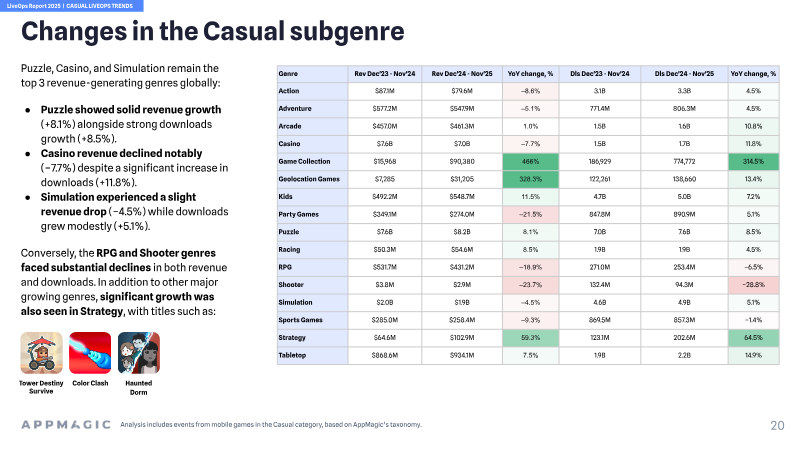
The mobile gaming industry is currently navigating a period of significant maturation, characterized by a marked deceleration in overall revenue and download growth.
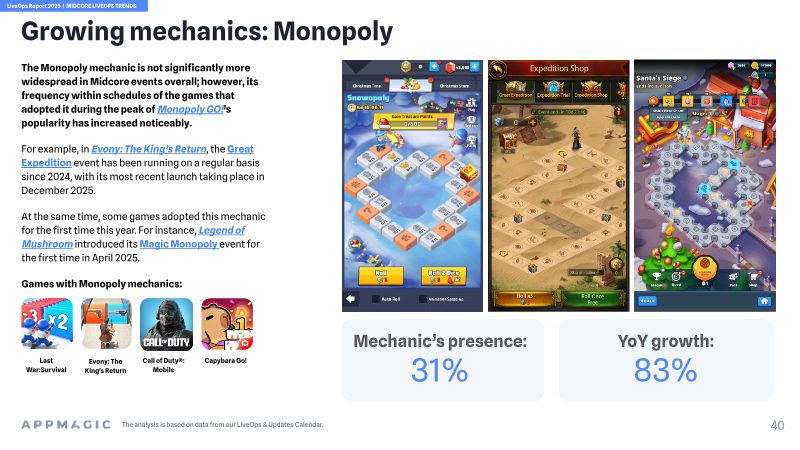
- Mobile gaming is shifting toward high-frequency engagement, with developers now averaging 89 events per month to combat stagnant revenue and download growth.
- The Hybridcasual segment is experiencing explosive revenue growth by integrating complex, midcore-inspired mechanics and ad-driven monetization models.
- Strategy has overtaken RPGs as the top-earning subgenre within the Midcore segment, which continues to be dominated by legacy titles launched between 2015 and 2020.

Apps vs Games on Mobile 2026: What’s Growing Faster (And Why)
The mobile ecosystem is undergoing a structural shift as capital flows away from gaming toward non-gaming applications.
- Mobile app acquisitions are increasingly favored over games due to higher profit margins, which frequently range between 55% and 70%.
- App businesses are easier to scale and maintain than games, often requiring small teams of approximately five people to manage six-figure monthly recurring revenue (MRR) businesses.
- Valuations for mobile apps typically command a profit multiple of 2x to 5x, making them attractive assets for acquisition compared to the complex, metric-heavy due diligence required for mobile games.

🤔 What if games paid players back?
The gaming industry is undergoing a fundamental shift toward embedded financial infrastructure, moving away from traditional monetization models that rely exclusively on heavy in-app purchases.
- Integrating embedded financial infrastructure allows developers to transition from traditional in-app purchase models to systems that facilitate real-world payouts.
- Ad revenue sharing models that distribute Bitcoin rewards to players can increase user retention rates by up to 180 percent.
- The shift toward loyalty-based models replaces 'churn-and-burn' acquisition strategies, significantly increasing the long-term lifetime value of users.

8 Reasons Most UA Strategies Fail as They Scale
User acquisition strategies frequently falter during scaling due to the misattribution of organic growth to paid channels, which leads to inflated return on ad spend projections and inefficient capital deployment.
- Scaling failures often stem from misattributing organic growth to paid channels, which leads to inflated ROAS projections and inefficient capital allocation.
- Studios must transition from aggregate performance targets to granular, campaign-specific profitability metrics that account for the distinct lifetime value curves of specific audience segments.
- To maintain the stability of machine learning algorithms, studios should limit budget fluctuations to a maximum of 20% and strictly respect defined conversion windows.

🔨 Forge Master review: Forging $3mil/month Revenue. Legend of Mushroom, westernized!
Forge Master functions as a high-performing, IAP-driven idle RPG that mirrors the core mechanics, user interface, and progression loops of Legend of Mushroom.
- Forge Master generates between $2 million and $3.5 million in monthly revenue by utilizing a gacha-based idle RPG model that mirrors the mechanics of Legend of Mushroom.
- The game successfully employs a strictly purchase-focused monetization model, eschewing the ad-supported progression timers common in the idle RPG genre.
- Despite a broader revenue decline in the idle RPG sector since early 2024, Forge Master consistently outperforms legacy titles such as AFK Arena and Idle Heroes.

2026 games industry predictions and trends | Week in Mobile Games podcast
The global games industry enters 2026 characterized by a strategic pivot toward operational efficiency and diversified revenue streams.
- The games industry faces potential hardware cost inflation in 2026, as the high demand for RAM and GPUs from AI companies drives up component prices, potentially delaying future console and mobile device manufacturing.
- Chinese publishers are exerting increased global dominance in specific genres, with Micro Fun leading in the merge category and First Fun and Century Games capturing significant market share in 4X strategy.
- Generative AI adoption is expected to become more brazen among large game companies, shifting from experimental use to the widespread integration of AI-generated assets in marketing and development workflows.

🚨📢 BREAKING NEWS: Block Blast Hits 70M DAU, Apple Fined €98M, Brazil Forces App Store Changes
The mobile gaming industry is currently navigating a period of significant regulatory pressure and rapid operational evolution.
- Hungry Studio’s 'Block Blast' has achieved 70 million daily active users and 300 million monthly active users by executing over 10,000 A/B tests in 2025, often running 300 experiments in parallel daily.
- By utilizing a proprietary user behavior simulation platform, Hungry Studio improved iteration efficiency and reduced post-launch technical issues by more than 50%.
- Italian regulators fined Apple €98 million for antitrust violations, ruling that its App Tracking Transparency (ATT) rules unfairly disadvantage third-party developers compared to Apple’s own services.

Roblox brainrot explained, Ustwo’s strategy switch, Ubi closes mobile studio, 2026 predictions, more
This analysis examines the current state of the mobile gaming industry as of early 2026, focusing on shifting development strategies, platform trends, and market performance.
- Mobile gaming remains the industry's largest sector, accounting for 55% of total gaming revenue in 2025, according to Newzoo.
- Ustwo Games is pivoting to a 'PC-first' development strategy, signaling a decline in the viability of subscription-based mobile platforms like Apple Arcade and Netflix Games for premium indie developers.
- Ubisoft is closing its mobile-focused studio in Halifax, Canada, resulting in 71 layoffs and the cessation of live operations for Assassin's Creed Rebellion.