Mobile reports and market data
Documents



Integrated Report 2021
COLOPL operates through a dual-segment strategy centered on entertainment and investment to navigate the inherent volatility of the global gaming industry.
- COLOPL maintains a strong financial position with an equity ratio of 93.7% and approximately 60 billion yen in cash reserves.
- The company reported 37,125 million yen in net sales and 6,320 million yen in operating profit for the 2021 fiscal year.
- Leadership has been restructured with Takashi Miyamoto appointed as President and CEO, while founder Naruatsu Baba moves to the role of Chairman and Chief Creator.

The Gaming Industry: 2019
The global gaming landscape in 2019 generated significant revenue across multiple platforms, with mobile gaming leading the market at 54.9 billion dollars, followed by console games at 47.9 billion dollars and computer games at 32.2 billion dollars.
- Mobile gaming dominated the 2019 market with $54.9 billion in revenue, followed by console gaming at $47.9 billion and computer gaming at $32.2 billion.
- Multiplayer experiences account for 53% of total play time, with adventure, strategy, and first-person shooters identified as the most popular genres.
- Financial barriers are the primary obstacle to monetization, as 45% of users cite high costs as the reason they do not purchase games, leading many to rely on torrent downloads.


COLOPL Integrated Report 2022
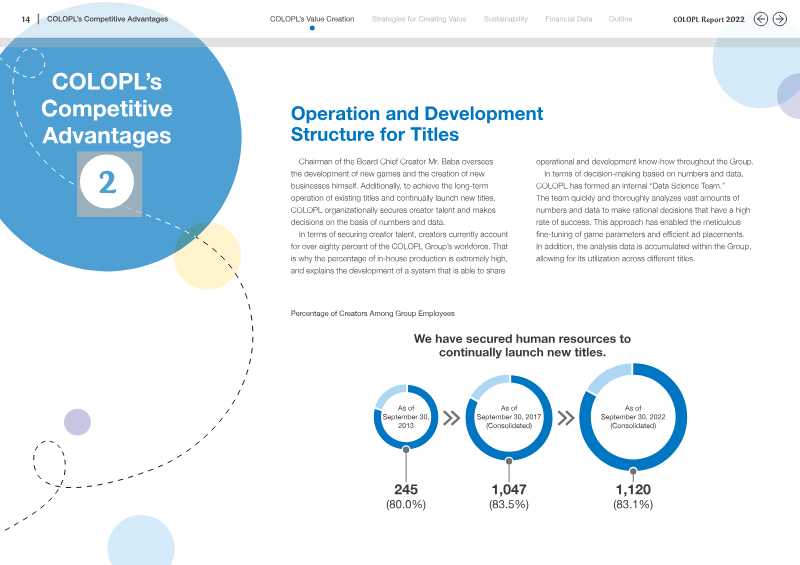
COLOPL is navigating a period of strategic transition following a challenging 2022 fiscal year, during which the company experienced a 13.9% decline in net sales and a 27.7% decrease in operating profit within its core Entertainment Business.
- COLOPL experienced a significant financial downturn in fiscal year 2022, with net sales declining by 13.9% and operating profit falling by 27.7% in its Entertainment Business.
- The company maintains a strong balance sheet to support its turnaround strategy, reporting approximately 55 billion yen in cash and 76.6 billion yen in total net assets as of September 2022.
- Management has set a target to reverse the current downward financial trend by the fiscal year ending September 2024 through a focus on high-quality IP and emerging technology integration.


COLOPL Report 2023
COLOPL’s 2023 strategic framework centers on the pursuit of "first-of-its-kind" entertainment to drive long-term growth, despite a period of financial contraction.
- COLOPL reported fiscal year 2023 net sales of 30.9 billion yen and an operating profit of 2.8 billion yen, reflecting a year-over-year decline.
- The company maintains a strong balance sheet with 76.2 billion yen in total net assets and a 93.3 percent equity ratio, providing capital for R&D in blockchain, AI, and extended reality.
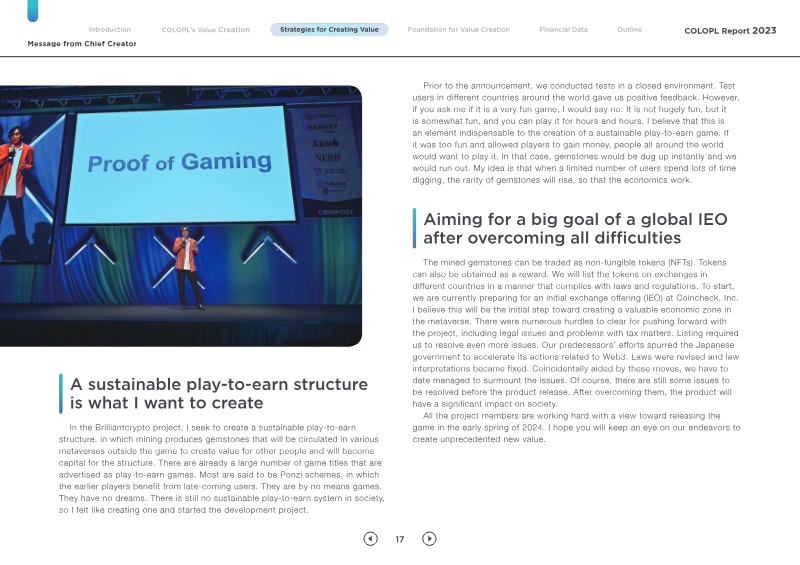
- COLOPL is launching Brilliantcrypto, a blockchain project utilizing a 'Proof of Gaming' model, with a global Initial Exchange Offering scheduled for 2024.


COLOPL Integrated Report 2024
COLOPL is navigating a period of significant strategic transition following a challenging fiscal year ending September 2024, during which the company recorded net sales of 25,975 million yen and an operating loss of 1,208 million yen.
- COLOPL reported a fiscal year 2024 net loss of 1,208 million yen on 25,975 million yen in sales, driven by delayed title releases and the sunsetting of legacy games.
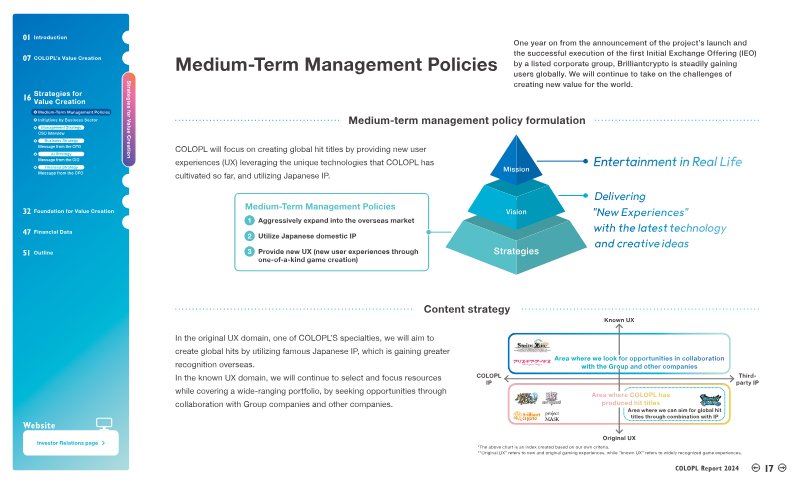
- The company is pivoting from a domestic mobile-only focus to a diversified strategy encompassing global expansion, console development, and blockchain integration.
- A central pillar of the new strategy is the Brilliantcrypto project, which established the company as the first Japanese listed corporate group to issue its own token.


COLOPL Report 2025: Integrated Report
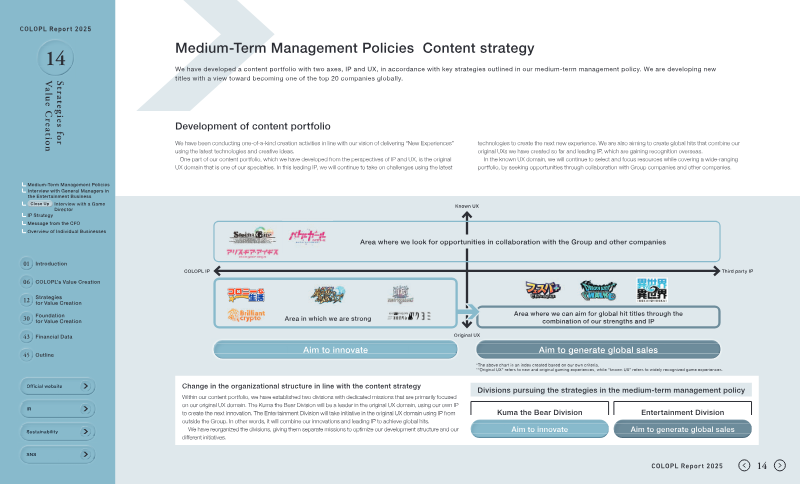
COLOPL is currently executing a strategic pivot to restore profitability and secure a position among the top 20 global mobile gaming companies.
- COLOPL returned to profitability in fiscal year 2025, reporting 25.9 billion yen in net sales and 1.0 billion yen in operating profit.
- The company has set long-term financial targets of at least 100 billion yen in net sales and 50 billion yen in operating profit, driven by aggressive overseas expansion.
- Strategic growth is supported by a portfolio of 1,055 patents and a dual-pronged approach that balances original IP with subsidiaries like MAGES. Inc. and Brilliantcrypto.

Global Gaming Report 2025
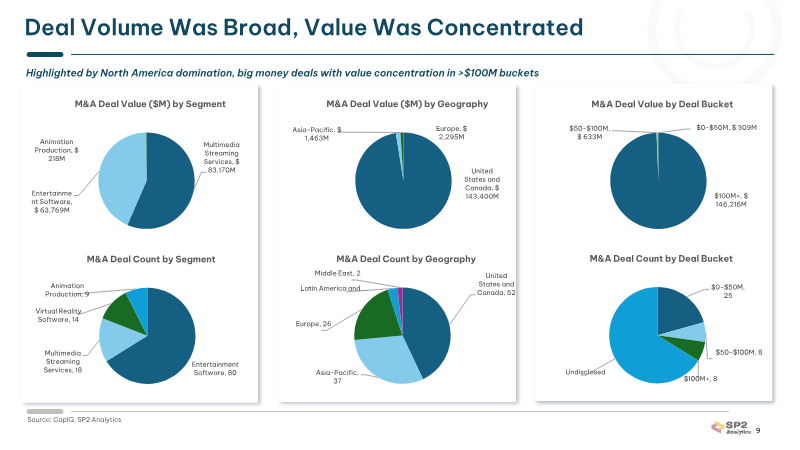
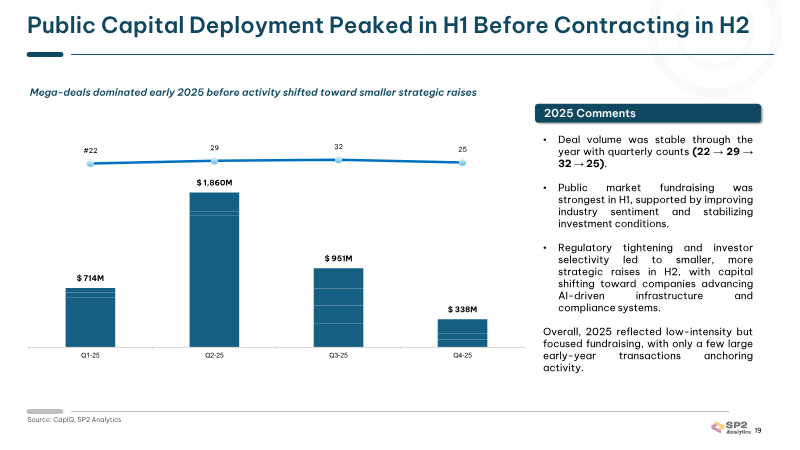
The 2025 Global Gaming Report characterizes the gaming industry as a capital-intensive, scale-driven sector where competitive advantage is increasingly defined by platform ownership, intellectual property (IP) aggregation, and long-term strategic positioning rather than individual title performance.
- The gaming industry saw $147 billion in M&A activity in 2025, headlined by the $83 billion Netflix-Warner Bros. merger and the $55 billion take-private acquisition of Electronic Arts.
- Market valuation is increasingly driven by platform ownership and IP aggregation, with top-tier strategic players now commanding EV/EBITDA multiples exceeding 25x.
- Capital deployment has become highly concentrated, with private placement rounds for AI-driven simulation and development tools consistently exceeding $100 million per transaction.

Gaming Trendz to Watch in 2025 and Beyond: Comprehensive Player Support Strategies
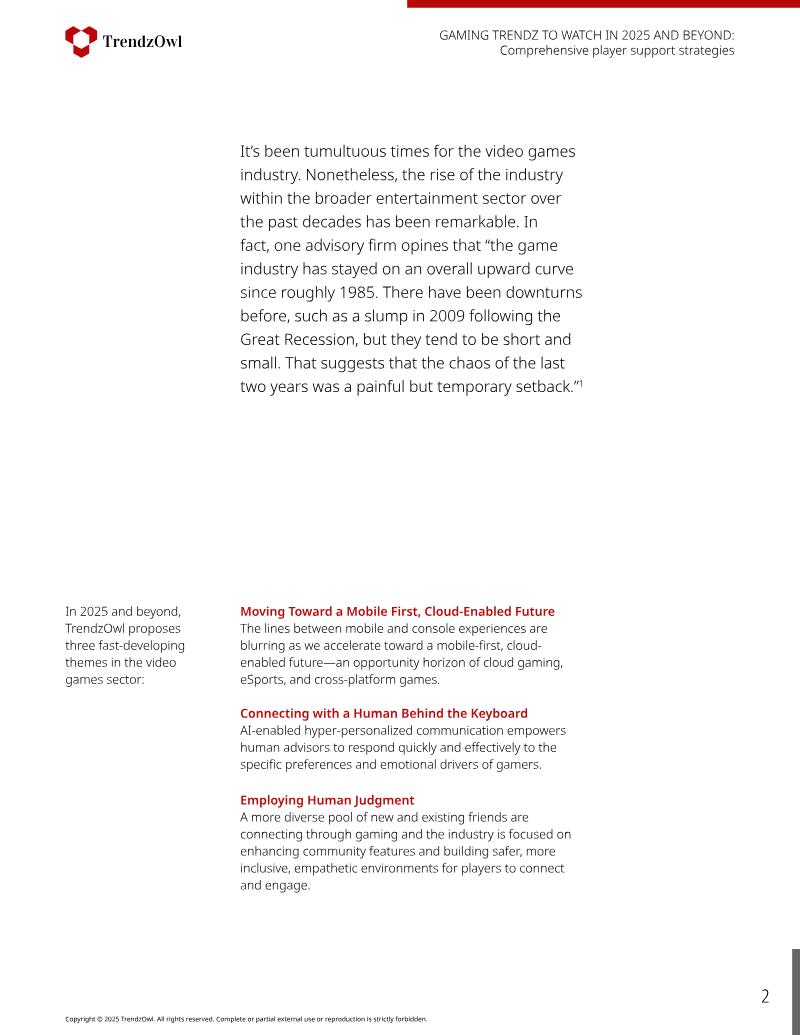
The video game industry is poised for a significant rebound in 2025 following a period of contraction characterized by layoffs and project cancellations.
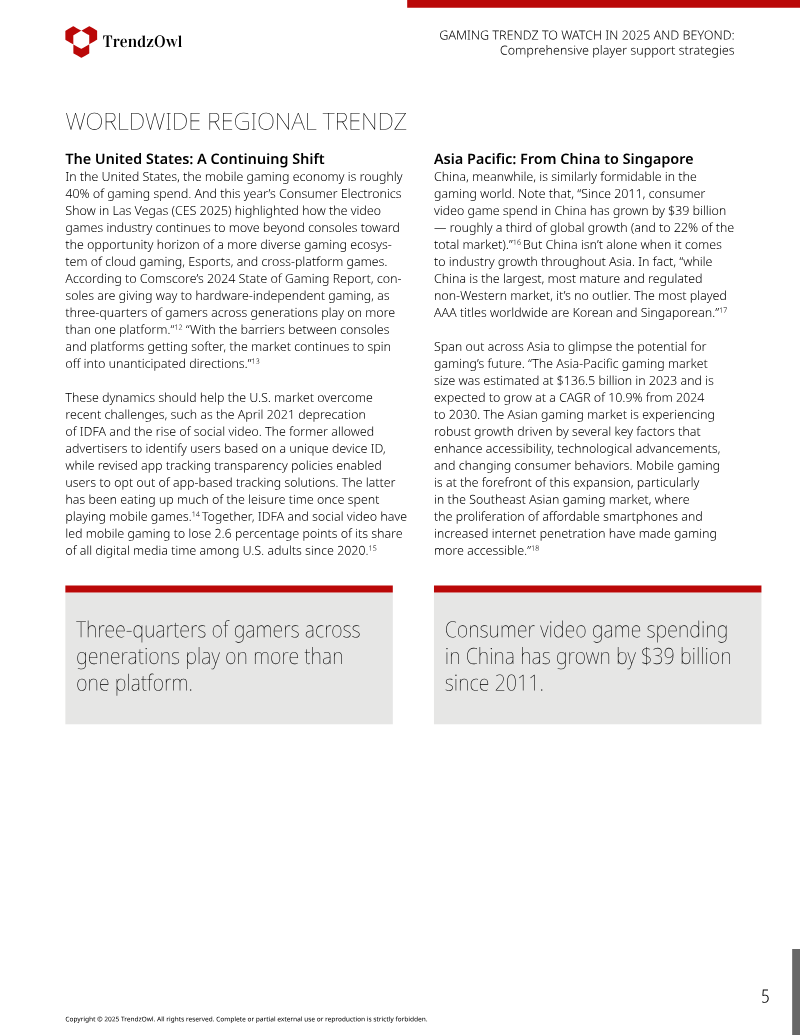
- The gaming industry is shifting toward a mobile-first, hardware-independent model, with mobile gaming now capturing 55% of the total market share.
- Providing a diverse range of contact options for player support increases customer loyalty by 41%.
- The Asia-Pacific region is projected to maintain a 10.9% compound annual growth rate through 2030, while Africa’s market is expanding six times faster than the global average.



Q3 2015 Data Digest
The Q3 2015 Data Digest provides a comprehensive analysis of the iOS mobile application market, focusing on global and U.S. trends in downloads, revenue, and advertising strategies.
- Gaming remains the dominant App Store category, generating over 20 times the revenue of the next leading category.
- Clash of Clans maintained its lead in Q3 2015, though Game of War significantly narrowed the revenue gap in the U.S. market.
- Aggressive advertising on the Facebook network, particularly using high-production image and video assets, shows a strong correlation with increased revenue for gaming and lifestyle apps like those from ContextLogic.

The State of Card Battler Mobile Games 2021: An Analysis of the Card Battler Sub-Genre
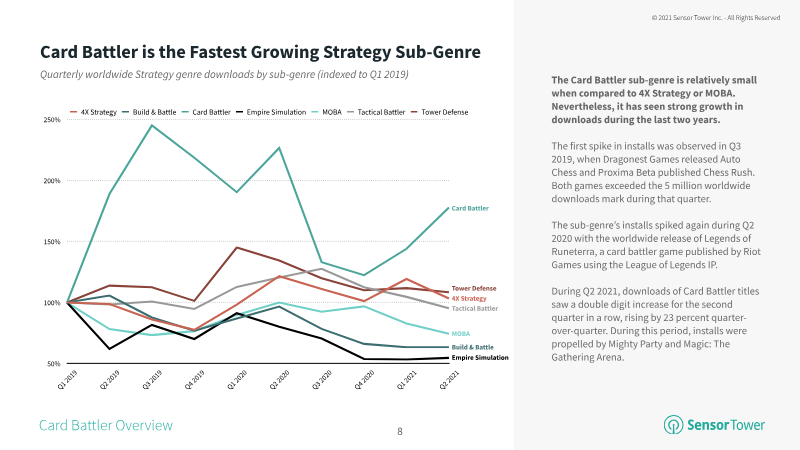
The mobile card battler sub-genre represents a growing, high-potential segment within the mid-core strategy market.
- The United States has become a critical growth market for card battlers, accounting for 27% of global player spending in the first half of 2021.
- U.S. card battlers exhibit a revenue-per-download (RPD) nearly double the worldwide average and are experiencing the fastest RPD growth among all strategy sub-genres.
- The market is currently dominated by established 'forever franchises' such as Yu-Gi-Oh! Duel Links and Hearthstone, alongside successful new entrants like Magic: The Gathering Arena.

An Analysis of Download Sources on Apple's App Store 2021
This analysis examines the primary drivers of first-time app downloads on the Apple App Store between 2018 and 2020.
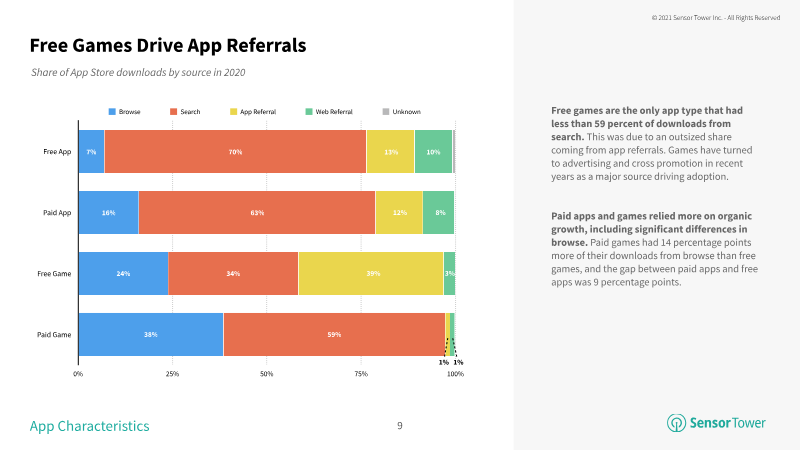
- Search is the primary discovery mechanism for the App Store, accounting for 59% of all first-time downloads in 2020.
- Non-game applications rely heavily on search for user acquisition, with 70% of their total downloads originating from this channel.
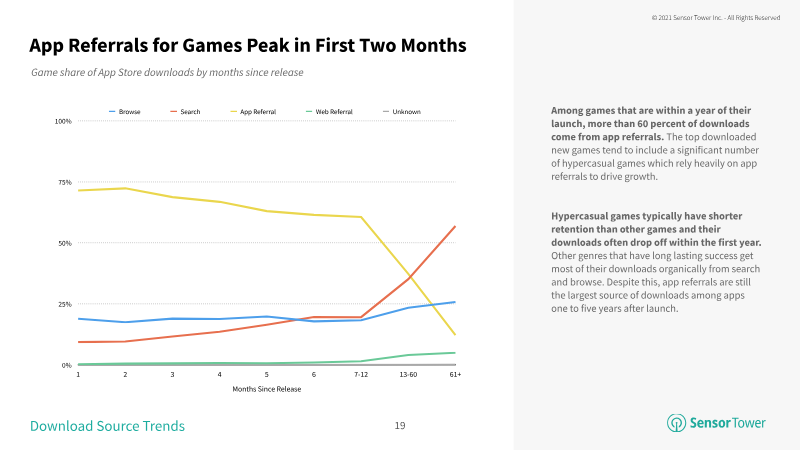
- App referrals for games grew from 26% in 2018 to 38% in 2020, driven largely by the hypercasual genre's reliance on cross-promotion.

U.S. Video Game Industry: Technological Advancements and Privacy Issues
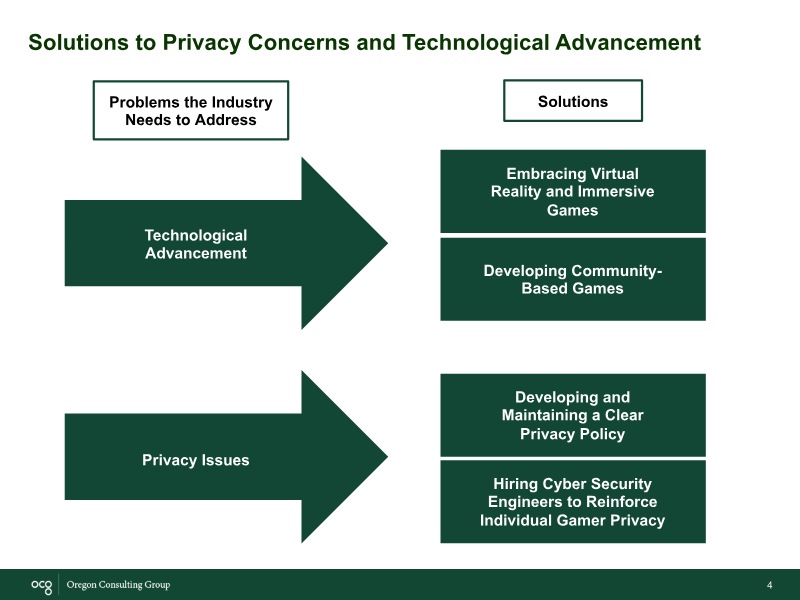
The U.S. video game industry, a significant global economic force, faces a critical juncture defined by rapid technological evolution and escalating privacy vulnerabilities.
- The U.S. video game industry is a $60.4 billion annual revenue sector employing 240,000 people across more than 42,000 businesses.
- Gaming platforms face severe cybersecurity threats, evidenced by 12 billion cyberattacks recorded against gaming websites over a 17-month period.
- Privacy risks are exacerbated by the re-identification of anonymized data and the use of psychometric evaluations, necessitating investments in specialized cybersecurity engineering similar to models used by Microsoft.