This activity was heavily skewed toward the second half of the year. It was anchored by transformational transactions.
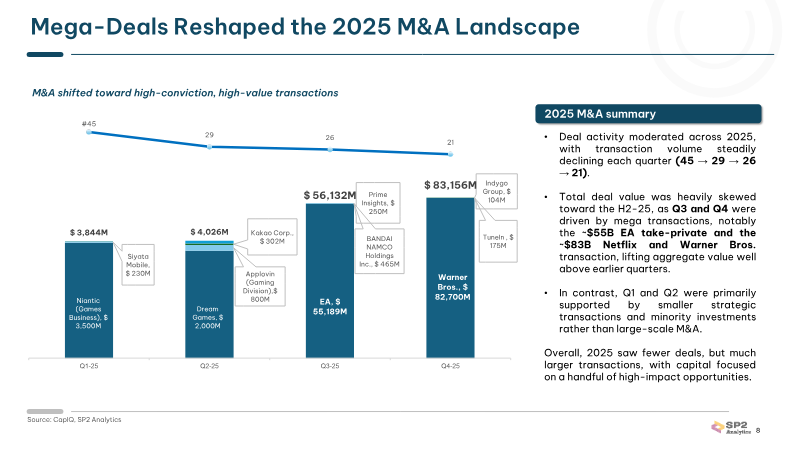
The Netflix-Warner Bros. merger was valued at $83 billion. The take-private acquisition of Electronic Arts was valued at $55 billion.
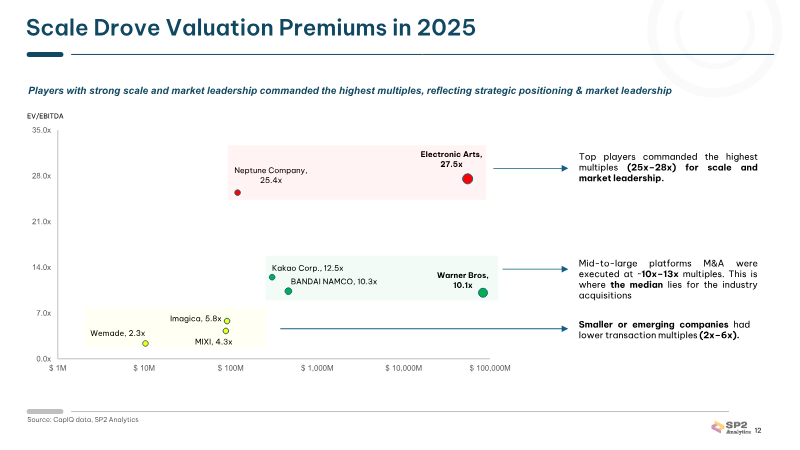
Top-tier strategic players are now commanding EV/EBITDA multiples exceeding 25x.
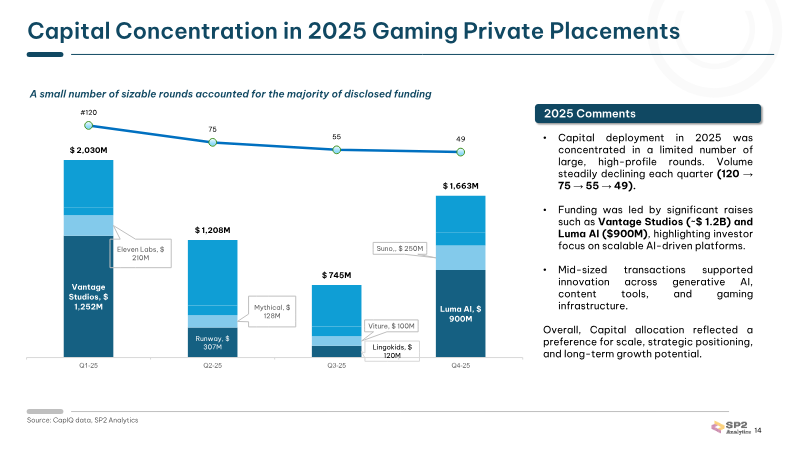
Private placement rounds for AI-driven simulation and development tools consistently exceeded $100 million per transaction.
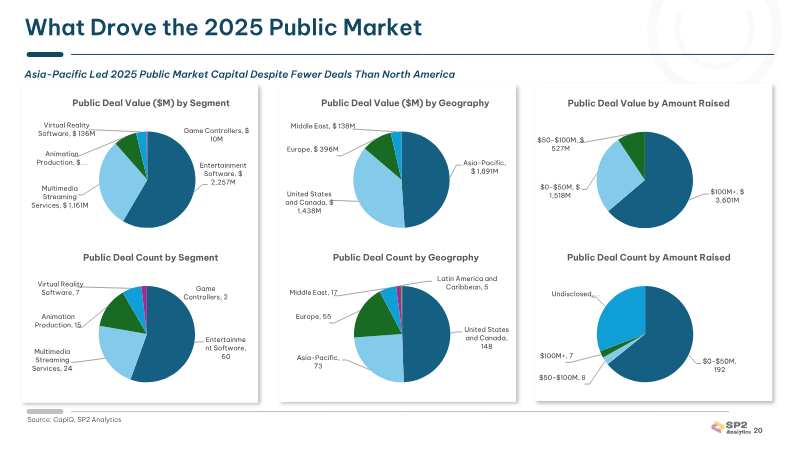
The Asia-Pacific region remained the primary driver for public market capital raises.
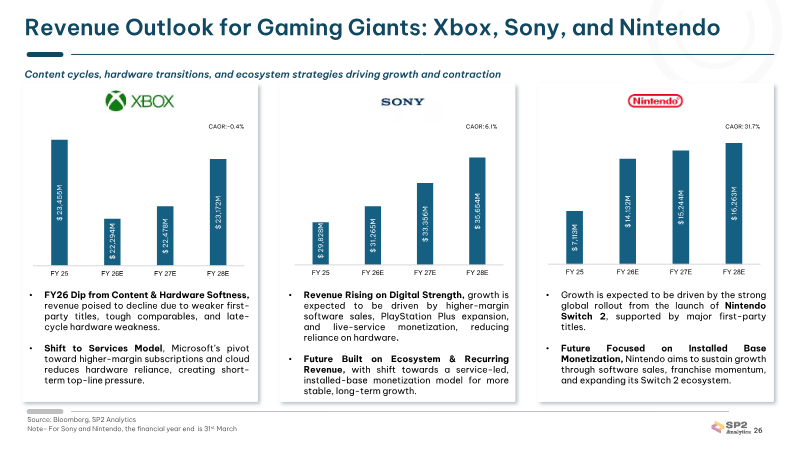
This growth will be supported by major IP sequels and hardware transitions. The Nintendo Switch 2 launch is a key hardware transition.
The 2025 Global Gaming Report characterizes the gaming industry as a capital-intensive, scale-driven sector where competitive advantage is increasingly defined by platform ownership, intellectual property (IP) aggregation, and long-term strategic positioning rather than individual title performance. The industry experienced a year of mega-deal consolidation, with approximately $147 billion in announced M&A value. This activity was heavily skewed toward the second half of the year, anchored by transformational transactions such as the $83 billion Netflix-Warner Bros. deal and the $55 billion take-private of Electronic Arts.
Market data indicates a widening valuation dispersion, with strategically positioned players commanding premium EV/EBITDA multiples exceeding 25x. While overall deal volume moderated throughout 2025, capital deployment became more concentrated, reflecting high-conviction investments in defensible growth platforms. Private placement activity followed a similar trend, dominated by a limited number of large-scale, infrastructure-led rounds—notably in AI-driven simulation and development tools—which attracted over $100 million per transaction. Public market activity was strongest in the first half of the year, shifting toward smaller, more disciplined strategic raises as regulatory and market conditions evolved.
Geographically, North America dominated both M&A and private placement deal values, while the Asia-Pacific region maintained a significant presence in public market capital raises. The report utilizes data sourced from CapIQ and internal research to analyze these trends across global gaming segments, including multimedia streaming, entertainment software, and virtual reality. Looking ahead to 2026, the industry anticipates a content-led growth phase driven by major IP sequels and hardware transitions, such as the rollout of the Nintendo Switch 2, as companies pivot toward service-led, recurring revenue models to ensure long-term stability.