Game Studies reports and market data
Documents
Narrating Machines and Interactive Matrices: A Semiotic Common Ground for Game Studies
Ferri's paper argues that video games should be understood as "interactive matrices" and "narrating machines" rather than as texts amenable to standard narratological analysis.
- Video games should be analyzed as 'interactive matrices' and 'narrating machines' rather than static texts, as their meaning is produced through the dynamic interaction between the player and the system.
- Standard narratological tools, such as Russian formalism and Propp’s structuralism, are insufficient for games because gameplay outputs vary across sessions and meaning emerges from the act of play.
- The proposed semiotic model treats gameplay, the game-text, and player engagement as mutually constitutive, utilizing Hjelmslev’s content/expression framework and Rastier’s differential semantics.
From Gamers to Scholars: Challenges of Teaching Game Studies
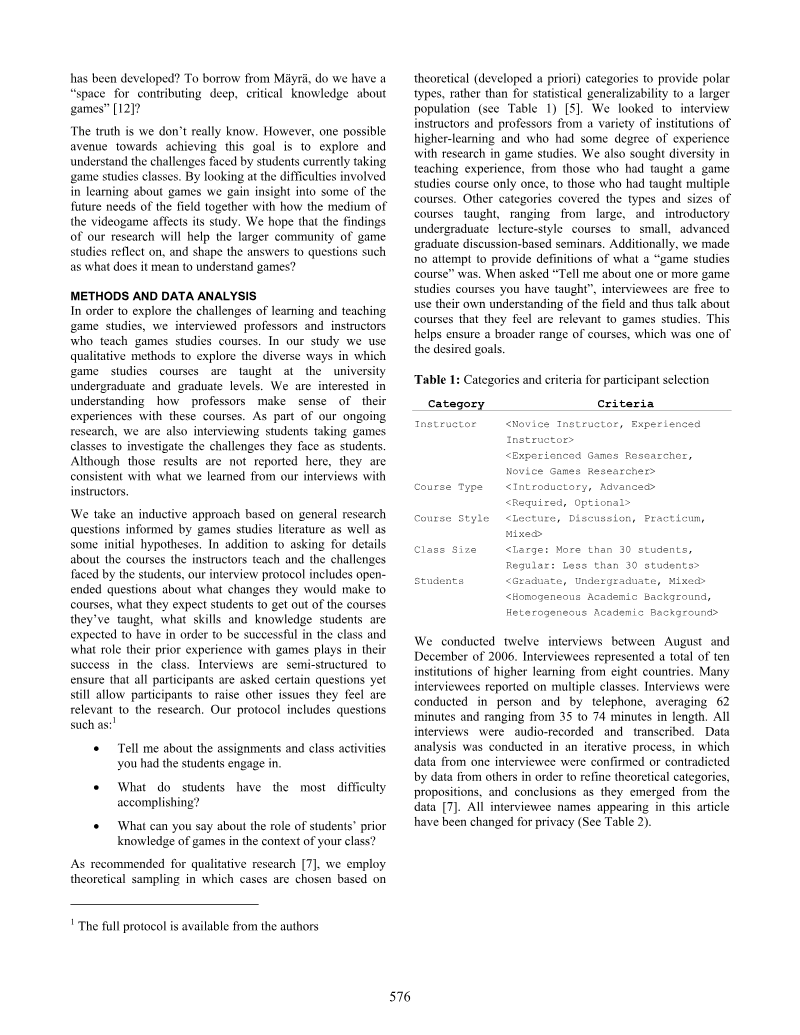
Zagal and Bruckman's paper examines the pedagogical difficulties of teaching game studies at the university level, drawing on interviews with twelve instructors in the field.
- Students' deep but narrow gaming backgrounds can boost motivation and supply rich analytical material, yet they often impede critical reasoning, as learners cling to genre-specific assumptions, dismiss older titles, and conflate skilled play with analytical insight.
- Instructors report that students resist perspectives that challenge their identity as "gamers," which makes it harder to foster the detached, critical stance that game studies requires.
- The field's relative youth, lack of an established canon, and practical access problems (platform obsolescence, time demands, uneven prior exposure) structurally compound the difficulty of teaching it.
Notes Toward a Sense of Embodied Gameplay
Peter Bayliss's "Notes Toward a Sense of Embodied Gameplay," presented at DiGRA 2007, argues that gameplay is best understood as an embodied phenomenon arising at the interface, the point where player and game meet, rather than as an escape into a virtual world or a purely formal rule system.
- Gameplay is framed as an embodied phenomenon arising at the interface where player and game meet, rather than as an escape into a virtual world or a purely formal rule system.
- The paper proposes a three-layer model of the interface (material, software, and conceptual) and critiques the 'immersive fallacy' that treats play as transport into a game world.
- Flow is distinguished from immersion: flow expands the player's sense of self and draws the game into the player's world, while immersion transports the player into the game's world.
CameraBots: Cinematography for Games with Non-Player Characters as Camera Operators
This paper proposes CameraBots, autonomous virtual camera operators modelled on the non-player character bots already common in 3D games, as a way to bring cinematographic principles into real-time game camera work.
- The paper proposes CameraBots, autonomous virtual camera operators built on the NPC bot code already common in 3D games, to bring film cinematography (shot selection, cutting, framing) into real-time game camera work.
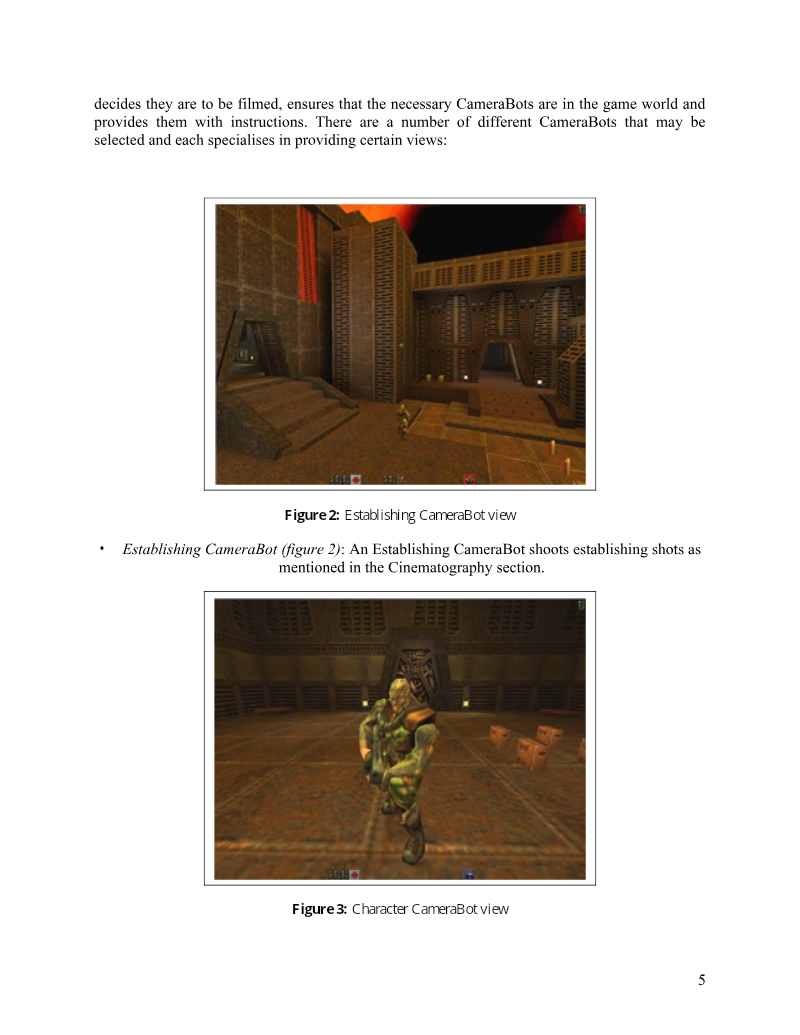
- The architecture mirrors a film set: a director module selects characters and props to film several times per second, and a cinematographer module assigns specialised CameraBots to shot types including establishing, character (long and medium), close-up, first-person, and over-the-shoulder.
- The cinematographer chooses shots based on whether the player's avatar or another principal character is attacking, moving, or stationary, and the modular design lets new CameraBot types be added and the system be ported to other engines via an API.
Playing Through: The Future of Alternative and Critical Game Projects
Patrick Crogan's DiGRA 2005 paper, "Playing Through: the Future of Alternative and Critical Game Projects," examines experimental games that disrupt the usual virtuality of play by making its physical and political stakes visible.
- Patrick Crogan's 2005 DiGRA paper reads experimental games such as Tekken Torture Tournament and the Painstation consoles as 'theatres of cruelty' that use real bodily consequences, like electric shocks and whips, to provoke reflection on the technocultural conditions of gaming.
- Crogan's central critical target is Gonzalo Frasca's claim that simulation is 'the form of the future,' positioned against narrative as the past and drama as the present, which Crogan argues is too rigid a temporal schema.
- Crogan argues that computer simulation grows out of military-industrial technoscience and therefore shares narrative's mnemotechnical, future-directed character rather than standing apart from it.
Architecting Scalability for Massively Multiplayer Online Gaming Experiences
Scalability in Massively Multiplayer Online Games (MMOGs) is framed here as the capacity to absorb growing player demand without degrading the player experience, a requirement that varies by genre, from fast-paced First Person Shooters to turn-based strategy.
- Scalability in MMOGs is defined as absorbing growing player demand without degrading the player experience, and the required standard varies by genre, from fast-paced FPS to turn-based strategy.
- The report argues that scalability challenges in simulation, communication, content distribution, and structural architecture are interdependent and cannot be solved in isolation, so a generic MMOG infrastructure needs an integrated design.
- Client/Server models remain dominant in deployed MMOGs, while Peer-to-Peer simulation is constrained by load balancing, state coherence, peer unpredictability, and cheating risks.
Games for Learning: Are Schools Ready for What's To Come?
This 2005 pilot study, presented at the DiGRA conference and conducted by researchers at the University of Calgary, examines whether K-12 teachers are ready to integrate digital games into classroom instruction.
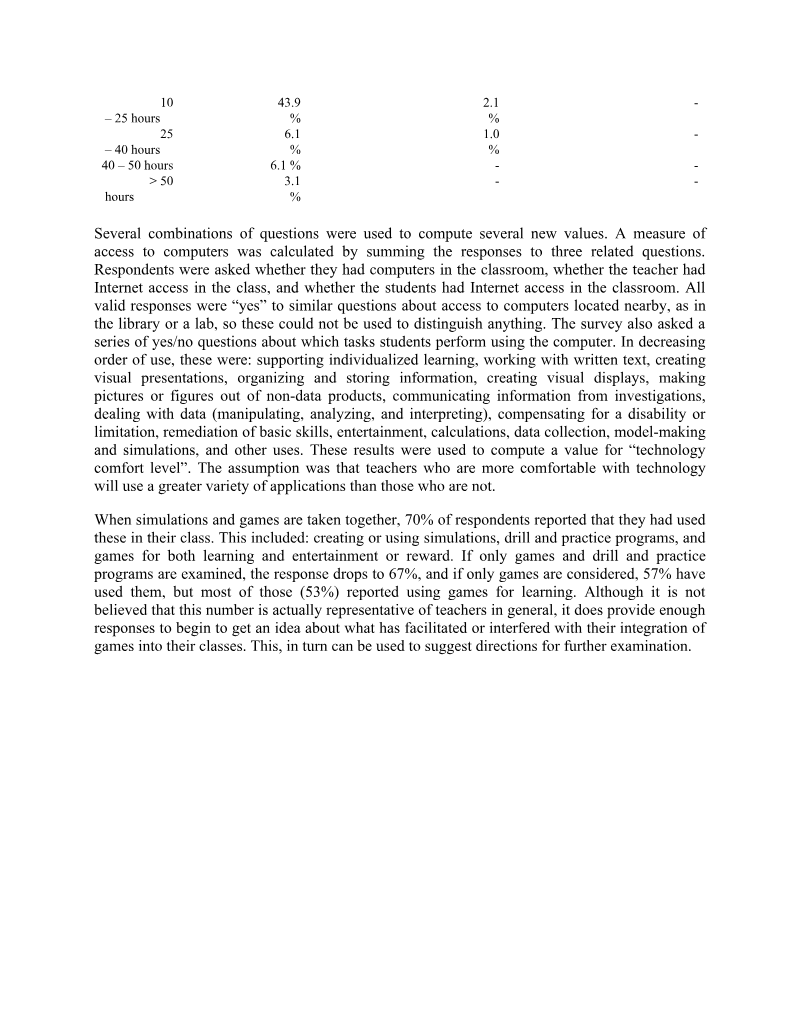
- Seventy percent of surveyed K-12 teachers reported using simulations or games in class, and 57 percent used games specifically, mostly for learning.
- The main barriers to classroom game use were inadequate hardware and software, insufficient time, and lack of knowledge about integrating games into curricula, rather than resistance to games themselves.
- Willingness to try game-related applications was generally high, with educational downloads and simulations rated most favorably and commercial off-the-shelf games receiving more mixed responses.
Playing Audio-Only Games: A Compendium of Interacting with Virtual, Auditory Worlds
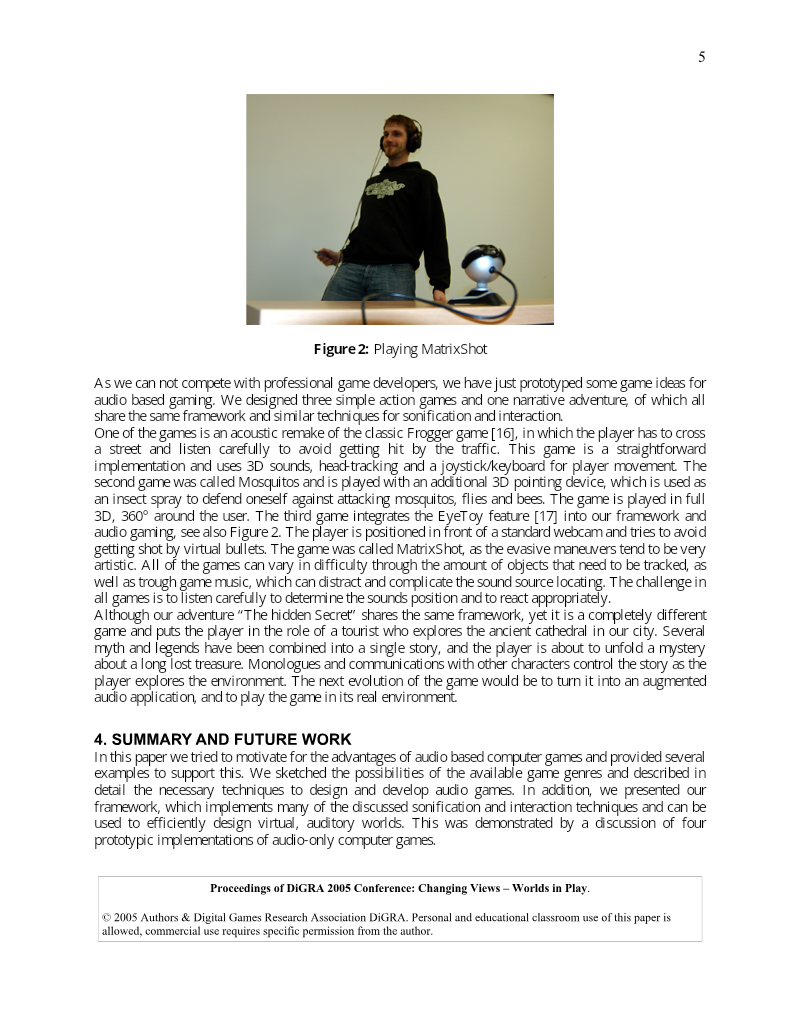
This paper presents an overview of audio-only computer games, games played and perceived entirely through sound and acoustics.
- Audio-only games were originally developed by and for visually impaired players, but the authors argue they offer advantages for gameplay experimentation, mobile gaming, and immersive storytelling that also appeal to hearing players.
- The central design challenge is balancing functional information for orientation and navigation against artistic aesthetics, avoiding both cluttered auditory displays and silent stretches that disorient players.
- Designers can tune difficulty through narration, monologues, the number of sound objects, and background music, which the paper presents as tools for managing this functionality-aesthetics balance.
The Play's the Thing: Practicing Play as Community Foundation and Design Technique
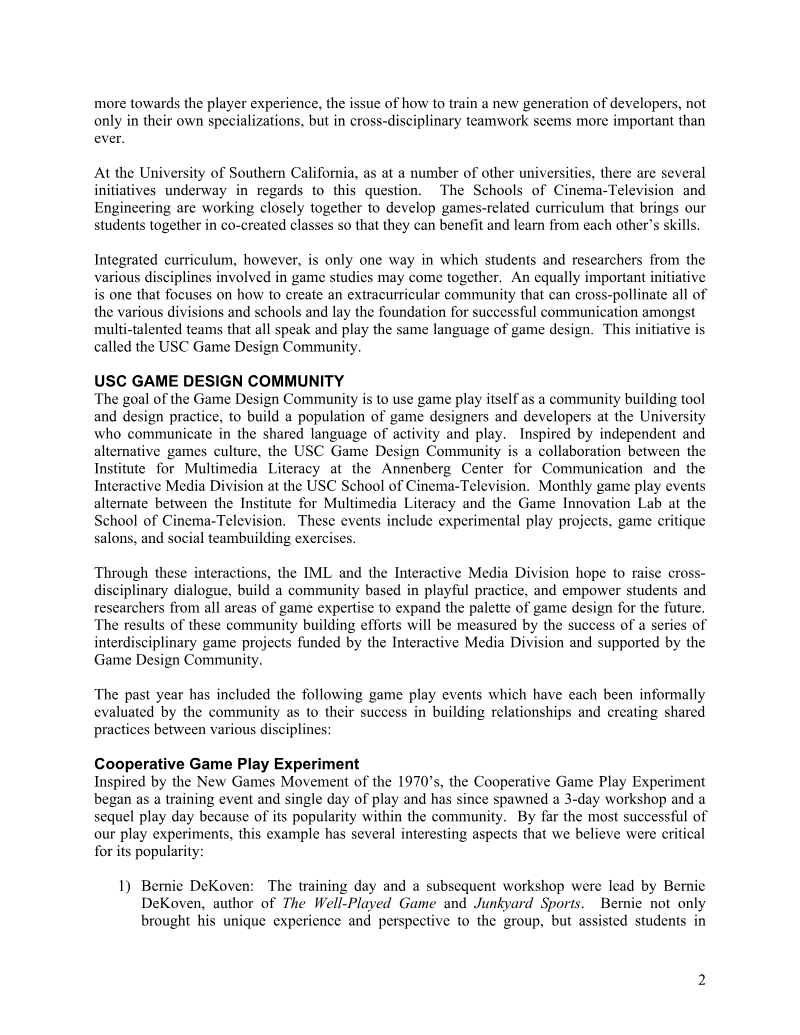
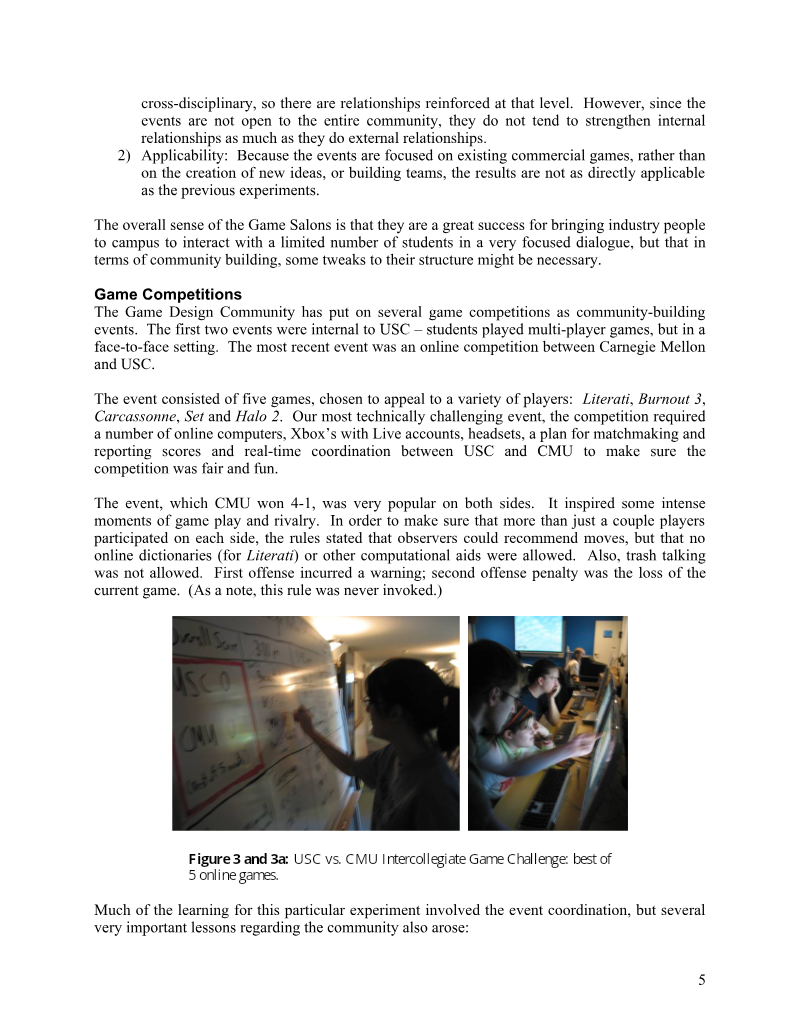
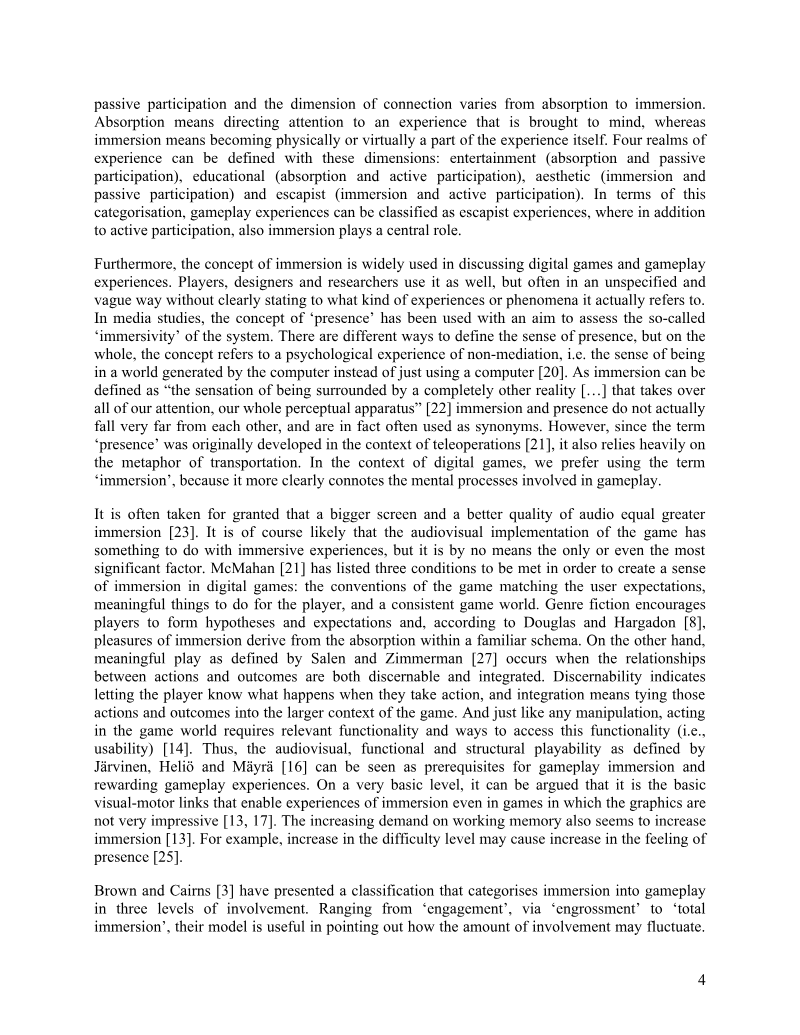
Tracy Fullerton's paper describes the USC Game Design Community, an extracurricular, cross-departmental initiative at the University of Southern California's School of Cinema-Television and Annenberg Center for Communication.
- Tracy Fullerton's paper argues that shared play experiences can give students and researchers from different disciplines a common vocabulary, social bonds, and collaboratively generated design concepts, complementing formal curricula that leave cross-disciplinary teamwork to chance.
- The USC Game Design Community is an extracurricular, cross-departmental initiative run through the School of Cinema-Television and the Annenberg Center for Communication at the University of Southern California.
- The Cooperative Game Play Experiment, drawing on the 1970s New Games Movement and led by Bernie DeKoven, was judged the community's most successful event, with its outdoor, technology-free format and the motto "play hard, play fair, nobody hurt" credited with sustaining discussion.
Fundamental Components of the Gameplay Experience: Analysing Immersion
This study examines immersion as a central component of the gameplay experience, proposing the Sensory, Challenge-based, and Imaginative (SCI) model as a way to distinguish qualitatively different forms of immersion.
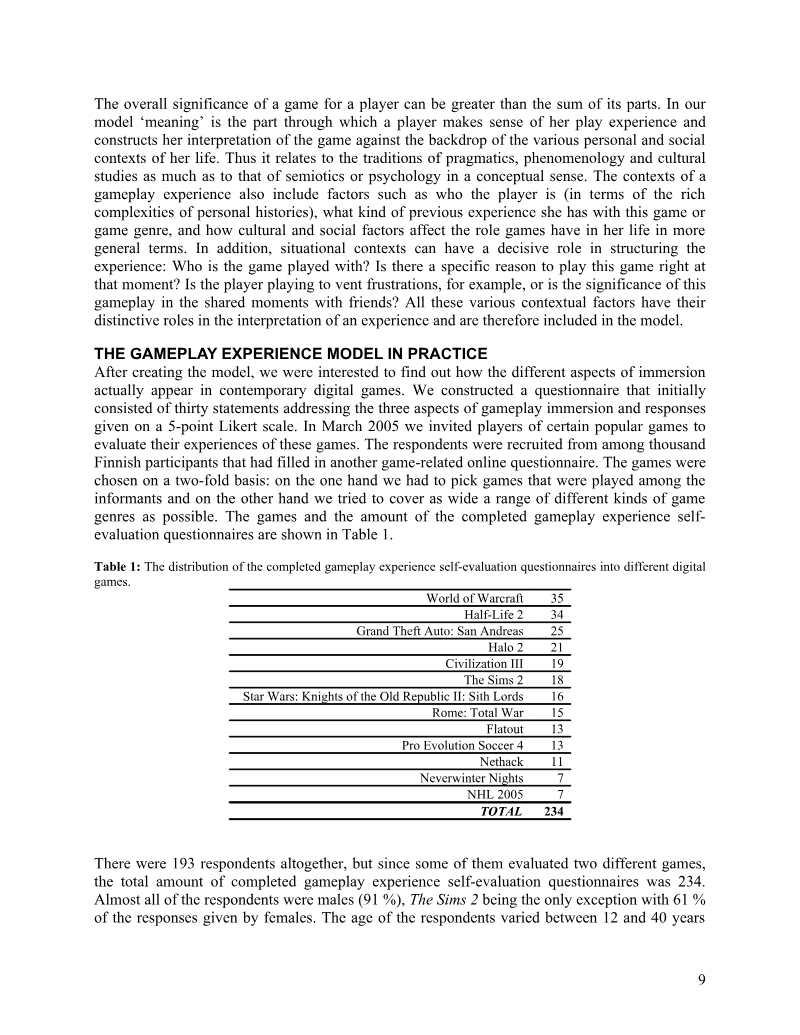
- The report proposes the Sensory, Challenge-based, and Imaginative (SCI) model to distinguish qualitatively different forms of game immersion, arguing that existing research lacked the qualitative distinctions needed to explain why different games absorb players in different ways.
- A survey of 234 self-reported gameplay experiences across 13 popular titles found overall immersion levels were high across the sample, which was predominantly male and aged 12 to 40.
- Half-Life 2 recorded the highest combined immersion score in the study, while The Sims 2 recorded the lowest.
Baldur's Gate and History: Race and Alignment in Digital Role Playing Games
Christopher Warnes's paper argues that digital role-playing games, using Baldur's Gate I and II as its central case, cannot be fully understood through the formalist approaches that dominate game studies, particularly the ludology/narratology debate.
- Christopher Warnes argues that digital role-playing games such as Baldur's Gate I and II cannot be fully understood through the formalist ludology/narratology approaches that dominate game studies, which he attributes to disciplinary insecurity and anxiety about the games industry's commercial pull.
- Warnes advocates historicised, cultural materialist and postcolonial critique as alternatives, applying them to commercially produced computer games in a sustained way for the first time.
- The paper is a theoretical and interpretive essay, not an empirical study; it draws on literary, historical, and media-studies sources rather than survey data or original player research.


Canadian Content in Video Games
Leonard J. Paul's paper, "Canadian Content in Video Games," examines whether video games produced in Canada reflect a distinct national culture, despite Canada being one of the world's leading producers and consumers of the medium.
- The paper's central finding is that Canadian-made video games show little distinct cultural identity, with Canadian content surfacing mainly in isolated touches like hockey-themed details or Quebec French-language requirements.
- Studios often replace Canadian place names and spellings with American or generic equivalents to reach the largest market, indicating that publisher market calculations, not national cultural policy, drive how Canadian content appears.
- The author concludes that the sector's economic growth has not yet been matched by culturally distinctive output, though academic game programs and new funding may eventually change this.