Game Studies reports and market data
Documents

Wuzzit Trouble: The Influence of a Digital Math Game on Student Number Sense
Digital games designed with intentional mathematical constraints significantly enhance number sense among third-grade students.
- Digital games featuring intentional mathematical constraints, such as Wuzzit Trouble, improve third-grade number sense more effectively than traditional procedural memorization.
- The game’s iterative cycle of trial, verification, and revision helps students master number composition and decomposition, allowing them to solve unconventional problems.
- By providing a low-risk environment for experimentation, the game fosters a growth mindset and helps students develop cognitive strategies for managing multiple constraints.
Video Game Self-efficacy and its Effect on Training Performance
Serious games serve as highly effective training instruments that leverage experiential, active, and situated learning to outperform traditional text-based instructional methods.
- Serious games outperform traditional text-based instruction for procedural skill execution by providing authentic, risk-free environments that mirror real-world demands.
- Video game self-efficacy is a critical moderator that dictates how effectively a trainee translates simulation exposure into actual performance outcomes.
- While both game-based and text-based methods are equally effective for acquiring long-term declarative knowledge, interactive simulations are superior for maintaining and executing complex procedural tasks.

Measuring Effectiveness of Persuasive Games Using an Informative Control Condition
Persuasive games are frequently promoted as superior tools for fostering attitude change and knowledge acquisition, yet empirical evidence often fails to substantiate these claims when compared to traditional media.
- A study of 46 university students comparing the game EnerCities to a PowerPoint presentation found no statistically significant difference in knowledge gain or attitude shifts between the two formats.
- Participants reported higher levels of credibility and learning outcomes when using traditional presentation materials compared to the interactive game.
- Interactive game features may introduce extraneous cognitive processing that distracts users from core educational content, negating the assumed persuasive advantage of the medium.
Games Are Motivating, Aren't They? Disputing the Arguments for Digital Game-Based Learning
Digital game-based learning is frequently promoted as a transformative educational panacea, yet these claims often lack the rigorous empirical foundation necessary to support such widespread adoption.
- Digital game-based learning currently lacks a rigorous empirical foundation, relying heavily on anecdotal evidence and speculative hypotheses rather than verifiable scientific data.
- The assumption that high player engagement inherently leads to effective learning is flawed, as game design often prioritizes rapid performance and immersion over the deep, metacognitive reflection required for knowledge acquisition.
- Game mechanics frequently lack the necessary instructional scaffolding, meaning that the freedom of movement in digital environments can hinder rather than facilitate learning.

Teaching Pre-Service Teachers to Integrate Serious Games in the Primary Education Curriculum
Integrating serious games into primary education curricula serves as a vital pedagogical strategy for enhancing student engagement, particularly within mathematics, science, and history.
- Successful integration of serious games in primary education relies on teachers acting as facilitators in a community of learners rather than as developers of original content.
- A study of 51 pre-service teachers in Quebec confirms that technical proficiency and time constraints are the primary barriers to creating bespoke educational games.
- Educators prefer repurposing existing entertainment titles or utilizing established serious games over developing original software due to the high preparation time required.
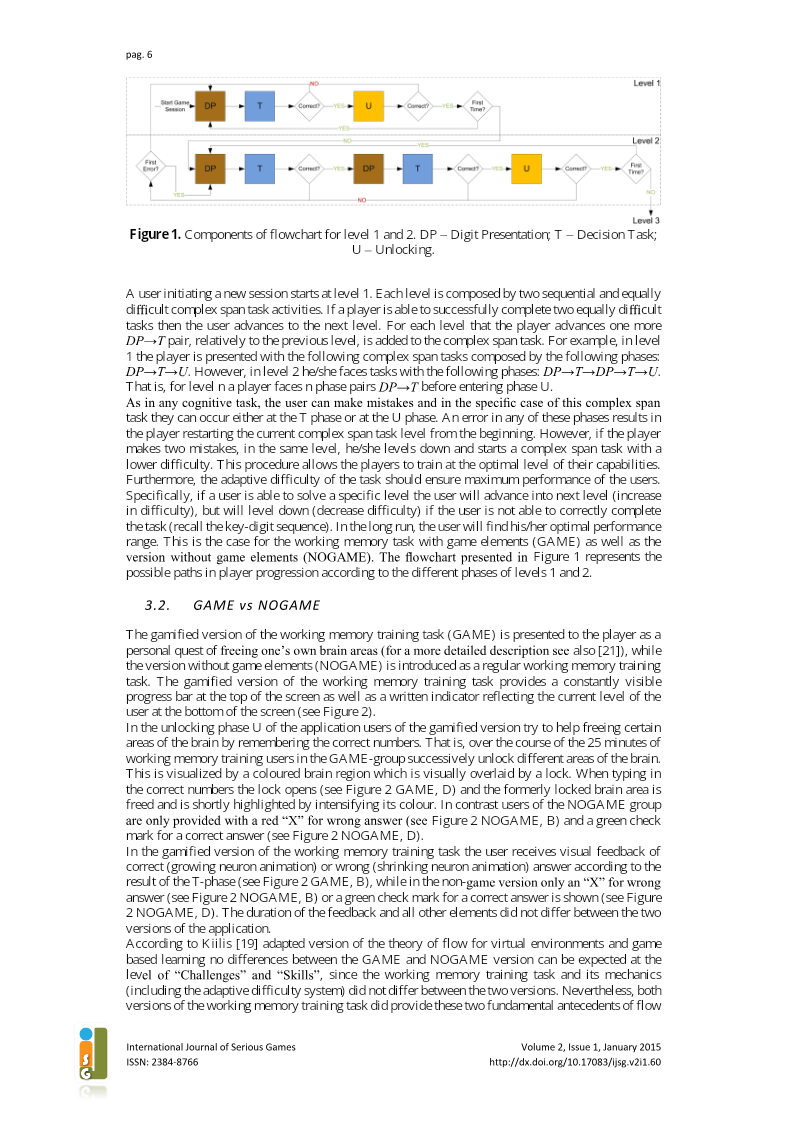

Game Elements Improve Performance in a Working Memory Training Task
Integrating game elements into cognitive training tasks significantly enhances user performance and operational efficiency.
- Gamification elements such as progress bars and level indicators significantly increase user performance and operational efficiency in working memory training tasks.
- The integration of game mechanics encourages participants to utilize their maximum working memory capacity more effectively than conventional, non-gamified training methods.
- Gamification acts as a performance catalyst for objective output without fundamentally altering a user’s maximum cognitive capacity.
Cognitive Intervention and Reconciliation: NPC Believability in Single-Player RPGs
NPCs in single-player RPGs are often experienced as mechanical and limited, a shortfall that erodes player immersion and enjoyment.
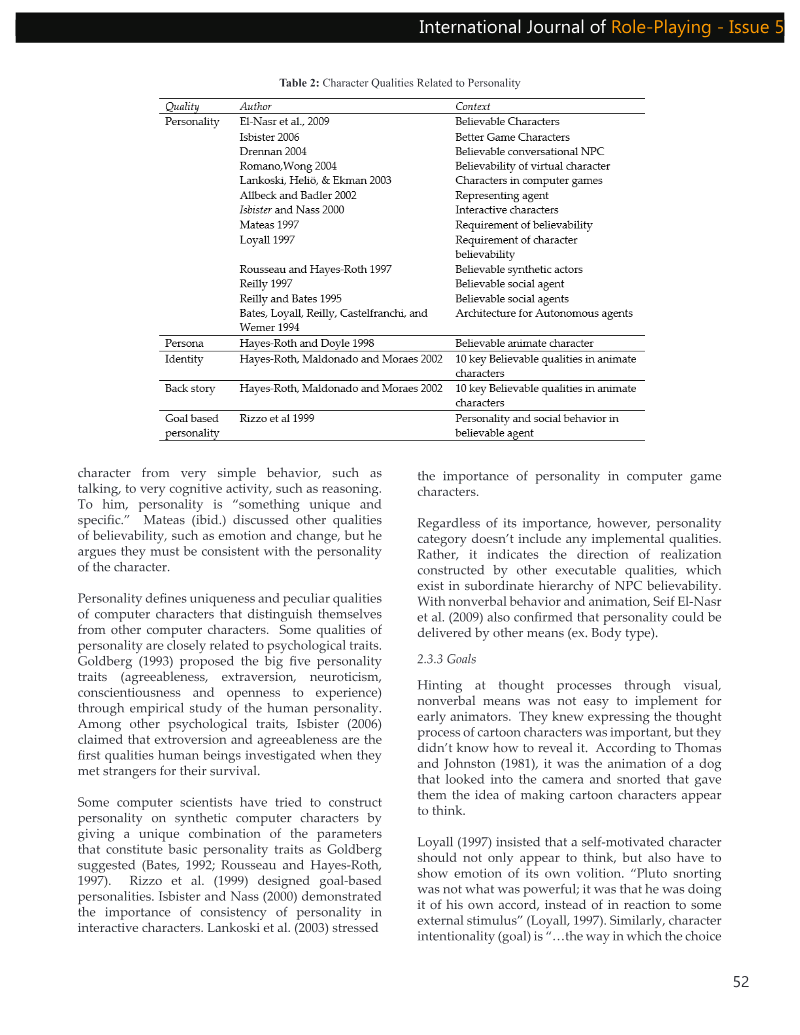
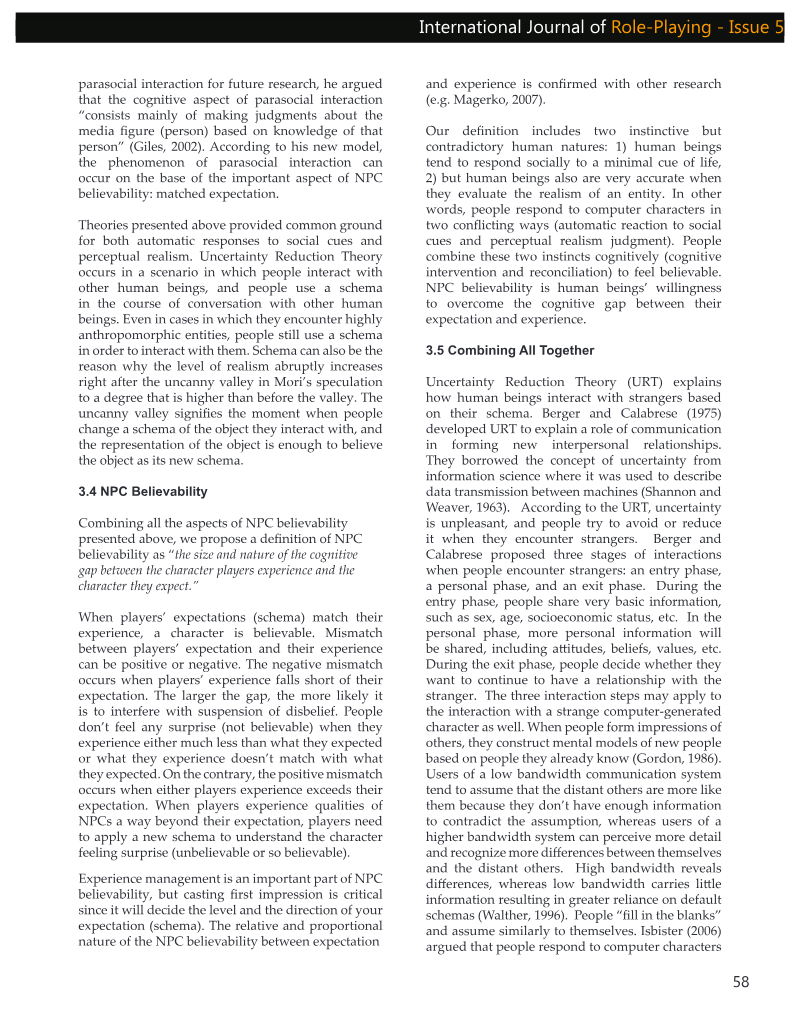
- Believability in single-player RPG NPCs is treated as a cognitive gap between players' expectations and their actual experience, and the report synthesizes AI, communication, film theory, and game studies to build a working definition rather than adopting one discipline's framing.
- Five qualities (appearance, behavior, personality, goals, and emotion) must be displayed clearly and consistently to players rather than assumed, since they act as precursors that shape one another.
- Appearance more expressive than an NPC's internal models produces false impressions, a risk illustrated by the Eliza and Tale-Spin effects.
Ecological Approach to the Performance of Larping
Lampo's paper proposes an ecological framework for understanding the performance of live action role-playing games (larps), drawing on Gibson's ecological perception, Kershaw's theatre ecology, and Ingold's notion of knots and lines.
- Larp performance is framed as an ecology rather than a set of isolated acts: individual player actions interweave into an interdependent, improvised texture drawing on Gibson's ecological perception, Kershaw's theatre ecology, and Ingold's knots and lines.
- Because larps are unscripted and transient, they can only be partially captured through documentation, and Taylor's concept of scenarios is proposed as a way to grasp their structure.
- The core model describes player performance as four steps: information pickup, extraction of possibilities, choice-making, and embodiment.
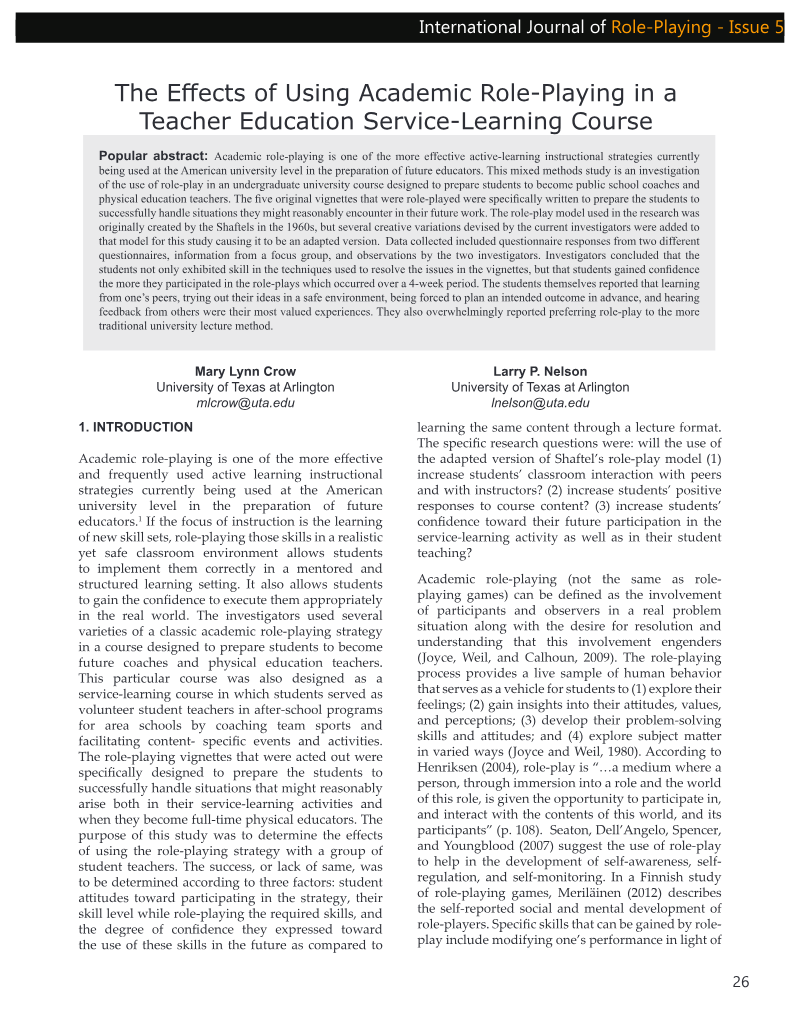
The Effects of Using Academic Role-Playing in a Teacher Education Service-Learning Course
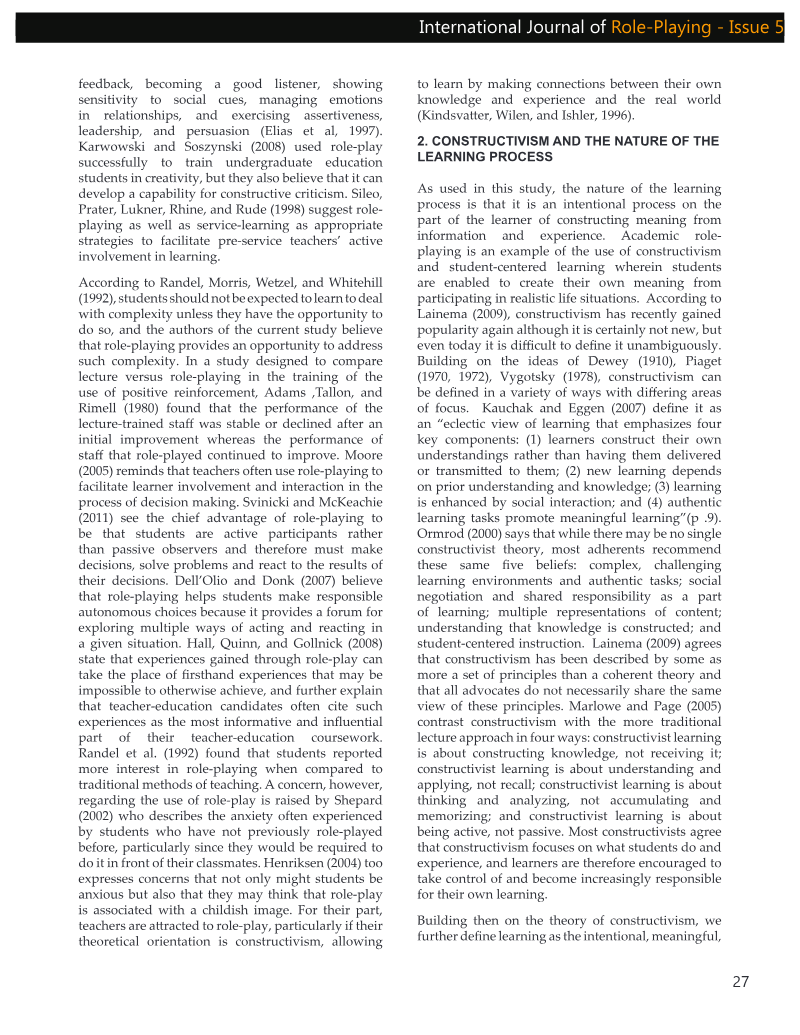
This study examines the effects of academic role-playing, using an adapted Shaftel model, in an undergraduate physical education and coaching service-learning course at a large urban university.
- Academic role-play using an adapted Shaftel model was tested in an undergraduate physical education and coaching service-learning course, comparing an intervention group of 52 students with a control group of 50.
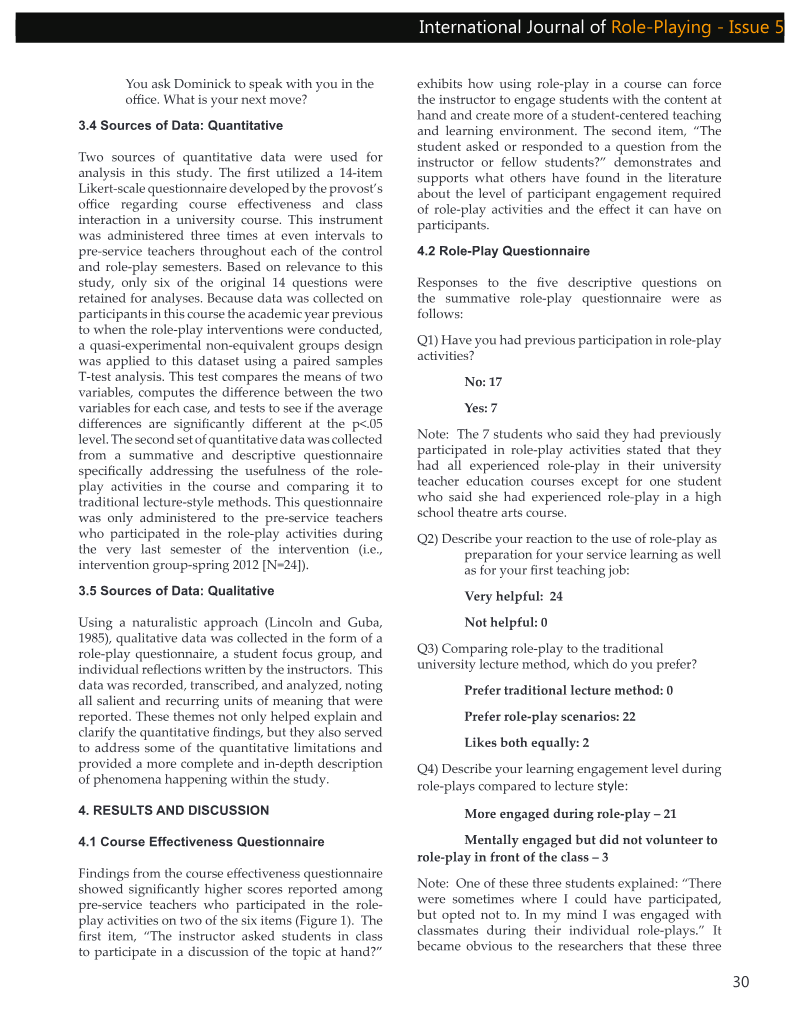
- Role-play participants scored significantly higher on two of six course effectiveness items: the instructor asking students to discuss topics (p=.037) and students asking and responding to questions (p=.039).
- In focus group and questionnaire data, 22 of 24 pre-service teachers preferred role-play to lecture, two rated both equally, and none favored lecture; 21 participants reported feeling more engaged during role-play sessions.

gamevironments 2015
The document announces the establishment of a new Video Gaming and Religion Seminar within the American Academy of Religion (AAR), a major professional body for religious studies scholars.
- The AAR Program Committee approved a new Video Gaming and Religion Seminar for a five-year term (2015–2019), with one session at each Annual Meeting.
- The seminar was founded to address the marginal status of video games within Religious Studies, with author Kerstin Radde-Antweiler arguing that video games now depict religious themes just as film did in the twentieth century.
- The seminar aims to build a multidisciplinary, international network covering personal computer, console, and mobile games, with a steering committee of six scholars from the United States, Canada, Germany, and Finland.


Current Key Perspectives in Video Gaming and Religion
Gregory Grieve's contribution to this special issue on video gaming and religion argues that religious studies should examine video games through a "cultural dialogic mode," treating games as a space where religion and human meaning-making emerge rather than as objects that either hide timeless sacred symbols or serve merely as…
- Gregory Grieve argues that religious studies should examine video games through a "cultural dialogic mode," treating games as spaces where religion and human meaning-making emerge, rather than as hiding timeless sacred symbols or as mere products of the scholar's imagination.
- Grieve draws on Mircea Eliade, J. Z. Smith, Mikhail Bakhtin, and Ian Bogost's concept of procedural rhetoric, contending that in Minecraft religious meaning arises from the embodied experience of play, especially the survival mode's cycle of exploration, resource gathering, construction, and combat.
- Grieve proposes a documentary methodology called "close play," which requires scholars to actually play the games they study, since procedural meaning cannot be fully grasped through narrative or imagery alone.

Current Key Perspectives in Video Gaming and Religion
Kerstin Radde-Antweiler's theses, published in a 2015 special issue on video gaming and religion, argue that religious studies cannot ignore video games, since games form part of today's mediatized life-worlds in which online and offline religious practice increasingly merge.
- Religious studies cannot ignore video games because they form part of today's mediatized life-worlds, where online and offline religious practice increasingly merge.
- Games reach well beyond 'digital natives': German data showed at least 20 percent of players in 2006 were aged 40 to 64, and gaming shapes religious identity construction generally, not only within digital culture.
- Radde-Antweiler warns against overstating any single medium, arguing that media change interacts with individualization, globalization, and economization, so research should start with actor-centered inquiry into gamers' mediatized worlds rather than games as isolated objects.