Game Studies reports and market data
Documents
Workshop: Ethics in Videogames
This workshop proposal, presented at the DiGRA 2009 conference, examines the emerging field of ethics in videogames, arguing that games offer a rich environment for practicing ethical reasoning, moral judgment, and critical thinking.
- Games are framed as both a site of ethical controversy, often blamed for social ills such as youth violence and child obesity, and a potential tool for teaching ethical decision-making.
- The authors define ethics as the practice of enacting choices and moral judgment, arguing that games offer a rich environment for practicing ethical reasoning and critical thinking.
- A 2008 Pew Report cited in the workshop found that 63 percent of teens who play games have witnessed people being mean or overly aggressive, and 49 percent have seen hateful, racist, or sexist behavior.
What We Talk About When We Talk About Game Aesthetics
Game aesthetics has long been undertheorized, often reduced to graphics or "eye candy" despite its capacity to illuminate games as embodied, sensory, and pleasurable experiences.
- Game aesthetics has been undertheorized and often reduced to graphics or 'eye candy', despite its capacity to illuminate games as embodied, sensory, and pleasurable experiences.
- The core thesis holds that aesthetics cannot be separated from play: sensory experience, bodily engagement, and the physical context of play all shape how games produce meaning and pleasure.
- Aesthetic terminology appeared in roughly 10 percent of DiGRA 2003 papers but fell to under 4 percent by 2005 and 2007, which the authors read as evidence that dominant design frameworks have marginalized the topic.
Evolution and Digital Game Studies
This paper argues that evolutionary psychology can make a valuable contribution to digital game studies, which have largely been shaped by cultural and humanities-based frameworks such as those of Johan Huizinga and cultural relativist approaches to play.
- The paper argues that digital game studies have been dominated by humanities and cultural frameworks (notably Huizinga's view of play as cultural), and that evolutionary psychology can make a valuable complementary contribution.
- It contrasts two lineages of play research: Karl Groos's functionalist view of play as evolutionary preparation for adult life, and Huizinga's cultural-phenomenon account.
- The authors use Tooby and Cosmides' Integrated Causal Model to critique the Standard Social Science Model, which treats the mind as a blank slate and separates culture from biology, and propose examining digital gaming through evolved cognitive modules.

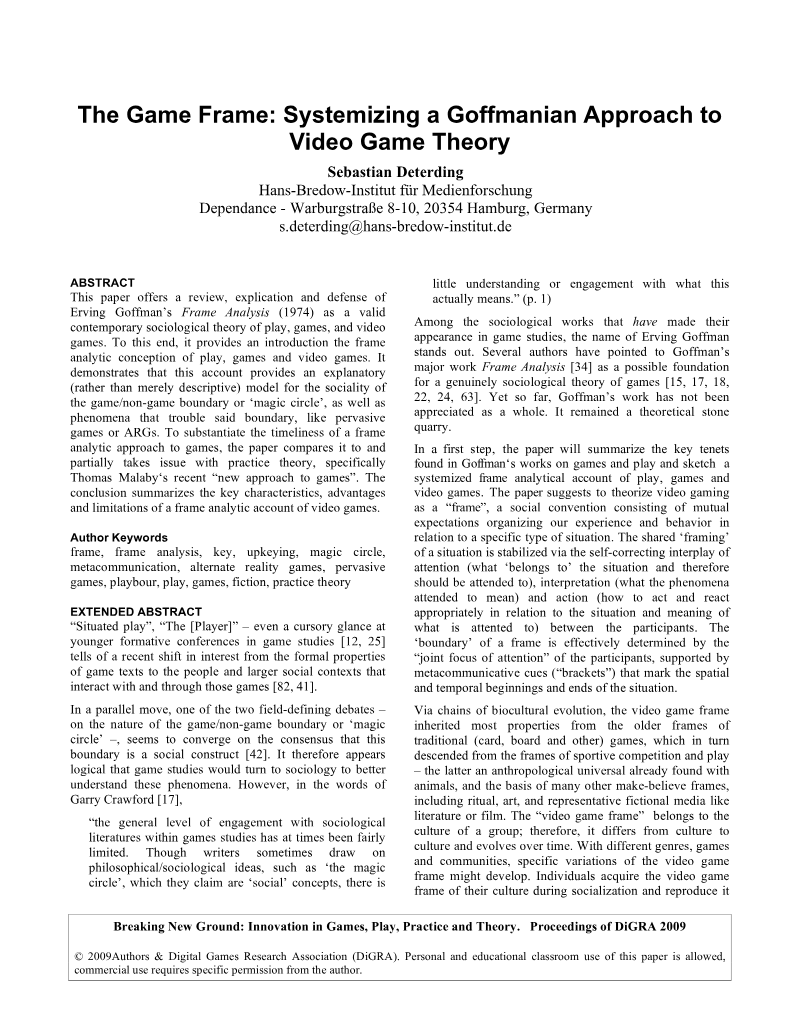
The Game Frame: Systemizing a Goffmanian Approach to Video Game Theory
Sebastian Deterding's paper argues that Erving Goffman's Frame Analysis (1974) offers a valid and underused sociological theory for understanding play, games, and video games.
- Deterding argues that Erving Goffman's Frame Analysis (1974) is a valid but underused sociological framework for understanding play, games, and video games, offered as an extended abstract for DiGRA 2009.
- The paper proposes treating the video game as a social frame: a convention of mutual expectations stabilized through metacommunication, joint attention, interpretation, and action among participants.
- Frame analysis is positioned as an alternative to the long-dominant 'magic circle' metaphor, which many scholars regard as socially constructed but have never explained mechanistically.



International Journal of Role-Playing: Issue 1
The inaugural issue of the International Journal of Role-Playing positions itself as a hybrid knowledge network linking academia, industry, the arts, and player communities, and its central aim is to establish a more rigorous scholarly foundation for the study of role-playing games.
- The inaugural International Journal of Role-Playing identifies the lack of a widely accepted definition of a role-playing game as a major obstacle to research, and proposes a provisional working definition built on participants, game world, player-controlled characters, character development, interaction, and emergent narrative.
- Markus Montola characterises role-playing as a social process governed by an imaginary game world, a distributed power structure, and personified characters, with objectives arising from diegetic and exogenous frames rather than endogenous rules.
- Erik Champion's case study of Bethesda's The Elder Scrolls IV: Oblivion finds the game strong in environmental presence but weaker in social and cultural presence, and suggests design remedies such as dynamic NPC responses and persistent player-influenced artefacts.
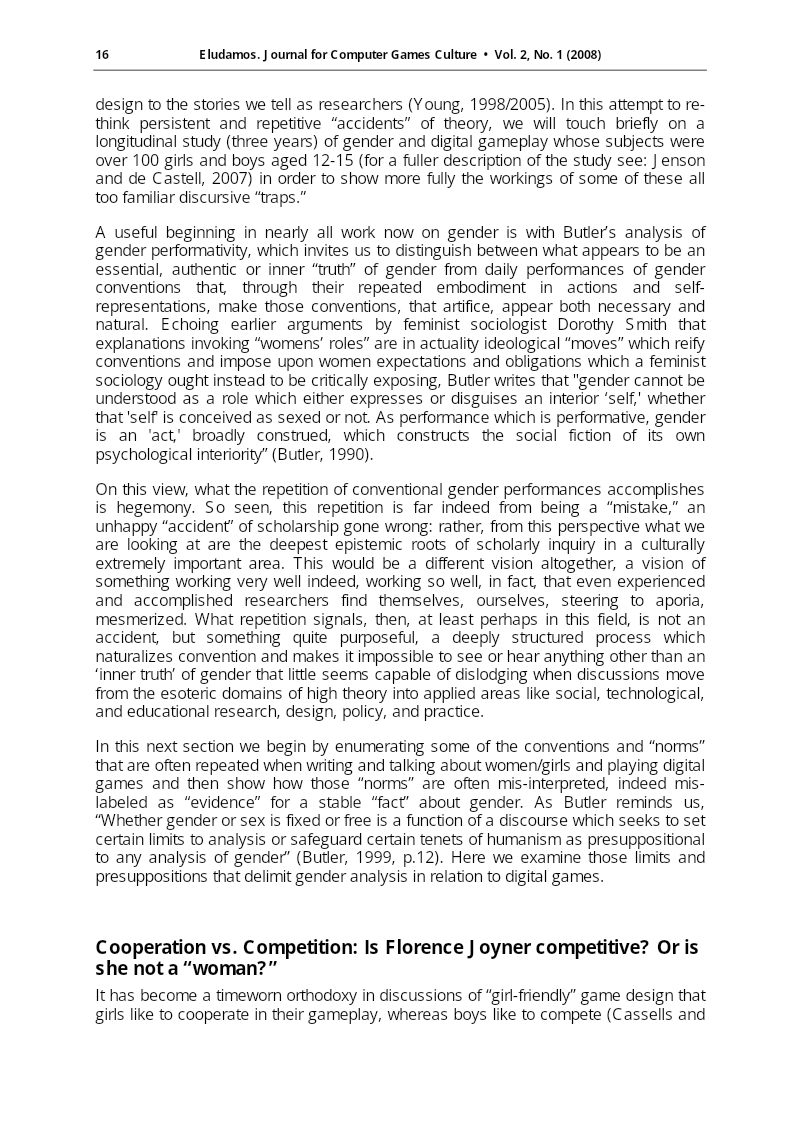
Theorizing Gender and Digital Gameplay: Oversights, Accidents and Surprises
Jenson and de Castell's chapter examines why research on gender and digital gameplay has repeatedly produced the same conclusions, and argues that these conclusions are often artifacts of researchers' assumptions rather than stable features of players.
- The chapter argues that recurring findings in gender-and-games research, such as girls preferring cooperation and boys preferring competition, are artifacts of researchers' assumptions and socially constructed categories rather than stable features of players.
- Drawing on Butler's theory of gender performativity, the authors contend that repeated framings in the field limit analysis and reinforce stereotypes, and they call for critical theorization of core concepts such as competition.
- In a longitudinal study of more than 100 children aged 12 to 15, many girls enjoyed competitive play, and what was labeled 'benevolent competition' appeared to reflect a shift from novice to expert roles rather than a distinct gendered trait.
Dimensions of Play: Gameplay, Context, Franchise and Genre in Player Responses to Command and Conquer: Generals
Geoff King's study examines how players responded to Command and Conquer: Generals, drawing on 284 reviews, 184 from Amazon and 100 from GameSpot.
- Gameplay is the dominant concern in player responses, addressed in roughly 58% of Amazon reviews and about 82% of GameSpot reviews, with graphics and comparisons to earlier series entries also prominent.
- The study argues that game experience is multi-dimensional, with players weighing gameplay, graphics, franchise continuity, narrative, technical performance, and geopolitical context in shifting combinations.
- The geopolitical dimension (post-9/11 Middle East resonances and the terrorist-aligned GLA faction) is named directly in only about 9–12.5% of reviews, rising to roughly 21–31% when oblique references are included.
Approaching Game-Studies: Towards a Reflexive Methodology of Games as Situated Cultures
This paper argues that the study of games as cultural practice requires a methodology grounded in reflexivity and situatedness, two complementary tools that together keep play at the center of inquiry while situating the researcher and the game within local and cultural contexts.
- The paper argues that game studies needs a methodology built on reflexivity (making the researcher's involvement visible) and situatedness (embedding the player and game in local, embodied social practice), keeping play central to inquiry.
- It builds on Espen Aarseth's call to account for the researcher's position as player and refines it with anthropologist Tom Boellstorff's advocacy of participant observation.
- Aarseth's framework of gameplay, game-structure, and game-world, and his adaptation of Bartle's player typologies, are critiqued as risking overly universal and Eurocentric categories when applied without attention to local cultural variation.
Narrating Machines and Interactive Matrices: A Semiotic Common Ground for Game Studies
Ferri's paper argues that video games should be understood as "interactive matrices" and "narrating machines" rather than as texts amenable to standard narratological analysis.
- Video games should be analyzed as 'interactive matrices' and 'narrating machines' rather than static texts, as their meaning is produced through the dynamic interaction between the player and the system.
- Standard narratological tools, such as Russian formalism and Propp’s structuralism, are insufficient for games because gameplay outputs vary across sessions and meaning emerges from the act of play.
- The proposed semiotic model treats gameplay, the game-text, and player engagement as mutually constitutive, utilizing Hjelmslev’s content/expression framework and Rastier’s differential semantics.
From Gamers to Scholars: Challenges of Teaching Game Studies
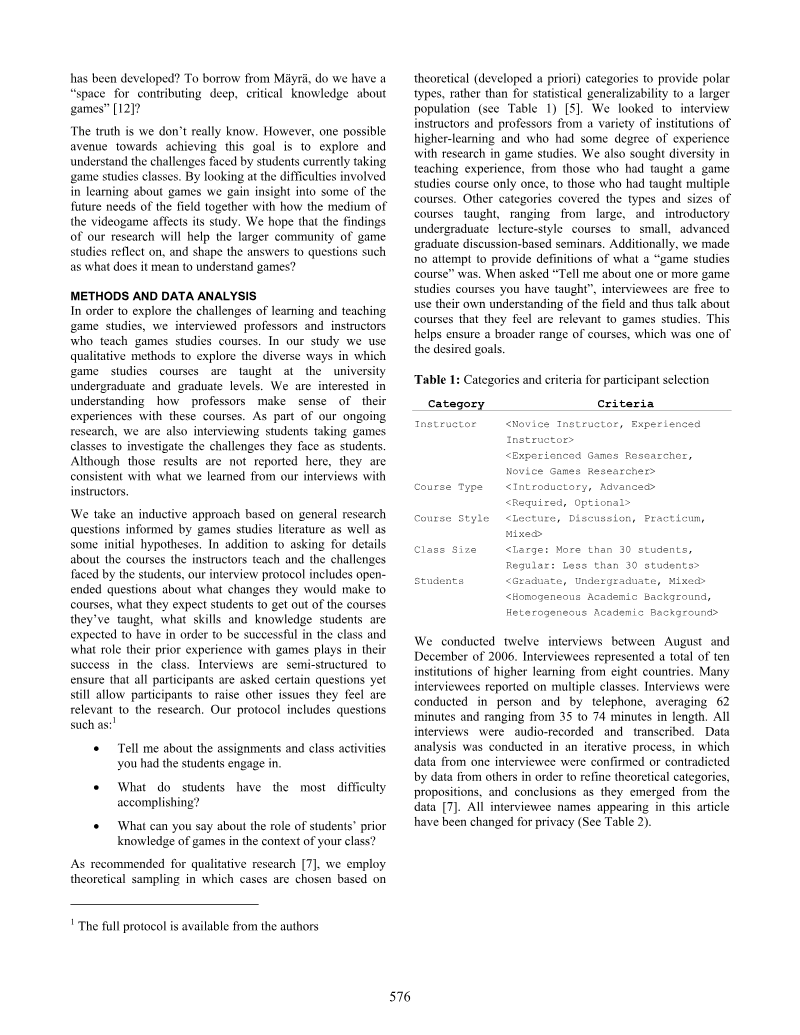
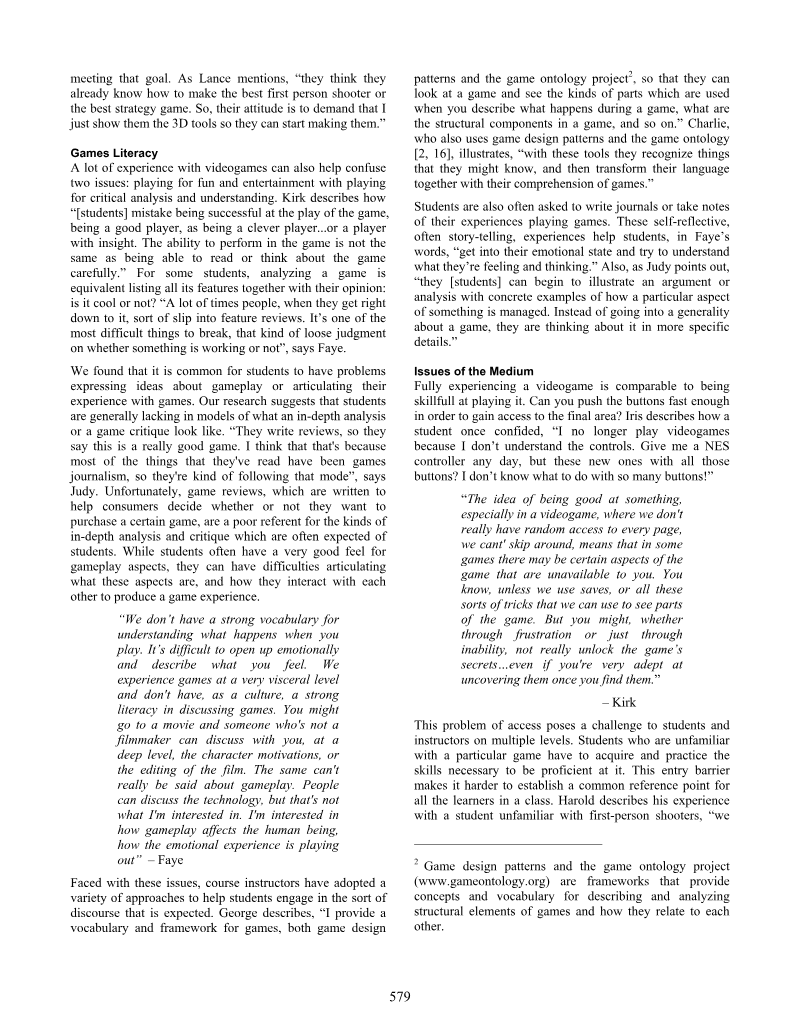
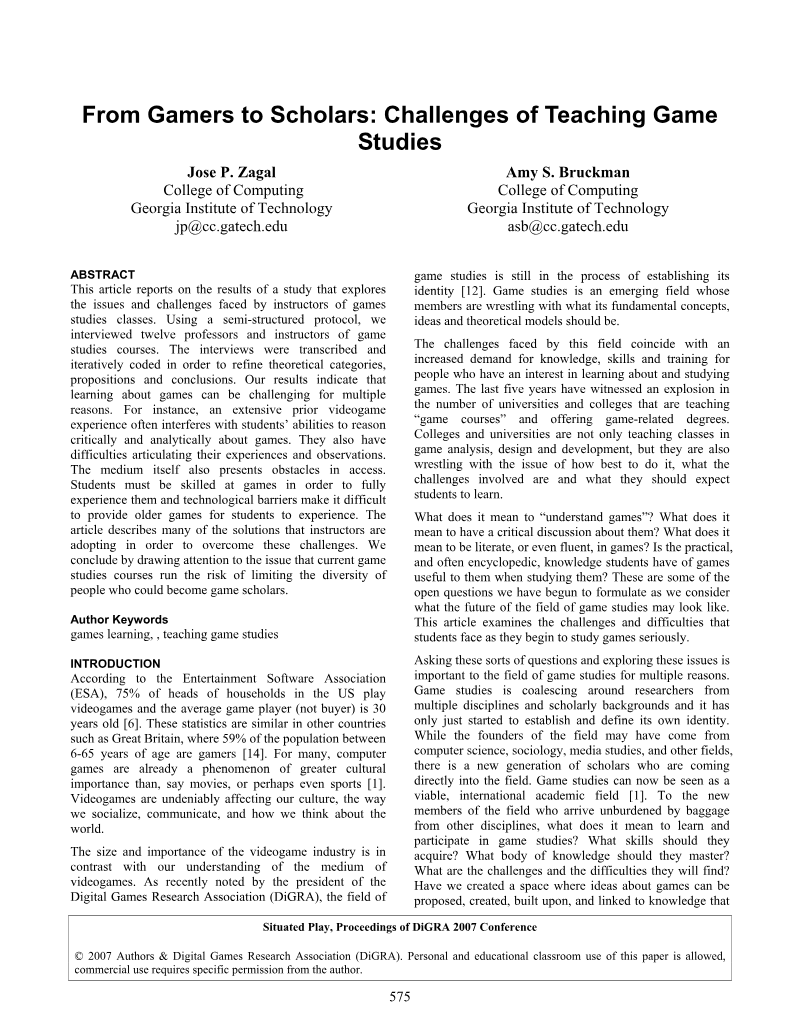
Zagal and Bruckman's paper examines the pedagogical difficulties of teaching game studies at the university level, drawing on interviews with twelve instructors in the field.
- Students' deep but narrow gaming backgrounds can boost motivation and supply rich analytical material, yet they often impede critical reasoning, as learners cling to genre-specific assumptions, dismiss older titles, and conflate skilled play with analytical insight.
- Instructors report that students resist perspectives that challenge their identity as "gamers," which makes it harder to foster the detached, critical stance that game studies requires.
- The field's relative youth, lack of an established canon, and practical access problems (platform obsolescence, time demands, uneven prior exposure) structurally compound the difficulty of teaching it.
Notes Toward a Sense of Embodied Gameplay
Peter Bayliss's "Notes Toward a Sense of Embodied Gameplay," presented at DiGRA 2007, argues that gameplay is best understood as an embodied phenomenon arising at the interface, the point where player and game meet, rather than as an escape into a virtual world or a purely formal rule system.
- Gameplay is framed as an embodied phenomenon arising at the interface where player and game meet, rather than as an escape into a virtual world or a purely formal rule system.
- The paper proposes a three-layer model of the interface (material, software, and conceptual) and critiques the 'immersive fallacy' that treats play as transport into a game world.
- Flow is distinguished from immersion: flow expands the player's sense of self and draws the game into the player's world, while immersion transports the player into the game's world.
CameraBots: Cinematography for Games with Non-Player Characters as Camera Operators
This paper proposes CameraBots, autonomous virtual camera operators modelled on the non-player character bots already common in 3D games, as a way to bring cinematographic principles into real-time game camera work.
- The paper proposes CameraBots, autonomous virtual camera operators built on the NPC bot code already common in 3D games, to bring film cinematography (shot selection, cutting, framing) into real-time game camera work.
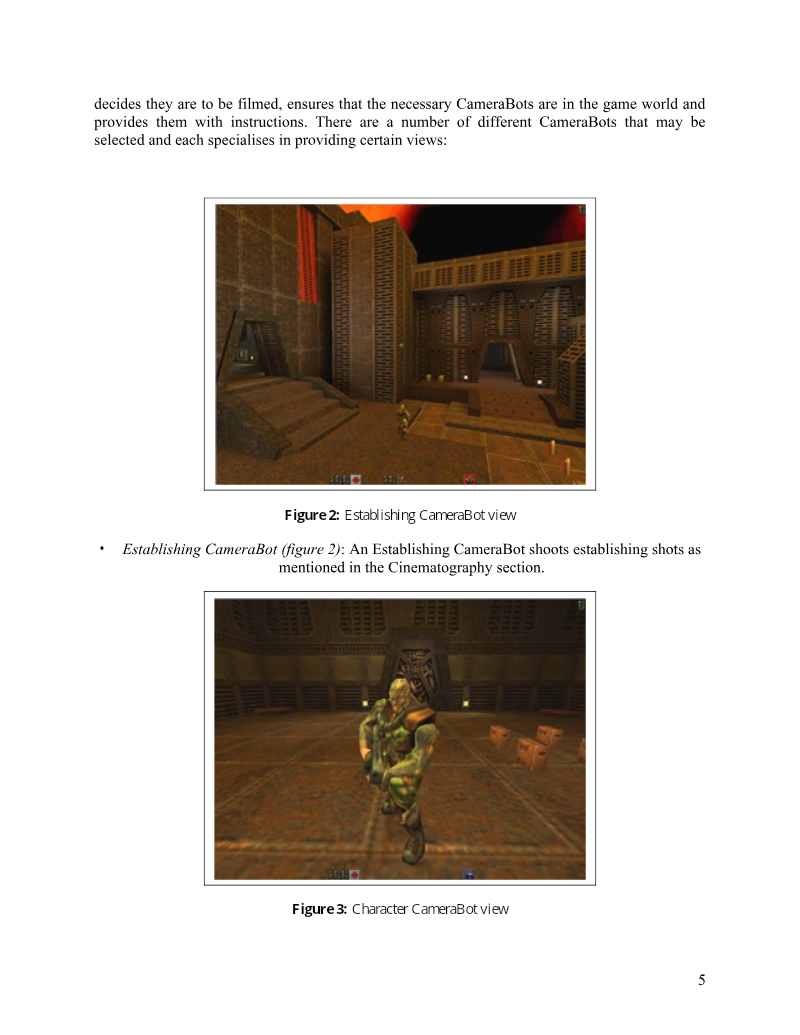
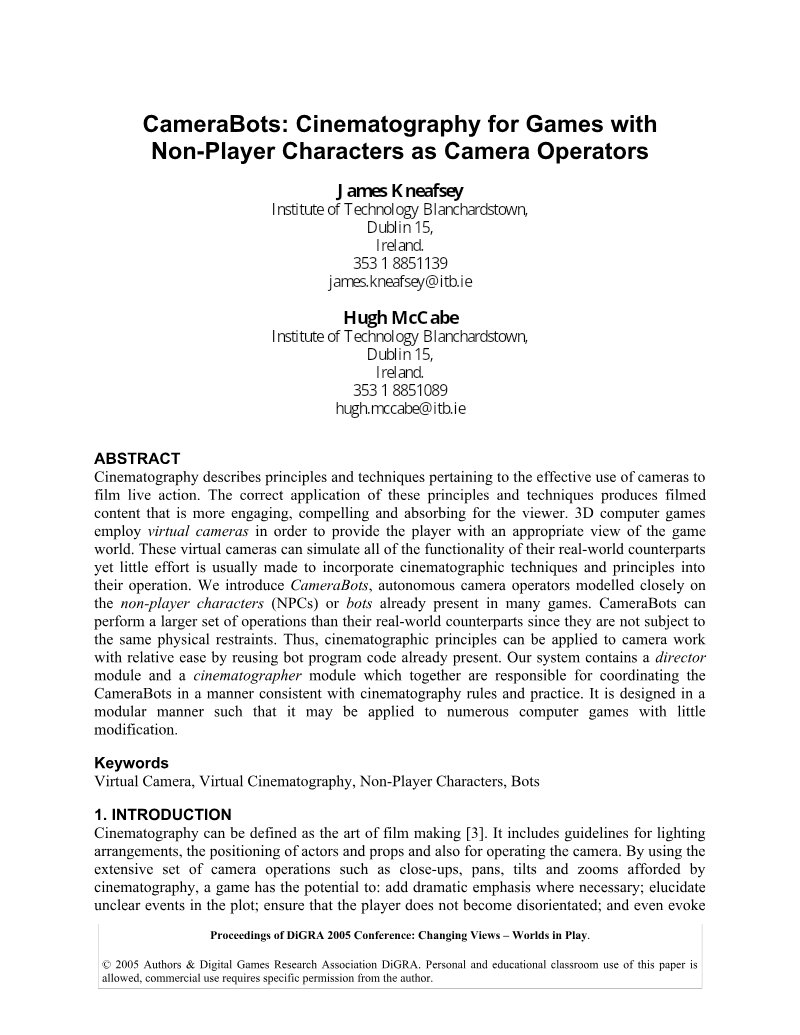
- The architecture mirrors a film set: a director module selects characters and props to film several times per second, and a cinematographer module assigns specialised CameraBots to shot types including establishing, character (long and medium), close-up, first-person, and over-the-shoulder.
- The cinematographer chooses shots based on whether the player's avatar or another principal character is attacking, moving, or stationary, and the modular design lets new CameraBot types be added and the system be ported to other engines via an API.