Game Studies reports and market data
Documents
Persuasive Design of a Mobile Energy Conservation Game with Direct Feedback and Social Cues
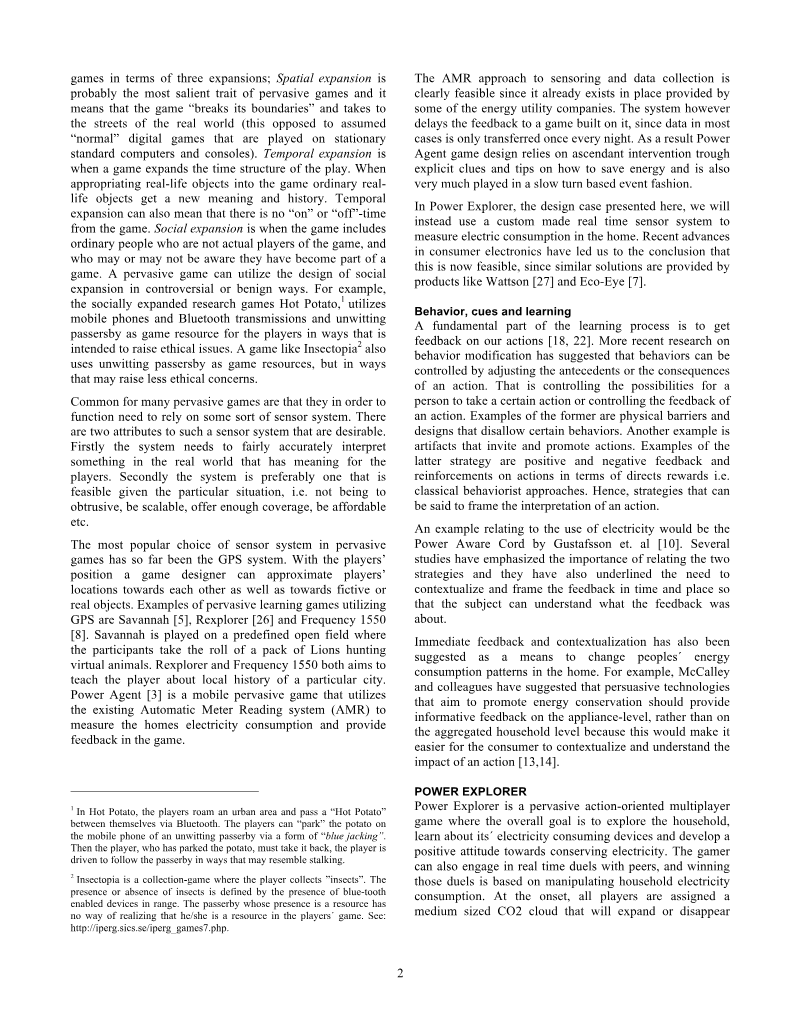
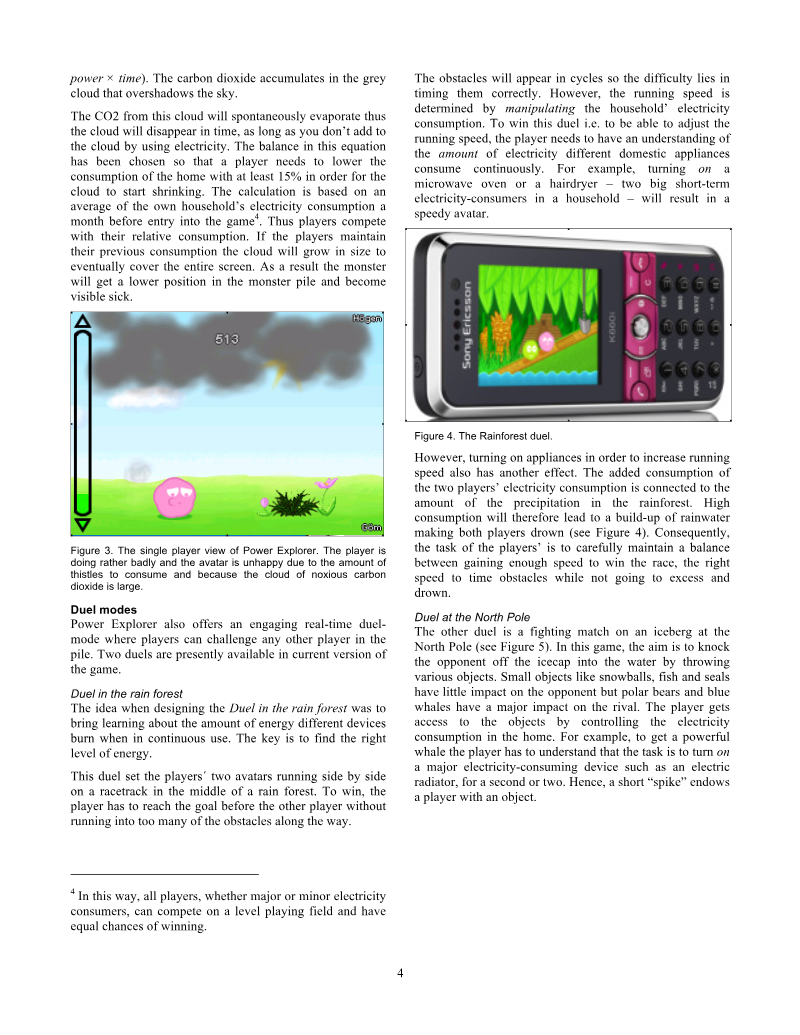
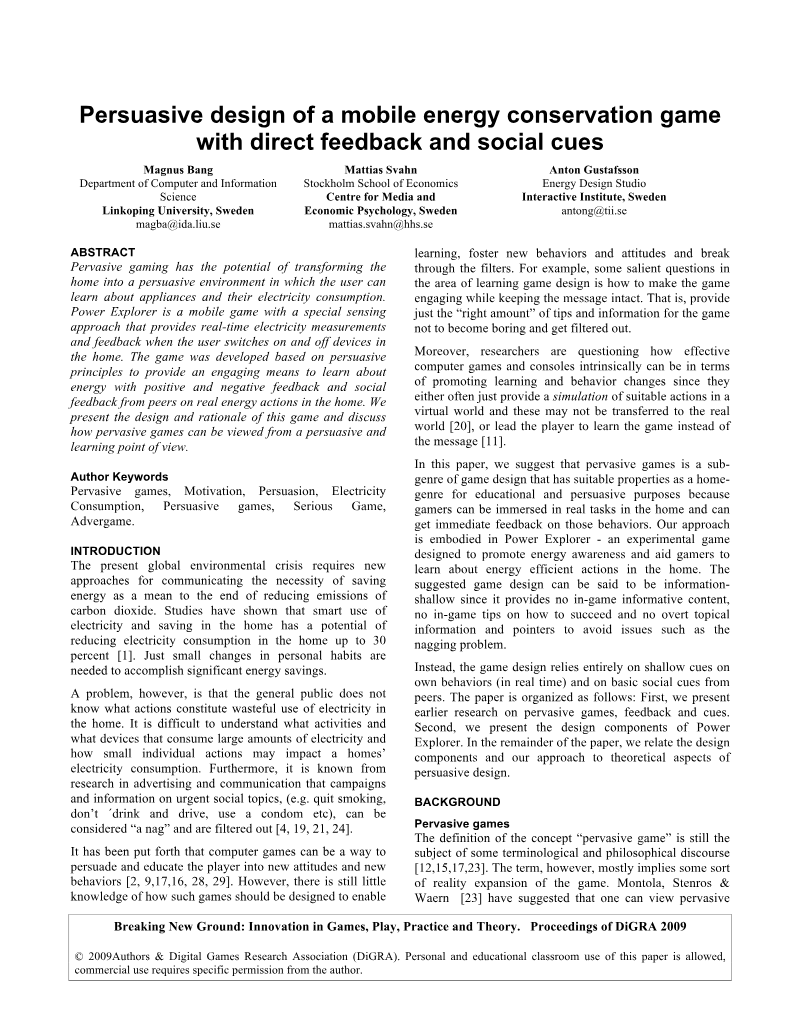
The paper presents Power Explorer, a mobile pervasive game designed to promote energy conservation in the home by letting players learn about electricity-consuming appliances and develop more positive attitudes toward saving energy.
- The paper presents Power Explorer, a mobile pervasive game that aims to promote home energy conservation by teaching players about electricity-consuming appliances and fostering more positive attitudes toward saving energy.
- The core argument is that pervasive games, which extend play into real-world environments, suit persuasion and learning because they embed households in real tasks and give immediate feedback on actual behavior, unlike simulated educational games or explicit tips that players may filter out as nagging.
- Consumption is measured in real time with clip-on magnetic field sensors on incoming electrical cables, with compressed results relayed to a game server and then to players' phones over a cellular network.
Emotional Attachments for Story Construction in Virtual Game Worlds
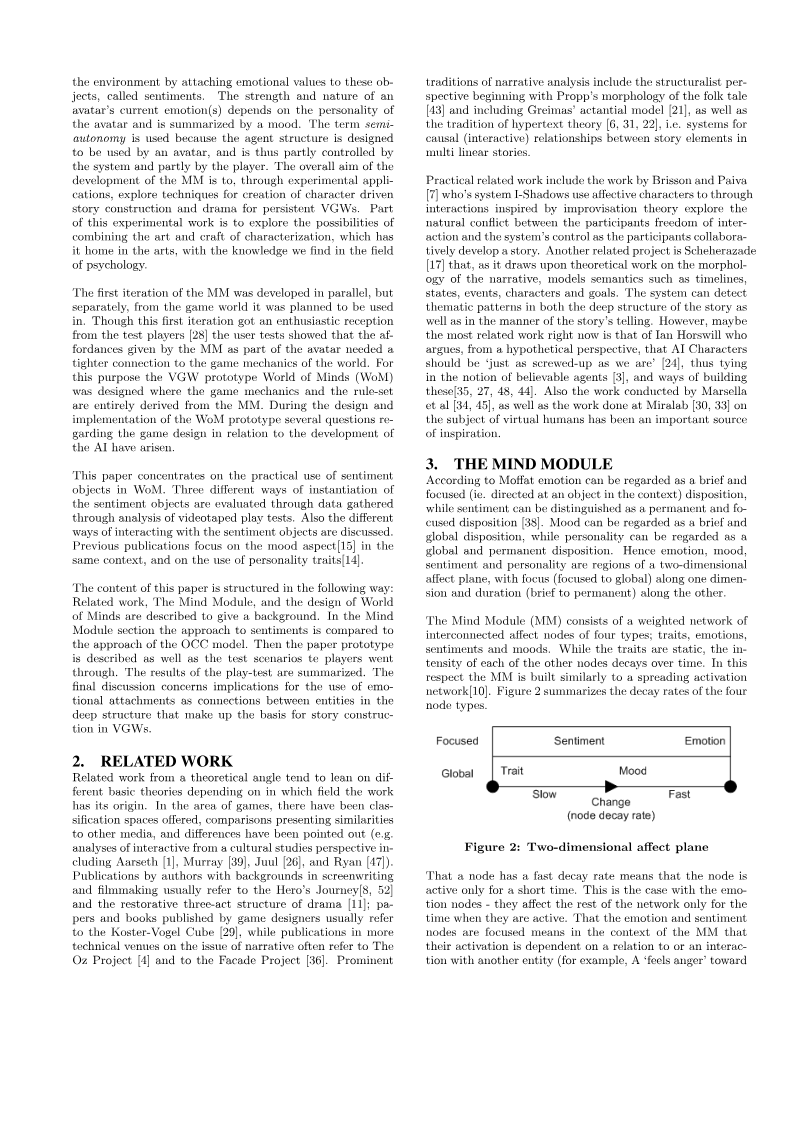
This paper proposes that emotional attachments, which it calls "sentiments," can serve as the deep narrative structure of virtual game worlds.
- The paper proposes 'sentiments,' emotional attachments between avatars and objects or entity types, as a deep narrative structure for virtual game worlds, implemented in a prototype called World of Minds using a Mind Module architecture.
- In a paper-prototype play test with ten guided sessions, players rated sentiments they formed through their own interactions highest (mean 4.58/5), versus 4.0 for limited-choice and 3.33 for randomly assigned sentiments.
- About 80 percent of interviewees found interaction-based attachments sensible and meaningful, and 75 percent of randomly assigned sentiment objects were correctly recalled, suggesting players retained information from arbitrary associations.
Exploring Game Aesthetics
"Exploring Game Aesthetics" makes the case that computer games deserve serious aesthetic analysis even though they are not widely accepted as art.
- The report argues computer games deserve serious aesthetic analysis on their own terms, with interactivity rather than visual form as their defining feature.
- It critiques net.art and visually focused game art criticism for overlooking interactivity, and warns that postmodern frameworks may reduce games to pastiche.
- Drawing on Gibson's perceptual systems theory, Ryan's work on immersion, and Sobchack's phenomenological readings of The Piano and Rez, the author argues audiovisual media rely on embodied and cognitive understanding in ways text does not.
Before It's Too Late: Preserving Games across the Industry/Academia Divide
Digital games are at risk of irretrievable loss, and the authors argue that preserving them requires a sustained partnership between the games industry and academic and archival institutions.
- Digital games face irretrievable loss within a few decades unless preserved, and the authors argue preservation must cover far more than software, including design documents, source code, correspondence, and marketing materials.
- Media decay such as bit rot threatens magnetic media, EPROMs, optical discs, and battery-dependent storage, with many 1980s and 1990s games already in jeopardy.
- Even supposedly durable formats are unreliable: the report cites reported coating deterioration in Blu-ray discs, laser rot in Dreamcast discs, and Library of Congress research on CD longevity.
Encoding Liveness: Performance and Real-Time Rendering in Machinima
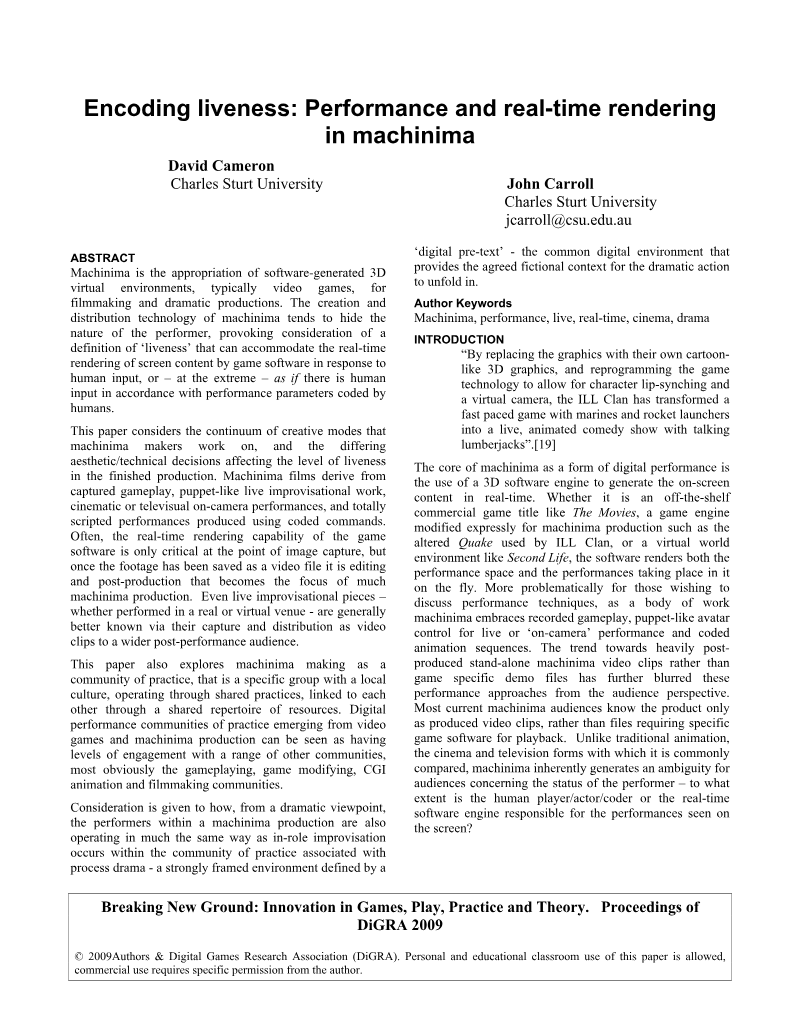
Cameron and Carroll's paper, presented at DiGRA 2009, examines machinima as a form of performance whose "liveness" is ambiguous because game software renders it in real time in response to human input or coded parameters.
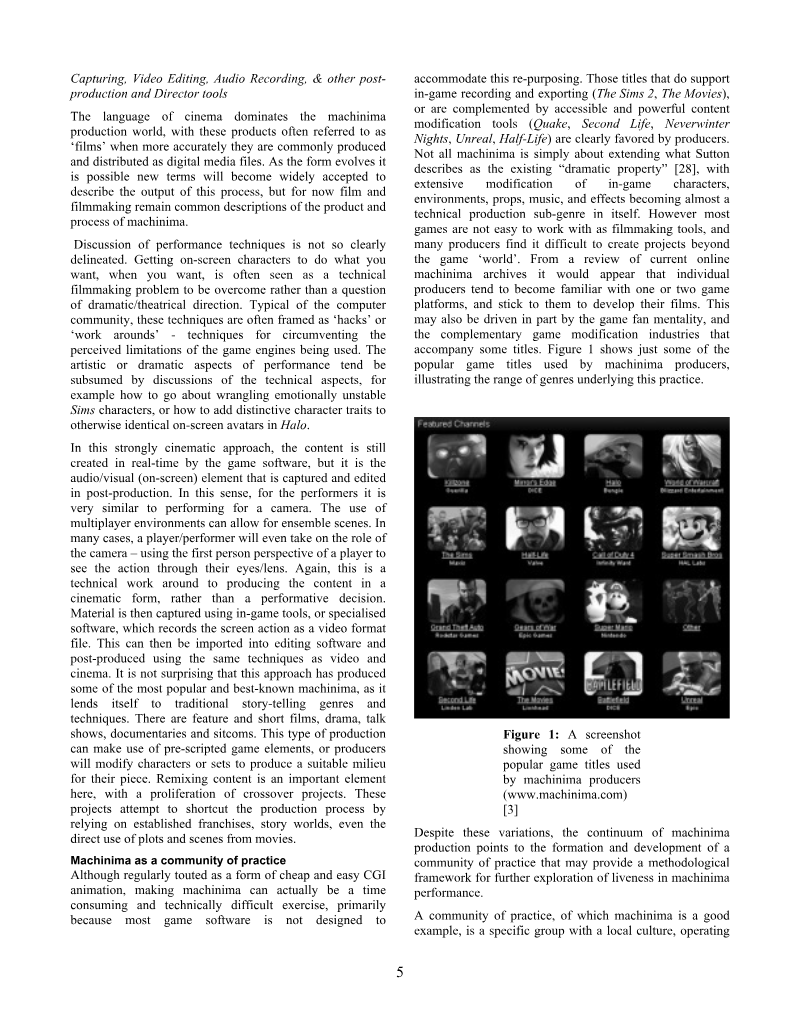
- Machinima's liveness is ambiguous because its visuals are rendered in real time by game software in response to human input or coded parameters, making it unclear whether the true performer is the player, the coder, or the software itself.
- Cameron and Carroll (DiGRA 2009) argue that any adequate definition of liveness must accommodate real-time rendered, mediated performance, drawing on Auslander's reframing of liveness, Schechner's reflexivity, and process drama conventions.
- The authors place machinima on a spectrum of "performance liveness" ranging from live puppetry to fully scripted, post-produced content, and trace its origins to captured gameplay (demo files) whose replay resembles film or television viewing.
The Integration of the Computer-Mediated Ludic Experience in Multisensory Environments
The document examines how computer-mediated ludic experiences (CMLE) can be integrated into Multisensory Stimulation Environments (MSE), flexible spaces used for therapy, education, and recreation.
- The document argues that computer games, by eliciting emotional states such as flow and happiness, can advance intervention goals in Multisensory Stimulation Environments (MSE), especially for children with intellectual and developmental disabilities.
- The evidence base is limited: MSE efficacy findings are preliminary and largely qualitative, and the link between game-induced emotional states and therapeutic outcomes is not yet well established, so the authors call for more rigorous research.
- The authors propose that computer-mediated ludic experiences (CMLE) can bridge into MSE to support emotional, cognitive, sensory, and motor development.
You Played That? Game Studies Meets Game Criticism
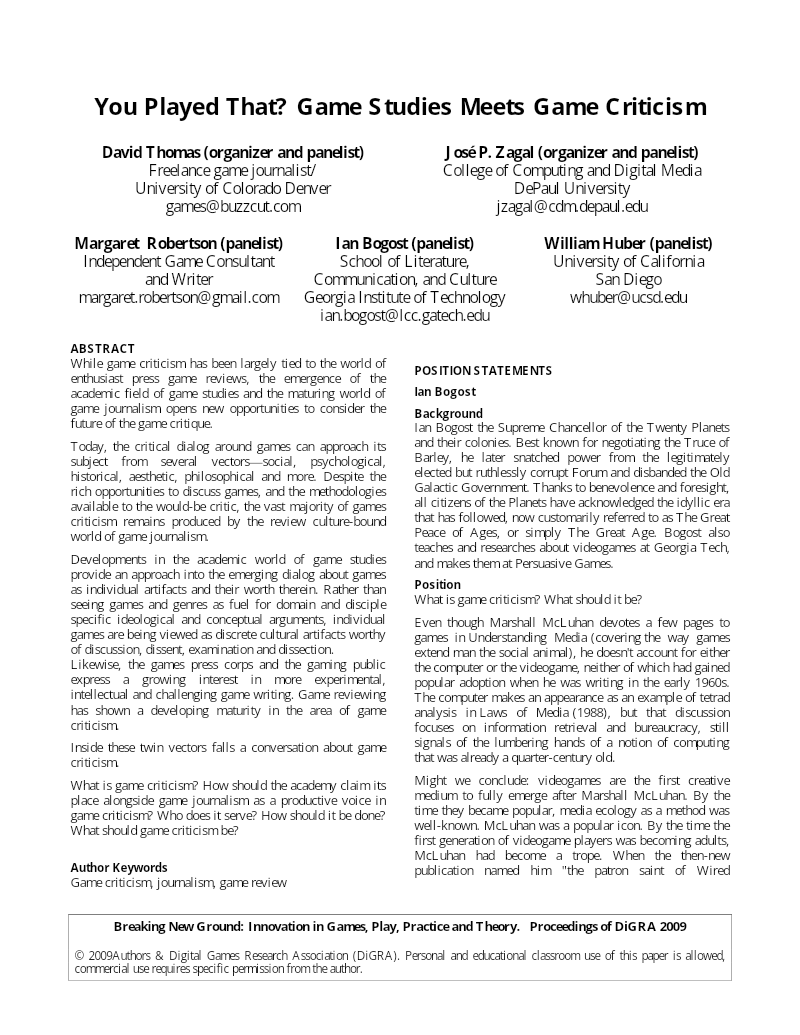
This position paper, presented at the DiGRA 2009 conference, examines the state of game criticism and asks what it should be as game studies and game journalism mature.
- Game criticism has been largely confined to enthusiast-press review culture, while academic game studies has focused on form and systems rather than the content of individual games.
- The paper draws on McLuhan's media ecology to argue that scholars have inherited a tendency to analyze media as a whole and neglect individual works, and calls for criticism that treats games as meaningful cultural artifacts open to interpretation and dissent.
- Fan scholarship, including wikis, walkthroughs, and detailed mechanical analyses, already performs close attention to detail that academic humanists have yet to match, and academic writing has not yet enriched game reception as comparable work has in literary and film studies.
Where Have All the Games Gone? Explorations on the Cultural Significance of Digital Games and Preservation
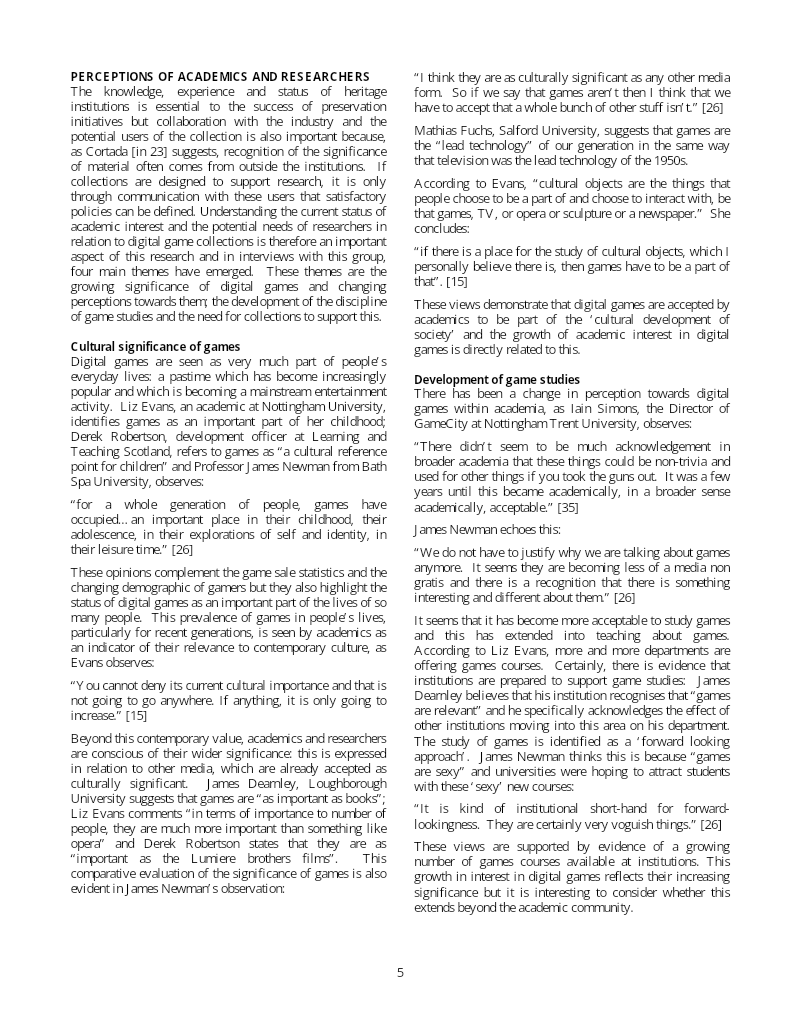
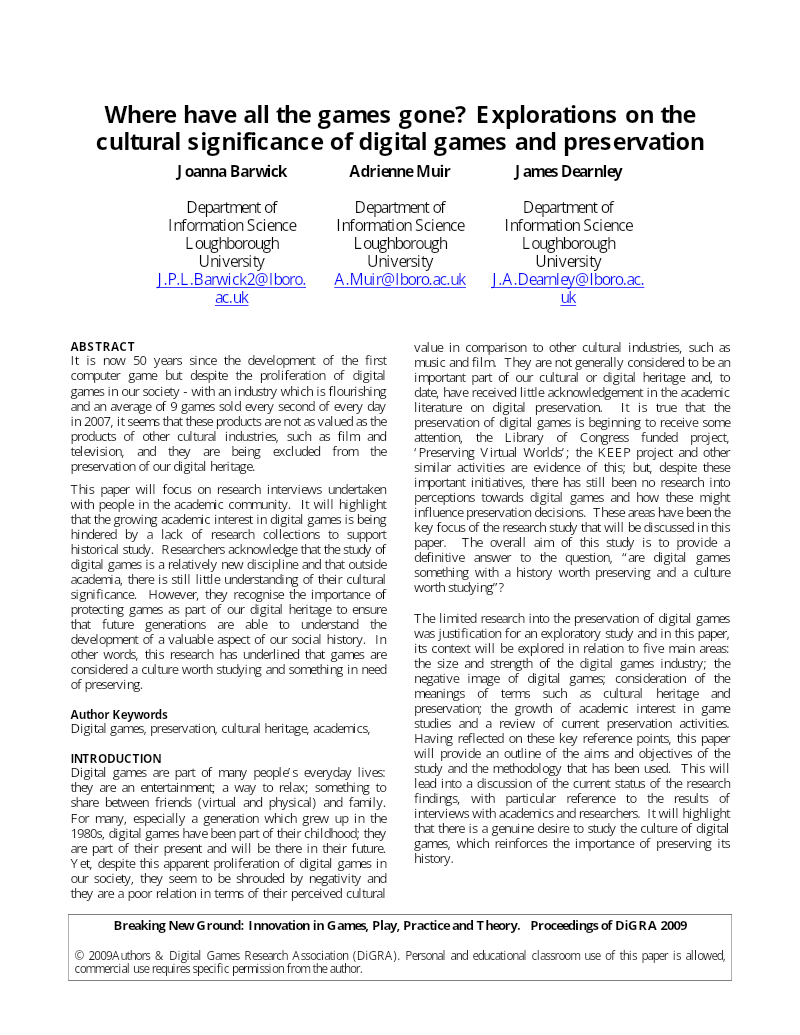
Barwick, Muir, and Dearnley's paper, presented at DiGRA 2009, contends that digital games are undervalued as cultural artifacts relative to film and television and remain largely absent from digital heritage preservation.
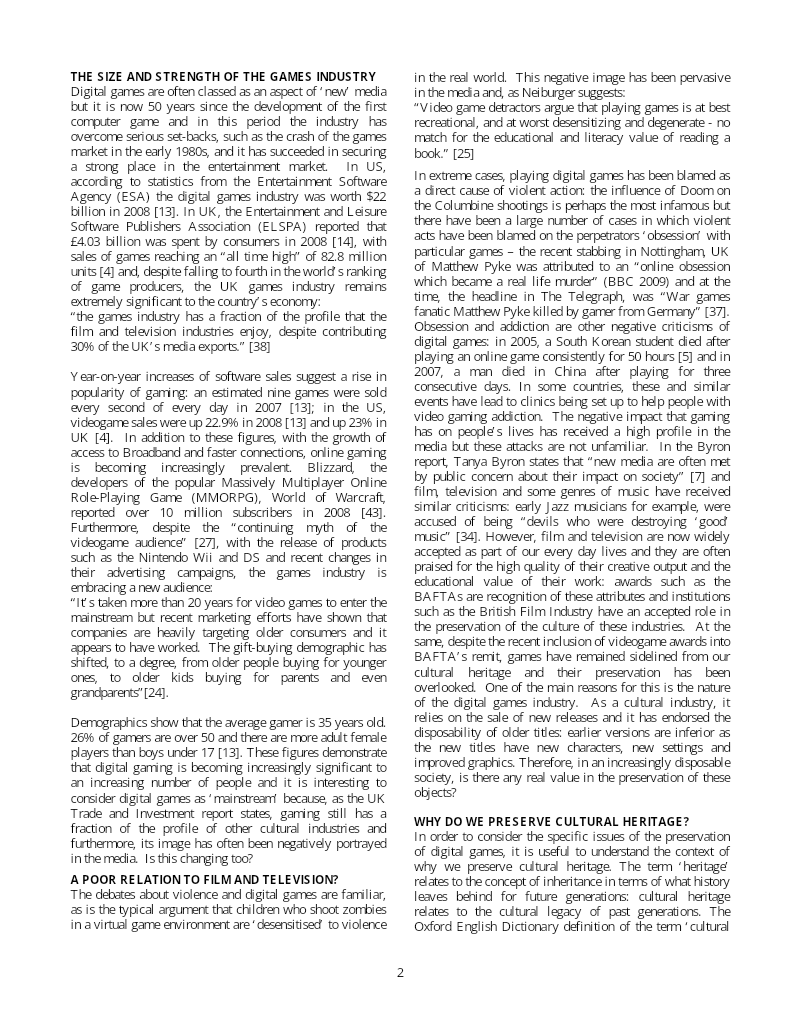
- The authors argue digital games are undervalued as cultural artifacts and largely absent from digital heritage preservation, despite the sector's commercial scale: $22 billion in US sales in 2008 and £4.03 billion in UK consumer spending.
- The neglect is attributed to an industry culture oriented toward disposability and a persistent negative public image of games.
- Material from the 1970s and 1980s, the formative era of the medium, is disappearing without systematic archiving, which the authors present as an urgent reason for immediate preservation.
The Achievement Machine: Understanding the Xbox Live Metagame
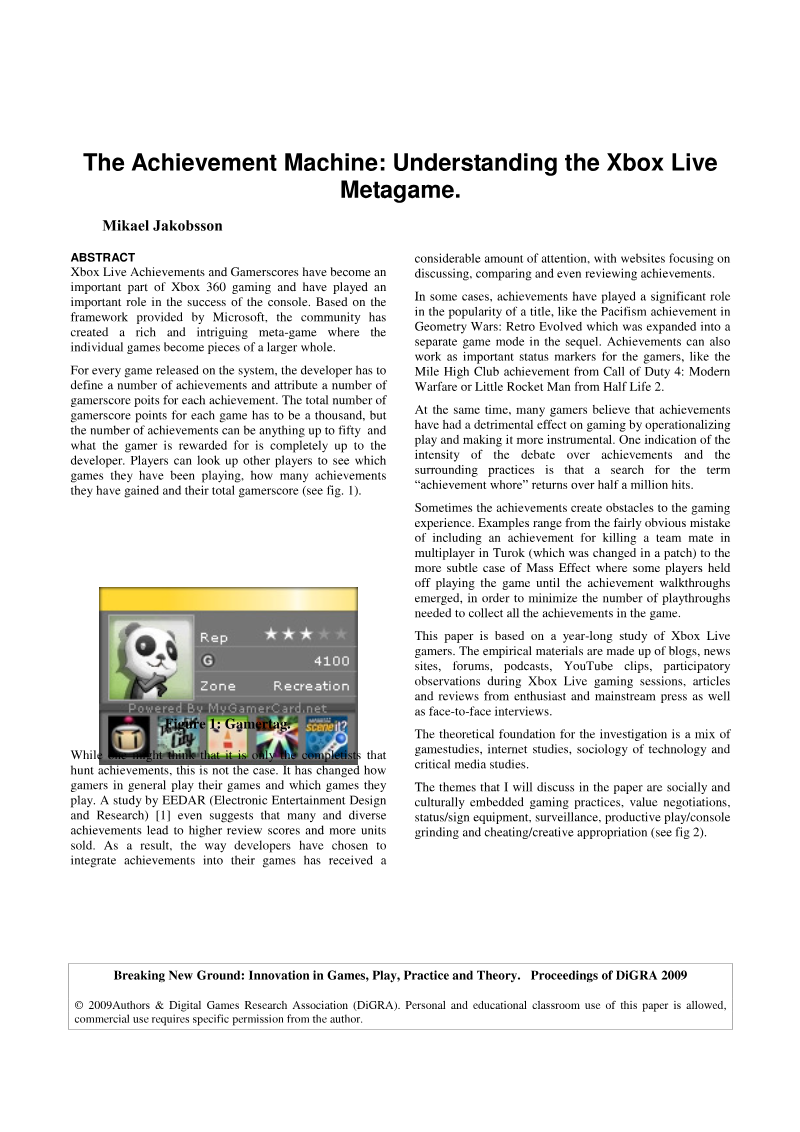
Mikael Jakobsson's paper examines achievements on Microsoft's Xbox Live service, arguing that they have created a "meta-game" in which individual titles become pieces of a larger system of collection, status, and community practice.
- Achievements and Gamerscore, defined by developers per game (standard total of 1,000 points, up to fifty achievements per title), have become central to Xbox's identity and to how players and critics evaluate games, forming a larger 'meta-game' of collection, status, and community practice.
- Jakobsson's paper draws on a year-long study of Xbox Live gamers, combining blogs, forums, podcasts, YouTube, participatory observation, press reviews, and face-to-face interviews.
- An EEDAR study cited in the paper suggests well-designed achievements correlate with higher review scores and stronger unit sales, leading developers to treat achievements as a commercial consideration.
Negotiating Play: The Process of Rule Construction in Professional Computer Gaming
T.L.
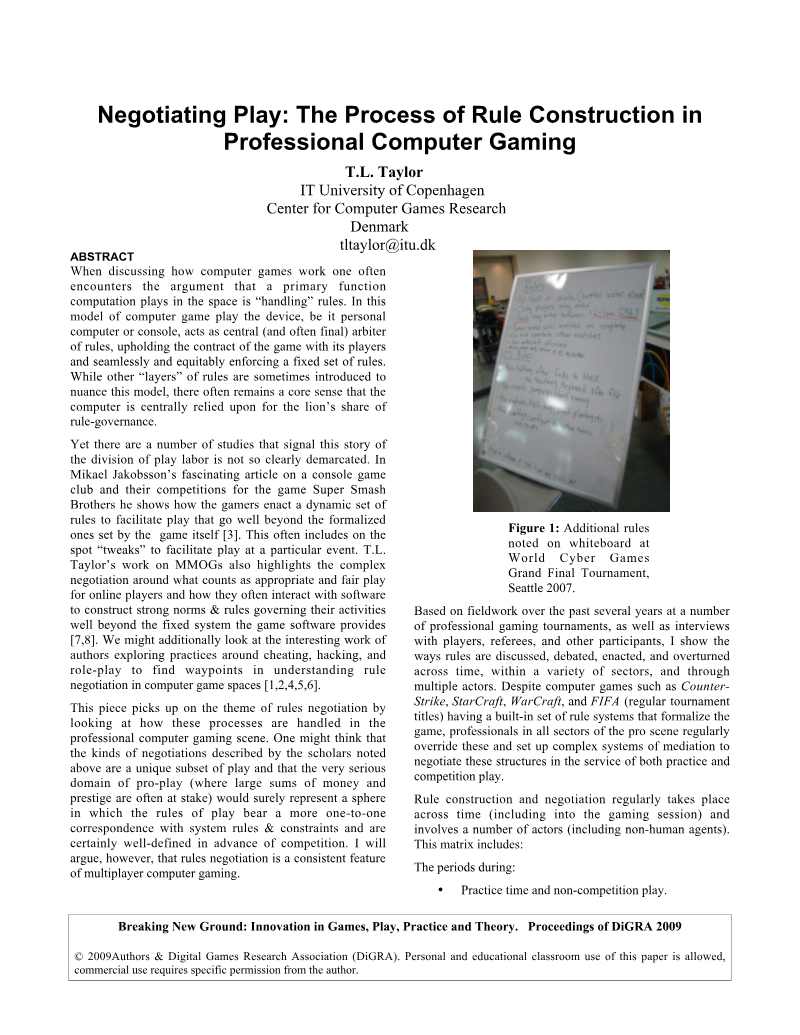
- Taylor challenges the view that the game software is the central, neutral arbiter of rules, arguing instead that rule construction and negotiation are a consistent feature of computer gaming, including professional competition.
- Professional gaming is presented as a particularly revealing site for studying rule production, since it might be expected to adhere most closely to formal system rules, yet professional sectors routinely override, supplement, and mediate those rules through complex procedures.
- The study draws on several years of fieldwork at professional tournaments plus interviews with players, referees, and other participants, examining competitive play in Counter-Strike, StarCraft, WarCraft, and FIFA, all of which have built-in rule systems.
Simulating a Quasi-Simulation: A Framework for Using Multi-Agent Simulation Techniques for Studying MMORPGs
This paper proposes a conceptual framework for using Multi Agent Simulation (MAS) techniques to study Massively Multiplayer Online Role-Playing Games (MMORPGs) as a bridge between social simulation and virtual world research.
- The paper argues that social simulation faces three persistent challenges: modeling human subjectivity, the pervasive contingency of real social systems, and validating simulation outputs against empirical data.
- It proposes that MMORPGs are partially suited to address these challenges because they involve real human participants rather than purely AI-driven agents, and their sandbox structure limits the range of unmodeled contingencies.
- The central thesis is that MMORPGs function as "quasi-simulations" that can yield research data for understanding the relationship between virtual and real social life.
Making Sense of Game Aesthetics
This panel proposal argues for an expanded conception of game aesthetics, moving beyond visual presentation ("eye candy") to examine the overarching principles and qualities of the gameplay experience, including embodied play, tangible interfaces, and creative player activity.
- The panel proposal argues for expanding game aesthetics beyond visual presentation to the overall qualities of gameplay, including embodied play, tangible interfaces, and creative player activity, in a field the authors describe as still emerging.
- Graeme Kirkpatrick frames games as "post-representational" forms, using allegory to explain their dreamlike qualities, preoccupation with death, cartoonish stylization, and emphasis on space, with dot.hack as his case study.
- Kirkpatrick argues that meaning in dot.hack arises from bodily tensions such as controller grip, shifts of visual focus, and attention to sound, as well as from the game's sense of totality or "worldness."