Game Development reports and market data
Documents
Game Developer Index 2010: Sweden
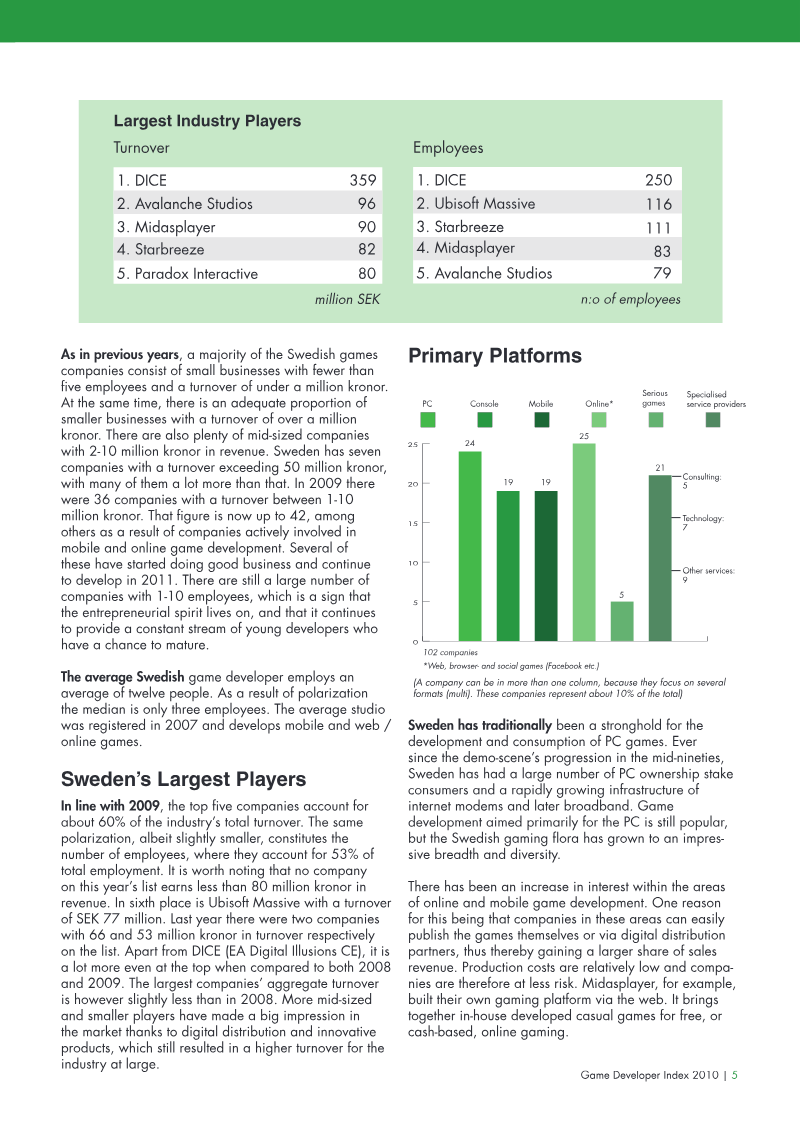
The Swedish game industry entered a period of significant expansion in 2010, characterized by a record turnover of 1.181 billion SEK and a 9.2 percent increase in total employment.
- The Swedish game industry reached a record turnover of 1.181 billion SEK in 2010, supported by a 9.2 percent increase in total employment.
- Market concentration remains high, with the five largest companies accounting for 60 percent of the industry's total revenue.
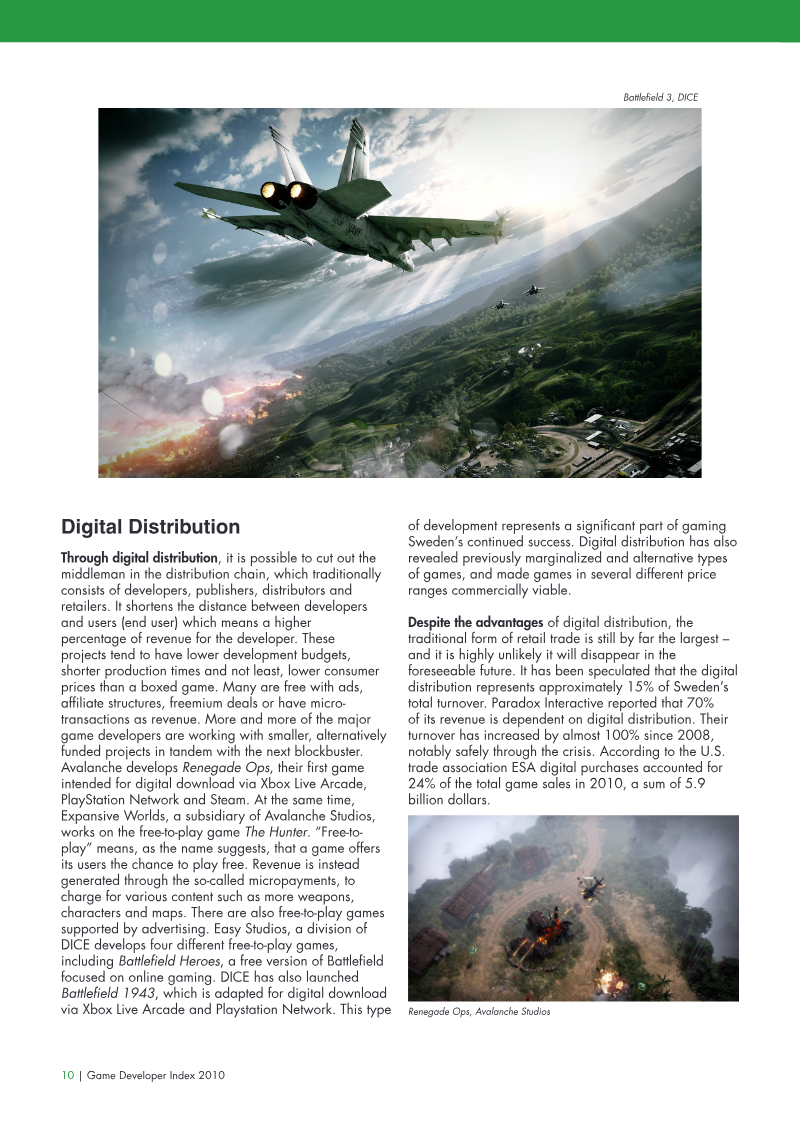
- The sector is successfully pivoting toward digital distribution and mobile platforms, utilizing diverse monetization strategies like free-to-play, freemium, and ad-funded models.


Designing for Player Experience: How Professional Game Developers Communicate Design Visions
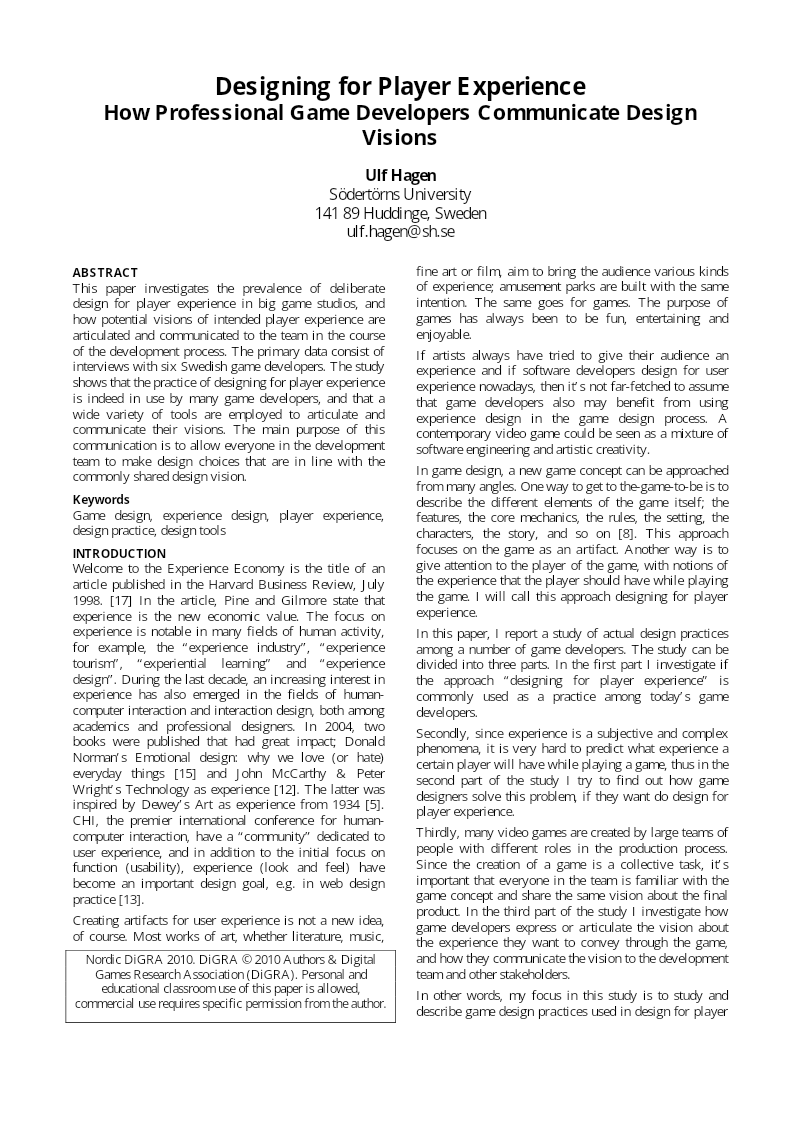
Hagen's study examines how professional game developers articulate and communicate the intended player experience of their games, focusing on Swedish studios.
- Designing for player experience, meaning the feelings a player should have rather than mechanics alone, is a widely practiced approach among professional developers, according to Hagen's study of six interviews with developers from five major Swedish studios.
- Strong game development depends on communicating a shared design vision so that team members can be creative within a common framework across large, multidisciplinary groups.
- Studios such as Dice, Harmonix, Avalanche, and Starbreeze communicate their visions through concise descriptors, similes, anti-exemplars, concept art, animation, and music rather than lengthy documents.



Capcom Annual Report 2010
The 2010 fiscal year represented a period of significant financial contraction and strategic realignment for Capcom.
- Capcom experienced a significant financial downturn in fiscal year 2010, with net sales dropping 27.3% to 66.8 billion yen and net income falling by 73.1%.
- The company is pivoting to a 'Single Content, Multiple Usage' strategy to leverage core IPs like Resident Evil, Street Fighter, and Monster Hunter across consoles, mobile, and online platforms.
- Management implemented a new matrix management structure and separated CEO and COO roles to improve operational accountability and decision-making speed.



Ubisoft Annual Report 2009
The 2009 Ubisoft Annual Report details a period of significant expansion and strategic transformation for the company during the 2008-2009 fiscal year.
- Ubisoft surpassed €1 billion in annual revenue for the first time in the 2008-2009 fiscal year, achieving €1.06 billion in sales, a 14% increase over the previous period.
- Net income declined significantly to €68.8 million from €109.8 million, driven by a strategic shift toward lower-margin casual titles and increased marketing expenditures.
- The company expanded its global workforce to 5,765 employees across 28 countries, supported by the strategic acquisitions of Massive Entertainment and Hybride Technologies.

Game Developer Index 2009: Sweden
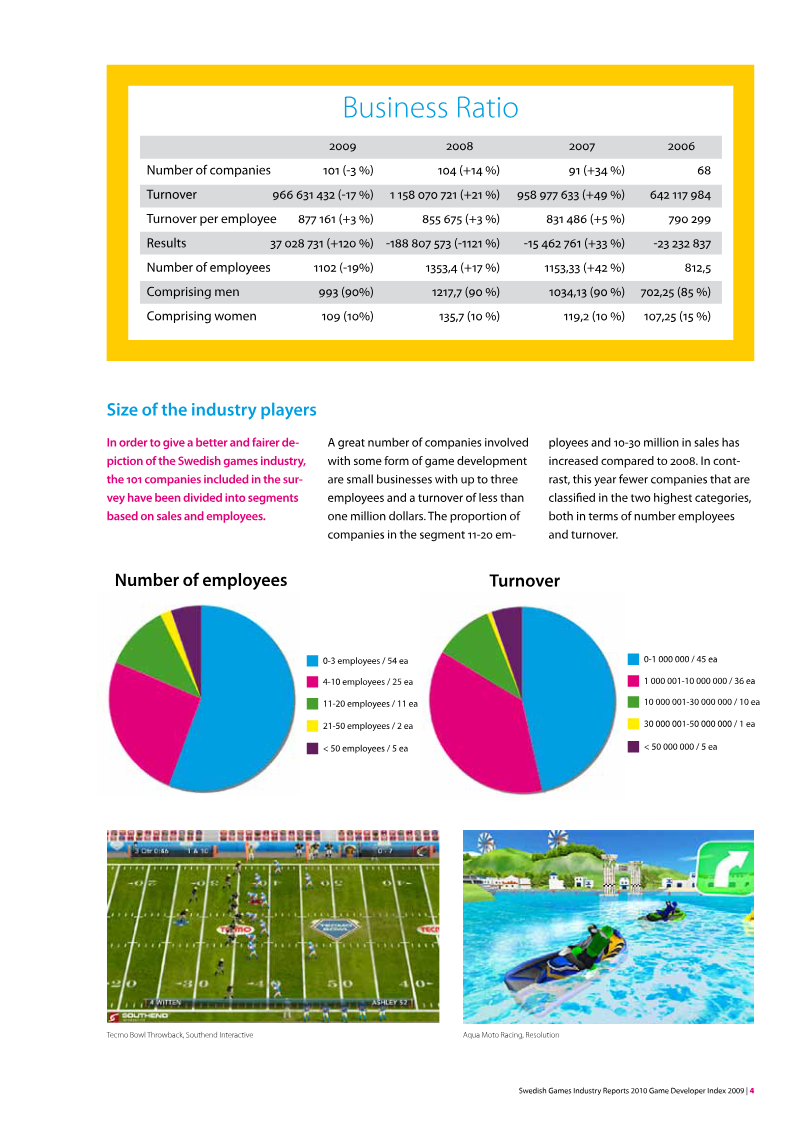
The Game Developer Index 2009 provides a comprehensive financial and operational overview of the Swedish game development industry.
- The Swedish game industry experienced a 19 percent decline in employment and a 17 percent decrease in total turnover during 2009 due to the broader economic downturn.
- The sector is highly concentrated, with the five largest companies accounting for over 60 percent of both total industry employment and total turnover.
- Despite the overall revenue decline, the industry improved its operational efficiency, marking the third consecutive year of rising turnover per employee.



CESA Game Development Technology Roadmap: 2009
The 2009 CESA Game Development Technology Roadmap serves as a strategic guide for industry professionals, researchers, and students to navigate the evolving landscape of game production.
- The industry is shifting toward automated, scalable development systems, emphasizing the integration of sophisticated asset management and automated testing to increase productivity.
- Programming efforts are prioritizing multi-core optimization and the adoption of higher-level languages to handle increasing technical complexity.
- Visual arts production is transitioning toward procedural generation, physical simulation, and real-time rendering techniques.
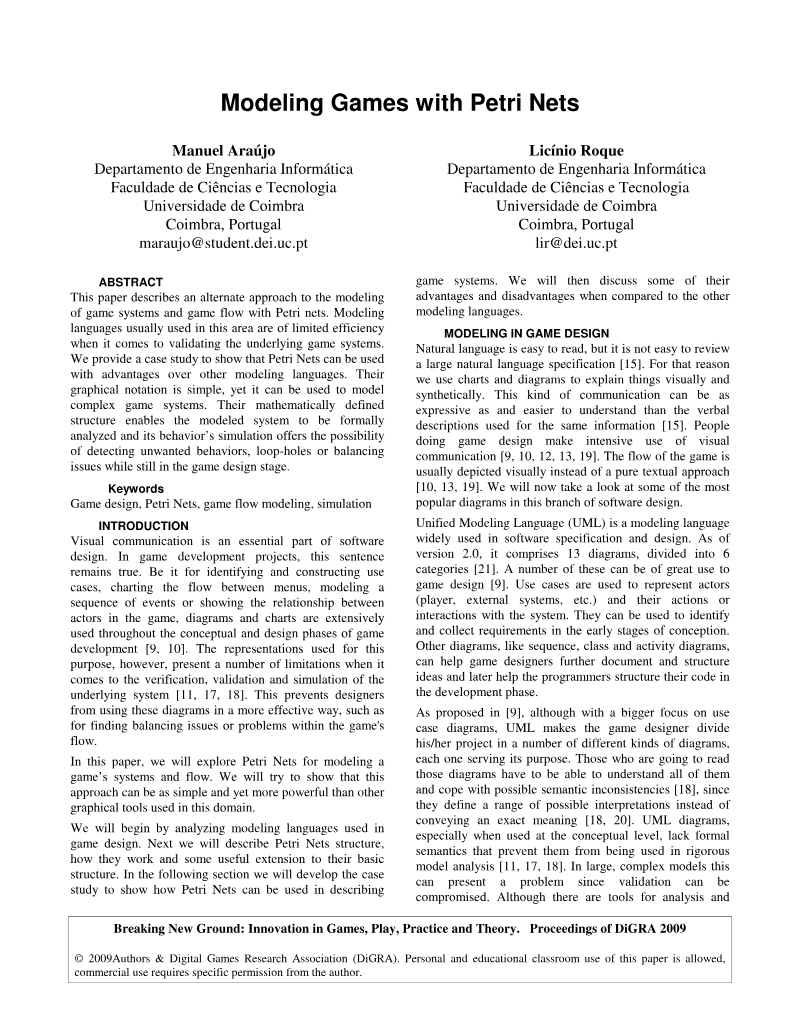
Modeling Games with Petri Nets
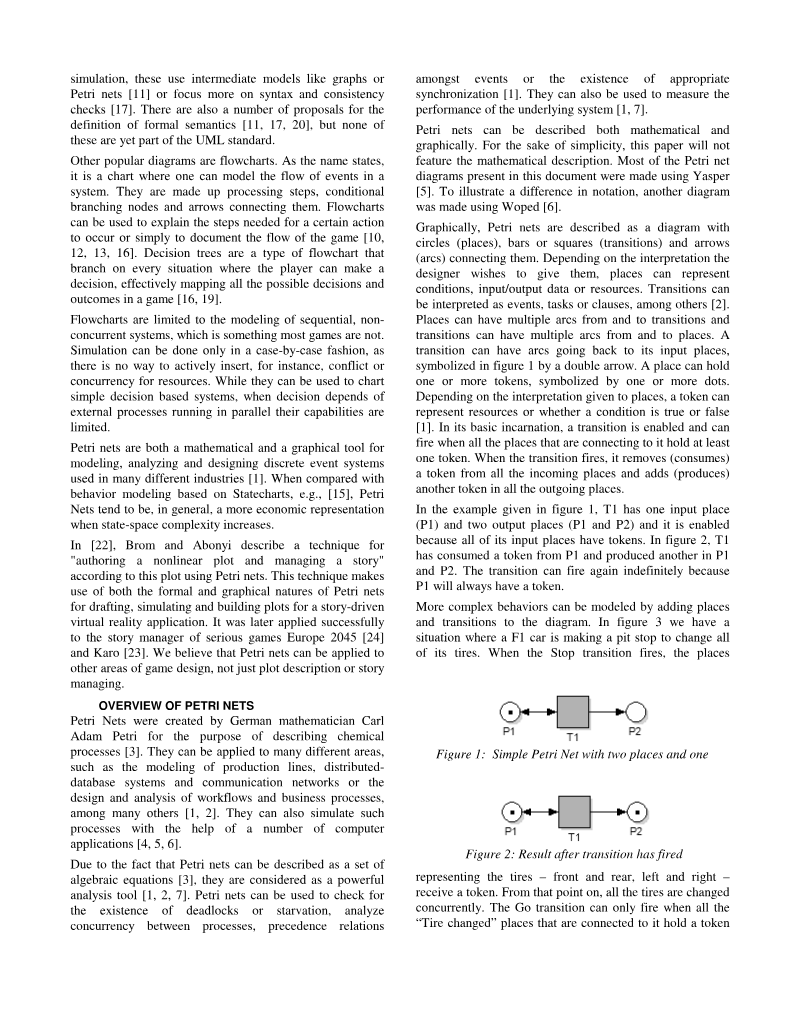
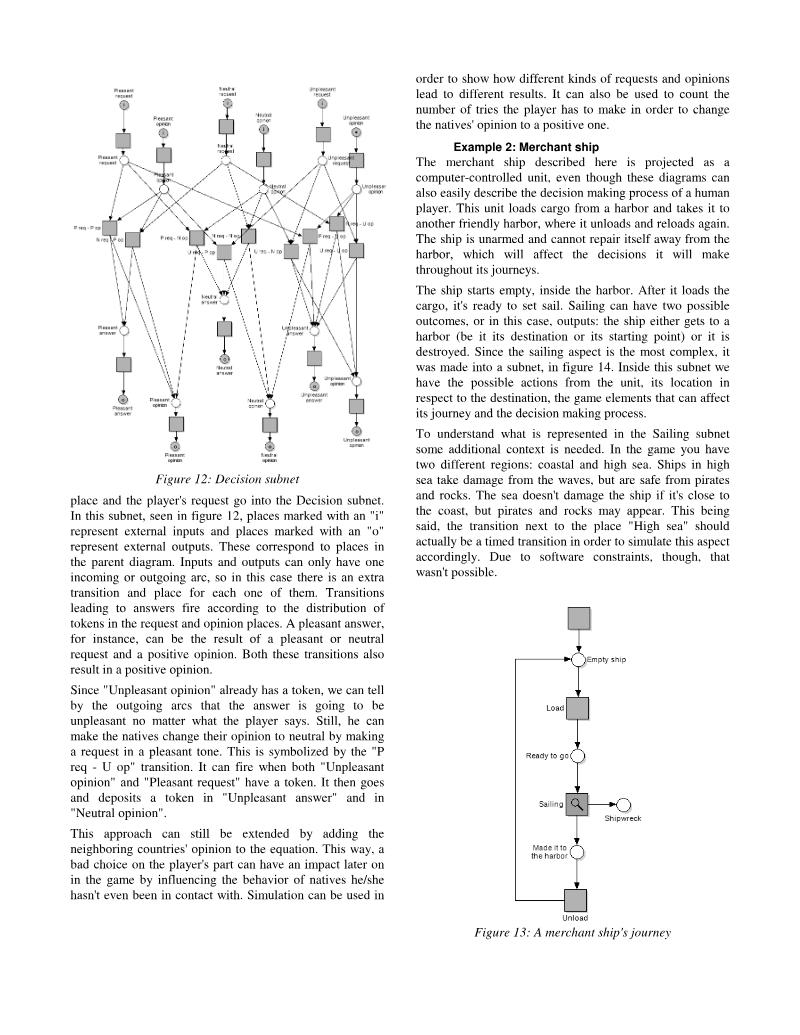
This paper argues that Petri nets offer a viable and in some respects superior alternative to conventional UML and flowchart notations for modeling game systems and game flow, particularly where concurrency, conflict, and resource management are involved.
- Petri nets are argued to be a viable and in some respects superior alternative to UML and flowchart notations for modeling game systems and game flow, especially where concurrency, conflict, and resource management are involved.
- Most common game-design visual notations lack formal semantics, so they cannot be rigorously validated or simulated, allowing unwanted behaviors, balancing problems, and loopholes to go undetected until playtesting.
- Petri nets pair a simple graphical notation with a mathematically defined structure that supports formal analysis for deadlocks, starvation, and precedence, as well as simulation during the design stage.
Collusion: Mapping the Interplay Between Paid and Unpaid Labourers in the Digital Games Industry
Julian Kücklich's paper argues that digital game production can be understood as a game itself, played among heterogeneous actors on a distributed playing field that spans both real and virtual spaces.
- Digital game production is framed as a game in itself, played among heterogeneous actors across both real and virtual spaces, with developers, publishers, and players treated as contingent players rather than passive prosumers or audiences.
- The central conflict is a struggle between 'luditude' and the imperial power of gaming capital over who writes the rules of games production and who is able to break them.
- Power over rule-setting is unevenly distributed: peripheral actors, such as workers in manufacturing plants building games console components, have little capacity to negotiate the rules governing them, while central actors can shape rule sets to their advantage.
Some Assembly Required: Starting and Growing a Game Lab
This DiGRA 2009 panel document examines how game labs can be established, operated, and grown, drawing on four case studies of labs situated in diverse institutional contexts.
- A game lab is presented as a valuable research resource that serves as a venue for interdisciplinary collaboration, a site for studying games in culture, and an environment for experimental game development and design innovation.
- The report's central recurring theme is the value of integrating theory and practice, with the Experimental Game Lab at Georgia Tech blending critical theory with practice and a 'critical play' orientation.
- Four labs were profiled: Georgia Tech's Experimental Game Lab, Tiltfactor (founded 2005 as one of the first US game research labs, known for Darfur Is Dying and Hush), the USC Electronic Arts Game Innovation Lab, and the Singapore-MIT GAMBIT Game Lab (developer of Grow-a-Game and VEXATA).
Morphology of the Tetromino-Stacking Game: The Design Evolution of Tetris
This essay offers a design-historical study of Tetris, the tetromino-stacking puzzle game invented in 1985, tracing how its mechanics have evolved while its core algorithm has remained essentially constant.
- The essay argues Tetris's ongoing coherent evolution comes from a tension between authoritative control (institutional standardization of rules) and experimental freedom (an extensive unofficial lineage of clones, variants, and training tools).
- The study restricts its analysis to implementations that faithfully reproduce the original algorithm, treating Tetris as a canonical form comparable to chess, Go, and mancala, even though its core algorithm has remained essentially constant since its 1985 invention.
- Two parallel histories are traced: the official trajectory, including the formation of the Tetris Holding IP licensing entity, adoption of the official Tetris Guideline, and expansion onto mobile and web platforms, and an unofficial history of hundreds of free clones and variants.
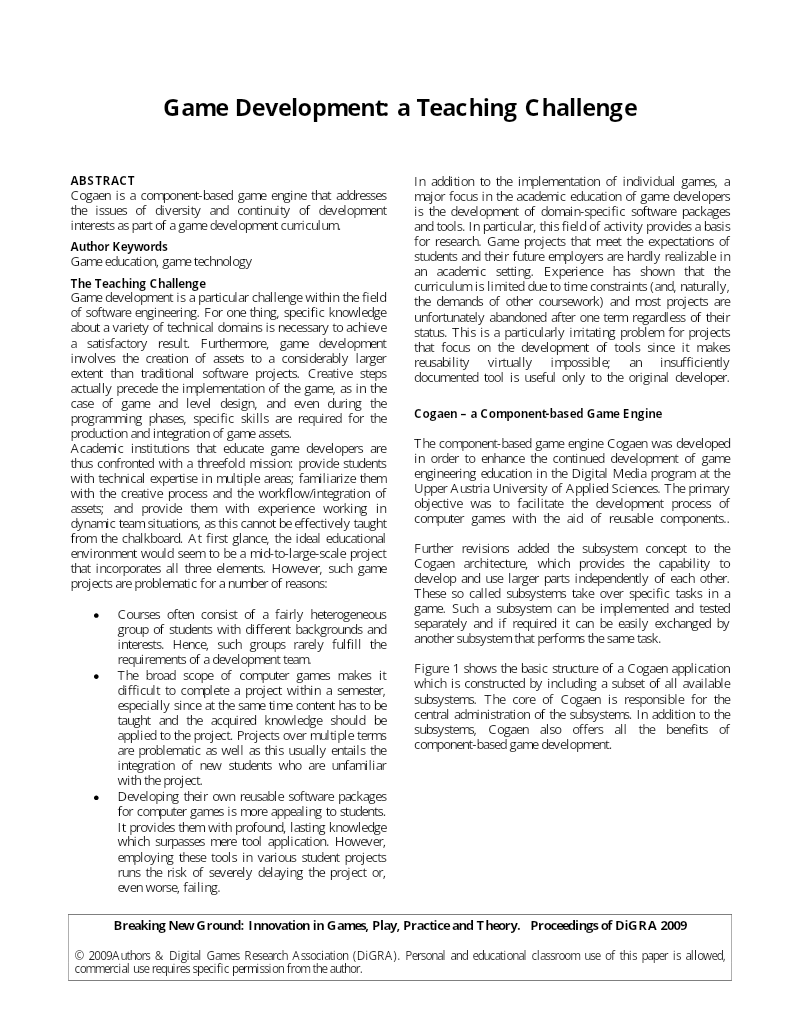
Game Development: A Teaching Challenge
The document examines the pedagogical difficulties of teaching game development in academic settings and proposes a component-based game engine, Cogaen, as a partial solution.
- Academic game development programs face a threefold mission: teaching technical expertise across multiple domains, familiarizing students with the creative process and asset workflows, and providing experience in collaborative team environments.
- Delivering this mission through a single mid-to-large-scale student project is problematic because course groups are heterogeneous in background, the breadth of game development rarely fits one semester, and multi-term projects suffer continuity problems as new students join.
- Student projects, especially tool-development projects, are often abandoned after one term, which makes their reuse nearly impossible.
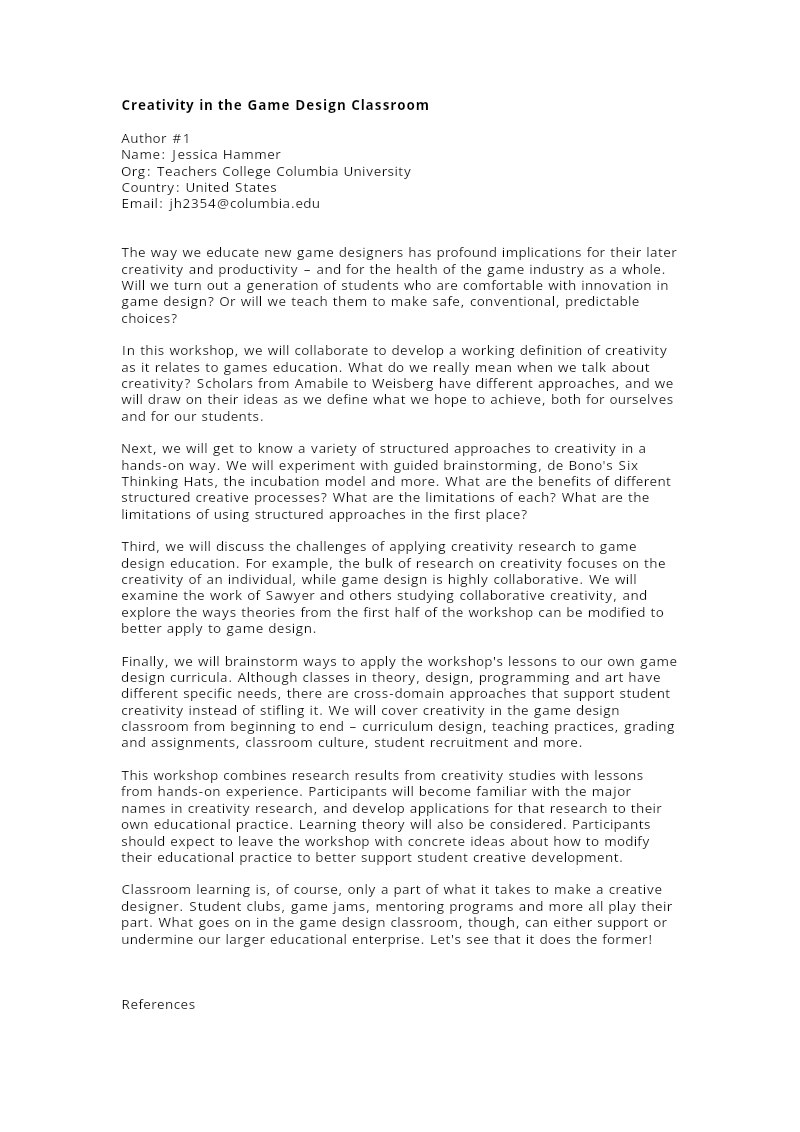
Creativity in the Game Design Classroom
This document is a workshop proposal by Jessica Hammer of Teachers College, Columbia University, addressing how creativity should be taught and supported in game design education.
- The central thesis is that how game designers are educated has lasting consequences for their creative capacity and, by extension, the health of the game industry, with the key question being whether graduates are prepared for innovation or default to safe, conventional choices.
- A significant challenge identified is that most creativity research focuses on individual creators, whereas game design is highly collaborative, requiring existing theories to be adapted using research on group creativity.
- Formal classroom instruction is only one component of developing creative designers, alongside student clubs, game jams, and mentoring programs, but classroom practice can either reinforce or undermine these broader efforts.