1 free read left. Create a free account for unlimited reading + AI research.
Create free accountWhitepaper DiGRA
1 free read left. Create a free account for unlimited reading + AI research.
Create free accountWhitepaperDiGRA
Game development programs aim to teach technical expertise across multiple domains, the creative process and asset workflows, and experience in collaborative team environments.
The document examines the pedagogical difficulties of teaching game development in academic settings and proposes a component-based game engine, Cogaen, as a partial solution. Its central thesis is that academic institutions training game developers face a threefold mission: giving students technical expertise across multiple domains, familiarizing them with the creative process and asset workflows, and providing experience in collaborative team environments. The authors argue that realizing this through a single mid-to-large-scale student project is problematic, because course groups are often heterogeneous in background, the breadth of game development rarely fits within a single semester, and projects spanning multiple terms suffer from continuity problems as new students join.
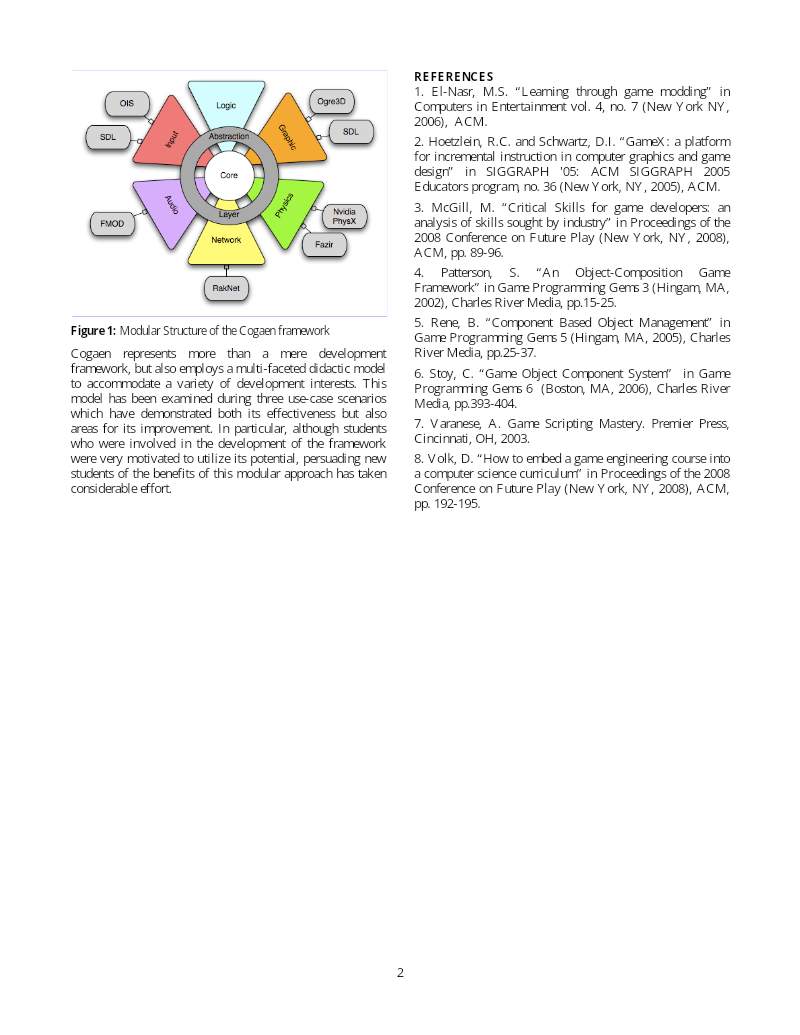
The work identifies a recurring pattern in which student projects, and especially tool-development projects, are abandoned after one term, which makes reusability nearly impossible. Cogaen was developed at the Upper Austria University of Applied Sciences within its Digital Media program to address this, using reusable, component-based architecture and later a subsystem concept that allows larger components to be developed, tested, and exchanged independently. The authors report that the framework was examined across three use-case scenarios, which demonstrated both its effectiveness and areas needing improvement. Students involved in building the framework were highly motivated, though persuading newer students of the benefits of the modular approach required considerable effort.
The paper was presented at the DiGRA 2009 proceedings, and its supporting literature draws on work concerning game modding, incremental instruction in graphics and game design, industry-sought skills, and component-based object management in game programming.
DiGRA · 2016
DiGRA · 2016
DiGRA · 2016
DiGRA · 2016
DiGRA · 2016
DiGRA · 2016
DiGRA · 2016
DiGRA · 2016
DiGRA · 2016
DiGRA · 2016
DiGRA · 2016
DiGRA · 2016