Game Development reports and market data
Documents
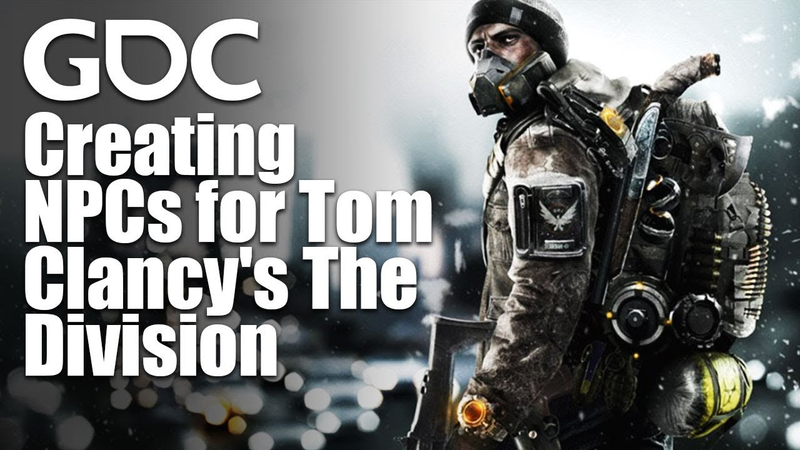
Blending Autonomy and Control: Creating NPCs for Tom Clancy's The Division
The development of artificial intelligence for Tom Clancy’s The Division centers on the integration of server-side behavior trees within the proprietary Snowdrop engine to create a dynamic, tactical combat experience.
- The Division features 36 unique combat AI variations categorized into 11 distinct archetypes, designed to create 'combat puzzles' where enemies synergize their skills to force specific player tactics.
- NPC behavior is built on a modular, priority-based system that evaluates critical events (like grenades or status effects) before executing scripted level-design orders or dynamic objectives.
- The AI detection system utilizes five alert levels—ranging from idle to combat investigation—governed by audio and visual stimuli defined by specific archetype vision cones.
Becoming a Game Developer... (5 Days in 1 Video!)
The pursuit of a career in game development requires a rigorous, multifaceted daily routine that balances academic coursework, independent project iteration, and content creation.
- Professional game development requires a rigorous, multifaceted daily routine that balances academic coursework, independent project iteration, and content creation.
- Success in the industry relies on disciplined time management and the use of organizational tools to maintain productivity across multiple concurrent projects.
- The development lifecycle is defined by a constant cycle of experimentation, where broad ideas are narrowed through iterative testing to identify viable prototypes.
Super Producers: Build Your Leadership and Make Great Games
Effective game production leadership centers on the producer’s role as a facilitator whose primary objective is to empower teams and ensure the delivery of high-quality products.
- Producers must transition from administrative scheduling to strategic leadership by empowering specialists rather than usurping their authority.
- Operational excellence requires transforming meetings into actionable outcomes and addressing conflicts directly to maintain a consistent shipping mentality.
- Project success depends on maintaining a clear, transparent balance between the three core constraints of time, resources, and quality.

The Portal Locomotion of Budget Cuts
The development of the portal-based locomotion system for the virtual reality stealth game Budget Cuts focused on solving the inherent challenges of VR movement, specifically motion sickness, navigation predictability, and gameplay pacing.
- The Budget Cuts locomotion system uses a physical translocator beacon to naturally constrain movement speed and distance, avoiding the disorientation associated with traditional point-and-click teleportation.
- To mitigate motion sickness, the game employs a portal window that previews the destination and uses spherical linear interpolation (slerp) to provide a smooth, consistent transition regardless of player head orientation.
- The team optimized performance by replacing resource-heavy render-target techniques with Z-buffer manipulation, which renders only the necessary geometry within the portal to reduce GPU load.
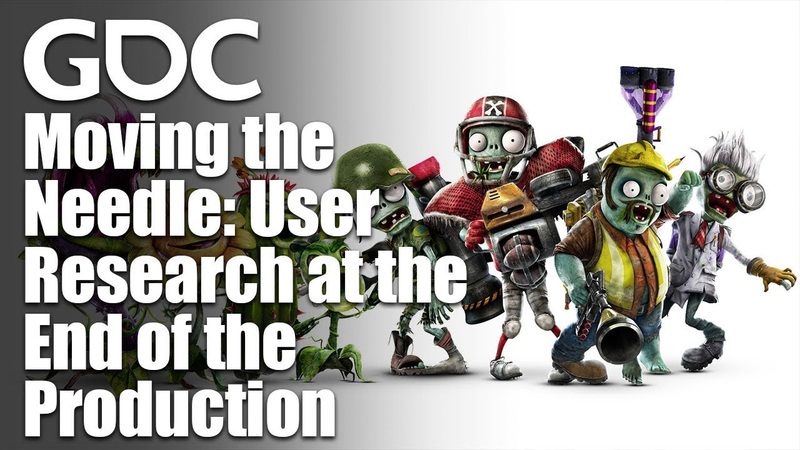
Moving the Needle: User Research at the End of the Production Cycle
User research remains a critical component of game development even during the final stages of production, when core mechanics are finalized and the project is committed to its primary design.
- Late-stage user research shifts focus from radical design changes to fine-tuning balance, progression, and polish to elevate a game's quality before launch.
- Development teams should transition from qualitative think-aloud sessions to quantitative metrics and telemetry during the final production phase to identify specific performance weak spots.
- During the final six months of Plants vs. Zombies Garden Warfare production, researchers used mixed-method studies with 24 to 48 participants per session to optimize map design and character balance.

Wolfenstein vs Call of Duty - The Need for “B” Games - Extra Credits
The gaming industry faces a significant disparity in how mainstream titles address sensitive historical and political themes.
- High-budget AAA franchises like Call of Duty often sanitize sensitive historical events, such as the Holocaust, to maintain broad appeal and avoid controversy.
- The 'B-game' model, exemplified by titles like Wolfenstein II: The New Colossus, uses lower budgets and reduced corporate oversight to explore transgressive themes like fascism and racism.
- B-games function similarly to historical B-movies by operating on the industry fringes to push boundaries in political discourse and violence that mainstream productions currently avoid.

Killer Portfolio or Portfolio Killer 2018: Advice from Industry Artists
The primary objective for aspiring game artists is to curate a portfolio that prioritizes exceptional quality over volume.
- Prioritize exceptional quality over volume by showcasing original work that highlights a specific specialization rather than mimicking industry trends.
- Demonstrate technical proficiency directly within game engines to prove an ability to function within a production pipeline, prioritizing mastery of core concepts like physically based rendering and real-time shaders over specific software packages.
- Tailor portfolios to specific roles, as recruiters prioritize candidates who demonstrate a distinct artistic voice and the ability to solve complex technical problems.

It IS Rocket Science! The Physics of Rocket League Detailed
The development of Rocket League centers on achieving a highly deterministic and responsive physics environment, prioritizing competitive integrity over hyper-realistic simulation.
- Rocket League achieves competitive integrity by utilizing the open-source Bullet physics engine running at a fixed 120Hz tick rate to ensure a deterministic simulation environment.
- The game prioritizes responsiveness over hyper-realism by using simplified, designer-controlled acceleration curves and custom lateral friction systems rather than modeling complex real-world mechanics.
- To eliminate lag-related penalties, the architecture uses client-side prediction that simulates the entire physics scene, relying on a reconciliation process that reruns physics frames to maintain server authority.

Nuts and Bolts: Modular AI From the Ground Up
Modular artificial intelligence architecture prioritizes the creation of small, reusable, and loosely coupled components to enhance code stability and streamline development workflows.
- Modular AI architecture improves stability and development efficiency by decomposing complex systems into small, reusable, and loosely coupled components.
- AI logic should be strictly separated into three functional areas: sensing (translating raw data to world state), deciding (triggering behaviors), and acting (executing behaviors).
- Using polymorphism and factory patterns allows modular components to function across diverse architectures, including finite state machines and hierarchical task networks.

How to Make a Viral Game! - Game Development: VLOG
The primary objective of this analysis is to define the strategic design principles required to achieve viral success in the video game industry.
- Virality is defined by the breadth of public awareness, distinct from popularity, which is measured by the number of active players.
- Design for virality by prioritizing four pillars: memorability, watchability, attention-grabbing aesthetics, and shareability.
- To maximize watchability for streamers and influencers, incorporate unpredictable gameplay elements and pattern breaks that keep audiences engaged.
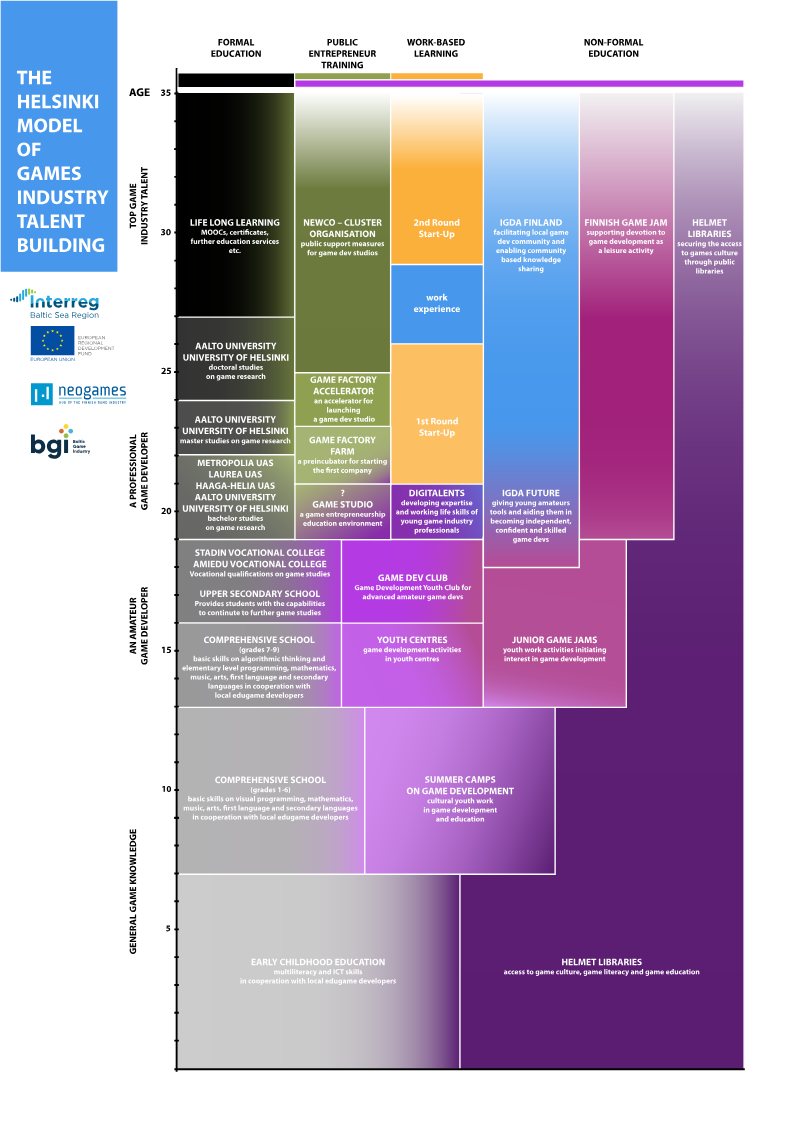
The Helsinki Model of Games Industry Talent Building
The Helsinki Model outlines a comprehensive, multi-stage talent development framework for the games industry, spanning from early childhood education through professional acceleration.
- The Helsinki Model creates a lifelong educational pipeline for game development that spans from early childhood literacy programs to doctoral research.
- The ecosystem relies on formal integration between academic institutions like Aalto University and the University of Helsinki and industry-focused infrastructure such as the Game Factory accelerator.
- Public-private collaboration between local government, educational bodies, and industry stakeholders is the foundational mechanism for sustaining the region's game development culture.
Concept Art is Dead
The evolution of AAA game development has fundamentally shifted the role of the concept artist from a traditional illustrator to a technical designer.
- The role of the concept artist has shifted from traditional illustration to technical design, requiring a workflow centered on 3D modeling, photo-bashing, and the use of pre-made asset libraries to meet AAA production demands.
- Modern concept art is defined as a disciplined problem-solving exercise rather than pure aesthetic expression, where artists must navigate project constraints to provide story-driven visual solutions.
- Technical proficiency is essential for high-fidelity, cinematic production, though traditional drawing and shape design skills remain necessary for stylized or cartoony projects.