1 free read left. Create a free account for unlimited reading + AI research.
Create free account
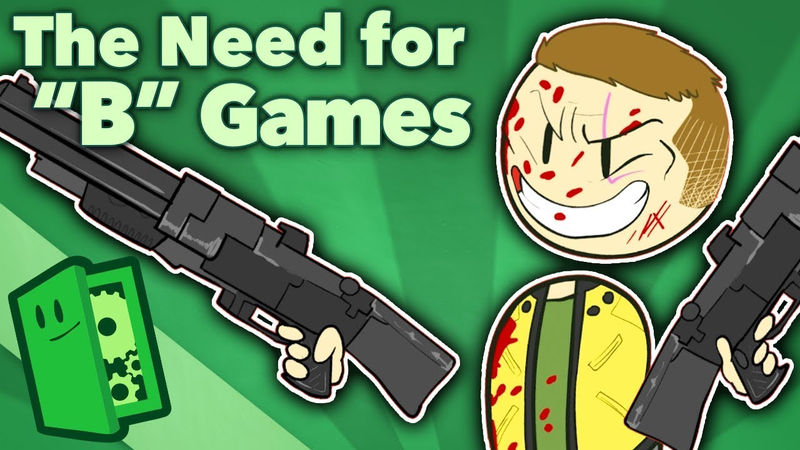
Wolfenstein vs Call of Duty - The Need for “B” Games - Extra Credits
Key insights
5 takeaways- 01High-budget AAA franchises like Call of Duty often sanitize sensitive historical events, such as the Holocaust, to maintain broad appeal and avoid controversy.
- 02B-games function similarly to historical B-movies by operating on the industry fringes to push boundaries in political discourse and violence that mainstream productions currently avoid.
- 03The 'B-game' model, exemplified by titles like Wolfenstein II: The New Colossus, uses lower budgets and reduced corporate oversight to explore transgressive themes like fascism and racism.
- 04By normalizing difficult conversations, B-games serve as a catalyst for industry maturation, potentially enabling future AAA titles to address complex social issues with greater sincerity.
- 05While B-games like Wolfenstein II may still rely on stereotypical tropes, their earnest approach allows for a more direct critique of authoritarianism than risk-averse, polished mainstream titles.
Ask AI about this video
Transcript
Just to start, I would like to commend Call of Duty World War II for including a concentration camp. For the first time, this major AAA franchise has done the World War II setting and actually depicted a part of the Holocaust. The problem is, it is a whitewashed sanitized depiction that comes and goes without really making an impact. It's more than a little frustrating that even in a series which shows a thousand horrific ways for a soldier to die, we are still shying away from perhaps the most horrific part of World War II. This is not the case in Wolfenstein. This video is brought to you by Cheddar. Check the description for a link to their new YouTube channel. Playing these two games back to back, I quickly realized something. Call of Duty is one of the biggest budget World War II epics ever made, and Wolfenstein II is over-the-top schlock. But only one of them actually has the guts to talk about Nazis and Nazism. Only one of them is
really willing to portray the evil found in that regime, and only one of them portrays the dangers of fascism, racism, and unfettered nationalism. And let me tell you, it's not the game that's, quote, historical. Call of Duty goes to great lengths to make sure that every gun looks authentic and every uniform looks accurate. But when it comes time to depict the Holocaust, it only shows us an empty concentration camp, devoid of any of the impact of something like that famous scene in Band of Brothers where they liberate part of Dachau. Wolfenstein, meanwhile, a spin-off of a series that originally had you fighting Robo Hitler, by the way, makes no bones about kicking things off with a racist dropping the N-word while talking about foreigners taking white jobs, as well as addressing the homophobia within the Nazi regime, talking frankly about the horrors and the genocide perpetrated by the Nazis, and even showing a totally emasculated and pathetic Hitler designed for ridicule and contempt. Why? Because Wolfenstein is a B game in the same way
that B movies are B movies. B movies, for those who don't know, originated as the low-budget second half of double features in American movie houses, but they quickly evolved into something fundamentally different from mainstream cinema. Because of their lower budget and the fact that they were made outside or at best on the fringes of the Hollywood studio system, these films had a lot less oversight. There was no one really telling these filmmakers what could and could not be done. And because of that, these movies became this hotbed for weird transgressive ideas. They pushed the boundaries of cinema, and they often did this simply to appeal to that more primal part of us that the big studios found unsavory, continuously pushing the level of sex and violence in film. But in doing so, the best of them also pushed what film could say. The best of these films, such as Body Snatchers and Dawn of the Dead, used all of those titillating features to keep an audience riveted while at the same time
commenting on the society that audience lived in. And it's important to note that these B films were fundamentally different than what we would today call independent films. Both of them may be low-budget outsider affairs, but B movies weren't aimed at the highbrow arthouse audience, and they weren't going to be relegated to those few dozen theaters that showed avant-garde pieces that made you think. B movies were films for the average Joe. The folks making these genuinely loved big-budget films. They wanted to be big-budget directors. Many of them didn't really think of themselves as being different from a big-budget filmmaker, and many of them didn't realize they weren't working on big-budget pictures because, well, a lot of them just weren't very good filmmakers. But that's important because it also meant that most of the folks working on these things didn't have a solid grounding in conventional industry wisdom. And as such, they didn't know what not to do. By breaking Hollywood taboos while still appealing to a mainstream audience, these schlock filmmakers started to expand what the
mainstream found acceptable. It's partially thanks to these B films that the Hays Code began to crumble, and levels of sex and violence that would have been shocking to a '50s audience started to become widely adopted in the Hollywood space. But, it wasn't just the titillation that crossed over. In addition to depicting more sex and violence, mainstream releases also started actually exploring topics like the Holocaust and questioning the wisdom of massive nuclear armament. Topics that had once been considered too political or too sensitive for most major studio films started to become acceptable. Without question, this new incarnation of the Wolfenstein franchise is part of this B tradition. It's over the top, it's ultra-violent, it's pushing all of the buttons it can. It's built on a lower budget than the really big AAA titles out there, but not so small a budget that it feels like it belongs in the indie space. It still feels like it's trying to appeal to that same broad AAA audience that Call of Duty sells to.
And the Wolfenstein games may lack some of that AAA polish, they may not have that same bottomless budget or infinite oversight of a top-tier AAA team, but there is a clear love of the medium behind all of those minor flaws. And most of all, Wolfenstein is ardently transgressive and in your face. Wolfenstein II: The New Colossus is perhaps the most frank indictment of Nazism, racism, and bigotry that I have ever seen in a mainstream game. It does not pull any punches, and it is not afraid to indict us for trading democracy for race hate. And that got me thinking about B games in general. Wolfenstein isn't bringing the conversation about these topics that we ultimately need to have, but maybe it's presenting the conversation we can have right now. Maybe it's the games like this that will unlock that door. That'll get us as an audience and a medium to have a surface level conversation about topics that before this seemed forbidden. And right now, even that surface level conversation is so
important. Maybe it is games like these that'll get us comfortable as a community and as developers talking about such things, paving the way for a true mega budget AAA game that really acknowledges the concentration camps, talks about the horrors of Nazism and of embracing an authoritarian nationalist regime. Wolfenstein is not perfect by any means. There is a lot wrong with it. It opens by using the abuse of women as a tool to tell you that the bad guys are bad. It has a Jewish character who rides the line of being a stereotype. But, the game is earnest. And maybe at the end of the day, it's that B-movie sincerity that matters. We'll see you next time. This episode was brought to you by Cheddar, a recently launched YouTube channel with videos that cover business, technology, media, and news, but without the boring parts. They recently released a video about how Pokémon Go changed tech company Niantic's whole trajectory, which seemed like something y'all might be into. And if you like, subscribe to their channel and check out more of their stuff. Tell them Extra Credits
sent you.
Summary
The gaming industry faces a significant disparity in how mainstream titles address sensitive historical and political themes. While high-budget AAA franchises like Call of Duty often prioritize historical aesthetic accuracy, they frequently sanitize or avoid the most harrowing aspects of their subject matter, such as the Holocaust. In contrast, titles like Wolfenstein II: The New Colossus utilize a "B-game" approach—characterized by lower budgets, over-the-top violence, and a lack of corporate oversight—to engage in frank, transgressive critiques of fascism, racism, and bigotry.
This phenomenon mirrors the historical role of B-movies in cinema, which operated on the fringes of the studio system. By bypassing conventional industry wisdom and avoiding the pressure to appeal to highbrow sensibilities, these films pushed boundaries regarding sex, violence, and political discourse. Over time, these transgressive elements permeated mainstream cinema, gradually expanding the range of acceptable topics for large-scale productions. B-games occupy a similar space, serving as a bridge that allows developers to explore complex social issues while still appealing to a broad, mainstream audience.
Although Wolfenstein II is not without its own flaws, such as the use of stereotypical tropes or problematic narrative devices, its earnestness allows it to address the dangers of authoritarianism in ways that more polished, risk-averse AAA titles currently avoid. By normalizing these difficult conversations, B-games act as a catalyst for the industry, potentially paving the way for future mega-budget titles to tackle historical atrocities and political ideologies with greater depth and sincerity. Ultimately, the B-game model provides a necessary, albeit imperfect, platform for the medium to mature and confront the realities of the world it depicts.

















Comments