Esports statistics and market reports
Documents

2016 Global Esports Market Report: An Overview of the Esports Market & Its Valuable Audience
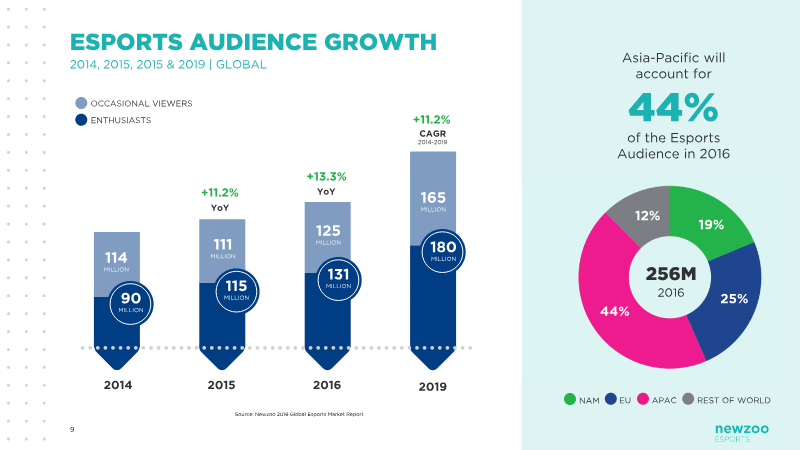
The 2016 Global Esports Market Report provides a comprehensive analysis of the burgeoning esports economy, identifying it as a transformative force in the video game industry.
- The global esports economy reached $325 million in 2015, with projections indicating continued rapid acceleration.
- The esports enthusiast audience grew by 13.3% year-over-year, signaling a shift in gaming from a personal activity to a spectator sport.
- Revenue per enthusiast is projected to rise from $2.20 in 2014 to $6.00 by 2019.
How big will eSports and mobile eSports be in 2016?
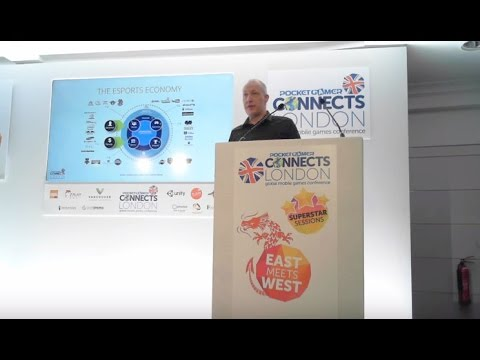
The global eSports market is experiencing rapid expansion, driven by a shift in consumer behavior where gaming has evolved from a solitary activity into a spectator-led entertainment ecosystem.
- The eSports market is projected to reach a billion-dollar valuation by 2019, growing from a current economic value of approximately $3.50 per fan.
- The industry is professionalizing through significant capital investment from traditional sports and media entities, including Turner and Madison Square Garden.
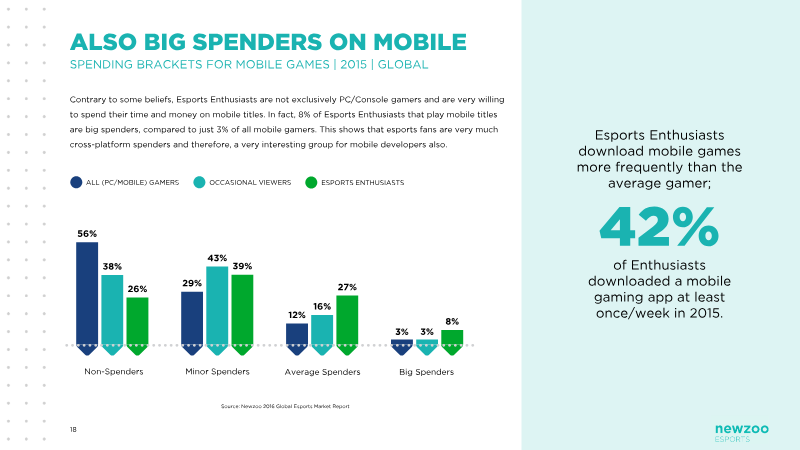
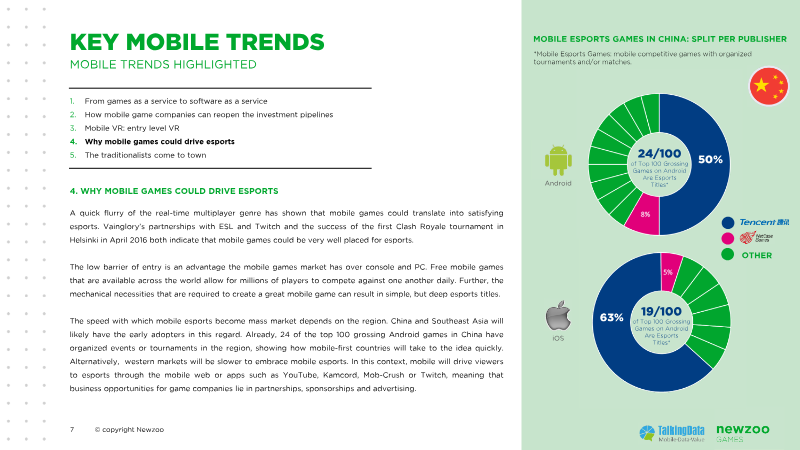
- Mobile eSports is a primary growth driver, as it facilitates seamless transitions between playing and spectating by integrating video content directly into game design.

LVP's Paul Heydon on investment, eSports, mobile MOBAs, and Europe's advantage
The mobile gaming investment landscape in 2016 is characterized by rapid growth, with mobile emerging as the fastest-expanding sector within the broader gaming industry.
- Europe is a net exporter of mobile gaming revenue, leveraging lower overhead costs and competitive salary structures compared to Silicon Valley to achieve superior capital efficiency and higher returns on investment.
- The mobile gaming sector is the fastest-expanding segment of the industry, driven by the successful monetization of mobile MOBAs like Clash Royale and the emergence of professional mobile eSports leagues for titles such as Vainglory.
- High-profile acquisitions, including the deals for Supercell and Activision-King, have validated the sector's profitability and are expected to fuel further reinvestment into game development.
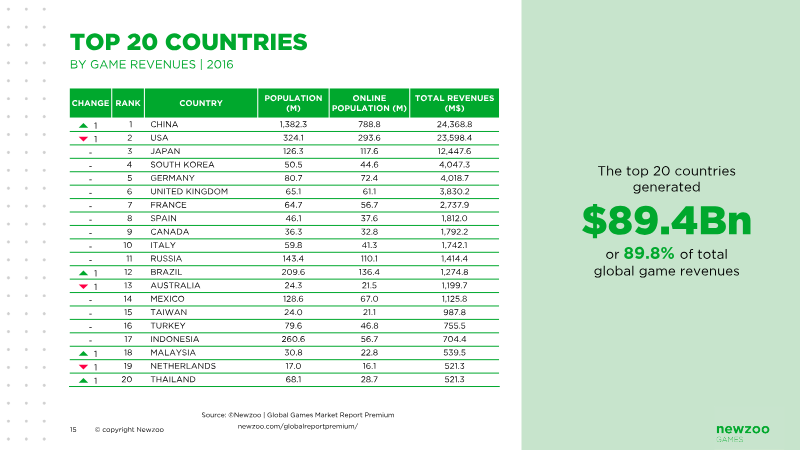

2016 Global Games Market Report: An Overview of Trends & Insights
The 2016 Global Games Market Report provides a comprehensive analysis of the international gaming landscape, offering revenue projections and trend forecasts for the 2015–2019 period.
- The global games market reached $99.6 billion in 2016, marking an 8.5% year-on-year growth rate.
- Mobile gaming is the primary industry driver, generating $36.9 billion in revenue and achieving a 21.3% year-on-year increase.
- The Asia-Pacific region is the dominant global market, accounting for 47% of total revenues with a 10.7% growth rate.

The most significant mobile gaming events in 2015
The mobile gaming landscape in 2015 was defined by significant industry consolidation, the rise of Eastern markets, and the strategic pivot of traditional console giants toward mobile platforms.
- Activision acquired King for $5.9 billion in 2015, signaling a major strategic shift by triple-A publishers to capture broader demographics and secure mobile gaming as a primary revenue stream.
- The global mobile gaming market saw a significant geographic shift as China, Korea, and Japan secured three of the top five global market positions, with Southeast Asia also showing rapid growth.
- Monetization models in 2015 matured by moving away from aggressive hard-currency tactics toward more balanced systems that integrate soft currency and advertisements.
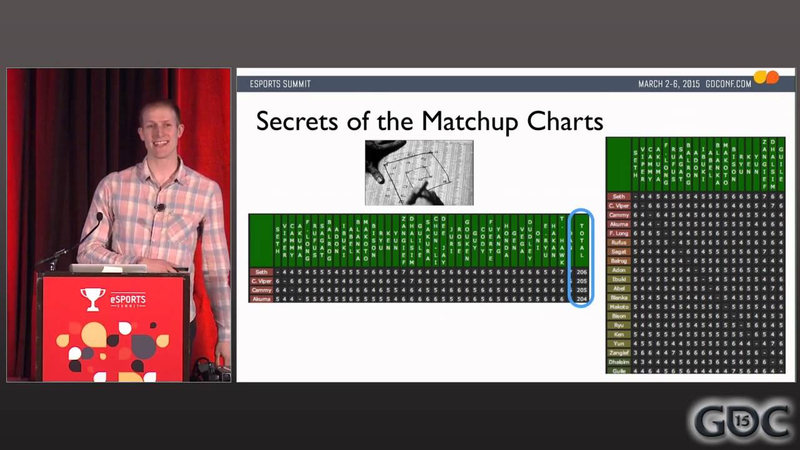
Metagame Balance For eSports & Fighting Games
Game balance in competitive titles, particularly fighting games, often suffers from a disconnect between developer data and player perception.
- Developers should shift from relying on simple win-rate averages to using game theory and linear programming to analyze character matchups as a matrix of win probabilities.
- By treating the meta-game as a formal 'selection game,' developers can calculate the theoretical bounds of character frequency to predict meta-game shifts before they occur in live environments.
- This methodology identifies three distinct categories of imbalance: characters that are always excluded, those that are sometimes dominant, and those that are always dominant.
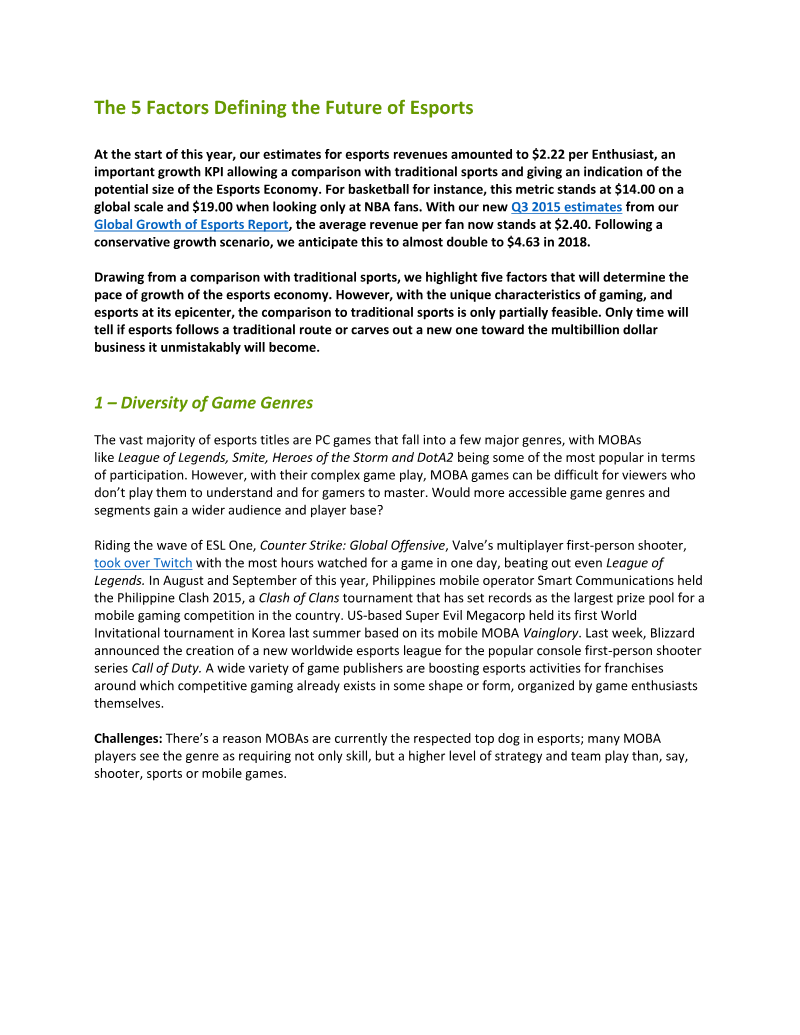
The 5 Factors Defining the Future of Esports
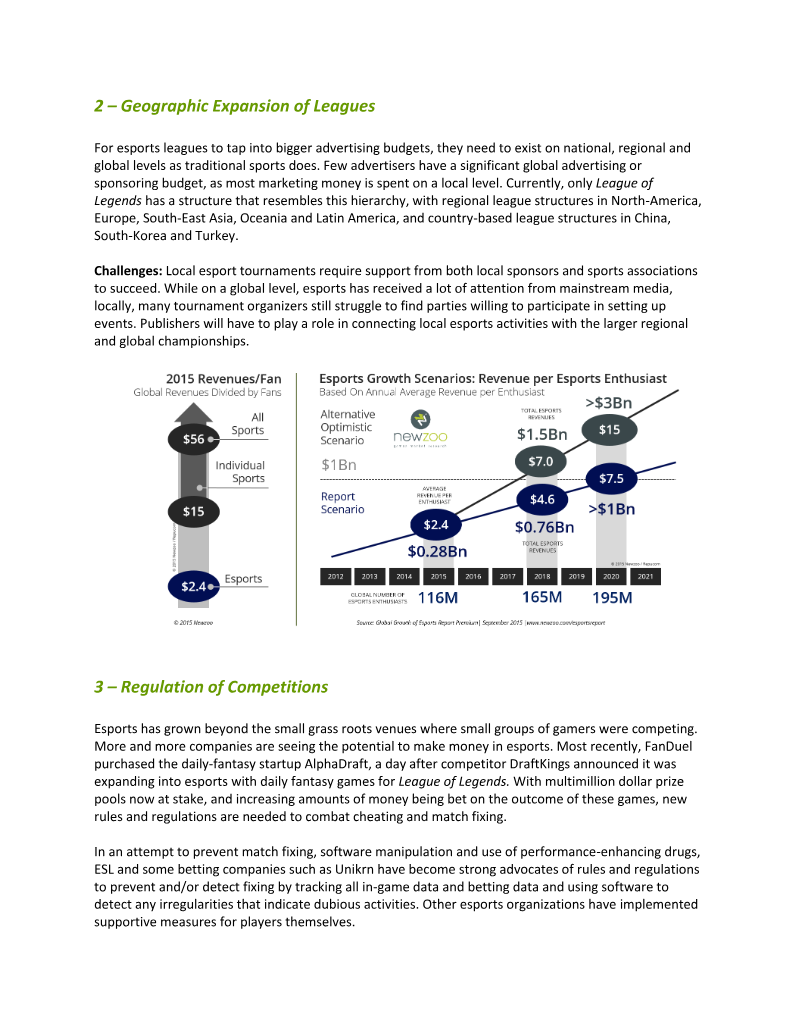
The esports industry is currently undergoing a rapid evolution, with revenue per enthusiast projected to grow from $2.40 in 2015 to $4.63 by 2018.
- Revenue per esports enthusiast is projected to nearly double, growing from $2.40 in 2015 to $4.63 by 2018.
- Esports operates under a unique ownership model where game publishers hold the intellectual property, necessitating a growth strategy distinct from traditional sports.
- The industry’s transition to a multibillion-dollar business is currently hindered by ambiguous media rights and a lack of standardized, globalized league hierarchies.

Biz Daily: Why Vainglory dev Super Evil raised $26 million
Super Evil Megacorp has secured $26 million in new funding to pivot its mobile MOBA, Vainglory, toward an eSports-centric business model.
- Super Evil Megacorp raised $26 million to pivot its mobile MOBA, Vainglory, toward an eSports-centric business model.
- The company is prioritizing long-term ecosystem growth and user acquisition over immediate monetization to establish a spectator-driven experience similar to League of Legends.
- The strategy focuses on the Asian market, specifically South Korea and China, to leverage established eSports cultures.

Biz Daily: Can Vainglory overcome the mobile MOBA curse?
Vainglory, a mobile multiplayer online battle arena (MOBA) developed by Super Evil Megacorp, represents a significant attempt to translate the complex, hardcore gameplay of PC-based MOBAs to mobile platforms.
- Super Evil Megacorp is positioning Vainglory as a mobile eSports title, using professional tournament partnerships in South Korea to establish the game as a competitive spectator sport.
- Vainglory reported 1.5 million monthly active players at the time of its Android launch, a figure the developer views as a strong foundation for a hardcore competitive title.
- To adapt the complex PC MOBA genre for mobile, the game utilizes a three-versus-three format with shorter session lengths to overcome touchscreen control limitations.
What's the point of the games media anyhow?
The role of games media in the modern digital landscape is defined by a shift from traditional gatekeeping to a diverse ecosystem of cultural analysis, community building, and specialized information sharing.
- Games media has evolved from a traditional gatekeeping role into a diverse ecosystem where professional journalism provides critical depth and authorial context that complements personality-driven influencer content.
- The media landscape is now segmented by audience demographics, with younger users favoring immediate, gameplay-focused video content while older, more engaged audiences prioritize the in-depth industry and cultural analysis found in established outlets.
- A multi-channel communication strategy is now essential for developers, utilizing social media for discovery, YouTube for community engagement, and traditional outlets for authoritative analysis.

Randomness in Esports - How Chance Affects Competitive Play - Extra Credits
The integration of randomness into competitive esports is often viewed as a threat to the integrity of skill-based play.
- Competitive integrity in esports is best maintained by shifting focus from individual match outcomes to aggregate performance over large sample sizes.
- Tournament structures such as round-robin or long-term league play are superior to single or double-elimination formats because they mitigate the impact of short-term variance.
- The concept of expected value, borrowed from professional poker, demonstrates that elite players distinguish themselves by consistently making statistically superior decisions over time rather than winning every individual instance.

Pro Gaming - What Esports Needs to Grow - Extra Credits
Professional gaming faces significant structural hurdles in establishing itself as a mainstream, long-term spectator sport, particularly in Western markets.
- The rapid obsolescence of video game titles prevents the development of stable, multi-generational professional ecosystems compared to traditional sports like baseball or chess.
- To achieve mass-market growth, the industry must shift design priorities to favor spectator-focused interfaces and broadcast tools that explain mechanics to casual observers.
- Professional gaming requires the cultivation of human narratives and athlete personalities to foster the emotional investment necessary for long-term cultural permanence.