Creative Ads reports and market data
Documents
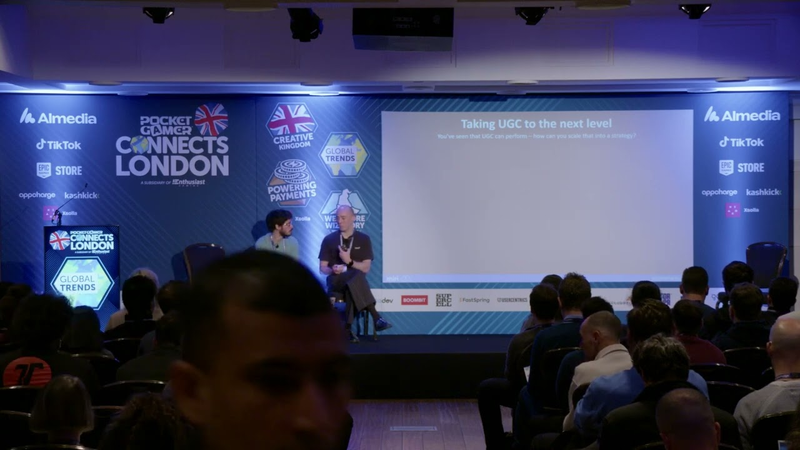
Fireside chat: How To Maximise Your Creative Win Rate - Zach van Driel & David Westerman.
Maximizing creative win rates in mobile game user acquisition requires a strategic balance between maintaining high-performing hero creatives and exploring new concepts to combat inevitable creative fatigue.
- Hero creatives typically experience performance degradation within four to eight weeks, necessitating a structured lifecycle management strategy to combat creative fatigue.
- When performance is strong, marketing teams should maintain a 40/60 ratio between exploring new creative concepts and iteratively testing existing winning assets.
- Underperforming creative sets should be addressed by pivoting toward competitor analysis or re-imagining past winners through different execution styles, such as shifting from gameplay to user-generated content (UGC).
Product trends for Mobile Games in 2025 by Jakub Remiar
The mobile gaming landscape in 2025 is defined by a strategic shift toward adapting proven PC and console mechanics into mobile-friendly formats.
- Mobile game developers are shifting from simple cloning to adapting core mechanics from successful PC and console titles like Palworld and Balatro, focusing on superior UI and sophisticated progression.
- Traditional casual genres such as solitaire and hidden object games are moving away from basic ad-driven models toward high-production, level-based structures with complex meta-game loops.
- Studios are integrating 'mini-game' advertisements directly into core gameplay to improve player retention and lower cost-per-install metrics in response to rising user acquisition costs.
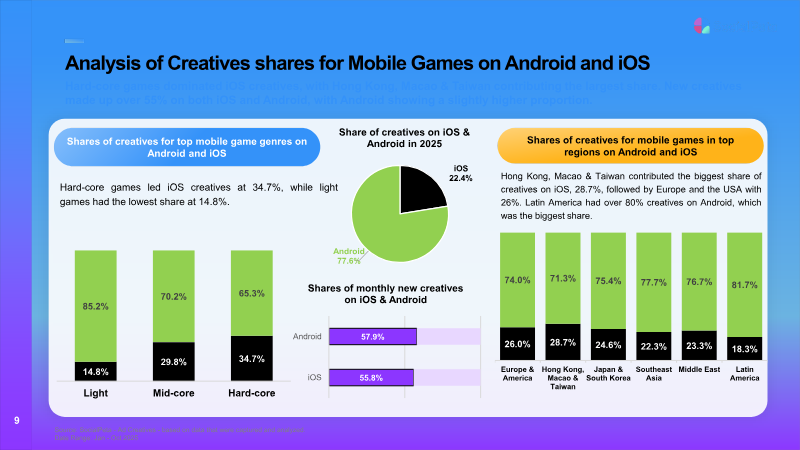
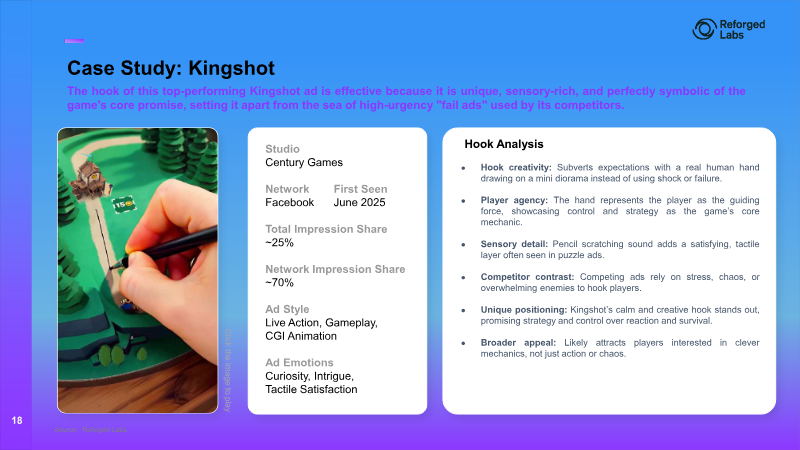

2025 Global Mobile Game Marketing Insights & Creative Breakdown
The 2025 Global Mobile Game Marketing Insights & Creative Breakdown provides a comprehensive analysis of the mobile advertising landscape, focusing on the evolution of ad creatives across more than 80 countries and 80 ad channels.
- Over 90% of mobile game advertisers now utilize AI to generate assets, marking a critical industry shift toward automation to combat rising competition.
- The average monthly creative volume per advertiser reached 123 in 2025, representing a 20% year-over-year increase, with new creatives accounting for 58% of total monthly output.
- Strategy games lead the industry in advertising intensity with 325 monthly creatives per advertiser, while Casino games prioritize the highest turnover with 65.6% of assets being new each month.

2.5 gamers x Live AM(F)A #7 - Ask Me Anything @ December 19 5:30pm CET
The mobile gaming industry is currently undergoing a structural shift, moving away from traditional store-dependent growth toward web-based platforms and Telegram mini-apps.
- The casual merge game market is currently dominated by Microfun and Moon Active, who have successfully scaled by maintaining high production quality and utilizing intrusive ad strategies that prioritize long-term retention over short-term revenue.
- For soft launches, the United States remains the primary testing ground; if a game fails to perform in the U.S. market, it is unlikely to succeed elsewhere.
- Consent Management Platform (CMP) implementation is critical for compliance, with paid solutions typically achieving 93–95% opt-in rates compared to 80–87% for free Google-based alternatives.

7 Habits of Incredibly Effective Gaming Jedis: Special Edition
Achieving long-term success in the gaming industry requires a strategic shift away from the constant pursuit of new titles toward the cultivation of sustainable growth and long-tail engagement.
- Long-term studio success requires shifting focus from constant new title development toward sustainable growth and long-tail engagement for existing intellectual property.
- Studios should balance creative vision with rigorous, data-driven operations, using data to enhance the player experience rather than dictate design decisions.
- In the 2025 mobile market, developers must implement hyper-segmentation and hybrid monetization models to maximize lifetime value.

Transforming UA Creatives Through AI (with Reforged Labs)
The mobile gaming industry is undergoing a fundamental shift in user acquisition strategy, moving away from manual, labor-intensive creative production toward automated, AI-driven experimentation.
- AI-driven creative engines are replacing manual production by deconstructing high-performing ads to generate large volumes of personalized video assets at scale.
- The integration of AI platforms has reduced the production cost of individual ad units to approximately $50, significantly lowering the barrier to entry for smaller studios.
- Reforged Labs and similar platforms are shifting the marketing professional's role from repetitive asset creation to high-level strategic optimization and data-backed validation.

Unlock Your Game's Next Level with TikTok
TikTok serves as a vital engine for mobile game growth, offering developers a strategic pathway to scale user acquisition and deepen player engagement.
- The 'Q5' period, spanning mid-December through January, offers a 13 percent reduction in cost-per-mille rates, providing a strategic window for cost-effective user acquisition.
- Utilizing TikTok's LiveOps tools, such as Smart Plus and value-based optimization, can increase in-app purchase spending by 1.6 times while simultaneously reducing acquisition costs by up to 28 percent.
- Developers should adopt a hybrid-casual model that integrates midcore mechanics and live events to extend product life cycles and improve long-term retention.
Creative trends in Mobile Games - October 2024
The mobile gaming industry is currently defined by a strategic shift toward aggressive, high-production advertising that prioritizes emotional engagement and viral tropes over accurate gameplay representation.
- Revenue performance in mobile gaming currently outweighs the importance of user reviews, as evidenced by games like Kingdom Guard maintaining high revenue despite user complaints about misleading ads.
- Creative strategies in mobile gaming are increasingly characterized by rapid iteration and the cross-pollination of mechanics, such as incorporating 'Idle Lumber' wood-stacking elements or 'Mob Control' style gameplay into diverse game genres.
- Successful ad creatives frequently utilize high-emotion hooks and 'micro-learning' narratives, such as text-heavy stories overlaid on stock footage, which are proving effective even for established titles like Subway Surfers.

Value Optimization, Hybridcasual, and the Impact of AI
The mobile gaming industry is undergoing a fundamental transition from a volume-based user acquisition model to a sophisticated, data-driven framework centered on long-term value optimization.
- The mobile gaming industry is shifting from volume-based user acquisition to long-term value optimization due to rising acquisition costs and increased market competition.
- Developers are transitioning from hyper-casual titles to hybrid models that combine in-app purchases and advertising to capture revenue from diverse player segments.
- Success in modern mobile ecosystems requires using custom events as proxies for long-term retention to navigate auction-based environments and extend optimization windows.

2.5 gamers x Live AM(F)A #6 - Ask Me Anything @ November 13 5:30pm CET
The mobile gaming industry is currently undergoing a strategic shift toward integrating ad-based gameplay directly into core loops, supported by cross-platform strategies designed to circumvent traditional store fees.
- Hybrid-casual games are increasingly adopting 'core gameplay' iterations, such as the 'hexa-sort' mechanic, which is proliferating across multiple titles and portfolios to drive UA performance.
- Publishers using AdMob mediation can increase banner revenue by integrating Pangle (which contributes 10–20% uplift) or Amazon (which contributes 15–35% uplift) to expand their total addressable market.
- For games with in-app purchase (IAP) revenue, publishers should segment payers to avoid showing interstitials or rewarded ads too early, ideally finding a 'sweet spot' for ad exposure by the third session or later to protect long-term LTV.

Comics to Games: Great Adaptations
Adapting comic book intellectual property into video games necessitates a rigorous synthesis of established fan expectations and interactive narrative design.
- Effective IP adaptation requires deep immersion in existing source material, including comics, scripts, show seasons, and fan wikis, to index key elements like powers, limitations, and locations.
- Collaboration between developers and IP holders should be an iterative discussion rather than a one-way request process, allowing for pushback and creative negotiation to find new opportunities.
- When adapting established characters like Spider-Man, developers must balance existing canon with the need for a unique, additive narrative that resonates with the audience's cultural understanding of the lore.

Capybara GO! Defining a new genre: Social Casino RPG! Another Mobile Sensation by Habby
Capybara GO! represents a strategic shift for Habby, establishing a new hybrid genre defined as a Social Casino RPG.
- Habby’s 'Capybara GO!' functions as a 'Social Casino RPG' that removes skill-based input, replacing active gameplay with passive, slot-machine-style mechanics that prioritize high-frequency monetization.
- The game demonstrates significant market potential, reaching 700,000 active users by November 1st following its August 30th soft launch, with expectations to outperform 'Survivor.io' after its official U.S. launch on November 22nd.
- The design strategy relies on 'gluing together' proven mechanics from other successful titles, such as the pet-building systems from 'Legend of Slime' and 'Legend of Mushroom,' while scaling them to increase depth and player retention.