AI reports and market data
Documents

Maximising Impact with AI: Ethical Strategies for Developing a Top-Rated Game on a Modest Budget
The integration of proprietary machine learning tools into game development workflows offers a viable pathway for independent studios to produce high-quality, interactive experiences despite significant budgetary constraints.
- vTime Games utilized proprietary AI tools to develop Border Bots VR, achieving a 4.9/5 rating while maintaining a modest budget by streamlining development workflows.
- Text-to-speech (TTS) technology was used exclusively for prototyping and placeholder audio, proving 100 times cheaper than leading third-party services while allowing for rapid iteration of 1,350 script lines.
- The studio prioritized human voice actors for final production to preserve emotional nuance and humor, successfully integrating AI-driven facial animation alongside human performances.

What will stop the Steam Machine failing again? And how did Helldivers 2's Xbox launch go?
The current landscape of the video game industry is defined by a tension between aggressive corporate consolidation and the necessity for studios to maintain distinct creative identities.
- The video game industry is shifting away from aggressive consolidation toward sustainable growth, evidenced by Square Enix’s divestment from Western studios as firms refocus on core competencies.
- Creative vision remains a viable market strategy, as demonstrated by the success of multiplayer-focused titles like Helldivers 2 despite a crowded and risk-averse landscape.
- High-profile release delays have created a temporary market reprieve, providing a strategic window for smaller developers to capture market share from major publishers.

Week in Mobile Games E70 - Squad Busters shuts down and Google Play's transformative changes
The mobile games industry is currently navigating significant shifts in development strategy, platform regulation, and corporate restructuring.
- Supercell is shutting down Squad Busters, which launched in May 2024, after the game failed to meet internal performance expectations despite generating over $100 million in lifetime revenue. In-app purchases will be disabled on October 30, 2024, and the game will receive its final update in December.
- Following an injunction in the Epic Games vs. Google case, Google Play in the US is now required to allow alternative payment methods and permit developers to communicate pricing options outside of the Google Play billing system as of October 29, 2024.
- Amazon is cutting approximately 14,000 corporate jobs, with significant layoffs impacting its games division, specifically in the San Diego and Irvine offices, alongside the closure of the game New World.



Digital Market Index: Q3 2025
Global mobile app consumer spending reached a record $43.2 billion in the third quarter of 2025, representing an 11.3% year-over-year increase.
- Global mobile app consumer spending reached a record $43.2 billion in Q3 2025, an 11.3% year-over-year increase driven by a 20% surge in non-game revenue.
- Generative AI tools emerged as a significant revenue driver, contributing $1.5 billion to the mobile app market during the third quarter.
- U.S. digital advertising spend rose 12% to $35.9 billion, with mobile app advertising identified as the fastest-growing segment at 42% year-over-year.

Pim De Witte on Turning Down $500 Million from OpenAI... Then Raising $134M.
General Intuition maintains its creative independence by prioritizing the development of spatially aware AI agents over acquisition, securing $134 million in funding to advance research into world models.
- General Intuition secured $134 million in funding to develop spatially aware AI agents, intentionally rejecting a $500 million acquisition offer from OpenAI to maintain creative independence.
- Games are being utilized as the primary training ground for general intelligence because they synthesize text, geometry, and complex decision-making into a measurable environment.
- The industry is shifting toward world models that function as spatial-temporal compressors, which are expected to eventually replace deterministic game engine components.
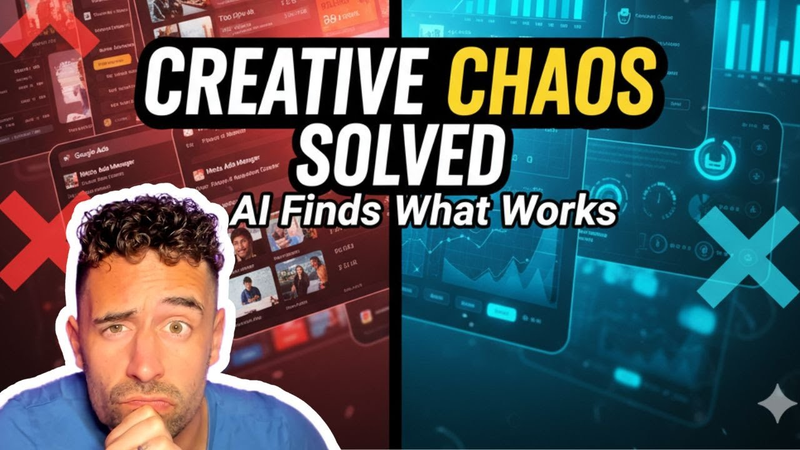
Creative optimisation 101: Creative chaos solved by Matej Lancaric
The provided content outlines a modern approach to creative optimization in mobile user acquisition (UA), emphasizing the transition from manual, spreadsheet-heavy reporting to automated, data-driven decision-making.
- Shift from manual spreadsheet reporting to centralized dashboards that integrate data from Meta, TikTok, Google, and AppLovin to prioritize ROAS and lifetime value over vanity install metrics.
- Implement AI-powered frame-by-frame tagging to categorize ad elements—such as characters, themes, and gameplay hooks—to identify the specific 'DNA' of high-performing creative assets.
- Mitigate creative fatigue by monitoring the age and performance trends of advertisements to trigger timely content refreshes before performance declines.

Ex-Take-Two CEO on Wetherl Big Game Companies Will Survive AI?
The gaming industry stands at a pivotal inflection point where the integration of artificial intelligence promises to fundamentally reshape content creation and operational efficiency.
- AI integration is shifting the industry from simple efficiency gains to the creation of new entertainment categories, such as intelligent NPCs and personalized, dynamic gaming experiences.
- Massive infrastructure investments by hyperscalers are lowering barriers to entry, allowing agile, AI-enabled startups to produce content that rivals the scope and quality of traditional AAA titles.
- Incumbent gaming companies face an existential threat from smaller, efficient startups, necessitating a transition toward AI-driven production models to maintain long-term survival.

Session: The Future Is Agentic: Unlocking Creative Research With AI - Robert Huynh, Reforged Labs.
The future of mobile game user acquisition (UA) is increasingly agentic, characterized by the integration of artificial intelligence to automate and enhance the labor-intensive process of creative research.
- Reforged Labs utilizes AI-driven creative tagging and semantic search to automate the manual process of analyzing competitor video ads across different networks and geographies.
- AI analysis can identify granular performance drivers, such as specific facial expressions in 'king in peril' ad tropes, which differentiate top 10% performing creatives from the bottom 10%.
- The platform correlates creative elements with internal performance metrics like retention and monetization (e.g., Day 7 metrics) to determine which ad concepts effectively drive user acquisition.
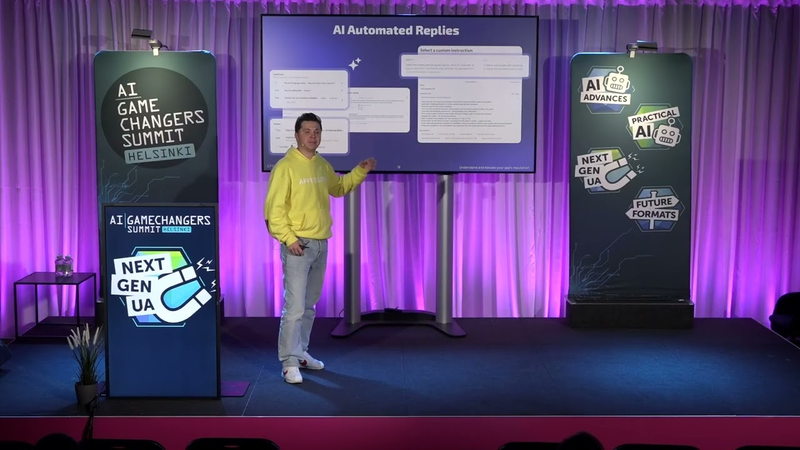
Session: AI & Automation Hacks For Ratings & Reviews - Anatoly Sharifulin, AppFollow.
The integration of artificial intelligence and automation into the management of mobile game ratings and reviews is essential for maintaining product quality, optimizing user acquisition, and improving store visibility.
- AI-driven analysis allows teams to process massive volumes of player feedback—such as the 240,000 reviews received by Call of Duty: Warzone or 300,000 by WhatsApp monthly—without requiring 40 hours of manual reading time.
- Maintaining a high reply rate is critical for game performance; while the average US market reply rate is 20%, top-performing titles often achieve 100% through a hybrid approach of AI-assisted automation and human oversight.
- Google Play and the App Store exhibit different user behaviors, with Google Play reviews tending to be higher in volume but shorter, while App Store reviews are often longer and provide more detailed qualitative insights.

Session: Studio Speaks: The Reality of AI Adoption in Games - Ilya Kuznetsov & Tomi Huttula.
The integration of artificial intelligence into game development serves primarily as a tool to augment human expertise rather than replace it.
- Cosmic Lounge utilizes an internal 'puzzle engine' built on Unity that stores game logic in data formats, allowing designers to rapidly prototype and test new mechanics without manual coding.
- AI is used to scale content production for puzzle games, which can require over 20,000 levels, by automating asset generation while maintaining consistent art styles through custom-trained models (LoRAs).
- AI does not possess creative 'taste' or an understanding of game logic, meaning human experts remain essential for defining artistic vision and ensuring gameplay mechanics function correctly.

Session: Accelerating ASO Experimentation With Gen AI Using PressPlay - Mikey Feingold, Phiture
App Store Optimization (ASO) has become increasingly complex, requiring a balance between visibility and conversion that often exceeds the time, budget, and human resources available to many mobile growth teams.
- Phiture’s PressPlay platform automates ASO experimentation, enabling teams to run hundreds of tests on icons, feature graphics, and screenshots without manual intervention.
- A case study demonstrated the tool's capacity to deploy 322 experiments over eight weeks, resulting in a projected 12 million installs.
- The platform utilizes a cyclical framework that integrates competitor intelligence, user review analysis, and brand-specific guidelines to ensure AI-generated assets remain strategically aligned.
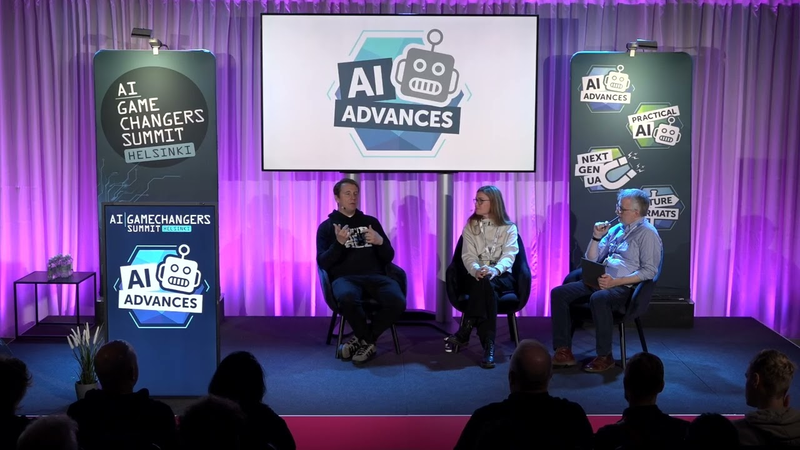
Panel: Beyond The Algorithm - Will AI Redefine Player Experiences?
Artificial intelligence is fundamentally shifting the game development paradigm from static, hardcoded systems toward dynamic, AI-native experiences.
- The primary barrier to AI integration in mobile free-to-play games is the high cost of inference when using large foundation models, which can threaten the viability of existing business models.
- Developers should prioritize smaller, domain-specific, or distilled models over massive general-purpose models to optimize resource usage and reduce inference costs.
- Future AI architecture in gaming will likely rely on a 'mixture of experts' approach, where specialized models are fine-tuned for specific tasks rather than relying on a single, generalized foundation model.