AI reports and market data
Documents
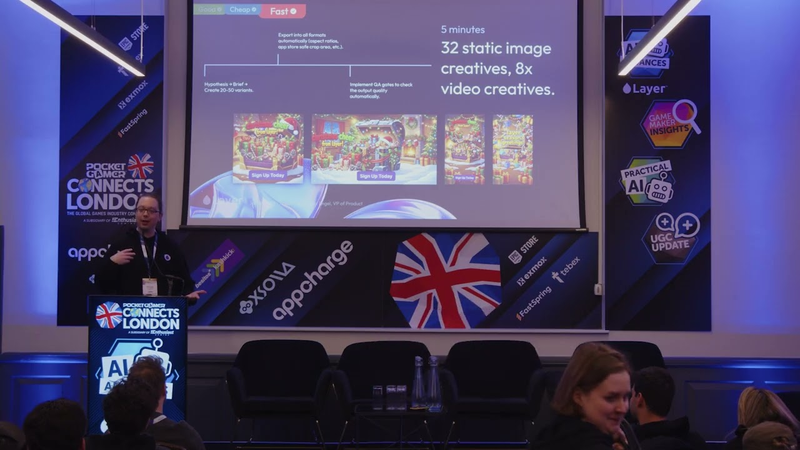
Session: 2026: The Year UA Could Become Good, Fast, & Cheap? - Alex Engel, Layer AI.
The mobile gaming industry is approaching a pivotal shift in User Acquisition (UA) where the traditional constraints of the "iron triangle"—balancing quality, speed, and cost—are being dismantled by advancements in generative AI.
- By 2026, the integration of AI reasoning models and node-based workflows is expected to resolve the 'iron triangle' of UA by enabling the production of high-quality, low-cost, and rapid creative assets at scale.
- The cost of generating high-definition video assets has dropped significantly, with current models like Cling 2.5 costing approximately 10 cents per second and V03.1 costing 27 cents per megapixel second.
- New training frameworks and custom LoRA models now allow for style-consistent asset generation using as few as a dozen images in a training set.

What do game developers really think of Project Genie? | Week in Mobile Games podcast
Google’s introduction of Project Genie, an AI-driven tool capable of generating playable environments from text prompts, has sparked significant market volatility, notably impacting the stock valuations of established platforms like Unity and Roblox.
- Google’s Project Genie has caused market volatility for Unity and Roblox, but industry professionals view the tool as an experimental prototype that currently lacks the mechanical depth and narrative sophistication required for professional game production.
- Nintendo is approaching a milestone of one billion total console sales, reflecting a successful recovery from the Wii U era and the sustained strength of its current hardware ecosystem.
- Arz Interactive secured $70 million in Series A funding to target specific genre gaps within the sports gaming market.

Art Directing in the AI Era with SciPlay's Peter Franco
Modern art direction within the social casino sector has transitioned from an intuitive, creative-led process to a rigorous, data-informed discipline.
- Art direction in the social casino sector has shifted from purely intuitive creative work to a data-informed discipline where design choices are validated by player surveys and key performance indicators.
- AI serves as a catalyst for operational efficiency by enabling rapid prototyping and asset iteration, allowing teams to meet the high-frequency content demands of the mobile gaming market.
- To maintain stylistic cohesion, studios are increasingly training custom AI models and utilizing human artists to refine and oversee the final output of automated tools.

🚨📢BREAKING NEWS: Gaming Stocks Crash, AI Panic Spreads, Meta Quietly Dominates 🤯
The gaming industry is currently experiencing a significant disconnect between market sentiment and operational reality.
- Gaming stocks including Unity, AppLovin, Roblox, and Take-Two experienced a disproportionate sell-off of up to 40% in one week due to investor panic over Google’s Project Genie, significantly outpacing the 4.5% decline of the broader NASDAQ.
- Meta continues to demonstrate massive scale, reporting 3.6 billion daily active users—a 7% year-over-year increase—and total company revenue exceeding $200 billion.
- Market capital is shifting away from experimentation toward operational discipline, as evidenced by Stillfront’s margin expansion through portfolio cleanup and MTG Group’s record profits via disciplined user acquisition.

TWiG #369: Genie 3 Explodes, Game Stores Die, & High Guard Stumbles
The gaming industry is currently undergoing a period of intense volatility, characterized by the rapid obsolescence of traditional retail models and the disruptive, often speculative, influence of generative artificial intelligence.
- The unveiling of Google DeepMind’s Genie 3, capable of generating 3D environments, triggered a $47 billion valuation drop across the gaming sector as markets reacted to the potential disruption of traditional production models.
- Physical game retail is in a state of collapse, evidenced by widespread storefront closures in the UK and the downsizing of major chains, cementing digital distribution as the industry's undisputed standard.
- High-budget marketing playbooks are failing to sustain player retention, as demonstrated by Highguard’s rapid decline despite high initial visibility, highlighting the necessity of clear value propositions and transparent community engagement.

State of Mobile 2026: 9 Trends That Matter
The mobile ecosystem is undergoing a fundamental transition from a volume-based growth model to a monetization-first strategy.
- The mobile market has shifted from volume-based growth to a monetization-first model, evidenced by a 1% stagnation in global downloads contrasted with an 11% surge in in-app purchase revenue.
- Non-game applications are currently outperforming the gaming sector, recording a 21% year-over-year revenue increase compared to the 1% growth seen in gaming.
- The United States remains the dominant revenue driver, accounting for 35% of global totals, while Western Europe and Brazil are identified as the most critical emerging growth regions.

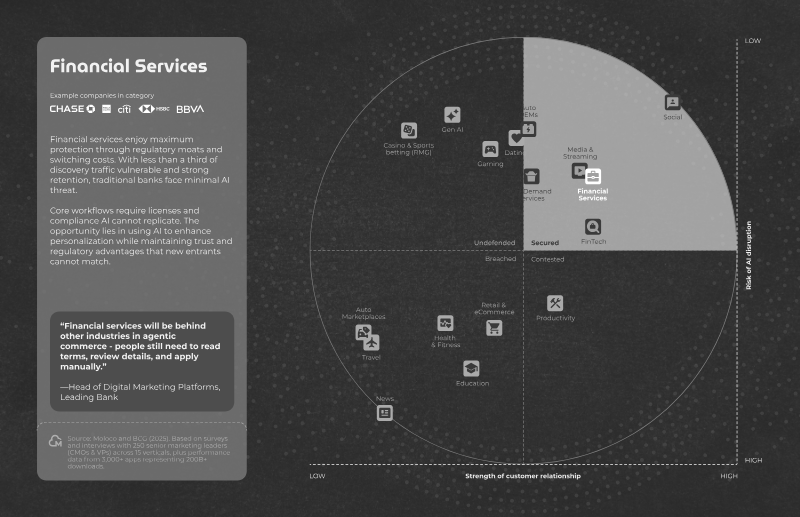

The AI Disruption Index: How AI Is Reshaping Consumer Discovery
The AI Disruption Index demonstrates that artificial intelligence is fundamentally altering how U.S. consumers discover and purchase brands, with one-third of adults now using personal AI agents to find products and nearly half employing AI for purchase research.
- One-third of U.S. adults now use personal AI agents for product discovery, while nearly 50% utilize AI for purchase research.
- AI-driven 'zero-click' discovery is actively eroding traditional paid search and organic search channels, threatening sectors like retail, education, and health & fitness.
- Sectors with strong regulatory or content moats, specifically financial services, media rights holders, and auto OEMs, currently maintain a defensive advantage against AI disintermediation.

☠️ The end of original creatives: Creative Trends just got darker
The mobile gaming industry is currently undergoing a fundamental shift toward a copy-first development strategy, prioritizing high-volume, replicable creative assets over original intellectual property.
- The mobile gaming industry is shifting toward a copy-first strategy that prioritizes high-volume, replicable creative assets over original intellectual property to maximize conversion metrics.
- Artificial intelligence is being leveraged to mass-produce deceptive creative content, significantly lowering production costs while enabling the rapid deployment of fabricated, high-drama scenarios.
- Publishers are increasingly utilizing 'fake ads' that feature unauthorized use of major global brands and misleading gameplay representations to drive user acquisition.

Pocket Gamer Connects London 2026 unwrapped | Week in Mobile Games podcast
The mobile gaming industry is currently experiencing a notable shift toward cautious optimism, marking a departure from the recent period of widespread workforce reductions.
- Direct-to-consumer web stores are gaining traction, with data indicating that 97% of web shop revenue is generated by repeat buyers, and 84% of customers who make three purchases will proceed to a fourth.
- User acquisition (UA) costs remain a persistent industry challenge, forcing developers to shift focus toward retargeting existing players rather than relying solely on expensive new user acquisition.
- The UK games industry continues to struggle with a lack of government support compared to international hubs like Canada, Vietnam, and Israel, prompting the formation of the UK Video Games Council to lobby for better policy alignment.

Everyone’s Using AI — So Why Is the Content Still Mid?
The current discourse surrounding generative AI in the gaming and content creation industries reflects a tension between rapid technological adoption and public perception.
- The gaming industry is currently divided on whether AI acts as a legitimate creative collaborator or a tool for rent extraction that risks homogenizing artistic quality.
- Public backlash against AI integration has forced some developers to distance themselves from these tools, a move analysts argue is an unnecessary concession to online sentiment.
- Platforms like ChatGPT have achieved significant scale with 800 million weekly active users, yet studios are still struggling to integrate these tools into production workflows effectively.

Google’s Zachary Kuney on Monetisation, AI & Why Vietnam is a Global Growth Engine
Vietnam has emerged as a critical growth engine within the global mobile application ecosystem, characterized by a unique combination of young, highly skilled talent, strong government support, and a collaborative, innovation-focused developer community.
- Vietnam is currently a primary growth engine within the APAC mobile app ecosystem, driven by a young, tech-focused talent pool and strong government support for the digital economy.
- AI is being leveraged by developers to transform massive datasets into actionable insights, effectively providing small studios with the capabilities of an in-house data science team.
- Google is shifting its support strategy for developers by integrating cross-functional teams—covering cloud, infrastructure, ad buying, and monetization—to provide a more cohesive and simplified scaling experience.


State of Mobile 2026
The 2026 State of Mobile report demonstrates that the global mobile ecosystem remains mature yet increasingly monetized, with 2025 in-app purchase (IAP) revenue reaching $85.6 billion—a 21% year-over-year rise that now places non-game apps ahead of games for the first time.
- Non-game apps surpassed games in in-app purchase (IAP) revenue for the first time in 2025, contributing to a total global IAP market of $85.6 billion, a 21% year-over-year increase.
- Generative AI and short-form drama are the fastest-growing subgenres, with AI assistants like ChatGPT generating $3.4 billion in 2025 and short-drama apps capturing over 10% of global video-entertainment time.
- Roblox solidified its dominance in the gaming web arena, accounting for 74% of all game-publisher site visits in 2025.