ReportBoston Consulting Group
Video Gaming Report 2026: How Platforms Are Colliding and Why This Will Spark the Next Era of Growth
1 Dec 202526 pages~49 min full read
Key insights
6 slides
The shift
Platforms are colliding into direct-to-consumer ecosystems.
The industry is transitioning from post-pandemic stagnation toward a new era of growth. Hardware-agnostic ecosystems and decentralized distribution are dismantling traditional barriers.
Page 18 of the report2018174
2019183
2020220
2021243
2022236
2023247
2024254
2025E263
The gap
Gaming captures only 3% of ad spend despite 12.5% of media time.
Gaming commands 12.5% of total media consumption time but captures only 3% of global advertising spend. This represents a significant opportunity for revenue growth.
Ad gap. Gaming accounts for 12.5% of gamers' time spent with media, but only around 3% of media ad spending.
Page 22 of the report20199
202113
202313
2025E12.5
2027E12
2029E12
Cloud growth
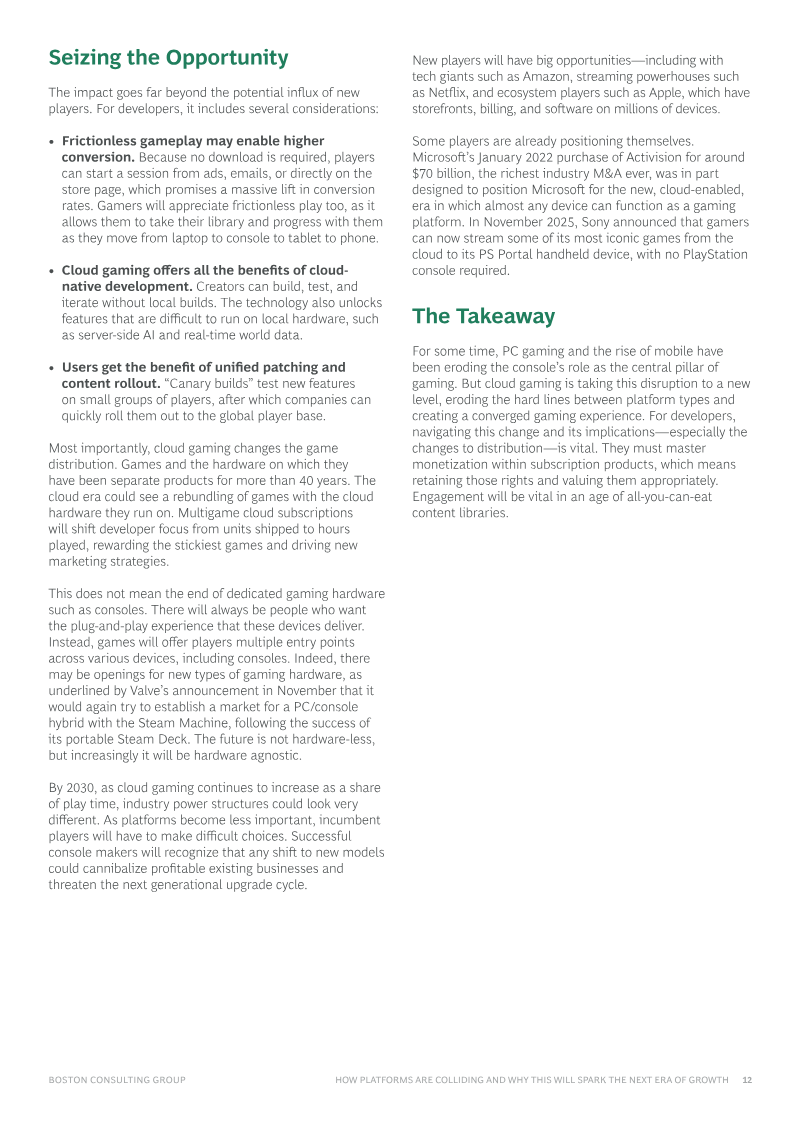
Cloud gaming revenue is projected to reach $18.3 billion by 2030.
Cloud gaming is projected to become a cornerstone of the industry's evolution. It serves as a critical infrastructure component for the transition.
Page 10 of the report20230.8
20241
20251.4
2026E3.7
2027E6
2028E10.1
2029E13.5
2030E18.3
Creative catalyst
Generative AI and UGC are accelerating development and engagement.
Generative AI is accelerating development cycles. User-generated content is fostering deeper intergenerational engagement across player demographics.
Engagement. Generative AI and user-generated content are being leveraged to accelerate development cycles and drive deeper intergenerational player engagement.
Page 5 of the reportGen Z5
Millennials6
Gen X12
Baby boomers22
Competitiveness
Competitiveness depends on moving away from legacy hardware dependencies.
Future competitiveness depends on moving away from legacy hardware dependencies. Stakeholders must prioritize engagement over legacy hardware dependencies to remain competitive.
Retention. Future competitiveness depends on moving away from legacy hardware dependencies toward community-driven platforms that prioritize long-term retention.
Navigation
Success requires navigating market saturation through content curation.
Strategic success will require navigating market saturation through sophisticated content curation. Flexible multiplatform windowing and resolution of intellectual property challenges are also required.
Page 23 of the report- 01Content curationNavigate market saturation through sophisticated content curation.
- 02Multiplatform windowingAdopt flexible multiplatform windowing strategies.
- 03IP resolutionResolve complex intellectual property challenges.
1 / 6
Ask AI about this report