
Report16 pages
Mobile Game Feature Impact Spotlight
Sensor Tower introduces Game IQ Deep Tags, a taxonomy of 70 specialized markers designed to analyze the impact of specific mobile game features on market performance. These tags are categorized into gameplay, monetization, engagement, and social elements, providing developers with a framework to benchmark competitor roadmaps and identify high-value feature sets. The analysis covers the top 1,000 mobile games globally from Q2 2024 through Q1 2025, a segment representing 16 billion downloads and $67 billion in consumer spend.
The findings reveal that feature density does not always correlate with market dominance. In the casual puzzle genre, titans like Royal Match and Candy Crush Saga utilize fewer luxury features, such as voice acting or cinematic cutscenes, compared to competitors like Gardenscapes, suggesting that core gameplay often outweighs feature volume. Conversely, in the mid-core RPG and strategy sectors, comprehensive monetization and engagement systems are standard. For instance, Age of Empires Mobile demonstrates high revenue per download by utilizing nearly all available monetization tags, while top RPGs leverage IP collaborations and recurring task systems to maximize player retention and session length.
The research identifies significant growth opportunities in the hybridcasual segment, where features like in-app purchase (IAP) bundles remain underutilized despite correlating with a $1.77 increase in lifetime revenue per download. Additionally, portfolio analysis of top publishers like Tencent, Scopely, and King shows a universal prioritization of login systems to track player data, while specific mechanics like "monetized retries" remain niche to casual puzzle specialists. Ultimately, the data suggests that strategic feature implementation, rather than exhaustive adoption, is the primary driver of commercial success across different mobile gaming verticals.
- Strategic feature selection, rather than exhaustive feature adoption, is the primary driver of commercial success across the top 1,000 mobile games globally.
- In the hybridcasual segment, implementing in-app purchase (IAP) bundles correlates with a $1.77 increase in lifetime revenue per download.
- Casual puzzle leaders like Royal Match and Candy Crush Saga maintain market dominance with lower feature density, proving that core gameplay often outweighs the addition of luxury elements like cinematic cutscenes.
- Mid-core strategy titles, such as Age of Empires Mobile, maximize revenue per download by utilizing a comprehensive suite of monetization tags.
- Top publishers including Tencent, Scopely, and King universally prioritize login systems to track player data, while mechanics like 'monetized retries' remain niche to the casual puzzle genre.
+1
Sensor TowerJun 2025

Report37 pages
Southeast Asia: Mobile Game Market Insights 2025
Southeast Asia solidified its position as the world’s second-largest mobile gaming market by downloads in early 2025, reaching 1.93 billion installs. While the region currently ranks seventh globally in revenue at $625 million, it demonstrates significant monetization potential fueled by expanding digital payment infrastructure and rising smartphone penetration. Indonesia serves as the primary volume driver with 870 million installs, while Thailand leads the region in consumer spending, generating $162 million. This growth is increasingly supported by publishers based in Singapore and Vietnam, who have emerged as a dominant global force, contributing over 5.8 billion installs to the international market through a mix of hypercasual hits and competitive titles.
Market dynamics reveal a shift toward high-engagement genres and localized content strategies. Although casual arcade and simulation games drive the highest download volumes, monetization is concentrated in Strategy, MOBA, and RPG segments. Mobile Legends: Bang Bang remains the regional revenue leader, sustained by hyper-local live operations and community engagement. Simultaneously, the 4X Strategy genre is experiencing rapid expansion, highlighted by a 77.7% revenue surge for titles like Last War: Survival. Conversely, traditional MMORPGs have seen a decline of nearly 20%, making way for Open World Adventure RPGs and sophisticated strategy games that leverage deep social and competitive mechanics.
The regional landscape is characterized by distinct national preferences and the global expansion of local firms. Vietnam has become a powerhouse for survival-themed hypercasual games, while Thailand shows a unique affinity for realistic sports simulations. Established titles like Garena Free Fire continue to dominate global charts by blending cultural relevance with nostalgic collaborations. Ultimately, the region’s trajectory is defined by a transition from high-volume downloads to sophisticated monetization, driven by a combination of community-led activations and the strategic global influence of Southeast Asian publishers.
- Southeast Asia is the world’s second-largest mobile gaming market by volume, recording 1.93 billion installs in early 2025, while ranking seventh globally in revenue at $625 million.
- Indonesia is the region's primary volume driver with 870 million installs, whereas Thailand leads in monetization, generating $162 million in consumer spending.
- Publishers based in Singapore and Vietnam have become a dominant global force, contributing over 5.8 billion installs to the international market through hypercasual and competitive titles.
- The 4X Strategy genre is experiencing rapid growth, evidenced by a 77.7% revenue surge for titles like Last War: Survival, while traditional MMORPGs have declined by nearly 20%.
- Monetization is concentrated in Strategy, MOBA, and RPG segments, with Mobile Legends: Bang Bang remaining the regional revenue leader due to hyper-local live operations.
+3
Sensor TowerJun 2025
Report9 pages
Q2 2025 Gaming Ad Snapshot
The snapshot presents a mid‑year overview of mobile gaming advertising activity, emphasizing the scale of creative assets, audience composition, and platform performance in the second quarter of 2025. Leveraging MarketIQ’s ad‑intelligence engine, which indexes more than three billion ads, the analysis groups campaigns by image, video, and playable formats to surface benchmark performance and creative inspiration for marketers. A core finding is the gender split of the active audience, with males accounting for roughly 61 % and females 38.5 %, while an insignificant 0.8 % remain unclassified. Google Ads dominates the network landscape, followed by Facebook Ads, reflecting the primary channels through which gaming promotions are delivered.
Creative trends highlighted include senior‑focused Mahjong titles, free‑to‑play shooters, and swipe‑based games, illustrating a diversification of themes and monetisation cues such as “No Wifi Needed” and “Get Free Robux.” Campaign metrics reveal a typical lifecycle of 13 million impressions expanding to 47 million, underscoring the rapid scaling potential of high‑performing assets. The data set draws from approximately 250 000 active campaign ads, providing a robust sample for benchmarking.
Overall, the snapshot underscores the importance of data‑driven creative optimisation in mobile gaming, recommending that advertisers exploit MarketIQ’s extensive repository to identify top‑performing formats, refine copy, and align with the prevailing gender distribution and platform preferences observed in Q2 2025.
- Google Ads and Facebook Ads remain the dominant platforms for mobile gaming promotion in Q2 2025.
- The active mobile gaming audience is composed of 61% males, 38.5% females, and 0.8% unclassified users.
- High-performing mobile gaming ad assets demonstrate rapid scaling, with impressions growing from an average of 13 million to 47 million over their lifecycle.
- The Q2 2025 analysis is based on a robust sample size of approximately 250,000 active campaign ads indexed from a total repository of over three billion ads.
- Current creative trends in mobile gaming emphasize diverse themes including senior-focused Mahjong titles, free-to-play shooters, and swipe-based mechanics.
+1
MarketIQJun 2025

Report28 pages
The Xsolla Report: State of Play Q2 2025
Mobile gaming has become the dominant engine of the global video‑game market, now accounting for more than half of total industry revenue and projected to exceed $126 billion in 2025, with an overall forecast of $150 billion for the segment. The surge is driven by unprecedented user engagement—4.2 trillion hours of app usage in 2024—and a rapid shift toward direct‑to‑consumer (D2C) commerce following the April 2025 court order in Epic Games v. Apple, which obliges iOS platforms to permit external web‑shops and allows developers to retain up to 95 % of transaction value. Early adopters report revenue recoveries measured in millions and a 60 % increase in user engagement for high‑volume titles.
Regulatory reforms across the EU, United States, Japan, South Korea and China are dismantling traditional app‑store monopolies, mandating alternative storefronts, transparent odds disclosure and the elimination of hidden fees. Despite tighter oversight, the mobile ecosystem remains robust, with the United States generating roughly $52 billion in in‑app‑purchase sales, while emerging markets in Latin America, Southeast Asia and Saudi Arabia expand the geographic footprint. Hybrid monetisation—combining in‑app purchases, advertising and subscriptions—is employed by 72 % of developers and now represents about three‑quarters of mobile revenue; live‑ops‑driven hybrid‑casual titles are delivering a 30 % year‑over
- Mobile gaming is the industry's primary revenue driver, projected to reach $126 billion in 2025 with a total segment forecast of $150 billion.
- Following the April 2025 Epic Games v. Apple court order, developers can now utilize direct-to-consumer web-shops to retain up to 95% of transaction value, with early adopters seeing millions in revenue recovery.
- Hybrid monetization models—combining in-app purchases, advertising, and subscriptions—are used by 72% of developers and account for approximately 75% of total mobile revenue.
- Global mobile user engagement reached 4.2 trillion hours in 2024, while the United States market alone generated $52 billion in in-app purchase sales.
- Regulatory reforms in major markets including the EU, US, Japan, South Korea, and China are mandating alternative storefronts and increased transparency to dismantle traditional app-store monopolies.
+2
XsollaJun 2025

Report231 pages
The State of Video Gaming in 2026
The global video game industry is currently navigating a period of significant contraction and structural realignment following a decade of rapid expansion between 2011 and 2021. Real-term spending on game content has declined by approximately 12% since 2021, as the market shifts from a growth-oriented environment to a capital-constrained, zero-sum landscape. This downturn is marked by record-high layoffs, widespread studio closures, and a sharp reduction in venture capital funding. The industry is increasingly dominated by a small cohort of entrenched live-service titles that act as "black holes," consuming the vast majority of player time and financial resources, which makes the launch of new, independent titles increasingly difficult.
Market dynamics are further complicated by extreme resource inflation, with AAA production budgets frequently ballooning to between $200 million and $500 million. While mobile gaming remains the primary driver of global revenue, it faces its own challenges, including declining download volumes and rising user acquisition costs. Meanwhile, the console sector shows signs of stagnation, with current-generation hardware trailing its predecessors in total unit sales. As traditional growth models stall, the industry is pivoting toward new strategies, including the integration of programmatic advertising, the adoption of generative AI to improve production efficiency, and a push toward cross-platform accessibility to maximize player retention.
Geographically, the center of gravity is shifting toward Asian markets, where local developers are increasingly challenging Western incumbents with high-performing, globally resonant titles. Concurrently, the rise of user-generated content platforms like Roblox and the maturation of PC-based modding ecosystems are redefining how players engage with digital worlds. Looking forward, the industry is pinning its recovery on technological advancements in cloud computing and AI-driven development, alongside regulatory shifts that may allow developers to capture a larger share of revenue through alternative distribution channels. Success in this new era requires moving beyond traditional gameplay loops toward interconnected, persistent ecosystems that prioritize social infrastructure and long-term engagement.
- The video game industry is in a period of contraction, with real-term spending on content declining by approximately 12% since 2021.
- AAA production budgets have ballooned to between $200 million and $500 million, contributing to a capital-constrained environment marked by record-high layoffs and studio closures.
- A small cohort of entrenched live-service titles now dominates the market, acting as 'black holes' that consume the majority of player time and spending, making new independent launches increasingly difficult.
- The industry is pivoting toward generative AI to combat production cost inflation and integrating programmatic advertising to offset stalling growth in traditional console and mobile sectors.
- The global center of gravity is shifting toward Asian markets, where local developers are increasingly challenging Western incumbents with high-performing, globally resonant titles.
+2
EpyllionMay 2025
Report50 pages
State of Mobile Gaming 2025
The global mobile gaming market entered a period of mature recovery in 2024, characterized by a strategic pivot toward live services and high-value player retention. While total downloads declined by 6.6%, global in-app purchase revenue grew by 4% to reach $82 billion. This growth was primarily driven by North America and the Middle East, offsetting spending declines in Asia. The industry has transitioned into a "live operations" era, where 84% of all revenue is generated by games utilizing continuous updates and seasonal events. This shift is further evidenced by a 50% decrease in new game releases since 2020, as publishers prioritize high-quality core titles over volume.
Genre performance highlights a market dominated by Strategy and RPG titles, which collectively generated over $34 billion in 2024. Action games emerged as the fastest-growing category with a 46% revenue increase, fueled by breakout hits like Last War: Survival. Despite the dominance of established franchises, a record 11 games surpassed $1 billion in annual consumer spend, including MONOPOLY GO!, which secured the top global position. The market is also seeing a demographic shift, particularly in the United States, where the 18-24 age group now represents 18% of the player base, up from 13% in 2022.
Marketing strategies have evolved to combat rising user acquisition costs, with a significant move toward high-intent creative content and short-form video platforms. TikTok experienced a 67% year-over-year growth in social ad share, while mid-core developers nearly doubled their impression share on social networks. To maintain profitability, publishers are increasingly leveraging external web stores, celebrity partnerships, and localized cultural influencers, such as virtual YouTubers in the Japanese market. These trends underscore a broader industry movement toward sophisticated monetization models and IP-driven growth in an increasingly concentrated competitive landscape.
- Global mobile gaming revenue grew 4% to $82 billion in 2024 despite a 6.6% decline in total downloads, signaling a shift toward high-value player retention.
- The industry has entered a 'live operations' era, with 84% of total revenue now generated by games utilizing continuous updates and seasonal events.
- Publishers have reduced new game releases by 50% since 2020, focusing resources on high-quality core titles rather than volume.
- Strategy and RPG titles remain the market leaders with over $34 billion in combined revenue, while Action games emerged as the fastest-growing category with a 46% revenue increase.
- A record 11 games surpassed $1 billion in annual consumer spend in 2024, with MONOPOLY GO! securing the top global position.
+1
Sensor TowerMar 2025

Report42 pages
Mobile App Trends: 2025 Edition
The mobile app economy is entering a significant scaling phase, with global consumer spending projected to reach $626 billion by 2030. This growth is underpinned by a 2024 surge in app installs and a notable rise in App Tracking Transparency opt-in rates to 35%, suggesting that privacy-centric measurement is successfully rebuilding user trust. As the industry moves into 2025, the integration of artificial intelligence and machine learning has transitioned from a conceptual trend to an operational necessity, particularly for predictive analytics and campaign optimization across diverse platforms like Connected TV and in-app advertising.
Mobile commerce currently serves as the primary driver of the digital landscape, accounting for 73% of global e-commerce sales with anticipated 2025 revenues of $2.5 trillion. While e-commerce app installs grew by 17% in 2024, the sector must navigate rising acquisition costs, which have reached an average of $3.44 per install. This financial pressure is particularly acute in emerging markets such as MENA and LATAM, where reliance on paid media is increasing. Simultaneously, the mobile gaming sector remains the most popular category, expected to reach $126.1 billion in 2025. Although gaming faces retention challenges in North America and Europe, strategy games have seen an 83% growth in installs, and global session lengths have extended to over 30 minutes.
The financial services vertical is also experiencing a period of robust expansion, especially within the APAC and LATAM regions. Global session lengths for finance apps have risen to 6.66 minutes, while average revenue per monthly active user has climbed significantly to $4.10. Across all sectors, the 2025 outlook emphasizes a shift toward omnichannel strategies and a rebound in mobile-first holiday shopping. Success in this evolving market requires developers to balance aggressive growth in high-potential regions with sophisticated, privacy-compliant data strategies to maintain long-term user engagement.
- Global mobile consumer spending is projected to reach $626 billion by 2030, supported by a 2024 surge in app installs and a 35% App Tracking Transparency opt-in rate.
- Mobile commerce accounts for 73% of global e-commerce sales, with 2025 revenues expected to hit $2.5 trillion despite rising acquisition costs averaging $3.44 per install.
- The mobile gaming sector is projected to reach $126.1 billion in 2025, with strategy games experiencing an 83% growth in installs and global session lengths exceeding 30 minutes.
- Financial services apps are seeing robust expansion in APAC and LATAM, with average revenue per monthly active user reaching $4.10 and session lengths increasing to 6.66 minutes.
- Artificial intelligence and machine learning have become operational necessities for predictive analytics and campaign optimization across Connected TV and in-app advertising.
+1
AdjustMar 2025

Report32 pages
Mobile Games Industry Trends Survey: Winter 2024/25
The mobile games industry entered a period of significant recalibration during the winter of 2024/25, characterized by a transition from rapid expansion to a focus on long-term sustainability. While the market is returning to growth, it is currently defined by a "reality check" phase where 56.7% of professionals identify widespread layoffs as the year’s most impactful trend. High user acquisition costs and evolving privacy regulations have created a consolidated landscape favoring established organizations, as evidenced by the fact that nearly 39% of companies have operated for over a decade while the presence of new startups has notably diminished.
Strategic priorities have shifted toward maintaining existing portfolios through live operations and hybrid-casual models rather than launching new intellectual property. Over 40% of organizations released no new titles in the past year, choosing instead to prioritize top-line revenue and retention as their primary performance indicators. In-app purchases and video advertisements remain the foundational business models, though rising acquisition costs are cited by 64.2% of respondents as the greatest threat to continued profitability. Despite these headwinds, the industry maintains a cautiously optimistic outlook for 2025, with 44.1% of professionals expressing confidence in the coming year.
Growth opportunities are increasingly sought in emerging markets, particularly the MENA region, and through strategic networking at global industry summits. Professional events remain vital for the ecosystem, with nearly 90% of participants attending for networking and over 31% seeking investment or publishing partnerships. As the industry moves forward, the reliance on proven development tools like Unity and a data-driven approach to player retention will be essential for navigating a market that increasingly rewards operational efficiency and established brand presence over speculative new ventures.
- Rising user acquisition costs are the primary threat to profitability, cited by 64.2% of industry professionals as the greatest challenge to the sector.
- The industry is in a period of consolidation, with 56.7% of professionals identifying widespread layoffs as the most impactful trend of the 2024/25 period.
- Strategic focus has shifted away from new IP, as evidenced by over 40% of organizations releasing zero new titles in the past year to prioritize existing live operations.
- The market landscape is increasingly dominated by established players, with nearly 39% of companies operating for over a decade while startup formation has notably declined.
- Despite current headwinds, 44.1% of industry professionals maintain a cautiously optimistic outlook for growth in 2025.
PocketGamer.bizMar 2025
Report56 pages
Mobile Gaming 2022-2024
The analysis tracks mobile‑gaming dynamics from 2022 through 2024, arguing that the sector’s financial expansion now exceeds its ability to attract new users. Revenue on Google Play rose roughly 10 % year‑on‑year in 2023‑24 while download volumes stagnated or slipped slightly, and iOS revenue grew about 12 % against an 8 % rise in downloads. Despite this divergence, the concentration of earnings among the top ten publishers has held steady, indicating that market power remains entrenched even as overall spend accelerates.
Consumer‑device preferences reveal a near‑universal reliance on smartphones, with 97 % of Brazilian gamers using mobile phones in 2024 and personal PCs ranking as the only other significant platform; console usage is negligible. Across the United States and Brazil, the primary incentives for trying a new title are free‑to‑play pricing, recognizable brands or characters, and easy access through subscription services. Gender nuances appear modest: men place greater value on non‑pay‑to‑win structures and strong single‑player experiences, whereas women are drawn to customizable avatars and peer recommendations.
Behavioral data show a pronounced tendency toward deep engagement with a single game. Approximately half of respondents in Brazil, Germany, Japan and the United States report completing one title before moving to the next, suggesting that the market favors sustained, title‑centric play rather than rapid turnover. The findings collectively underscore a maturing mobile‑gaming ecosystem where revenue growth is driven by monetisation depth and brand loyalty rather than sheer user acquisition.
- Mobile gaming revenue growth is decoupling from user acquisition, with Google Play revenue rising 10% and iOS revenue growing 12% in 2023–2024 despite stagnant or slowing download volumes.
- Market power remains highly concentrated, as the top ten publishers continue to capture the vast majority of earnings despite the overall acceleration in consumer spending.
- The mobile ecosystem is shifting toward a maturity model where revenue increases are driven by monetization depth and brand loyalty rather than the expansion of the total user base.
- Approximately 50% of gamers in major markets like the U.S., Germany, Japan, and Brazil prefer deep, sustained engagement with a single title rather than rapid game turnover.
- Consumer acquisition is primarily driven by free-to-play pricing, recognizable IP, and accessibility through subscription services.
+1
Mariusz Gasiewski (Google)Jan 2025
Report95 pages
State of Mobile 2025
The global mobile economy reached a significant milestone in 2024, with consumer spend hitting $150 billion. This growth was primarily propelled by a 25% surge in non-gaming app revenue, particularly within the entertainment, productivity, and generative AI sectors. While total app downloads declined for the fourth consecutive year, indicating a maturing market, user engagement reached a record 4.2 trillion hours. The rise of generative AI served as a primary catalyst for this engagement, with AI chatbot downloads increasing by 635 million and the subgenre generating nearly $1.3 billion in revenue.
The mobile gaming sector demonstrated a robust recovery in 2024, reaching $80.9 billion in internal purchase revenue. Although total game downloads fell by 6%, the market shifted toward high-quality, core genres. Strategy and RPG titles dominated monetization, while the "hybrid-casual" model—combining simple mechanics with midcore progression—emerged as a vital growth driver. Established franchises continue to exert dominance, with titles older than two years accounting for over 80% of revenue. Notably, the industry saw a record eleven games surpass $1 billion in annual revenue, signaling a concentration of wealth among top-tier performers.
Beyond gaming, the landscape was defined by the continued dominance of social media, which accounted for 2.4 trillion hours of global usage. TikTok became the first non-game app to reach $15 billion in lifetime spend, reflecting a broader trend of social platforms diversifying revenue through in-app purchases and subscriptions. In the retail sector, Chinese e-tailers like Temu and SHEIN expanded their global footprint, while the finance sector saw a resurgence driven by cryptocurrency and digital wallets. Despite signs of "digital fatigue" in traditional streaming, the mobile ecosystem remains resilient, characterized by strategic shifts toward ad-supported tiers, meaningful AI integration, and incentivized health and fitness platforms.
- The global mobile economy reached $150 billion in consumer spend in 2024, driven by a 25% surge in non-gaming revenue despite a four-year decline in total app downloads.
- Mobile gaming revenue recovered to $80.9 billion, with 80% of earnings generated by titles older than two years and a record eleven games surpassing $1 billion in annual revenue.
- Generative AI became a primary engagement catalyst, with chatbot downloads increasing by 635 million and generating nearly $1.3 billion in revenue.
- Total mobile user engagement hit a record 4.2 trillion hours, with social media platforms accounting for 2.4 trillion of those hours.
- The 'hybrid-casual' gaming model has emerged as a critical growth driver, while strategy and RPG titles continue to dominate monetization.
+1
Sensor TowerJan 2025

Report60 pages
Global LiveOps Trends 2025
The global mobile gaming landscape in 2025 is characterized by a notable deceleration in overall market growth, with revenue increases stalling at 0.7% and download growth slowing to 4.1%. In response to this stagnation, developers are intensifying LiveOps strategies to sustain engagement and monetization. The average number of monthly events per game has risen to 89, shifting away from traditional holiday-centric scheduling toward persistent, competitive mechanics such as Win Streaks, Leaderboards, and various collection-based systems. This strategic pivot reflects a broader industry effort to maximize the lifetime value of existing player bases, particularly within the Midcore and Hybridcasual segments.
Genre performance is undergoing a significant realignment, as Puzzle and Strategy titles experience growth while RPG and Shooter categories face substantial declines. Midcore titles remain the primary drivers of revenue, relying on cooperative events and targeted monetization of high-spending players to maintain stability. Simultaneously, the Hybridcasual sector has emerged as a high-growth area, recording a 75% year-over-year revenue increase despite stagnant download figures. This success is largely attributed to the integration of Casual-style mechanics, such as Digging and Expedition events, which effectively boost session length and ad-based monetization.
The industry is currently defined by a move toward greater mechanical complexity and event density. By adopting diverse features like Stamp-based systems and Core Duplicates, developers are successfully diversifying their monetization strategies across different player archetypes. While Midcore games continue to prioritize whale-focused cooperative events, Hybridcasual titles are increasingly leveraging competitive, short-term engagement loops to drive performance. Ultimately, the 2025 market environment demonstrates that sustained success is no longer dependent on rapid user acquisition, but rather on the sophisticated, data-driven application of LiveOps to deepen engagement within established gaming ecosystems.
- The global mobile gaming market has stagnated, with revenue growth slowing to 0.7% and download growth to 4.1%, forcing a shift toward maximizing the lifetime value of existing players.
- Hybridcasual games have emerged as a high-growth sector, recording a 75% year-over-year revenue increase despite flat download numbers.
- LiveOps strategy has shifted toward high-frequency engagement, with the average number of monthly events per game rising to 89.
- Developers are moving away from holiday-centric calendars in favor of persistent, competitive mechanics like Win Streaks, Leaderboards, and collection-based systems.
- Genre performance is realigning, with Puzzle and Strategy titles showing growth while RPG and Shooter categories face substantial declines.
+3
AppMagicJan 2025

Report22 pages
Mobile App Trends: Türkiye 2025
The mobile app economy in Türkiye is experiencing a high-growth phase, characterized by a young, tech-savvy population and robust digital infrastructure. With 80.7 million active mobile connections and internet penetration reaching 87%, the market is maturing into a global competitor. The sector is supported by government incentives and a thriving startup ecosystem, with total revenue projected to reach $1.65 billion by 2029. This analysis, covering the period from January 2023 through July 2025, utilizes data from a mix of 5,000 top-performing apps and the broader dataset tracked by Adjust to benchmark performance across gaming, finance, and e-commerce verticals.
The gaming sector remains a primary driver of growth, with Türkiye’s studios achieving significant international success. In the first half of 2025, gaming installs in Türkiye grew 4% year-over-year, while sessions increased by 12%, significantly outpacing global and regional benchmarks. Average session lengths reached 32.8 minutes, reflecting high user engagement. While day-1 retention in Türkiye stands at 19%, the market shows shorter user lifecycles compared to global averages, suggesting a need for refined engagement strategies.
Finance and e-commerce apps are also evolving rapidly. Finance app installs surged 30% in the first half of 2025 compared to the same period in 2024, despite a slight decline in session lengths, which may indicate improved efficiency in user transaction flows. E-commerce apps demonstrated resilience, with a 4% increase in sessions during the first half of 2025, outperforming both global and MENAT regional trends. Retention rates in both sectors remain competitive, with Türkiye consistently exceeding regional and global medians.
A notable trend is the rapid expansion of AI-powered applications, which saw a 142.5% year-over-year increase in downloads in 2024. This growth is fueled by a shift of talent from hypercasual gaming to AI-first development and the creation of proprietary Turkish-language large language models. As the market matures, the integration of AI-driven personalization and streamlined, friction-free user experiences remains critical for developers aiming to capture and retain high-value audiences in this increasingly competitive landscape.
- The Turkish mobile app market is projected to reach $1.65 billion in revenue by 2029, supported by 80.7 million active mobile connections and 87% internet penetration.
- AI-powered applications experienced a 142.5% year-over-year increase in downloads in 2024, driven by a talent shift from hypercasual gaming to AI-first development.
- Finance app installs surged by 30% in the first half of 2025 compared to the same period in 2024, despite a slight decline in session lengths indicating more efficient transaction flows.
- Gaming sessions in Türkiye increased by 12% in the first half of 2025 with average session lengths of 32.8 minutes, significantly outpacing global and regional benchmarks.
- While gaming session engagement is high, day-1 retention stands at 19% with shorter user lifecycles than global averages, highlighting a need for improved engagement strategies.
+3
AdjustJan 2025

Report133 pages
Vorhaus Digital Strategy Study: All Findings
The 2025 digital landscape is defined by a fundamental transition in entertainment consumption, as smartphones and connected TVs have officially supplanted traditional television as the primary mediums for American audiences. This shift is accompanied by a broader decline in legacy pay TV services, with nearly a quarter of consumers signaling an intent to cancel subscriptions within the next year. While the streaming market remains highly competitive, with the average consumer maintaining 3.5 paid subscriptions, cost-sensitivity has emerged as the primary driver for churn. Simultaneously, digital engagement is deepening across gaming and social platforms, with 80% of the population now participating in gaming activities, reflecting a 4% increase since 2024.
Gaming has evolved into a central pillar of digital life, characterized by rising in-game spending and a growing preference for mobile platforms across all age groups, including those over 55. Discovery mechanisms are also shifting, as traditional advertising loses efficacy in favor of video-based gameplay content, which has become a critical influence for younger demographics. While interest in emerging technologies like the Metaverse, virtual reality, and augmented reality remains concentrated among the 18–34 cohort, adoption is tempered by broader consumer apprehension regarding data privacy and security. Furthermore, while the creator economy is expanding in terms of participation, monetization remains a significant hurdle, with many creators facing declining average earnings despite the rise of user-generated content platforms.
The demographic profile of this digital ecosystem is largely composed of educated, established homeowners, though self-identification varies sharply by age. Younger users increasingly embrace niche digital identities, whereas older cohorts lean toward mainstream engagement. Looking ahead, the integration of virtual goods and blockchain-based tracking presents a potential avenue for increased revenue, as a significant portion of gamers express a willingness to spend more if ownership and transferability of digital assets are secured. Despite this, cryptocurrency adoption remains limited, suggesting that while consumers are increasingly comfortable with digital transactions, they remain cautious regarding speculative financial technologies.
- Gaming participation has reached 80% of the U.S. population, marking a 4% increase since 2024 and establishing gaming as a primary pillar of digital engagement.
- Traditional pay TV is in decline, with nearly 25% of consumers planning to cancel their subscriptions within the next year as smartphones and connected TVs become the dominant media platforms.
- Cost-sensitivity is the primary driver of churn in the streaming market, where the average consumer currently maintains 3.5 paid subscriptions.
- Mobile gaming is the preferred platform across all age groups, including users over 55, while video-based gameplay content has replaced traditional advertising as the most effective discovery mechanism for younger demographics.
- While interest in the Metaverse, VR, and AR is concentrated in the 18–34 age demographic, widespread adoption is currently hindered by consumer concerns regarding data privacy and security.
+4
Vorhaus AdvisorsJan 2025

Report37 pages
Insights into the Japanese Gaming Market: 2025
The Japanese gaming market stands as a uniquely high-value ecosystem, generating 9.1% of global industry revenue despite accounting for only 2.2% of the worldwide player base. This disparity underscores a high average revenue per user driven by a mature demographic that prioritizes quality, depth, and domestic intellectual property. While Nintendo and established local publishers maintain a firm grip on the console sector, the landscape is undergoing a structural shift as PC gaming emerges as a critical growth engine, representing a substantial $2.5 to $3.0 billion opportunity for international entrants.
Success within this region necessitates a nuanced understanding of local consumer behavior, which diverges significantly from Western trends. Japanese players demonstrate a profound preference for narrative-driven, single-player role-playing games and fantasy-themed experiences, often eschewing the open-world, sports, and multiplayer-centric titles that dominate other major markets. This cultural specificity acts as a barrier to entry for many global publishers, who must tailor their content to align with these distinct aesthetic and gameplay expectations to achieve meaningful penetration.
Beyond cultural alignment, international companies must navigate complex macroeconomic conditions, most notably the volatility of the Japanese Yen. While the market remains a lucrative target, the combination of currency headwinds and the entrenched dominance of domestic franchises requires a strategic, long-term approach. By focusing on high-fidelity, story-rich experiences that resonate with the local appetite for solo play, external publishers can effectively capture a share of this high-margin market, provided they remain adaptable to the evolving preferences of the Japanese gaming audience.
- The Japanese gaming market generates 9.1% of global industry revenue despite representing only 2.2% of the worldwide player base, indicating an exceptionally high average revenue per user.
- PC gaming is a critical growth engine in Japan, representing a $2.5 to $3.0 billion opportunity for international publishers.
- Success in Japan requires prioritizing narrative-driven, single-player role-playing games and fantasy themes, which contrast with the multiplayer and sports-centric preferences of Western markets.
- Domestic publishers and Nintendo maintain a firm grip on the console sector, creating a high barrier to entry for international companies.
- International entrants must navigate macroeconomic challenges, specifically the volatility of the Japanese Yen, when planning market entry.
+2
NewzooJan 2025

Report20 pages
Games Industry Region Report: China 2025
China maintains its position as the world’s most lucrative and influential gaming market, generating $48.7 billion in total revenue during 2024. While the domestic landscape has faced challenges such as stringent regulatory licensing, rising production costs, and intense competition, the industry has successfully transitioned from a mobile-centric model toward the development of high-end, triple-A intellectual property. This evolution is underscored by the global success of titles like Black Myth: Wukong and the fact that Chinese companies or their subsidiaries now account for 14 of the top 30 highest-grossing games worldwide.
The financial performance of the sector remains robust, with mobile App Store revenue reaching $15.6 billion and PC gaming experiencing significant growth bolstered by platforms like Steam. Although domestic App Store downloads have receded from their 2020 peak, Chinese publishers have effectively offset this by expanding their international footprint, generating over $18.5 billion in worldwide gross revenue. Furthermore, the ecosystem is diversifying through the rise of accessible platforms such as WeChat Mini Games, which provide unique avenues for engagement alongside traditional gaming segments.
Looking toward the future, the Chinese games industry is poised to lead in the integration of artificial intelligence and the export of original, globally recognized content. As regulatory barriers show signs of easing, the market is increasingly fostering international collaboration, positioning itself as a strategic gateway for Western studios. By balancing domestic market saturation with aggressive global expansion, the region is cementing its role as a primary architect of the modern gaming landscape, moving beyond its historical reliance on mobile titles to become a comprehensive powerhouse of interactive entertainment.
- The Chinese gaming market generated $48.7 billion in total revenue in 2024, maintaining its status as the world's most lucrative region.
- Chinese publishers generated $18.5 billion in international gross revenue, successfully offsetting a decline in domestic App Store downloads from their 2020 peak.
- Chinese companies or their subsidiaries now account for 14 of the top 30 highest-grossing games worldwide, signaling a shift toward high-end, triple-A intellectual property.
- Mobile App Store revenue reached $15.6 billion in 2024, while PC gaming experienced significant growth supported by platforms like Steam.
- The domestic market is diversifying through the rise of WeChat Mini Games, which offer new engagement avenues alongside traditional gaming segments.
+1
PocketGamer.bizJan 2025

Whitepaper26 pages
Maximize Your ROAS: Cutting-Edge Attribution Strategies in Mobile Gaming
Mobile gaming marketers currently face a critical measurement crisis driven by tightening privacy regulations, increased media fragmentation, and the inherent inaccuracies of traditional Last-Touch Attribution. These factors have rendered legacy models insufficient for capturing the true impact of marketing spend, as they frequently over-index on bottom-of-funnel touchpoints while ignoring the incremental value generated by upper-funnel awareness campaigns. To maintain competitive advantage and optimize Return on Ad Spend, the industry is transitioning toward sophisticated Marketing Mix Modeling, which leverages aggregated, privacy-compliant data to provide a more comprehensive view of channel performance.
The most effective strategy for modern publishers involves a dual-measurement framework that integrates tactical, real-time insights from Last-Touch Attribution with the strategic, long-term perspective offered by Marketing Mix Modeling. This hybrid approach is particularly vital for organizations managing substantial monthly budgets across diverse media channels, provided they possess at least one year of historical data to ensure model accuracy. By identifying the true incrementality of various platforms, developers can move beyond attribution blind spots and allocate resources with greater precision.
This analytical shift is essential for navigating the complexities of the global mobile gaming landscape. Platforms such as Kochava’s Always-On Incremental Measurement, often utilized in tandem with partners like TikTok for Business, represent the current standard for advertisers seeking to reconcile privacy-first data requirements with the need for actionable growth insights. Adopting these advanced modeling techniques allows publishers to move past fragmented measurement silos, ensuring that marketing investments are directed toward the channels that provide the most significant, measurable impact on long-term user acquisition and revenue growth.
- Mobile gaming marketers must transition from legacy Last-Touch Attribution to Marketing Mix Modeling (MMM) to overcome privacy regulations and media fragmentation that render bottom-of-funnel-focused models inaccurate.
- A dual-measurement framework combining real-time Last-Touch Attribution with long-term Marketing Mix Modeling is the most effective strategy for optimizing Return on Ad Spend.
- Marketing Mix Modeling requires a minimum of one year of historical data to ensure the accuracy necessary for identifying true channel incrementality.
- The hybrid measurement approach is specifically recommended for organizations managing substantial monthly budgets across diverse media channels.
- Platforms such as Kochava’s Always-On Incremental Measurement, used alongside partners like TikTok for Business, are currently the industry standard for reconciling privacy-compliant data with actionable growth insights.
+2
KochavaJan 2025
Report3 pages
2025 Half-Year Market Model Update: Asia & MENA
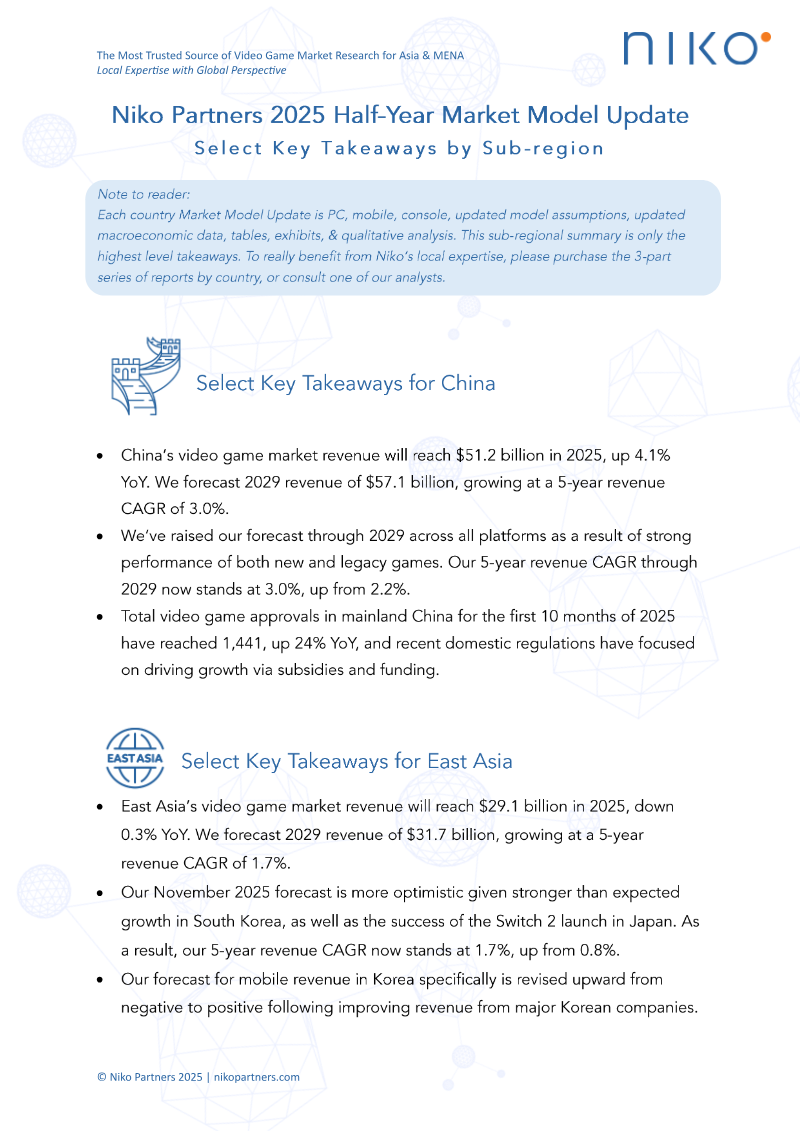
The 2025 Half-Year Market Model Update provides a comprehensive assessment of the video game industry across Asia and the Middle East and North Africa (MENA) region. By synthesizing macroeconomic data, platform-specific performance metrics, and regulatory developments, the analysis offers updated revenue forecasts through 2029 for key markets, including China, East Asia, India, Southeast Asia, and the MENA-3 region. The primary objective is to adjust long-term growth expectations based on recent industry performance, government policy shifts, and evolving consumer behavior.
Regional performance varies significantly, with India emerging as a high-growth market, projected to reach $1.1 billion in 2025 with a robust 12.9% five-year compound annual growth rate (CAGR). China remains the dominant market, with 2025 revenue expected to hit $51.2 billion, supported by a 24% year-over-year increase in game approvals. Conversely, East Asia and Southeast Asia show more moderate growth trajectories, with five-year CAGRs of 1.7% and 3.5%, respectively. The MENA-3 region is forecasted to reach $2.2 billion in 2025, though long-term projections have been tempered by economic headwinds in Egypt and slower mobile growth in Saudi Arabia and the UAE.
Methodologically, these insights are derived from proprietary market models that integrate platform-specific data for PC, mobile, and console segments. The analysis highlights the critical role of government intervention, such as the PROG act in India and regulatory subsidies in China, in shaping market expansion. By updating previous forecasts to reflect current fiscal realities and hardware cycles, such as the Switch 2 launch in Japan, the findings offer a refined outlook for stakeholders navigating the complex regulatory and economic landscapes of these diverse geographic segments.
- China remains the dominant regional market with projected 2025 revenue of $51.2 billion, bolstered by a 24% year-over-year increase in game approvals.
- India is positioned as a high-growth market expected to reach $1.1 billion in 2025 with a 12.9% five-year compound annual growth rate (CAGR).
- The MENA-3 region is forecasted to reach $2.2 billion in 2025, though long-term growth is tempered by economic headwinds in Egypt and slowing mobile performance in Saudi Arabia and the UAE.
- East Asia and Southeast Asia exhibit moderate growth trajectories, with five-year CAGRs of 1.7% and 3.5%, respectively.
- Market expansion across these regions is increasingly driven by government policy, including the PROG act in India and regulatory subsidies in China.
+5
Niko PartnersJan 2025

Report10 pages
Take Rates in China: Will Quality Development Beat Out Traditional Distribution?
The Chinese mobile gaming market is currently undergoing a significant shift in distribution dynamics as developers increasingly challenge the traditional 50% take rates imposed by domestic Android app stores. While global discourse remains focused on the 30% take rate standard contested in the Epic v. Apple litigation, Chinese developers face a more restrictive domestic environment where smartphone manufacturers and major tech firms consolidate power through the Mobile Hardcore Alliance and the Global Developer Service Alliance. These entities justify high fees by providing integrated marketing and distribution services, yet these costs have become a primary point of contention for major studios.
To circumvent these high fees, prominent developers such as miHoYo, Lilith Games, and NetEase are increasingly adopting direct-to-consumer distribution models. By leveraging high-quality intellectual property, substantial marketing budgets, and community-driven platforms like TapTap and Bilibili, these studios can bypass traditional stores entirely. This strategy allows developers to retain significantly higher gross profit margins—often exceeding 95%—compared to the 50% margin typically realized through standard distribution channels. The success of these titles has begun to force concessions, as evidenced by Xiaomi offering reduced take rates to high-profile games like Genshin Impact.
The industry landscape is bifurcated, as smaller developers often remain dependent on traditional stores for the reach and infrastructure necessary to sustain their operations, viewing the 50% fee as an acceptable cost of doing business. However, the rise of direct distribution and community-centric marketing signals a broader trend where quality content and brand loyalty are becoming more influential than traditional store placement. As developers continue to prioritize direct engagement and alternative platforms, the dominance of traditional Android app stores in China faces mounting pressure, potentially reshaping the economic model of the global mobile gaming industry.
- Major Chinese developers like miHoYo, Lilith Games, and NetEase are bypassing traditional Android app stores to achieve gross profit margins exceeding 95%, compared to the 50% margin typical of standard distribution.
- The Chinese mobile gaming market is dominated by a 50% take rate imposed by smartphone manufacturers and tech firms organized under the Mobile Hardcore Alliance and the Global Developer Service Alliance.
- High-profile titles are successfully leveraging direct-to-consumer models and community platforms like TapTap and Bilibili to circumvent traditional distribution fees.
- The shift toward direct distribution has forced some concessions from traditional stores, such as Xiaomi offering reduced take rates for high-profile games like Genshin Impact.
- The market is bifurcated, as smaller developers remain dependent on traditional stores for necessary infrastructure and reach, accepting the 50% fee as a standard cost of business.
+2
NikoJan 2025

Report35 pages
Guide to Growing Chinese Gaming Apps Overseas
Chinese gaming developers are aggressively expanding their global footprint by leveraging sophisticated monetization models and high-volume, AI-driven marketing strategies. The primary objective for these publishers is to balance the high revenue potential of mature markets like the United States, Japan, and South Korea against the rising costs of user acquisition. By prioritizing video advertising, which currently yields the highest Day 7 return on ad spend at 21%, developers are successfully capturing market share in competitive strategy and RPG segments.
Success in these international territories is increasingly predicated on hyper-localization and technological integration. Publishers are utilizing generative AI to streamline the production of localized ad creatives, voice-overs, and performance-tested copy, allowing for rapid iteration and regional customization. Leading titles demonstrate that high-engagement gameplay loops—such as the inclusion of social hangout spaces, customizable home systems, and minigame integrations—are essential for sustaining long-term retention. These efforts are further bolstered by strategic partnerships with local influencers and the implementation of innovative, time-limited gacha mechanics.
To maintain consistent growth, developers are diversifying their engagement tactics through gamified live events, including seasonal collections and interactive board-style challenges. These features, combined with trial character systems, allow publishers to cater to varied player motivations while maintaining a steady revenue stream. By synthesizing competitive intelligence with agile content updates, Chinese gaming apps are effectively navigating the complexities of global expansion, ensuring that both monetization and user interest remain high across diverse geographic regions.
- Video advertising is the most effective monetization channel for Chinese developers in mature markets, currently yielding a 21% Day 7 return on ad spend.
- Generative AI is being deployed at scale to automate the production of localized ad creatives, voice-overs, and performance-tested copy to reduce costs and speed up regional market entry.
- Long-term player retention is increasingly driven by integrating social hangout spaces, customizable home systems, and minigames into core gameplay loops.
- Developers are prioritizing expansion into high-revenue mature markets, specifically the United States, Japan, and South Korea, to offset rising global user acquisition costs.
- Engagement is being sustained through gamified live events, such as seasonal collections and interactive board-style challenges, alongside trial character systems.
+6
EAJan 2025

Report40 pages
The Gaming App Insights Report 2025: Unlocking Growth Opportunities for Mobile Marketers
The mobile gaming industry is entering a period of strategic recalibration, projected to reach $126.1 billion in revenue by 2025. This growth is underpinned by a transition toward hybrid monetization models and the integration of AI-powered personalization to combat persistent retention challenges. While global install volume grew by 4% in 2024, the market exhibits a distinct geographic divide; North American and European markets face stagnation, whereas Latin America and the Middle East and North Africa regions demonstrate robust expansion. Success in this evolving landscape requires developers to move beyond traditional acquisition, favoring diversified channels such as Connected TV and localized, player-centric engagement strategies.
Data from early 2025 indicates that user tracking remains a pivotal operational hurdle, with global App Tracking Transparency opt-in rates hovering at 37.9%. Although arcade games have seen notable improvements in opt-in performance, the United States remains relatively static at 32%, underscoring the necessity for refined messaging strategies to maintain visibility. Concurrently, the industry is grappling with a complex financial environment characterized by rising costs per install and declining average revenue metrics. These headwinds are forcing a shift in marketing tactics, as developers increasingly rely on a broader array of acquisition partners and data-informed creative experimentation to sustain growth.
Ultimately, the path to profitability in 2025 lies in prioritizing long-term player value over short-term acquisition metrics. By leveraging AI-driven optimization and fostering community-building initiatives, developers can mitigate the impact of declining revenue per user. The industry is clearly moving toward a more sophisticated, data-reliant ecosystem where the ability to measure performance across fragmented channels—including mobile and Connected TV—is essential for maintaining a competitive advantage in a maturing global market.
- The mobile gaming market is projected to reach $126.1 billion in revenue by 2025, driven by a shift toward hybrid monetization and AI-powered personalization.
- Global install volume grew by 4% in 2024, but growth is geographically polarized with stagnation in North America and Europe contrasted by expansion in Latin America and the MENA region.
- Global App Tracking Transparency (ATT) opt-in rates remain low at 37.9%, with the United States market stagnant at a 32% opt-in rate.
- Developers face a challenging financial environment defined by rising costs per install and declining average revenue metrics, necessitating a shift toward long-term player value over short-term acquisition.
- To sustain growth, developers must diversify acquisition channels beyond traditional mobile ads, specifically integrating Connected TV and data-informed creative experimentation.
+5
GamingReportJan 2025