Key insights
7 slides
The shift
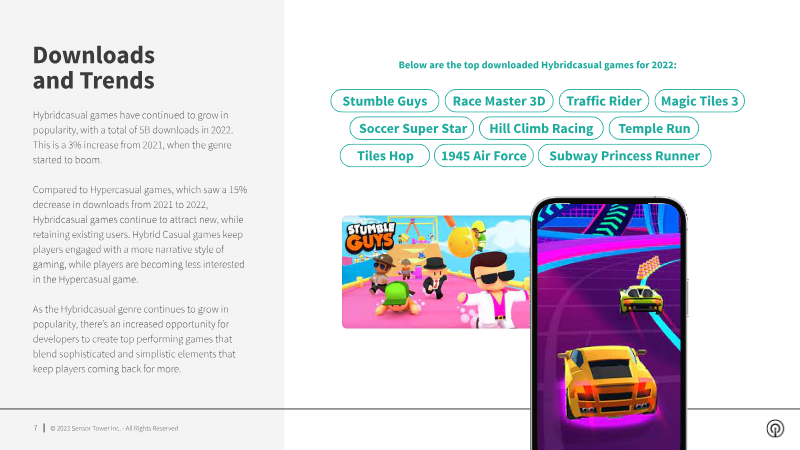
Hybridcasual downloads reached 5 billion in 2022.
Hybridcasual games blend simple mechanics with deeper metagame layers. Traditional hypercasual downloads decreased 15% between 2021 and 2022.
Session length
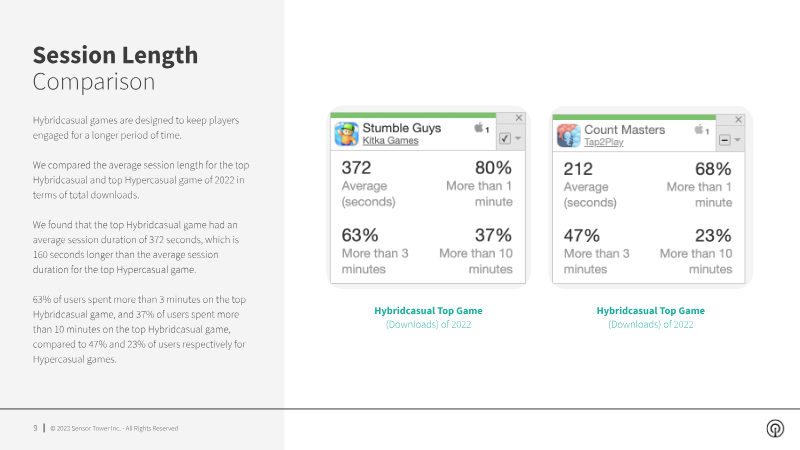
Top-tier hybridcasual sessions average 372 seconds.
Top-tier hybridcasual games average 372 seconds per session. This exceeds hypercasual benchmarks by 160 seconds.
Retention
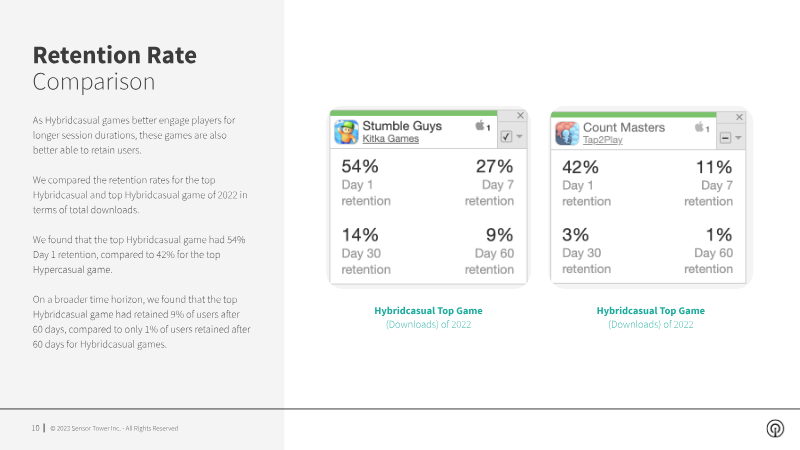
Hybridcasual titles achieve 54% Day 1 retention.
Hybridcasual titles achieve 54% Day 1 retention and 9% Day 60 retention. These rates significantly outperform traditional hypercasual benchmarks.
Revenue model
Hybridcasual shifts revenue toward optional ads and IAPs.
The model shifts revenue dependency away from mandatory advertisements. It moves toward optional, rewarded ad formats and increased in-app purchases.
Page 8 of the report2020502,009,629
2021666,984,768
2022974,586,761
IAP strategy
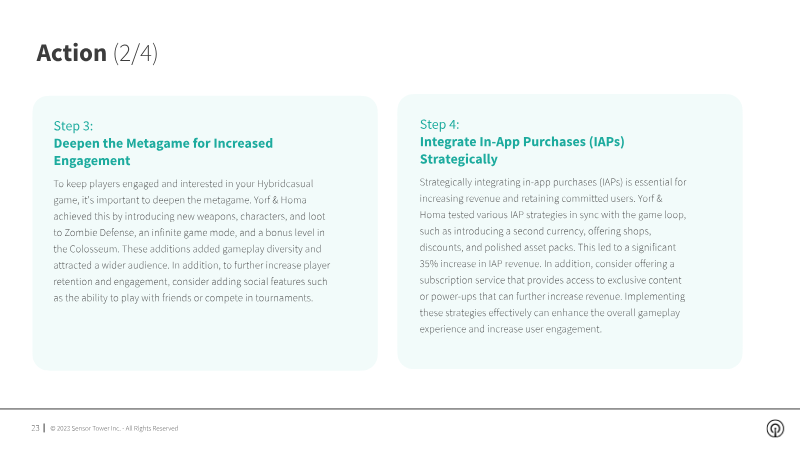
IAP strategies can increase revenue by up to 35%.
Integrating secondary currencies and exclusive content packs can increase IAP revenue by up to 35%.
Post-launch
Long-term success requires data-driven post-launch optimization.
Long-term success requires A/B testing of game economies and continuous content updates.
Page 24 of the report- 01A/B test game economiesTest economic systems with player data
- 02Segment audiencesTailor experiences to player groups
- 03Integrate new contentSustain engagement through continuous updates
The thesis
Blending mechanics increases retention, session length, and LTV.
Developers can significantly increase user retention, session length, and lifetime value. This is achieved by blending simple mechanics with deeper metagame layers.
1 / 7
Ask AI about this report