Market (Overall)·Updated Apr 8, 2026 by Tenjin
Report · January 1, 2023
Published by Tenjin
The report examines the evolving landscape of mobile gaming in 2023, focusing on the decline of pure hyper‑casual profitability and the rise of hybrid models that blend ad revenue with in‑app purchases. It attributes the downturn to factors such as iOS App Tracking Transparency, post‑COVID user behavior shifts, and stricter publisher gatekeeping that now demands “absolute hit” metrics. Consequently, developers increasingly self‑publish and diversify monetization strategies, incorporating IAPs and meta gameplay elements. Key findings highlight that India leads in ad impressions and IAP volume, while the United States dominates eCPM earnings across both Android and iOS platforms. Apple Search Ads remains the top iOS ad network, securing three of the highest positions, whereas Applovin dominates Android advertising. In monetization channels, ironSource and Meta networks top the rankings for revenue generation on both operating systems. The data set spans global markets, covering major regions such as North America and Asia, and includes both Android and iOS ecosystems. The methodology relies on Tenjin’s comprehensive data warehouse, aggregating millions of installs and ad impressions to produce rankings and predictive insights. The analysis integrates LTV prediction models, attribution visualization, and advanced metrics to provide actionable guidance for publishers transitioning from hyper‑casual to hybrid monetization strategies.
© Introduction Tenjin was there at the inception of the hyper-casual genre. Our free dashboard, pioneering ad revenue LTV metrics, and data warehouse for marketers (DataVault), along with other top-notch tools, have helped thousands of developers to scale their apps and build sustainable business models. We were the first to introduce a costeffective mobile marketing toolset that empowered smaller developers of new game genres to start publishing their hyper-casual games on their own. Today, the hyper-casual business is no longer as profitable as it used to be. There is a strong downward trend in ad revenue due to App Tracking Transparency (ATT) on iOS, changes in user-behavior post-COVID, and various other factors. Some publishers have stopped accepting hyper-casual games from third-party developers completely. And those that do still accept them demand the metrics of an "absolute hit" game. As a result, we see more and more developers opting for self-publishing instead of focusing solely on game development. Moreover, hyper-casual developers have started doing what they do best—innovating. They are adapting to the changing market by increasing the use of in-app purchases (IAPs) and the integration of meta gameplay components. In conclusion, we are seeing a mass transition of hyper game developers to hybrid ones. This is why we have decided to cover the entire Tenjin data set—including hybrid games—instead of just focusing on the hyper-casual industry.
p purchases (IAPs) and the integration of meta gameplay components. In conclusion, we are seeing a mass transition of hyper game developers to hybrid ones. This is why we have decided to cover the entire Tenjin data set—including hybrid games—instead of just focusing on the hyper-casual industry. In this report, we are not only going to take a closer look at the trends mentioned above. Our goal is to help smoothen the transition to hybrid by providing essential insights in the form of rankings that cover both sides of the coin: advertising and monetization.
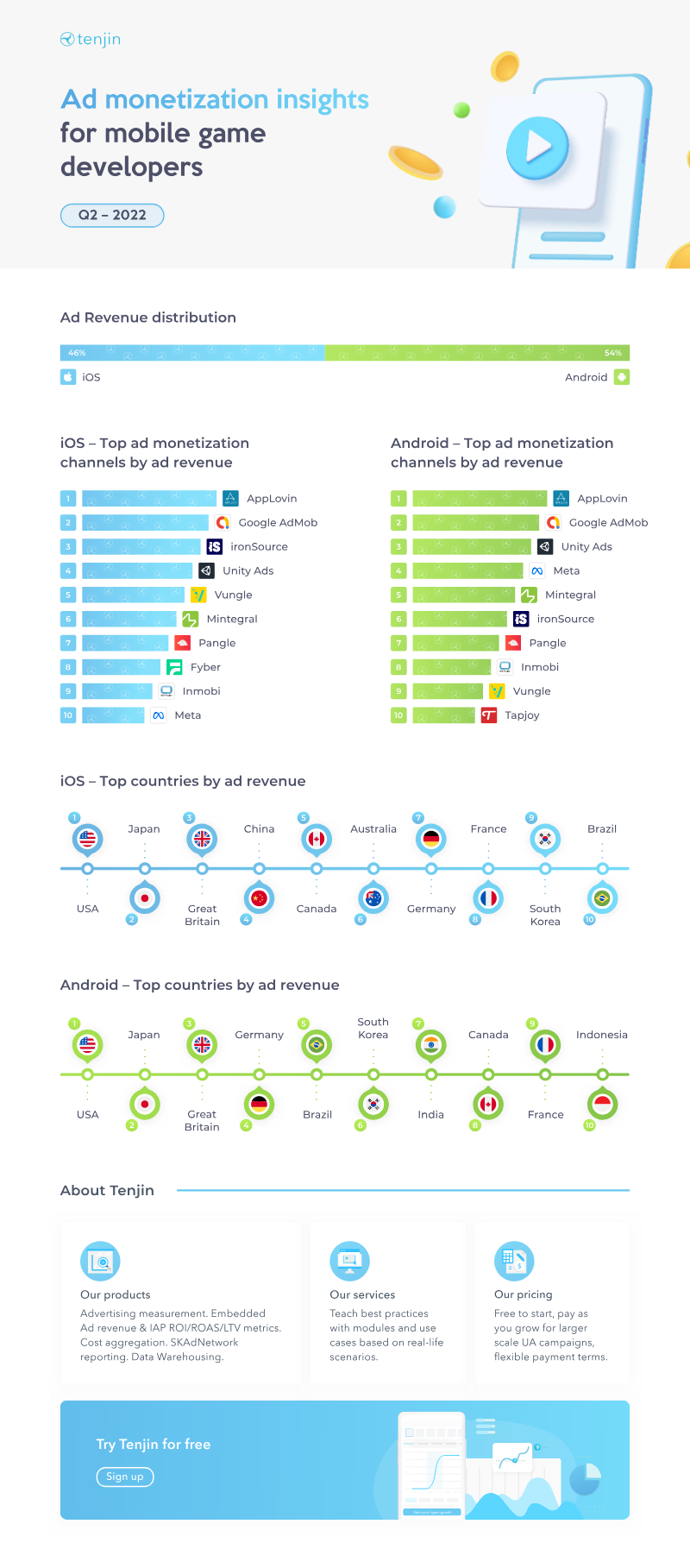
@ Summary Ad impressions and The number of IAPs India ranked #1 in The USA ranked #1 for eCPMs declined for grew on both the category of countries ad revenue and in-app both Android and Android and iOS with the highest number purchases on both iOS in 2022 in 2022 of installs on Android Android and iOS Search Ads iS 9 is APPLOVIN The iOS ad network rankings show that Apple Search Ads occupies the majority of #1 positions, with a total of three The Android ad Applovin is the #1 ironSource & Meta network rankings show monetization channel Audience are leading that both Applovin and by ad revenue the ad monetization ironSource are ranked on both iOS and ranking by eCPM for at #1 in two categories Android Android and iOS each respectively
LTV Prediction Ad Networks LTV Prediction Ad Networks d d Attribution Data Visualization Attribution Data Visualization M Monetization Marketing Automatior App Stores Advanced Metrics Analytics Organic Uplift https://hubs.ly/Q01MG2y_0
This analysis explores the hypercasual mobile gaming landscape, comparing market dynamics between Western regions, such as the United States and United Kingdom, and Eastern markets, specifically Japan and South Korea. Utilizing 2021 download data and consumer insights from Newzoo and Pangle, the findings reveal that hypercasual games accounted for 36 of the top 100 most-downloaded mobile games globally. While the genre dominates Western charts—representing nearly half of the top 100 downloads in the U.S. and U.K.—it maintains a smaller footprint in Japan and South Korea, where it comprises approximately 20% of top downloads. The sector is characterized by rapid evolution and high competition, with only eight of the top 36 hypercasual titles from 2020 remaining in the 2021 rankings. A significant shift in subgenre popularity occurred during this period, as runner and racing mechanics overtook simulation and ASMR themes. Demographically, hypercasual players across all four key markets skew male and are younger than the general mobile gaming population, with an average age below 30. These players often engage with midcore and hardcore genres, such as RPGs and strategy games, making them a valuable audience for cross-genre user acquisition. To combat historically low retention rates—often falling below 10% by day seven—developers are increasingly adopting "hybrid-casual" strategies. This involves integrating lite meta features, progressive difficulty, and live operations to deepen engagement. Monetization remains heavily reliant on in-game advertising, with interstitial videos being the most prevalent format. However, the rise of hybrid models has introduced new revenue streams, including "remove ad" IAPs and battle passes. Success in Eastern markets specifically requires deep localization, including busier user interfaces and culturally specific live events, to effectively scale and improve lifetime value.
Mobile gaming solidifies its position as the leading segment of the global video‑game market, with revenue projected to reach $83 billion in 2024, reflecting a 6 percent year‑over‑year increase. In contrast, home‑console spending is expected to decline by 1 percent to $42 billion, while handheld revenues are slated to fall 2 percent to just under $2.5 billion. The upward trajectory of mobile is driven primarily by rapid expansion in emerging regions such as India and Indonesia, where user acquisition and spending are accelerating faster than in mature markets. Within mobile, fast‑growing sub‑genres—particularly simulators and multiplayer online battle arenas—accounted for $2.34 billion, representing 5.8 percent of total mobile revenue, and achieved a modest 0.4‑point rise in download share during the latest reporting period. In the United States, monetisation patterns among mobile players continue to favour rewarded‑video advertisements. These ads recorded the highest net‑sentiment score of +20 points and were the most frequently encountered format in the third quarter of 2023. Other ad formats, including playable, native, banner/display, and standard video, lagged behind both in visibility and user sentiment, indicating a clear preference hierarchy that shapes publisher revenue strategies. Overall, the data underscore a market increasingly centred on mobile platforms, propelled by growth in developing economies and reinforced by user‑friendly ad experiences. Console and handheld segments face modest contractions, suggesting that future investment and innovation will likely concentrate on mobile‑first titles, emerging‑region outreach, and optimisation of rewarded‑video ad ecosystems to sustain growth.
The Mobile Ad Creative Index provides a comprehensive analysis of performance benchmarks and emerging trends within the mobile advertising ecosystem. Covering the period from January 2023 to January 2024, the data is derived from a massive sample of 602 billion impressions, 49.4 billion clicks, and 144 million installs across the gaming, e-commerce, finance, and entertainment sectors. The primary thesis asserts that while traditional formats like banners remain cost-effective for driving specific actions, high-engagement formats such as video, playables, and interstitials are significantly more effective at converting impressions into installs. Key findings highlight a stark contrast in performance across formats. In gaming, video and playable ads are over 20 times more likely to result in an install than banners, while interstitial ads in the finance sector are 18 times more likely to convert. However, cost-per-install (CPI) varies greatly by platform; for instance, native ads are the most cost-effective on iOS for gaming, whereas playables offer the best value on Android. In e-commerce, native and banner ads excel at driving post-install purchases, achieving install-to-action rates exceeding 30%. The analysis identifies several pivotal trends for 2024, most notably the integration of generative AI to enhance the speed and scale of creative production, such as automated localization and voice-overs. User-generated content (UGC) remains a dominant force, with optimized UGC ads showing 20% lower CPIs than standard video. Furthermore, there is a measurable shift toward longer, more immersive ad experiences. Spend on long-form video grew by 245% year-over-year, and "triple-page" ads—combining video, playables, and end cards—saw a 355% increase in spend, suggesting that users increasingly prefer transparent, high-quality engagement over short, deceptive creative tactics.
This analysis examines the performance of the mobile puzzle game category during the first quarter of 2023, utilizing data from the Apptica platform across 35 countries. The study focuses on the Apple App Store and Google Play, evaluating market trends, subgenre popularity, and advertising activity to provide a comprehensive overview of the sector’s economic and engagement landscape. The puzzle category remains a significant driver of mobile gaming, accounting for approximately 20% of all gaming downloads on iOS and 11% on Android. While Android dominates in total download volume—capturing 80% of the market share compared to 20% on iOS—the revenue distribution favors iOS, which generates 56% of total puzzle game earnings. Candy Crush Saga emerged as the leading title for combined revenue, while Royal Match demonstrated exceptional performance on iOS. Match 3 games represent the dominant subgenre, accounting for roughly one-third of all downloads and between 56% and 86% of revenue across the analyzed markets. Other subgenres, such as Trivia, Merge, and Word games, show varying levels of regional success; for instance, Merge puzzles are particularly profitable in Japan, while Bubble Shooters maintain a strong download presence in India and Pakistan. Advertising remains a critical component of the category’s strategy, with puzzle games representing over 50% of ad traffic on iOS and more than 33% on Android. Despite this high volume of traffic, the number of unique creatives is slightly higher on Android (32%) than on iOS (30.2%). The United States leads in both total downloads and revenue, followed by major markets including India, Brazil, Japan, and Germany, confirming the global reach and sustained commercial viability of the puzzle genre.