Unreal
Game
Documents about Unreal

The Unreal and Epic Games Ecosystem | Develop:Brighton 2024
The Epic Games ecosystem is defined by its dual identity as both a technology provider and a veteran game developer.
- Epic Games operates as a developer-first organization with 4,000 employees across 15 countries, utilizing the same internal tools and Unreal Engine technology to build their own titles, such as Fortnite, that they provide to the industry.
- The Unreal Engine business model is royalty-driven, meaning Epic only collects a maximum 5% royalty on gross revenue once a game exceeds $1 million in lifetime earnings.
- Epic Games charges a 12% revenue share for sales conducted through their marketplaces, which they position as a lower-cost alternative to industry-standard distribution fees.

Unreal Engine Development Update | Develop Brighton 2024
Unreal Engine is undergoing a strategic evolution focused on maximizing graphical fidelity, streamlining large-scale world building, and enhancing overall developer productivity.
- Unreal Engine 5.5 will introduce experimental support for skeletal mesh Nanite, enabling internal hierarchies, animation, and displacement on skinned meshes.
- Epic is optimizing Nanite for dense foliage rendering to improve performance on Gen 9 consoles, addressing current limitations with small-scale geometry aggregation.
- The engine is shifting toward a 'Mega Worlds' initiative, utilizing smart assets with embedded Procedural Content Generation (PCG) graphs to allow environment artists to build complex biomes without manual placement.
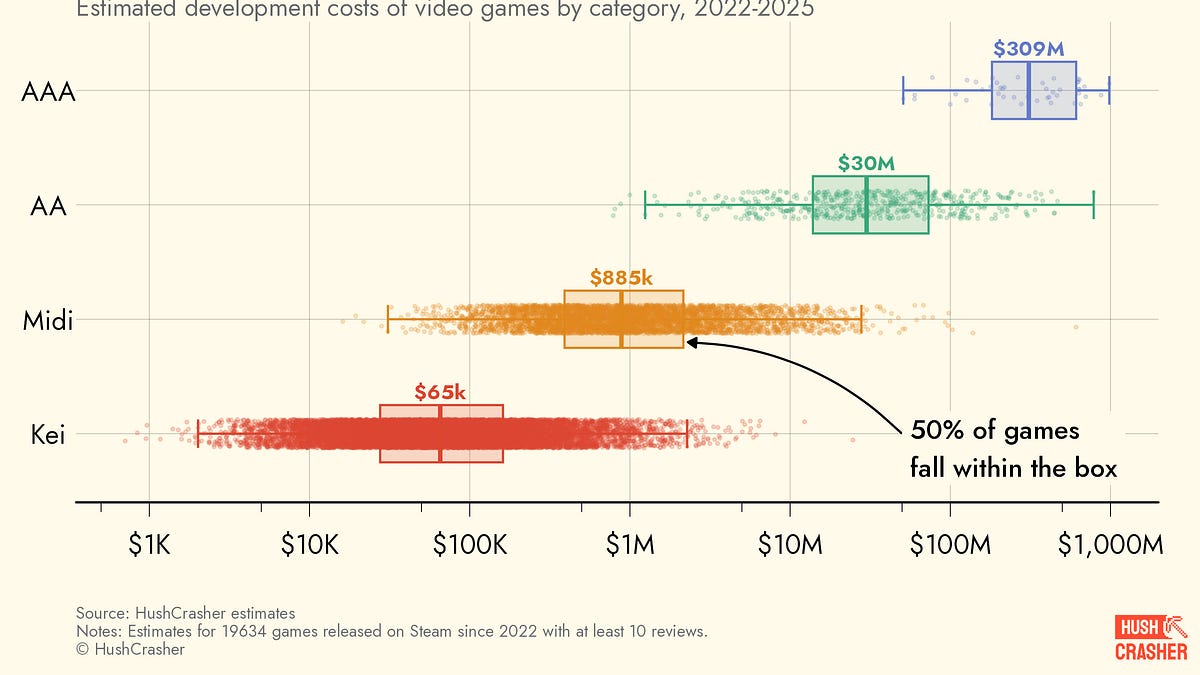
How Much Does It Cost to Make a Video Game?
The video game industry faces a persistent lack of transparency regarding development budgets, which are rarely disclosed publicly.
- Development costs scale exponentially with project scope, as evidenced by AA games costing 33 times more than 'Midi' games, and AAA titles costing 10 times more than AA titles.
- Multiplayer games represent only 16% of the total market but account for 50% of all games with budgets exceeding $10 million.
- Partnering with a publisher significantly increases development budgets, typically resulting in costs three to four times higher than self-funded projects.

AI and Human Dignity
The integration of artificial intelligence into game development must be strictly governed by ethical considerations, specifically the preservation of human dignity and the protection of intellectual property.
- The developer prioritizes ethical AI integration, limiting its use to administrative tasks like meeting summarization to avoid potential copyright, authorship, and human rights violations inherent in current data-scraping models.
- Performance optimization is a core design philosophy for the project, with the team actively considering bypassing the Unreal Engine 5 (UE5) renderer in favor of a simpler, more lightweight solution to avoid excessive hardware requirements.
- The project emphasizes manual craftsmanship over automated tooling, with 100% of the level design currently being built by hand rather than relying on procedural generation or AI-assisted workflows.

Market Update: UEFN Monetization, Meta’s Vision, and the Future of Consoles
The gaming industry is currently navigating a period of structural transition, characterized by a shift toward platform-driven economies, hardware innovation, and evolving financial models.
- Epic Games is expanding UEFN monetization to empower creators, though the long-term impact remains uncertain regarding whether this revenue is truly additive or if it cannibalizes existing Fortnite store spending.
- Meta is prioritizing an entertainment-focused strategy for its hardware, exemplified by the $799 price point for its latest AR glasses, which aims to attract early adopters to build an app ecosystem despite current limitations in user comfort and content depth.
- The gaming investment landscape is shifting toward specialized financing models, such as UA (user acquisition) financing, which allows companies to raise capital specifically for scaling growth rather than relying solely on traditional equity rounds.

Should You Switch To Godot? (GODOT vs. UNITY vs. UNREAL)
The discussion evaluates the comparative utility of Godot, Unity, and Unreal Engine for independent game developers, focusing on the trade-offs between engine accessibility, technical capability, and production requirements.
- Engine selection should be treated as a functional business decision based on project scope and technical requirements rather than an ideological preference for open-source software.
- Godot is the optimal choice for 2D projects and developers prioritizing a lightweight, efficient architecture and cost-effectiveness.
- Unity and Unreal Engine remain the industry standards for large-scale production, complex 3D rendering, and reliable console deployment.
Gameplan Launches Unreal Engine 3D Fundamentals Certification
Gameplan, an edtech company based in Upsala, Sweden, has introduced a new Unreal Engine 3D Fundamentals Certification program.
- Gameplan has launched an Unreal Engine 3D Fundamentals Certification program developed in direct collaboration with Epic Games.
- The certification covers a broad range of technical skills, including game development, animation, virtual production, visual effects, architecture, and extended reality (XR) simulations.
- Individual vouchers for the certification are priced at approximately $50 USD, with additional bulk and course-specific pricing options available.



Skonsolidowany Raport Półroczny za okres 01.01.2025-30.06.2025
PCF Group reported a significant increase in consolidated sales revenue for the first half of 2025, reaching 115.3 million PLN compared to 76.3 million PLN in the same period of 2024.
- PCF Group reported a consolidated net loss of 21.3 million PLN for H1 2025, an improvement over the 33.3 million PLN loss in H1 2024, despite a revenue increase to 115.3 million PLN.
- Liquidity remains a critical concern as cash reserves dropped from 58.1 million PLN to 11.2 million PLN, following a failed 350 million PLN funding round in late 2024.
- The company executed a strategic pivot toward third-party development, securing work-for-hire collaborations with Microsoft (Project Maverick/Gears of War: E-Day), Sony (Project Delta), and Krafton.
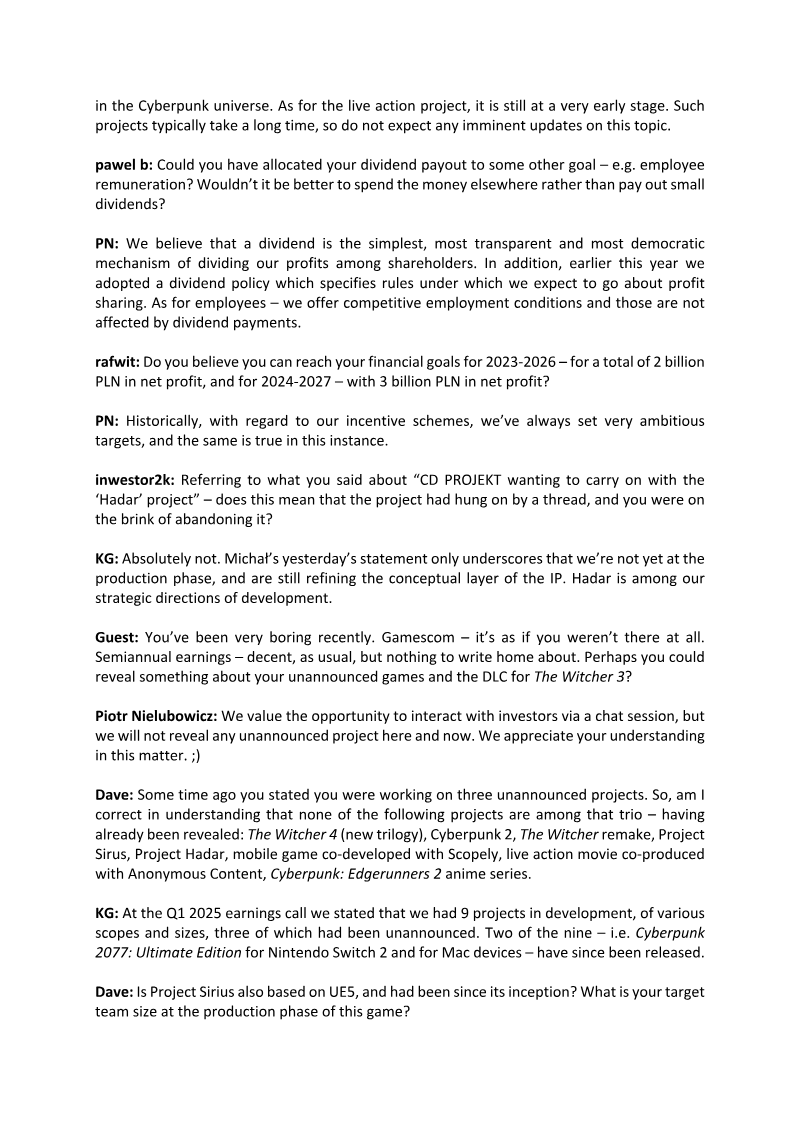
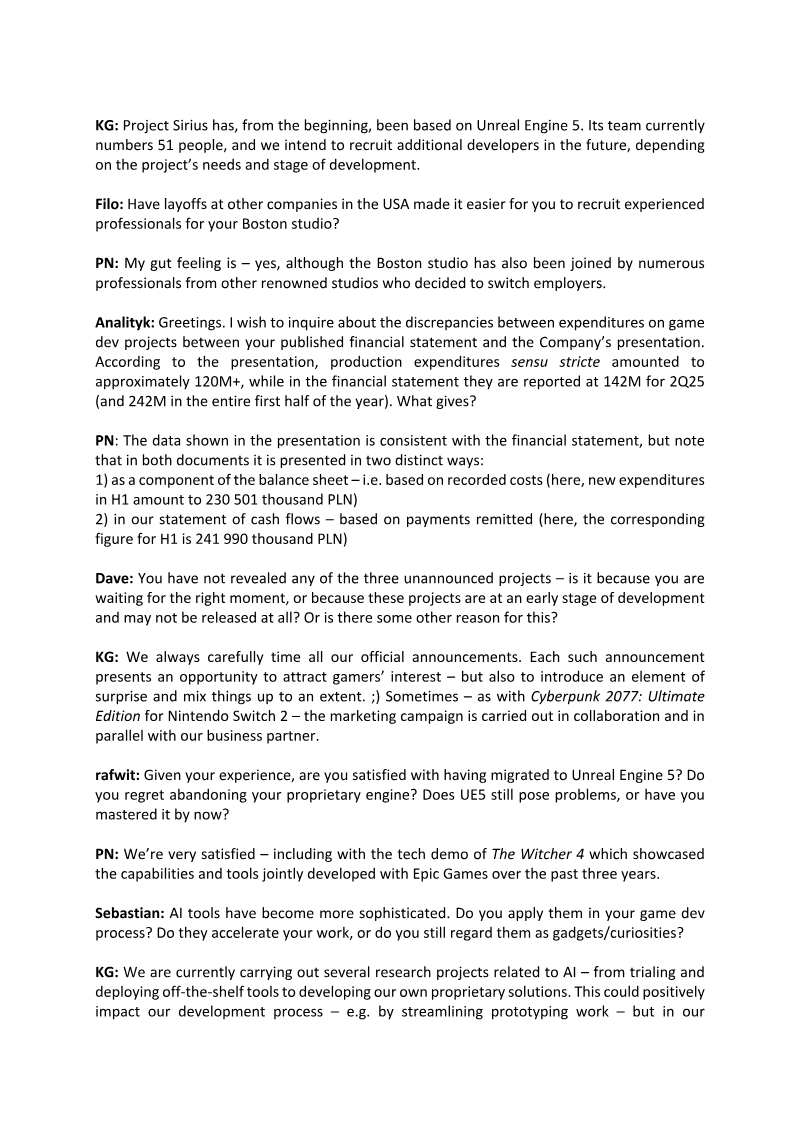

CD PROJEKT Group H1 2025 Earnings: Chat Session with Individual Investors
The CD PROJEKT Group H1 2025 investor chat served as a forum for management to address financial performance, project development, and strategic direction.
- CD PROJEKT is maintaining its strategic focus on large-scale, story-driven AAA open-world titles, rejecting a pivot toward smaller AA projects.
- The company is managing a pipeline of nine active projects, including Project Sirius, a multiplayer title built on Unreal Engine 5 with a dedicated team of 51 developers.
- Development of the Cyberpunk 2 project is scaling up, with management targeting a headcount of 150–160 staff by the end of 2025.
CD Projekt H1 2025 Earnings Report
CD PROJEKT demonstrated sustained financial stability and strategic expansion during the first half of 2025, reporting consolidated revenues of 443 million PLN and a net profit of 155 million PLN.
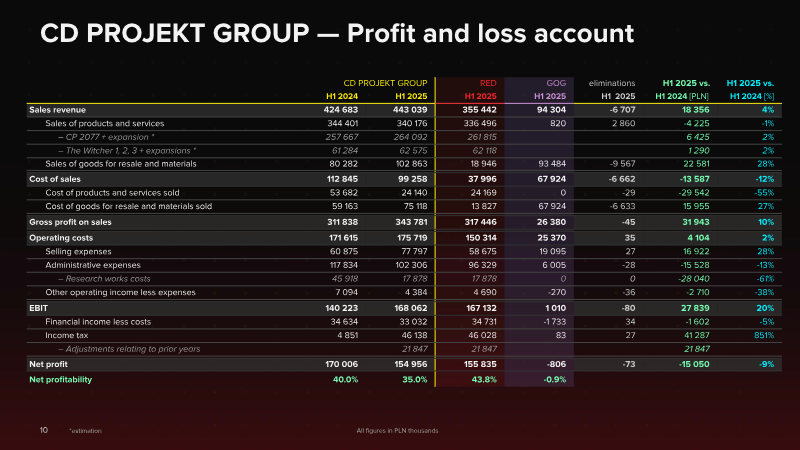
- CD Projekt reported H1 2025 consolidated revenues of 443 million PLN and a net profit of 155 million PLN, driven by the Cyberpunk 2077 franchise.
- The company invested over 240 million PLN in development expenditures during H1 2025, marking the transition of the Cyberpunk 2 project into preproduction.
- The Witcher 3: Wild Hunt surpassed 60 million units sold, while the Phantom Liberty expansion reached 10 million units sold.
CD PROJEKT Group H1 2025 Earnings Transcript
The CD PROJEKT Group’s H1 2025 earnings report outlines a period of strategic expansion, characterized by significant technological milestones and the diversification of its core franchises.
- CD PROJEKT Group reported H1 2025 net profit of 155 million PLN and sales revenue of 443 million PLN, a 4% increase year-over-year.
- The company maintains a strong liquidity position with 1.43 billion PLN in cash, deposits, and bonds as of June 2025.
- Development of the next Cyberpunk title (Cyberpunk 2) moved into pre-production in Q2 2025, while The Witcher 4 reached a technical demonstration milestone on Unreal Engine 5.

CD PROJEKT Group H1 2025 Earnings Presentation
The CD PROJEKT Group H1 2025 earnings presentation outlines the company’s financial performance and operational progress for the first half of the year.
- CD PROJEKT reported H1 2025 sales revenue of 443 million PLN, a 4% year-over-year increase, with a net profit of 155 million PLN and a 35% net profitability margin.
- Development expenditure is a primary focus, with 230.5 million PLN in new spending during H1 2025 and a 29% increase in capitalized development expenditures contributing to total assets of 3.19 billion PLN.
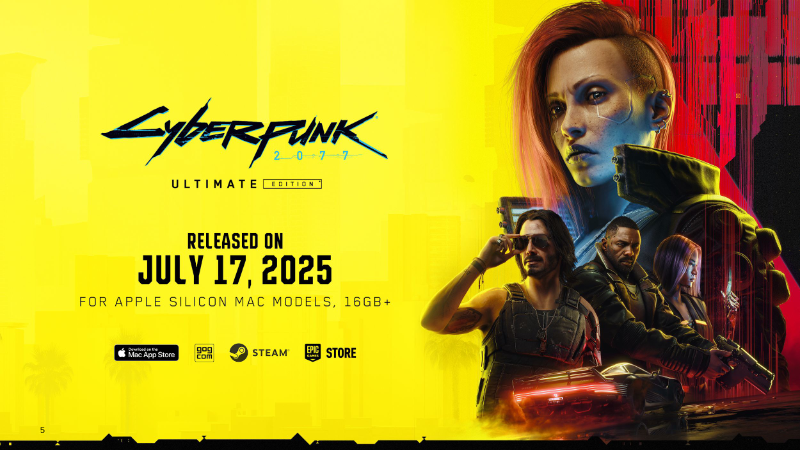
- The company is expanding the Cyberpunk 2077 franchise with upcoming releases for the Nintendo Switch 2 and Apple Silicon Mac models.