Shenmue
Game
8 documents in the library are about Shenmue, from writers such as DiGRA and Game Dev Unchained. Each has a summary and key insights with the page they come from.
Connections
Each row is a game or company named alongside Shenmue, each column a document, oldest first. A mark means that document names it. Select a row to see those documents.
Documents about Shenmue
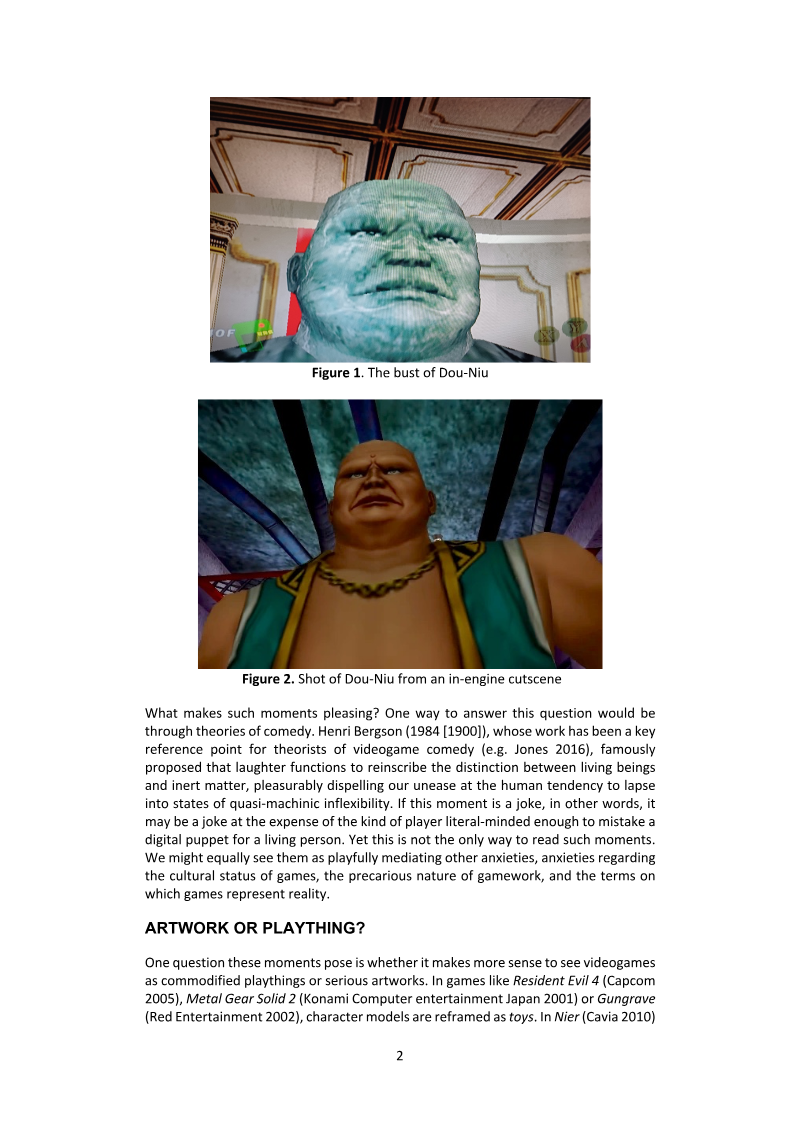
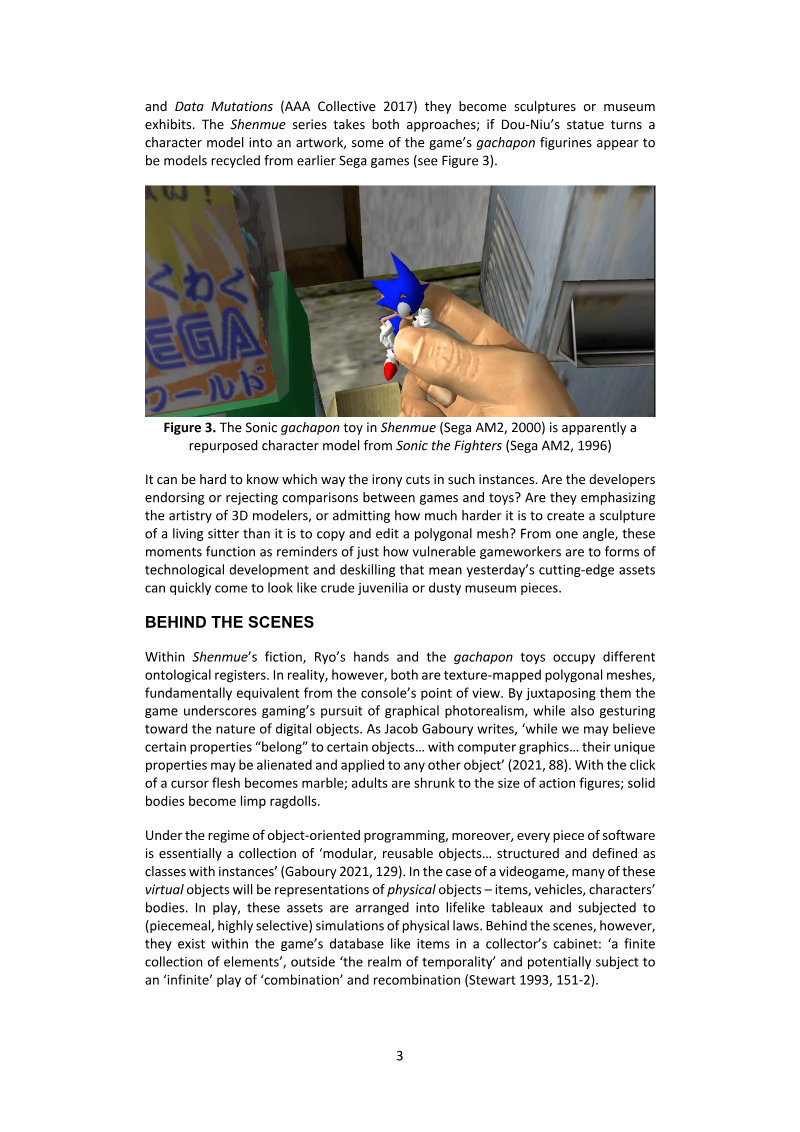
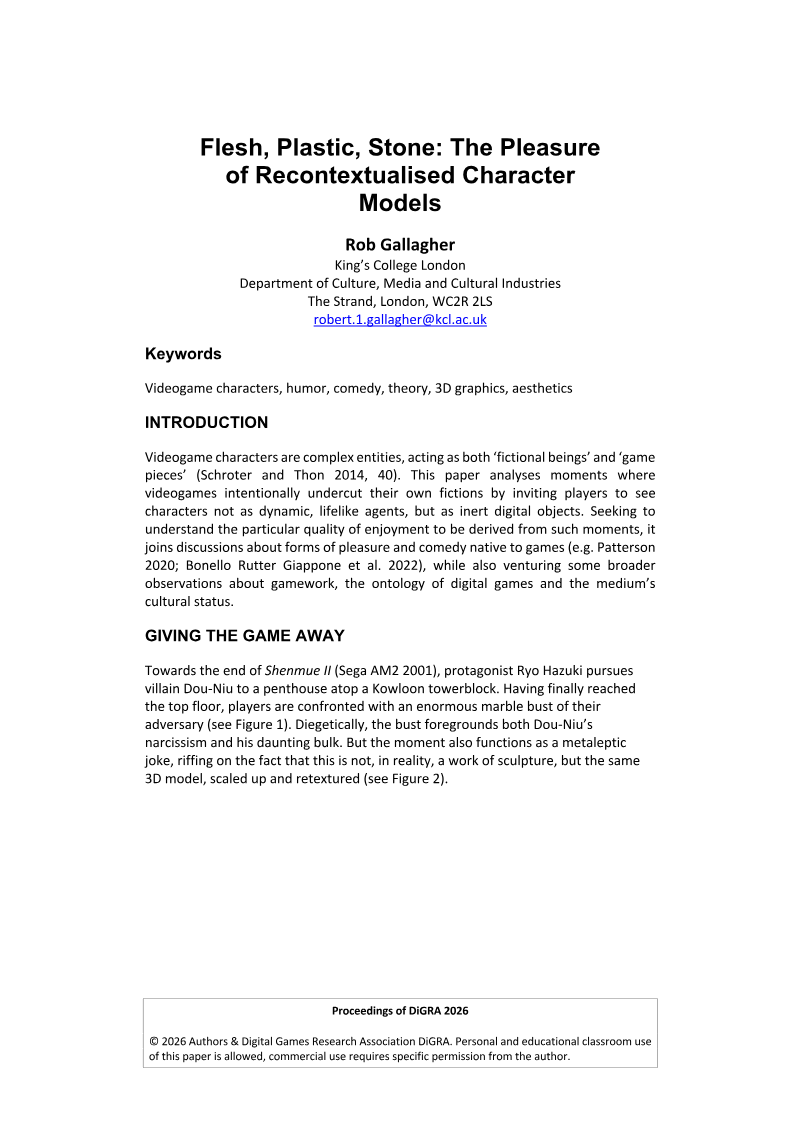
Flesh, Plastic, Stone: The Pleasure of Recontextualised Character Models
This paper examines moments in videogames that deliberately undercut their own fictions by presenting characters as inert digital objects rather than lifelike agents.
- The paper argues that moments where game characters appear as statues, toys, or museum exhibits deliberately undercut their own fictions and produce a distinctive pleasure, analysed through theories of comedy, the ontology of digital objects, and the cultural status of games.
- Its central example is Shenmue II, where a marble bust of a villain turns out to be the same scaled and retextured 3D model used for the character himself.
- The author contends such moments do more than mock players who mistake digital puppets for living people (as Bergson's theory of laughter might suggest), also mediating anxieties about games as commodified playthings versus serious art, and the deskilled, precarious labour of developers whose cutting-edge assets become obsolete.
From Play to Playces: The Representation of Contexts of Play in Japanese Games and Popular Media
This paper examines how Japanese popular media, including manga, anime, video games, and television, represents "playces," the physical and social contexts in which play occurs, such as game centers, entertainment districts, theme parks, and domestic spaces.
- The paper argues that depictions of 'playces' (game centers, entertainment districts, theme parks, domestic spaces) in Japanese manga, anime, games, and TV are meaningful sites rather than neutral backdrops, where spatial affordances, cultural rhetorics of play, and digital game development intersect.
- The analysis draws on a corpus of roughly forty items, including manga such as Game Center Arashi and Hi-score Girl, games such as the Yakuza, Shenmue, and Persona series, and the TV program Game Center CX, and is funded by the Japan Society for the Promotion of Science.
- Its framework combines semiotic models with dimensions covering architectural properties, ludic activities, space-player identity relationships, societal and self-rhetorics, and, for games, the interaction between simulated space and player agency.
Japanese Ludiquity: Spatial Reframing of Play in Japan
This paper by Vincenzo Idone Cassone, presented at DiGRA 2022, examines how Japanese cultural and historical developments reshaped the spatial and temporal frames of play, and how these changes helped lay groundwork for the broader global process of "ludicization," the blurring of boundaries between play and everyday life.
- The paper argues that Japan's play contexts, including arcades, game centers, entertainment districts, and theme parks, gained autonomy in relation to time and space from the late 1970s onward, challenging the traditional view of play as a bounded, separate, unproductive activity.
- The author contends that ludicization (the blurring of play and everyday life) is usually framed as a Western phenomenon dating to roughly twenty years ago, whereas Japan's influence on this process has received little systematic scholarly attention.
- The study identifies arcades, home consoles, cosplay, gacha systems, and otaku behavior as key Japanese game-related cultural practices that shaped the spatial and social boundaries of play.

Shenmue 3 Versus Backers | Games ReCAP Episode 022
The development of Shenmue 3 serves as a cautionary case study regarding the intersection of high-profile crowdfunding and established intellectual property.
- Ys Net alienated its core Kickstarter backers for Shenmue 3 by pivoting to an Epic Games Store exclusivity deal and withholding promised retail-exclusive content.
- The Shenmue 3 case demonstrates that prioritizing immediate financial incentives over long-term brand equity can cause significant misalignment between developers and their initial capital providers.
- High-profile crowdfunding campaigns for established franchises often distort industry standards by under-budgeting and over-promising, which creates unrealistic expectations for development costs and timelines.

Jedi Fallen Order Not So Bad | Games ReCAP Episode 006
Star Wars Jedi: Fallen Order suffers from a fundamental disconnect between its source material and its execution.
- The gaming industry is shifting away from traditional annual sequel models, such as those seen in Call of Duty, toward persistent games-as-a-service models that prioritize long-term evolution and player mastery.
- Star Wars Jedi: Fallen Order is criticized for a disconnect between its source material and gameplay, specifically failing to capture the tension of lightsaber combat through its reliance on arcade-style mechanics.
- High-quality single-player titles like Elden Ring and God of War remain industry pillars, demonstrating that strong brand reputation is a primary driver of commercial success.
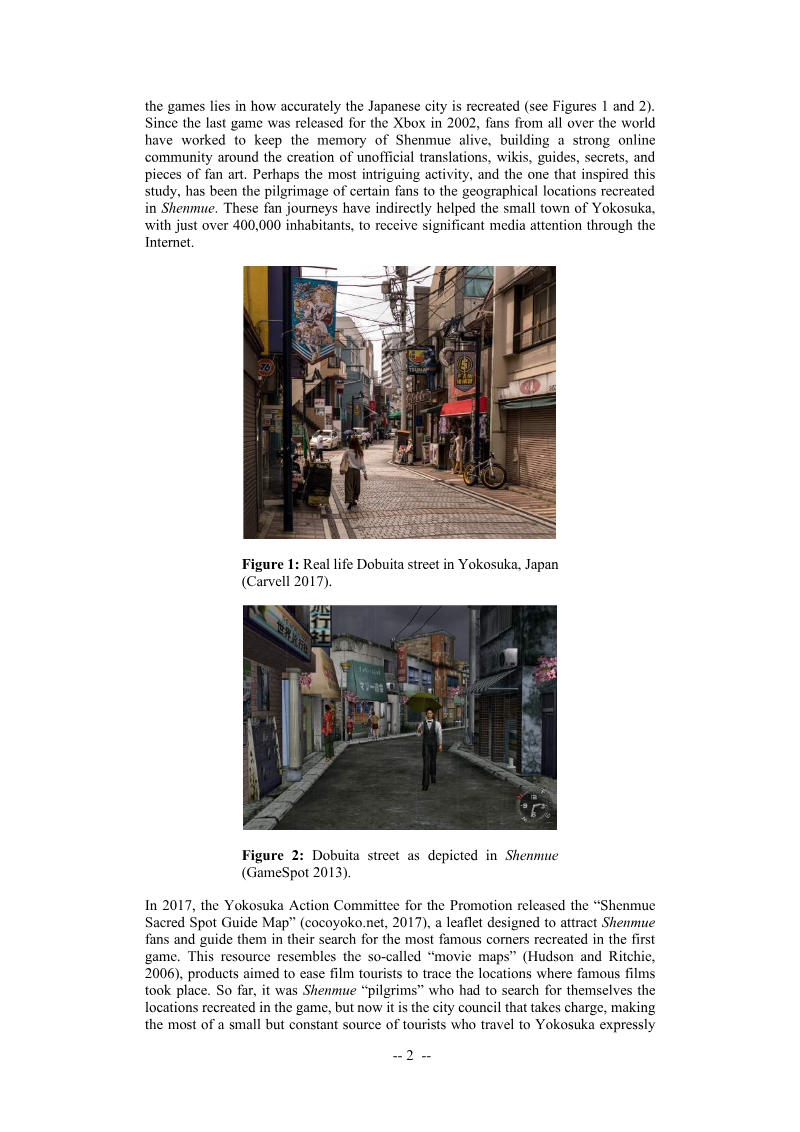
Promoting Yokosuka via Video Game Tourism: The Case of the Shenmue Sacred Spot Guide Map
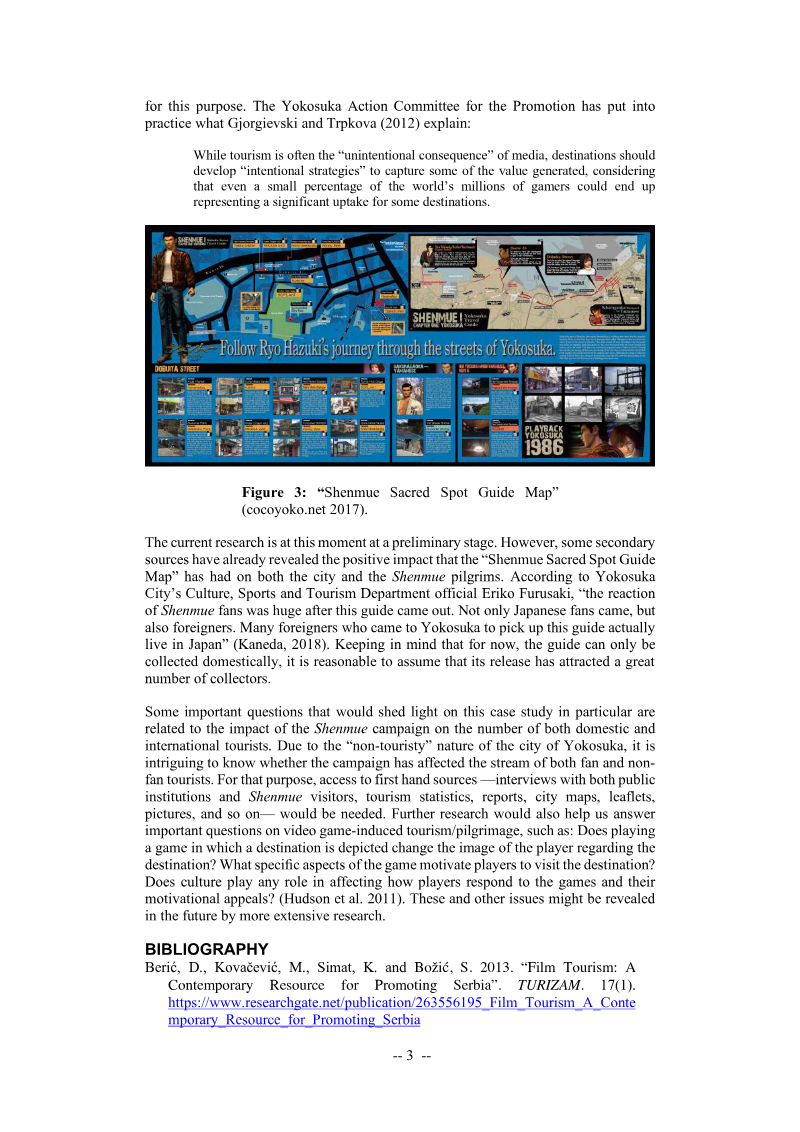
This paper examines how the video game Shenmue (SEGA-AM2, 2000) has generated tourism to Yokosuka, Japan, and how the city's Yokosuka Action Committee for the Promotion responded by releasing the "Shenmue Sacred Spot Guide Map" in 2017.
- Yokosuka, a city of roughly 400,000 people in Japan, has drawn tourism driven by fan pilgrimages to locations recreated in SEGA-AM2's 2000 game Shenmue, a phenomenon the author calls "video game-induced tourism" or "secular pilgrimage."
- In 2017 the Yokosuka Action Committee for the Promotion released the "Shenmue Sacred Spot Guide Map," shifting the municipality from passively benefiting from fan travel to deliberately capturing its economic value through a promotional leaflet modeled on film "movie maps."
- Per an interview with a Yokosuka City tourism official, demand for the guide is strong among both Japanese and foreign fans, many of whom were residents of Japan, and the guide is currently available only domestically.

Realism and the Everyday in Digital Games
Paul Martin's paper develops Alexander Galloway's theory of "social realism" in digital games, arguing that realism's critical potential becomes visible only when three elements are considered together: the mode of representation, the everyday, and what the Marxist critic György Lukács called the social totality.
- Martin revises Alexander Galloway's theory of 'social realism' in digital games, arguing that realism's critical potential emerges only when the mode of representation, the everyday, and Lukács's concept of the social totality are considered together.
- The paper critiques Galloway's account for neglecting representation, conflating realism with critique in general, and relying on a 'congruence requirement' that ties the everyday life depicted in a game to players' own everyday experience.
- Drawing on Lukács's defence of literary realism and Yuri Lotman's view of everyday life as a boundary zone where personal habits collide with dominant codes, Martin frames realism as a means of linking individual lives to the totality of social relations.
Space, Agency, Meaning and Drama in Navigable Real-Time Virtual Environments
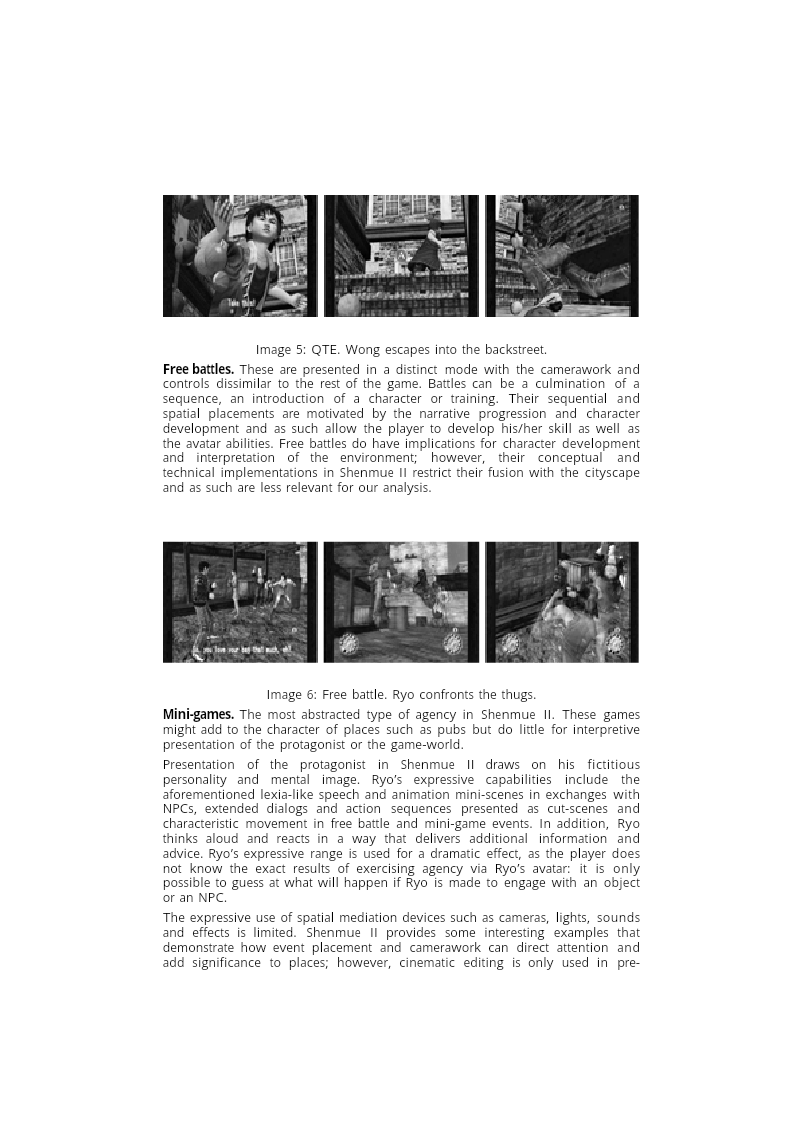
Navigable real-time virtual environments, examined through the action-adventure role-playing game Shenmue II, derive their meaning and dramatic force from a hybrid structure that combines rule-based, systematic organization with situational knowledge drawn from real-world experience.
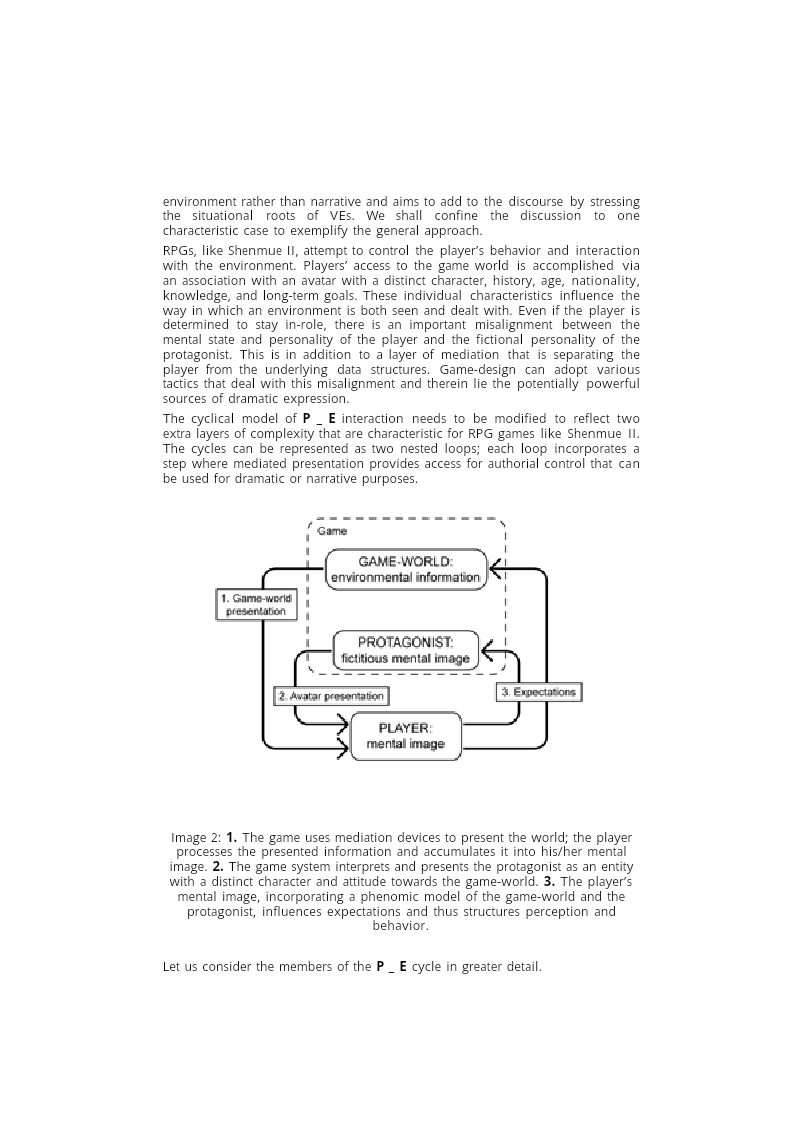
- Navigable real-time virtual environments derive meaning and dramatic force from a hybrid of rule-based systematic organization and situational knowledge drawn from real-world experience.
- Grounded in environmental psychology, the authors frame person-environment interaction as a cyclical, bi-directional process in which perception is continually shaped by prior experience, a cycle virtual environments replicate with an added layer of authorial mediation.
- The authors conclude that interactivity and culturally situated associations are the principal sources of engagement, and designers who neglect links to the external world risk producing confusion rather than immersion.