
Counter-Strike
GameBy Valve · Released Nov 9, 2000
Reports and documents about Counter-Strike
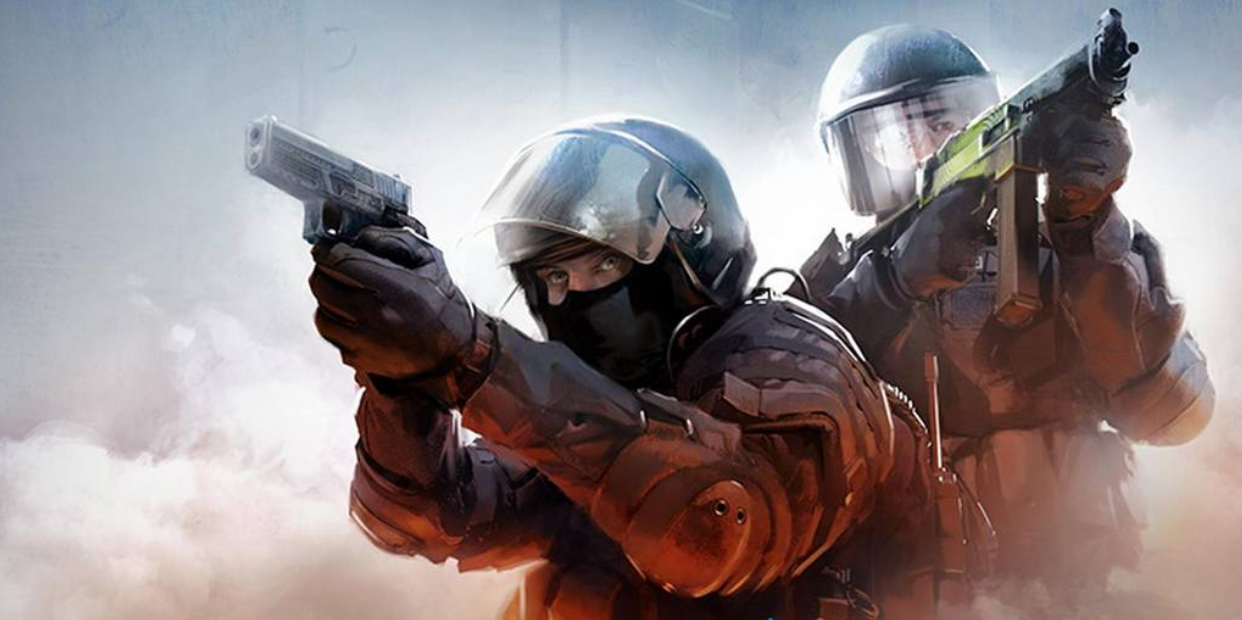
How Counter Strike Can Sell a Single Skin for $61,000
The success of Counter-Strike: Global Offensive in generating significant revenue through digital weapon skins is rooted in a sophisticated ecosystem that leverages scarcity, social visibility, and a robust secondary market.
- Valve’s integration of the Steam Marketplace allows for a player-driven economy that removes price ceilings, enabling individual digital skins to sell for as much as $61,000.
- The 'Weapon Wear' system uses procedural generation to assign a unique floating-point value to every item, creating thousands of permutations for a single skin and driving long-term scarcity.
- CS:GO utilizes a three-variable RNG system for case openings—skin rarity, wear value, and StatTrak status—which exponentially increases the difficulty of obtaining 'perfect' items.

One Fourth of All German Internet Users Play Multiplayer Games
Multiplayer gaming serves as a significant social and cultural pillar within the German digital landscape, engaging a substantial portion of the population.
- Approximately 18 million German internet users aged 16 and older, representing 27% of that demographic, engage in multiplayer gaming.
- About 21% of German internet users, totaling 14 million people, dedicate up to 50% of their total gaming time to multiplayer experiences.
- Multiplayer gaming preferences are split between online play (8.4 million users), local/same-room competition (4.7 million users), and a mix of both (4.9 million users).
NEXON Q2 2016 Earnings Conference Call Transcript
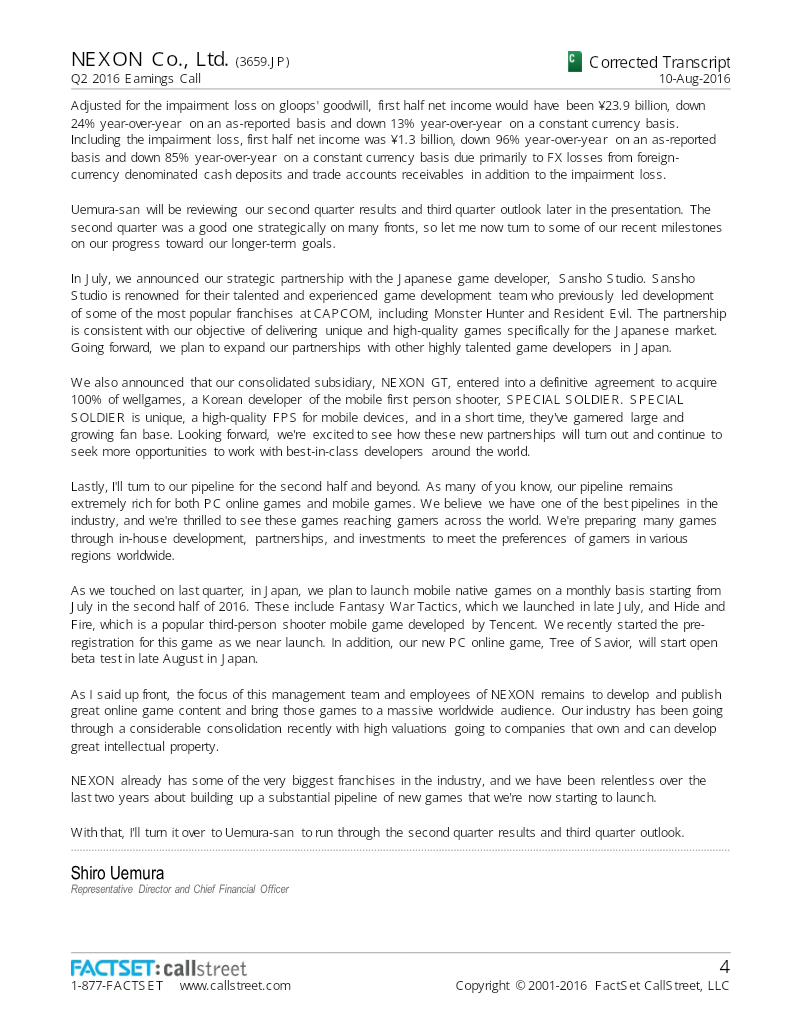
Nexon’s financial performance during the second quarter of 2016 reflects a complex interplay between robust operational growth and significant macroeconomic volatility.
- Nexon reported stagnant as-reported revenue for Q2 2016 due to foreign exchange headwinds, despite underlying growth in the Chinese market driven by Dungeon&Fighter.
- The company projects year-over-year declines in both revenue and operating income for Q3 2016, citing currency depreciation against the Japanese yen and softening performance in China and Korea.
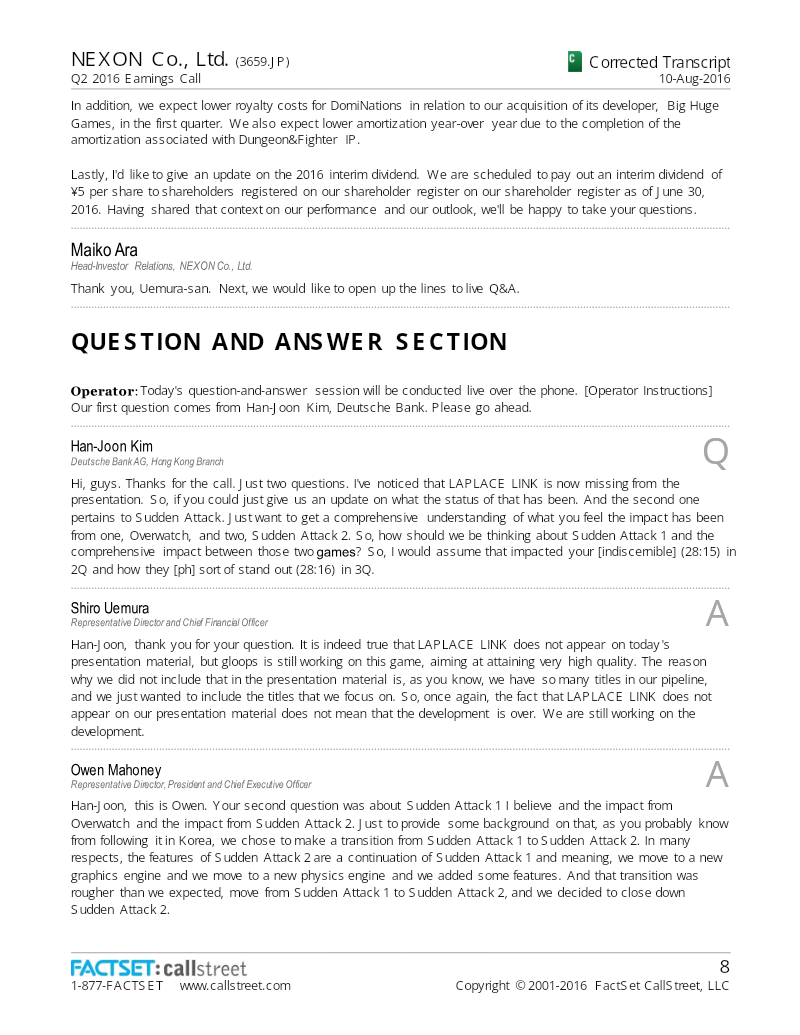
- Nexon discontinued Sudden Attack 2 following its failure to meet market expectations, signaling a strategic shift to streamline the development pipeline toward more viable PC and mobile projects.
Mapping the Shooter Genre
The shooter genre is often viewed through a monolithic lens, but analysis of player motivation reveals significant diversity in how gamers engage with these titles.
- The primary differentiator in the shooter genre is a strong negative correlation between competition and story, meaning games typically prioritize either high-stakes competitive play or narrative-driven experiences.
- Shooter games are defined by three core axes of motivation: competition versus story, community versus competition, and strategy versus competition.
- Counter-Strike stands out as a significant outlier in the genre, demonstrating a much higher level of competitive intensity compared to other shooter titles.
Revisiting the Strategy Genre Map: Age, Audience Homogeneity, and the Lasso Effect
This analysis updates the strategy genre map by integrating demographic and motivational data from over 220,000 global gamers.
- Games with high strategic complexity attract more homogenous audiences with similar motivation profiles, whereas high-excitement games do not exhibit this restrictive 'lasso' effect.
- There is a clear correlation between gameplay pace and player age: fast-paced competitive titles like League of Legends, DotA, and Counter-Strike attract the youngest audiences, while turn-based or pause-able games like Civilization and SimCity attract the oldest.
- World of Tanks is a significant outlier in the strategy genre, demonstrating the broadest age appeal among all analyzed titles with a standard deviation of 10.3.
Most Popular Games by Gaming Motivations
The primary objective of this analysis is to categorize popular video games based on specific player motivations, providing a framework to understand what drives engagement across different gaming experiences.
- Quantic Foundry analyzed data from over 100,000 gamers to map specific game titles to 12 distinct psychological motivations, normalizing results to account for the base-rate popularity of major franchises.
- Games associated with the 'Power' motivation include World of Warcraft, Diablo, and League of Legends, while 'Completion' is driven by titles like Final Fantasy, Assassin’s Creed, and Animal Crossing.
- The 'Excitement' and 'Destruction' categories are dominated by high-intensity franchises such as Call of Duty, Battlefield, Destiny, and Counter-Strike.
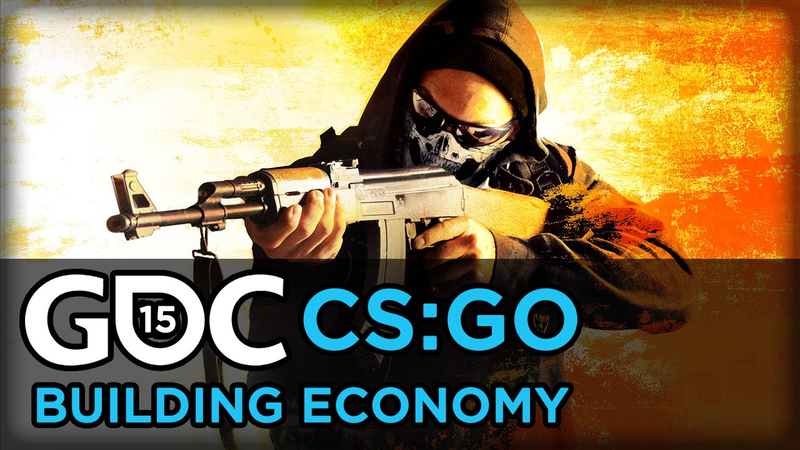
Building the Content that Drives the Counter-Strike: Global Offensive Economy
The Counter-Strike: Global Offensive economy functions as a highly scalable, community-driven ecosystem designed to maximize player engagement without compromising competitive integrity.
- Valve launched the 'Arms Deal' update for Counter-Strike: Global Offensive to build an economy with a small team of two artists by leveraging community-generated content through the Steam Workshop, which eventually grew to over 30,000 user-authored weapon finishes.
- To scale content production efficiently, Valve implemented procedural coloration and shader-based techniques like hydrographic-style texturing and anodization, allowing for a high volume of aesthetic variety without requiring unique assets for every item.
- Valve discovered that players valued 'paint gun' aesthetics over realistic military camouflage, proving that the game's economy is driven by its identity as a competitive sport rather than a military simulation.
Q1 2013 Nexon Co. Ltd Earnings Conference Call and Webcast
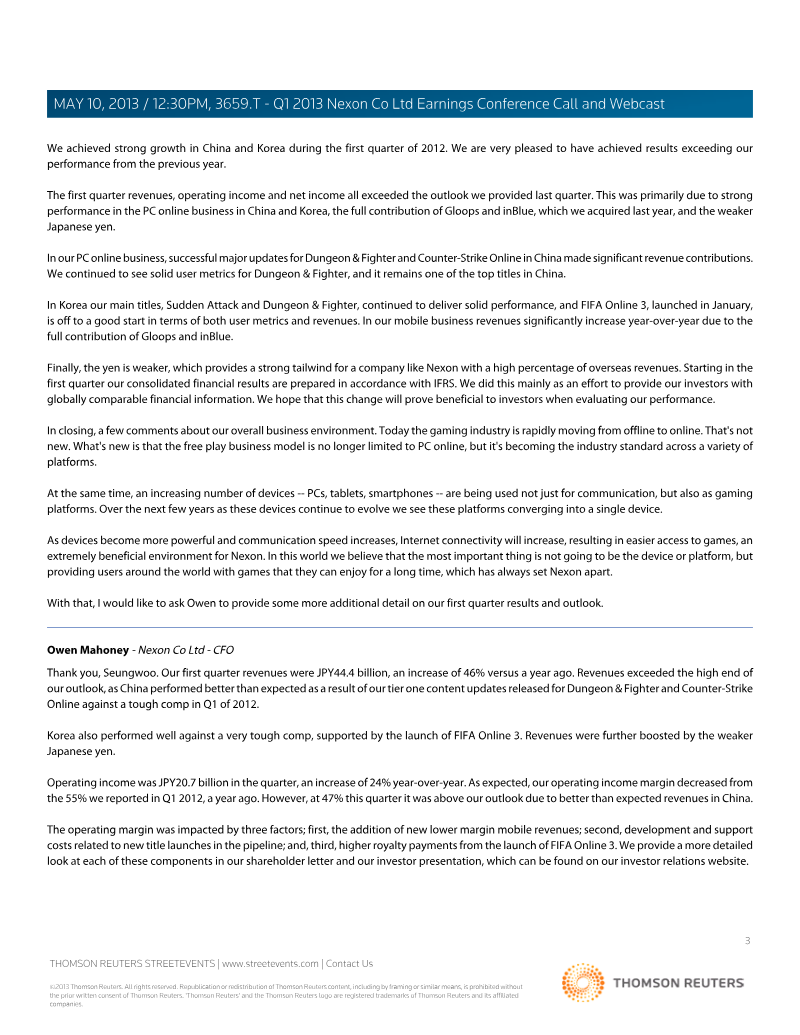
Nexon’s first quarter 2013 earnings call highlights a period of significant financial growth and strategic transition for the company.
- Nexon reported Q1 2013 revenue of JPY 44.4 billion, a 46% year-over-year increase, with operating income reaching JPY 20.7 billion and net income at JPY 15.2 billion.
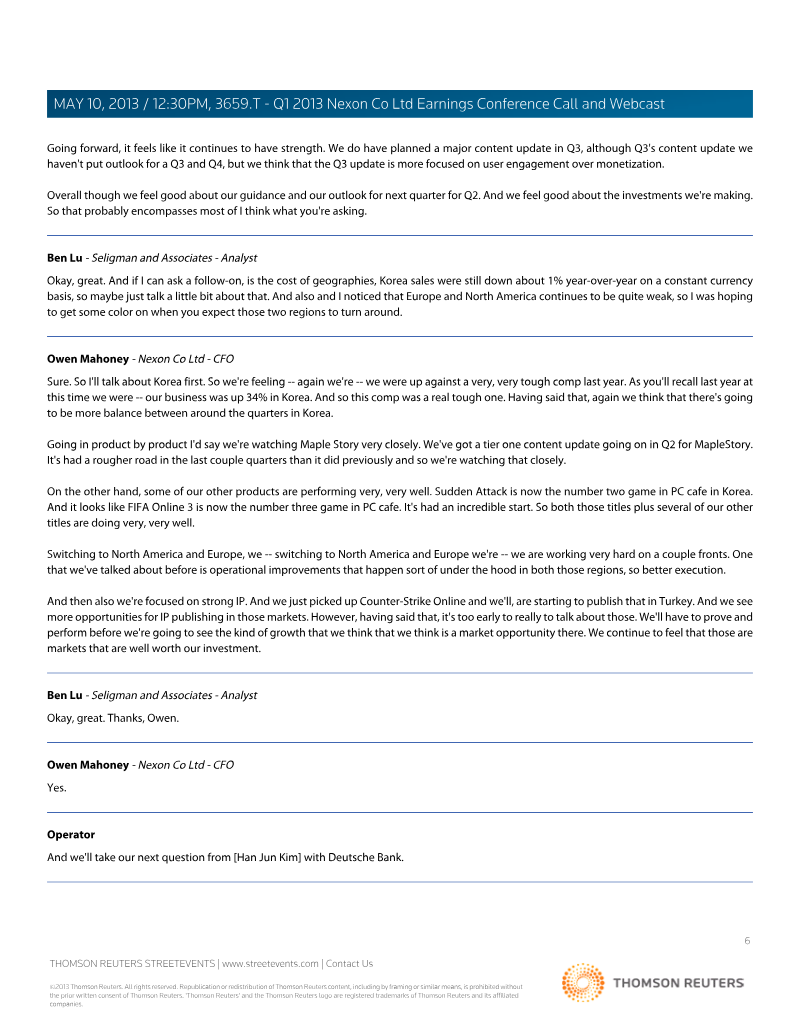
- Growth was primarily driven by strong PC online performance in China and Korea, fueled by content updates for Dungeon & Fighter and Counter-Strike Online, and the launch of FIFA Online 3.
- The company successfully integrated acquired mobile entities Gloops and inBlue, contributing to a strategic pivot toward mobile gaming despite the lower margins associated with platform fees.
Nexon Investor Presentation: Q3 2012
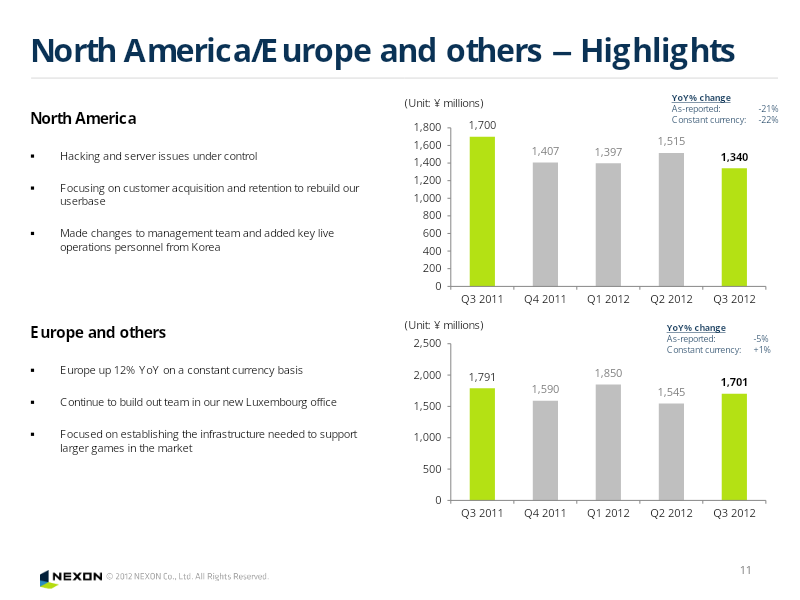
Nexon’s third-quarter 2012 financial results reflect a period of strategic transition characterized by steady revenue performance and a significant expansion into the mobile gaming sector.
- Nexon reported Q3 2012 revenue of ¥24.2 billion, which was flat year-over-year but represented a 3% increase on a constant currency basis.
- The acquisition of gloops, Inc. was completed to establish a mobile gaming presence, with mobile revenue projected to reach 20% to 25% of the company's total moving forward.
- China remains the company's primary market, contributing 47% of total revenue and experiencing 31% year-over-year growth.
Nexon Second Quarter 2012 Financial Results
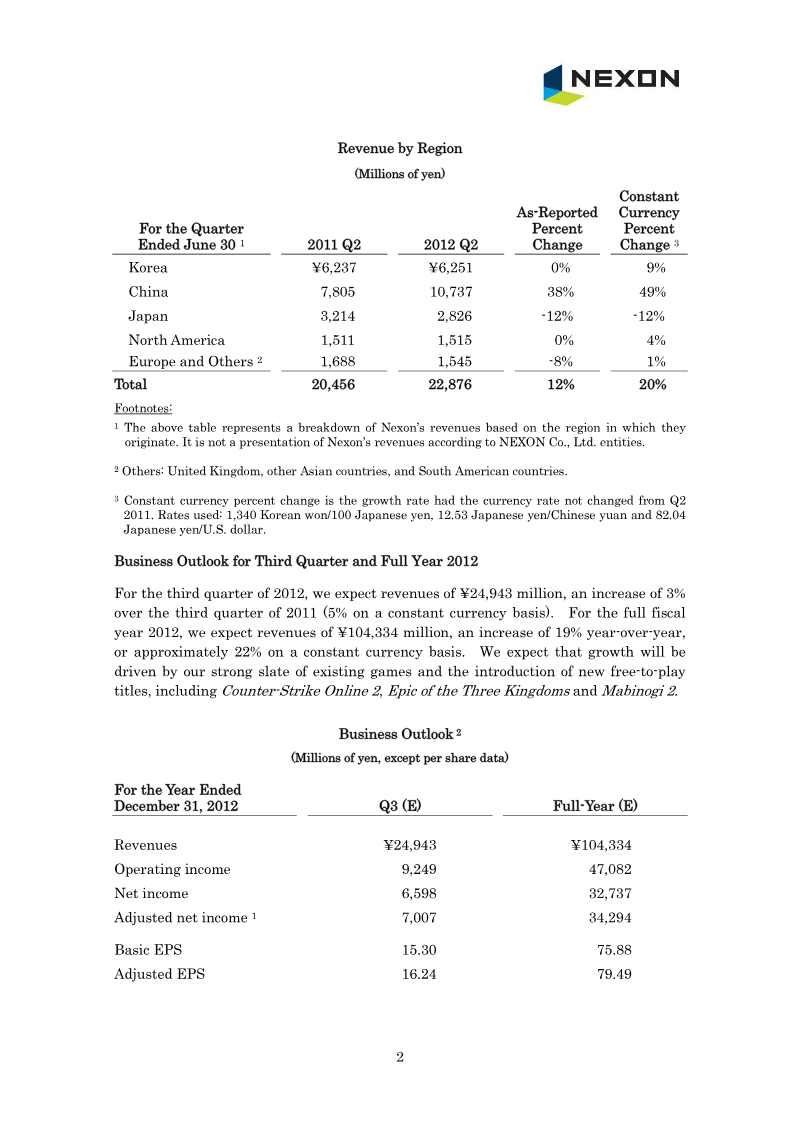
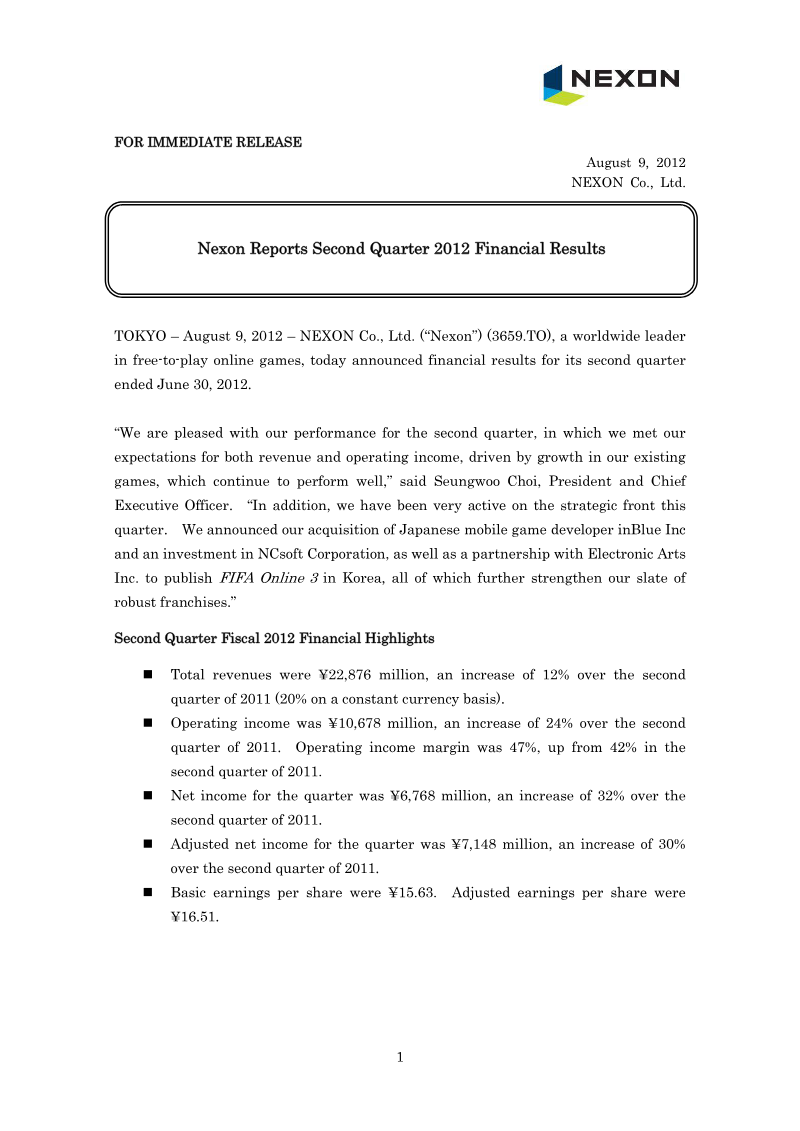
Nexon demonstrated robust financial growth during the second quarter of 2012, characterized by double-digit increases in revenue and profitability.
- Nexon reported Q2 2012 revenue of ¥22,876 million, a 12% year-over-year increase, with net income rising 32% to ¥6,768 million.
- Operating income grew 24% to ¥10,678 million, resulting in an improved operating margin of 47% compared to 42% in Q2 2011.
- Revenue growth was primarily driven by a 38% increase in the Chinese market, while performance in Korea and North America remained stable.

Esports in the Americas: Sports, Spanish, and Spending
The Americas represent a critical hub for the global esports industry, accounting for 25% of the worldwide audience and 40% of total industry revenues.
- The Americas represent a major global esports hub, accounting for 25% of the worldwide audience and 40% of total industry revenues.
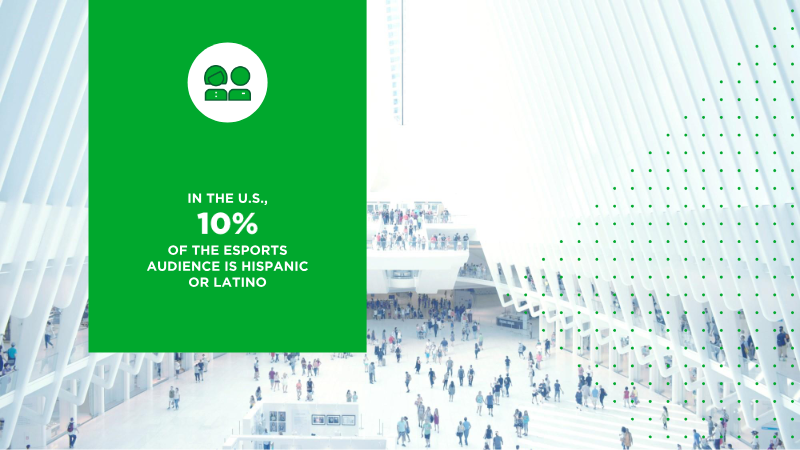
- Nearly 50% of the regional esports audience speaks Spanish or Portuguese, necessitating localized strategies rather than a unified approach for North and Latin American markets.
- Traditional sports organizations are increasingly acquiring esports teams to diversify fan engagement and reach younger demographics across both continents.
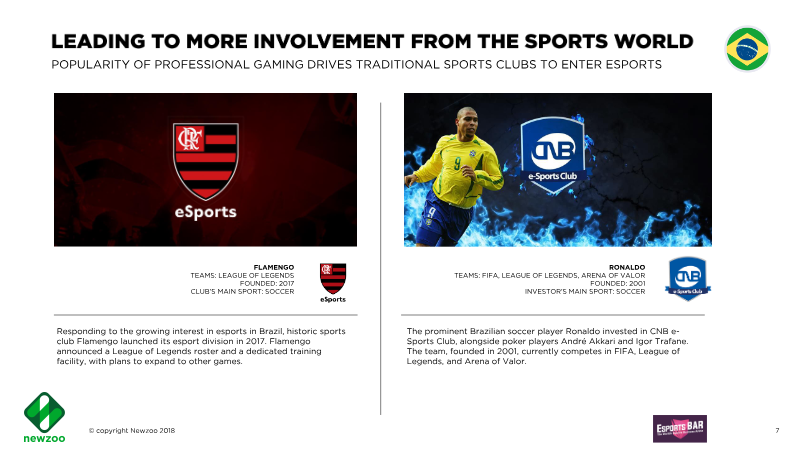
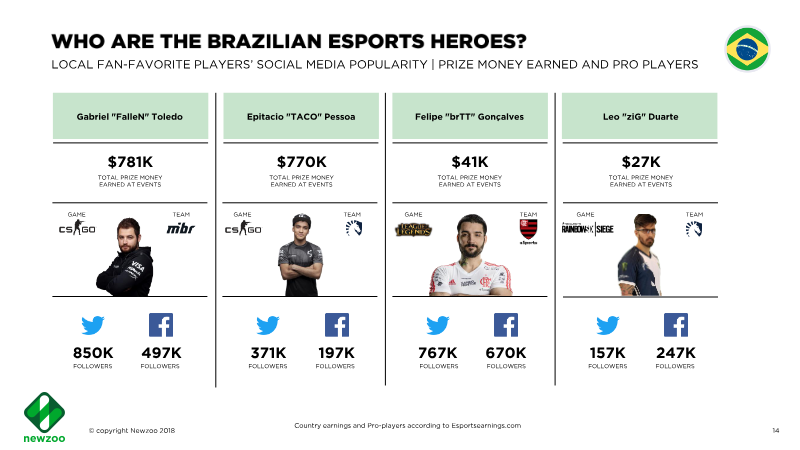
Esports in Brazil: Key Facts, Figures, and Faces
Brazil has emerged as a global powerhouse in the esports industry, ranking third worldwide with 7.6 million esports enthusiasts as of 2018.
- Brazil is a top-tier global esports market, ranking third worldwide with 7.6 million enthusiasts as of 2018 and a projected audience growth to nearly 30 million viewers by 2020.
- The Brazilian gaming market is supported by a large base of 75.7 million gamers out of a 210.9 million online population, generating $1.5 billion in total game revenues.
- The audience is exceptionally young, with 43% of enthusiastic viewers falling within the 10 to 20 age demographic.