1 free read left. Create a free account for unlimited reading + AI research.
Create free accountArticle Quantic Foundry
1 free read left. Create a free account for unlimited reading + AI research.
Create free accountArticleQuantic Foundry
This analysis updates the strategy genre map by integrating demographic and motivational data. It plots titles along axes of 'Strategy' and 'Excitement'.
This analysis updates the strategy genre map by integrating demographic and motivational data from over 220,000 global gamers. The study utilizes the Gamer Motivation Profile to map various strategy titles along two primary axes: Strategy (planning and complex decision-making) and Excitement (fast-paced, high-thrill gameplay). By aggregating the motivation profiles of core audiences for specific franchises, the research identifies how different game mechanics correlate with player demographics and behavioral homogeneity.
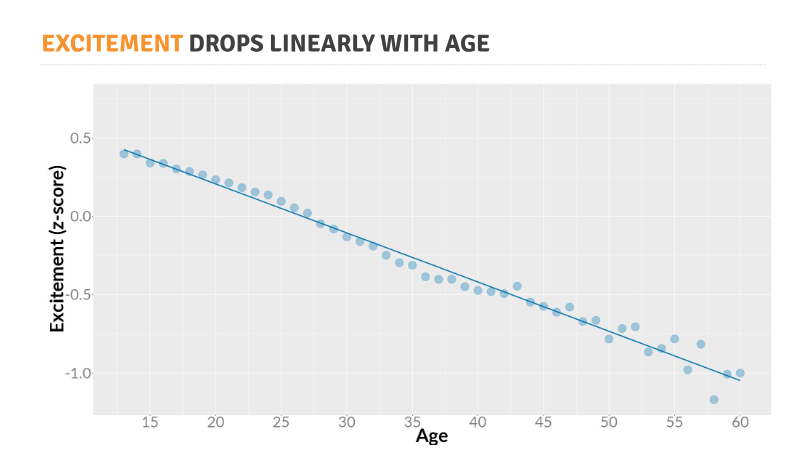
A key finding is the strong negative correlation (r = -.70) between a game’s Excitement score and the median age of its audience. Fast-paced competitive titles like League of Legends and Counter-Strike consistently attract younger players, whereas turn-based or pause-able games like Civilization and SimCity skew toward older demographics. While gender distribution remains relatively consistent across the genre—averaging approximately 90% male—no clear trend emerged linking gender to either the Strategy or Excitement axes.
The research also introduces the concept of the "lasso effect," observing that games with high strategic complexity tend to attract highly homogenous audiences with very similar motivation profiles. Conversely, games with high excitement scores do not restrict motivation profiles to the same degree. World of Tanks serves as a notable outlier, demonstrating the broadest age appeal of any title analyzed. Ultimately, the data suggests that as strategic complexity increases, a game’s appeal narrows to a specific, specialized cohort of players, whereas lower-complexity or high-excitement titles maintain broader, more diverse player bases.
Quantic Foundry · 2026
Quantic Foundry · 2025
Quantic Foundry · 2025
Quantic Foundry · 2025
Quantic Foundry · 2025
Quantic Foundry · 2024
Quantic Foundry · 2023
Quantic Foundry · 2023
Quantic Foundry · 2023
Quantic Foundry · 2021
Quantic Foundry · 2021
Quantic Foundry · 2021