MobyGames
Company
5 documents in the library are about MobyGames, from writers such as DiGRA, Eludamos: Journal for Computer Game Culture and Hushcrasher. Each has a summary and key insights with the page they come from.
Connections
Each row is a game or company named alongside MobyGames, each column a document, oldest first. A mark means that document names it. Select a row to see those documents.
Documents about MobyGames

Number of video game journalists plummets. Plus! More on Xbox and Atari launches IMDB rival
The global video game industry is currently navigating a period of profound structural instability, characterized by widespread workforce reductions, the contraction of traditional media, and a strategic pivot toward consolidation and niche sustainability.
- The global gaming media sector has faced a significant contraction, with over 280 journalists exiting the industry during the first half of 2026.
- Xbox is undergoing major internal restructuring and shifting its strategic focus toward massive, mainstream-oriented franchises like Call of Duty and Minecraft following ineffective post-acquisition integration.
- Atari is attempting to revitalize its operations by centralizing administrative functions and expanding its MobyGames platform into a professional networking tool for developers.

By the Way, What’s a AA?
The video game industry currently lacks a standardized, objective framework for classifying production scope, often relying on ambiguous terms like "indie" that conflate development scale with creative intent or business models.
- A data-driven clustering analysis of Steam games identifies credit length and disk size as the primary objective indicators of production scope, rendering subjective terms like 'indie' obsolete for professional classification.
- The 'Kei' category—referring to small-scale, often solo-developed games—has seen a 16-fold increase in releases over the last decade, now accounting for over 70% of all new titles on Steam.
- Despite the massive surge in Kei game releases, their collective share of total market reviews has remained stagnant at approximately 25% for the past ten years.


chludens.ch: Developing an Interactive Archive for Swiss Vintage Games and Its Community
The paper presents the design and development of chludens.ch, a digital web archive for Swiss vintage games and their surrounding community, produced as part of the CH LUDENS research project at the Zurich University of the Arts.
- The chludens.ch project is a digital web archive for Swiss vintage games and their community, developed at the Zurich University of the Arts to preserve a largely overlooked pre-Internet game development scene.
- The archive adopts a 'archiving the game without the game' approach, focusing on contextual materials such as interviews, gameplay videos, metadata, and historical documents rather than collecting software or source code.
- A flexible wiki structure with a filter system, clear categorizations, and systematic file naming was found necessary to integrate heterogeneous data types and map relationships between people, games, and institutions.
Would You Like Games with That Computer? Revisiting Early Game History and Culture with the Commodore 64
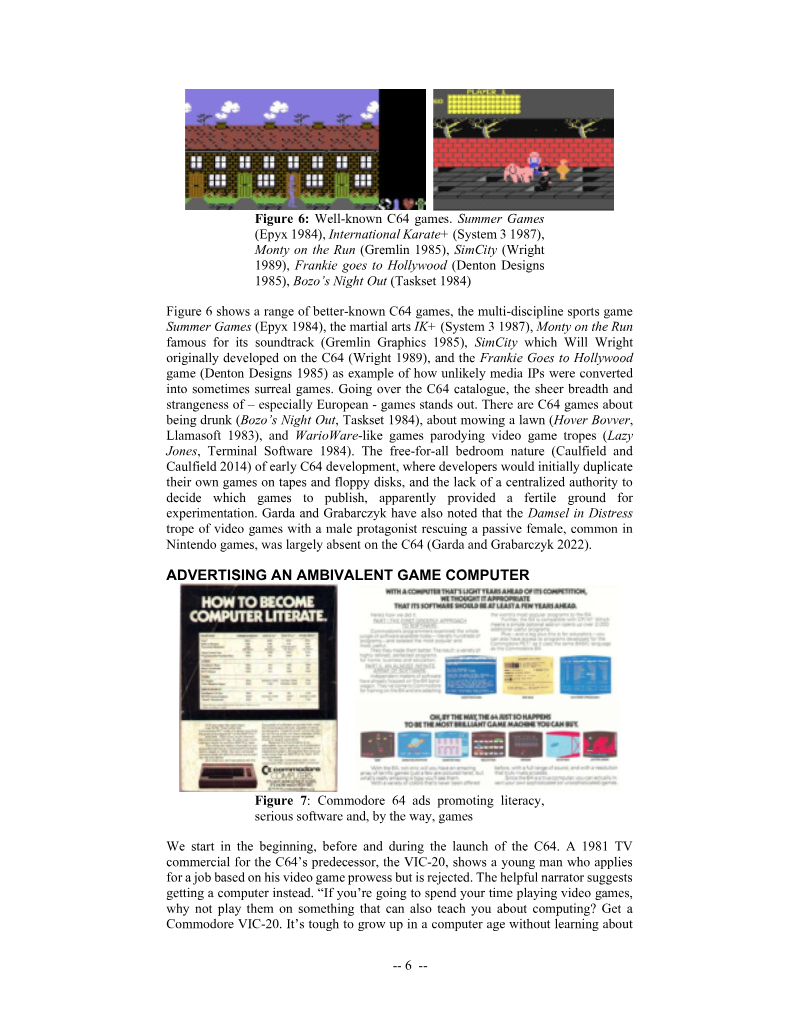
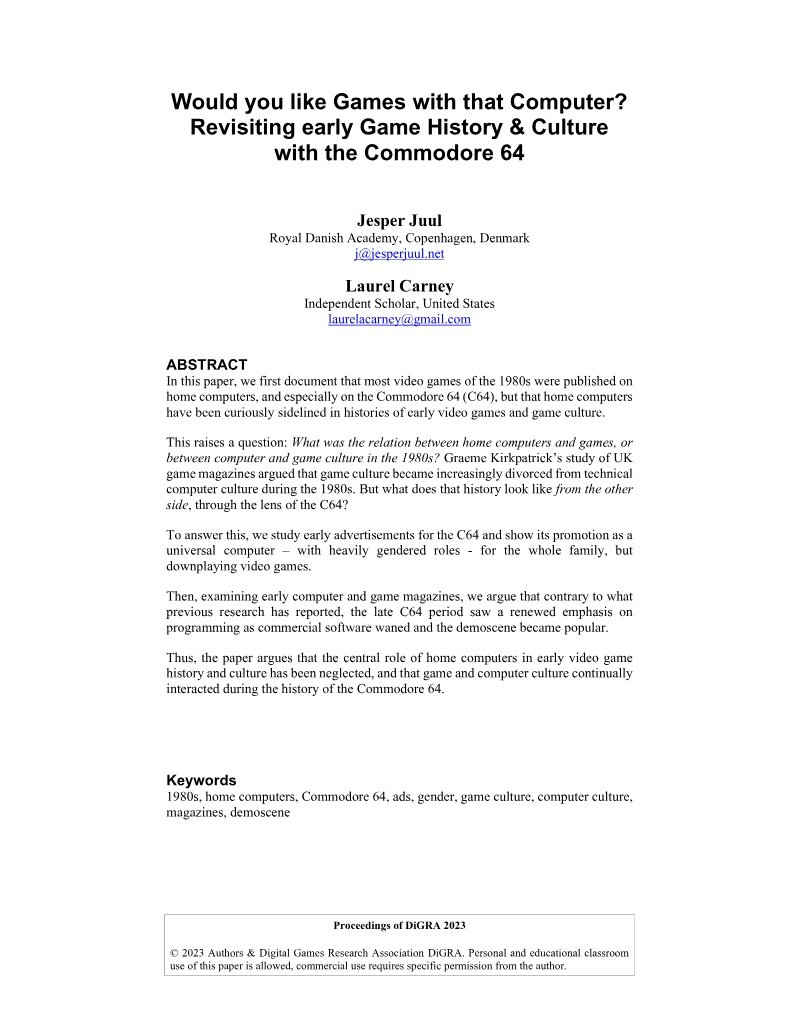
Early 1980s video game history has long centered on consoles such as the Nintendo Entertainment System and the Atari 2600, but this study argues that the home computer, and especially the Commodore 64, was the primary venue for game publishing in the decade.
- The Commodore 64 is argued to be the primary venue for early 1980s game publishing, hosting far more game releases than any competing platform according to MobyGames data, and selling roughly 12.5 million units as the best-selling desktop computer.
- The authors contend that the historical record has neglected home computers like the C64 by focusing on consoles such as the Nintendo Entertainment System and Atari 2600, skewing understanding of how games and computing developed together.
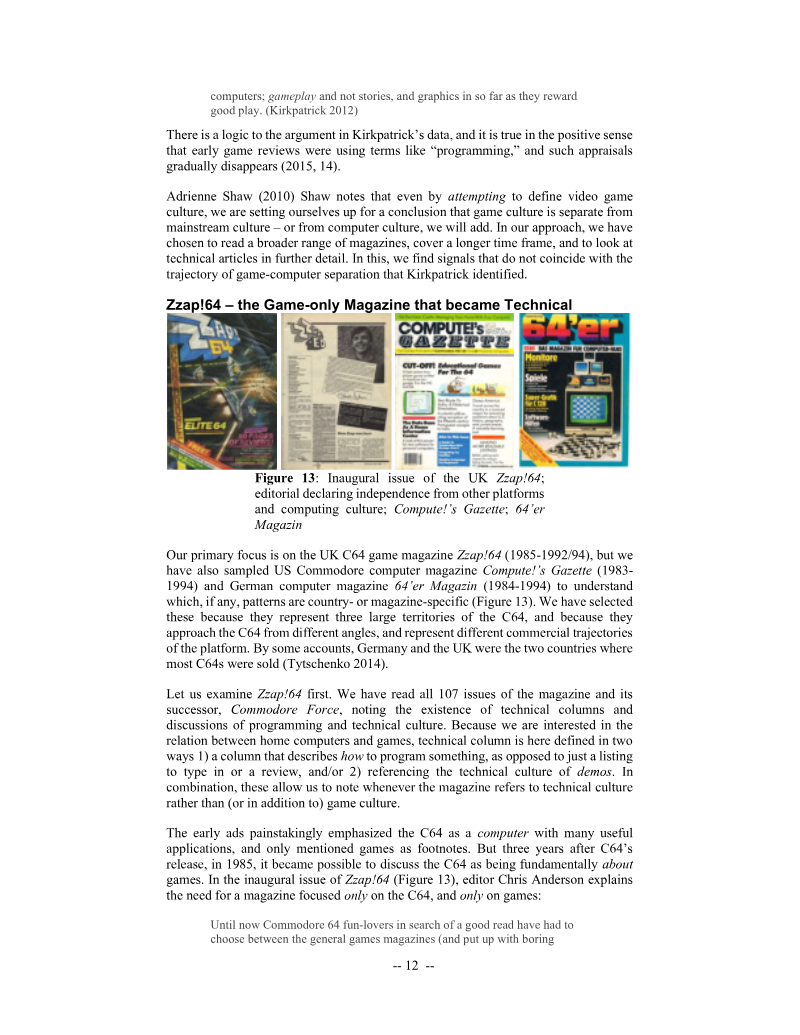
- Advertising for the C64 and VIC-20 from 1983 to 1985 framed the machines mainly around education, literacy, and career productivity, mentioning games only in passing, while also gendering computer use with men shown programming or gaming and women in brief professional or domestic roles.
Video Game Genre, Evolution and Innovation
Arsenault's analysis challenges the widely held notion that video game genres "evolve" in a linear, progressive fashion, arguing instead that the concept of genre itself is contested, fluid, and under-theorized when applied to games.
- Arsenault argues that video game genre is a contested, fluid, and under-theorized concept, and that industry taxonomies such as MobyGames, AllGameGuide, Metacritic, and GameSpot classify games inconsistently, often conflating gameplay, theme, and platform.
- The author rejects Darwinian, linear models of genre evolution, contending that because works are produced by human agents rather than reproducing organisms, genre change is better described as nonteleological variation than as progress toward improvement.
- Innovation within genres is described as an internal problem-solving logic in which imitation and revision of successful titles, such as the proliferation of 'Doom clones,' drive advancement, and the solutions often generate new problems.