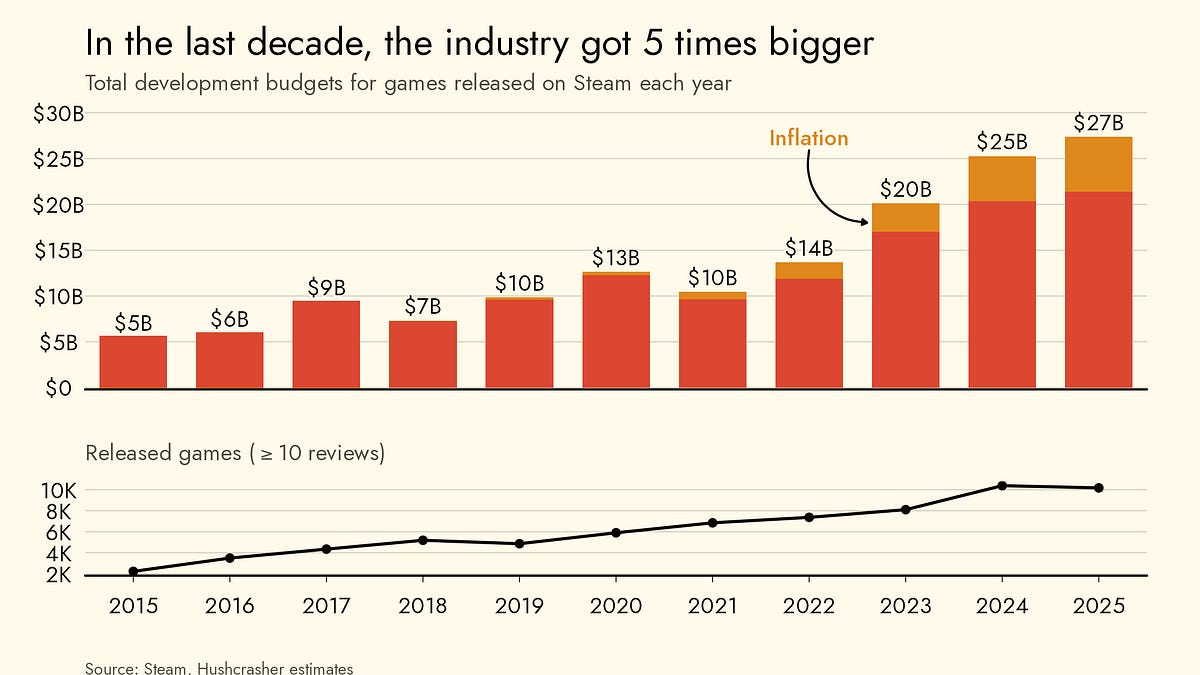
The video game industry has experienced a significant escalation in development costs over the last decade, with total annual spending on Steam-released titles reaching $27 billion in 2025. This figure represents a 2.7-fold increase since 2019, or a 2.2-fold increase when adjusted for inflation. The analysis confirms that rising budgets are not merely a byproduct of inflation but reflect a genuine trend of increasing financial requirements across the industry, driven by heightened competition for player attention in a winner-takes-all market.
The research categorizes games into four distinct scopes—Kei (solodev), Midi (small studios), AA, and AAA—to track these trends. While all segments have seen cost increases, the growth is most pronounced at the high end, where AA and AAA budgets have tripled over the last decade. AAA projects, in particular, have seen average costs climb from approximately $100 million in 2019 to nearly $300 million by 2025. Conversely, smaller-scope games have largely differentiated themselves through horizontal innovation, such as unique mechanics or art styles, which allows them to mitigate some of the extreme cost pressures faced by larger studios that compete through vertical scaling and content volume.
Methodologically, the findings rely on a proprietary model designed to estimate development budgets for games released on Steam. The data indicates that the surge in costs is most acute in popular genres like action-adventure and free-to-play, as well as in virtual reality, which saw a 4.3-fold increase in costs over seven years. While publisher involvement remains a significant factor in the budget gap for smaller projects, the distinction becomes negligible for AAA titles, where the studio-publisher relationship is often integrated. Ultimately, the industry is characterized by an arms race where efficiency gains from new technologies are frequently reinvested into higher production ambitions rather than cost reduction.