MobyGames
Company
Documents about MobyGames
Article
By the Way, What’s a AA?
The video game industry currently lacks a standardized, objective framework for classifying production scope, often relying on ambiguous terms like "indie" that conflate development scale with creative intent or business models.
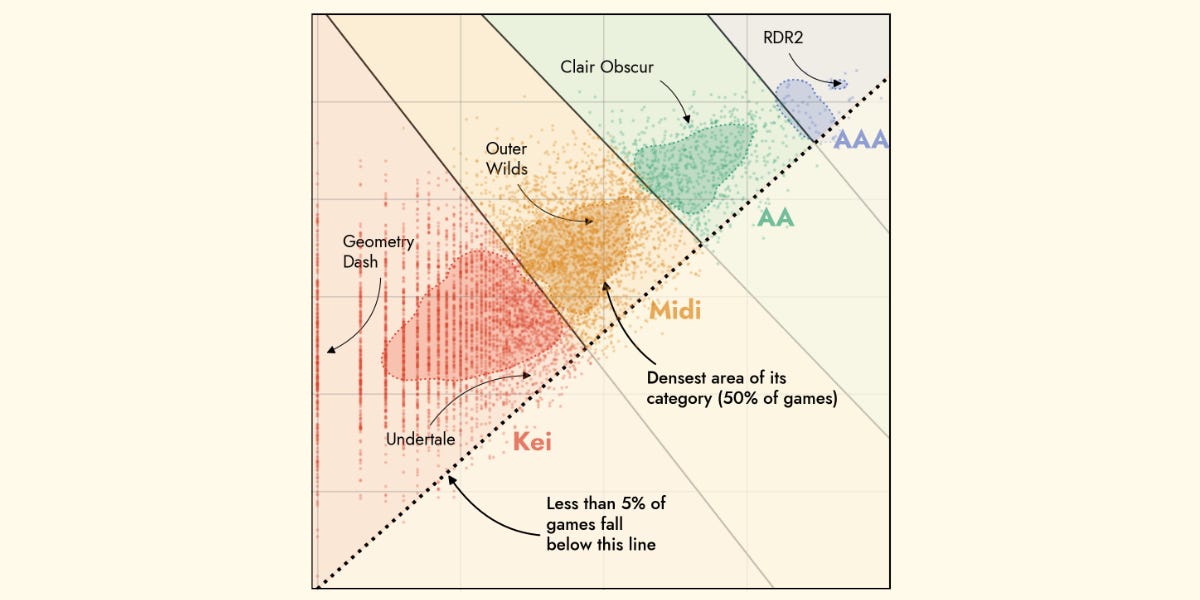
- A data-driven clustering analysis of Steam games identifies credit length and disk size as the primary objective indicators of production scope, rendering subjective terms like 'indie' obsolete for professional classification.
- The 'Kei' category—referring to small-scale, often solo-developed games—has seen a 16-fold increase in releases over the last decade, now accounting for over 70% of all new titles on Steam.
- Despite the massive surge in Kei game releases, their collective share of total market reviews has remained stagnant at approximately 25% for the past ten years.
HushcrasherSep 2025
Article
Video Game Genre, Evolution and Innovation
Arsenault's analysis challenges the widely held notion that video game genres "evolve" in a linear, progressive fashion, arguing instead that the concept of genre itself is contested, fluid, and under-theorized when applied to games.
- Arsenault argues that video game genre is a contested, fluid, and under-theorized concept, and that industry taxonomies such as MobyGames, AllGameGuide, Metacritic, and GameSpot classify games inconsistently, often conflating gameplay, theme, and platform.
- The author rejects Darwinian, linear models of genre evolution, contending that because works are produced by human agents rather than reproducing organisms, genre change is better described as nonteleological variation than as progress toward improvement.
- Innovation within genres is described as an internal problem-solving logic in which imitation and revision of successful titles, such as the proliferation of 'Doom clones,' drive advancement, and the solutions often generate new problems.
Eludamos: Journal for Computer Game CultureOct 2009