Magnavox
Company
8 documents in the library are about Magnavox, from writers such as G|A|M|E – The Italian Journal of Game Studies, American Journal of Play and Bina Nusantara University. Each has a summary and key insights with the page they come from.
Connections
Each row is a game or company named alongside Magnavox, each column a document, oldest first. A mark means that document names it. Select a row to see those documents.
Documents about Magnavox

Trial of the Space Invaders
Simon Parkin talks to us about his forthcoming book, Trial of the Space Invaders, and the court case that shaped an industry
- Simon Parkin’s forthcoming book, 'Trial of the Space Invaders' (releasing January 27, 2027), details how a 1980s patent dispute between Magnavox and Nintendo fundamentally shaped the modern video game industry.
- Magnavox generated over $100 million in revenue from patent litigation against early arcade pioneers like Atari, Activision, and Midway, despite only selling 350,000 units of its own console.
- Anthropic has updated its Claude AI model with specific instructions to prevent the decompilation and recreation of existing video games to mitigate intellectual property infringement.
Nintendo and the Last Hardware Exclusives
Nintendo is positioned as the last major company still committed to selling its first-party games exclusively on its own hardware, an observation prompted by the June 2025 launch of the Switch 2.
- Nintendo remains the only major video game company to maintain a strict hardware-exclusive business model, tethering its software library exclusively to its proprietary consoles.
- While competitors like Microsoft and Sony have shifted toward hardware-agnostic strategies by porting titles to PC and other platforms, Nintendo continues to prioritize the traditional model established with the 1983 launch of the Famicom.
- The release of the Switch 2 demonstrates Nintendo's ongoing commitment to leveraging its intellectual property to drive consumer investment in its specific hardware ecosystem.

gamevironments: Pirating Platform Studies and Other Essays
Phillip Penix-Tadsen's article argues that Latin American clone consoles, active from roughly 1973 to 1994, deserve a central place in platform studies and game history.
- Informal practices such as reverse engineering, cloning, and hardware localization, not formal industry channels, were the dominant means by which most players in Latin America accessed games between roughly 1973 and 1994.
- The article's catalogue documents roughly ninety clone consoles derived from the Magnavox Odyssey, Pong, Atari VCS, Sega Master System, and Nintendo Famicom/NES, with Brazil accounting for the majority of entries.
- Brazil's 1980s informatics market reservation encouraged domestic clone production under protectionist conditions, and many Brazilian clones were tied to this policy.
The History of the Toy and Games Industries Seen through a Jewish Lens: An Interview with Stephen Jacobs
The document explores the profound and often unacknowledged influence of Jewish individuals on the global toy and game industries, particularly from the 19th century through the late 20th century.
- Roughly one-third of Toy Industry Hall of Fame inductees have Jewish backgrounds, and historian Stephen Jacobs has identified over one hundred Jewish figures contributing to the toy and game industries across more than two centuries.
- Germany's toy industry from the 1850s to the early 1930s saw prominent Jewish founders thrive during a period of relative tolerance and industrial growth, a era that ended with the rise of Nazism.
- Of the twenty-nine Jewish-linked businesses identified in the research, Gebruder Bing went bankrupt in 1932 and J. W. Spear and Sons was Aryanized in 1938.
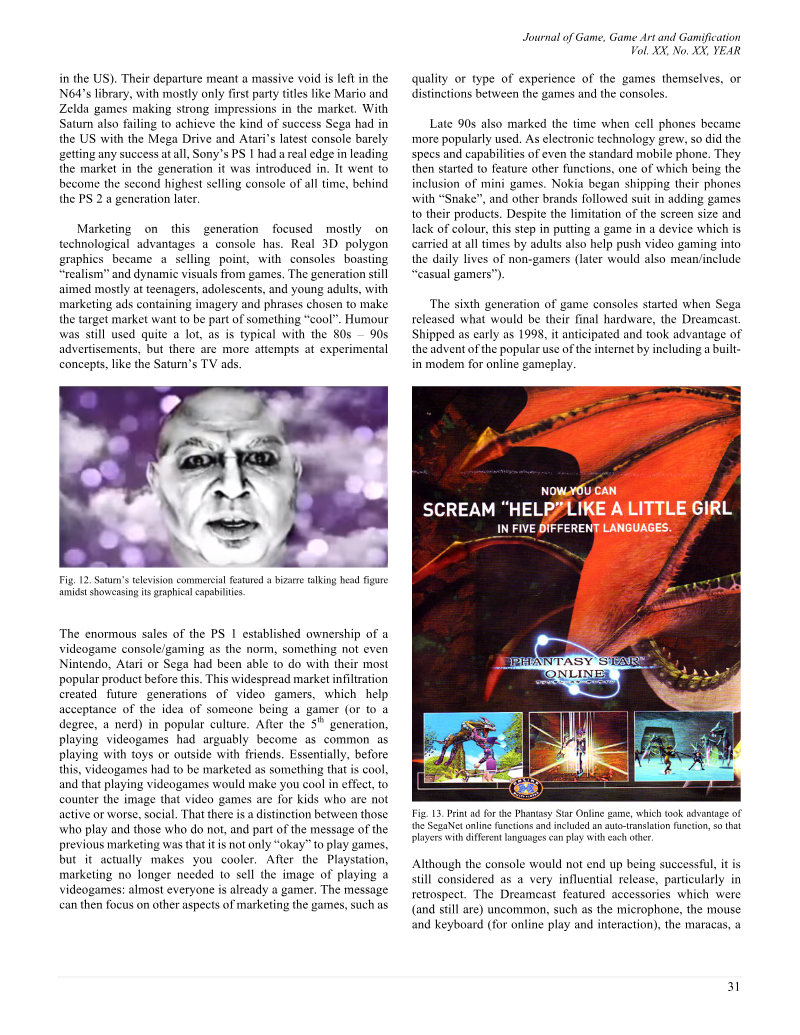
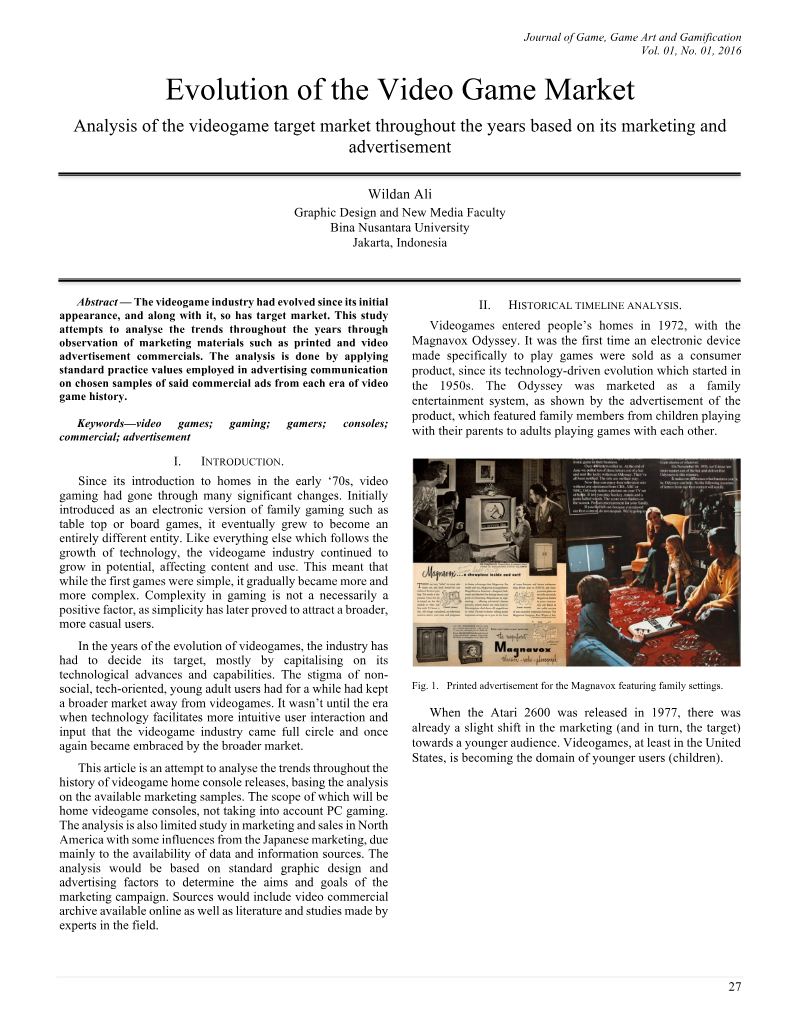
Evolution of the Video Game Market: Analysis of the Videogame Target Market
This analysis examines the evolution of the video game industry by tracing shifts in target market demographics through the lens of historical marketing and advertising materials.
- The gaming market has shifted from a niche novelty to a mass-market phenomenon, with 49% of American adults now playing games while only 10% identify as traditional 'hardcore' gamers.
- The industry has successfully normalized gaming across all age groups as the first generation of gamers has reached financial independence.
- Modern gaming has evolved into a multifaceted platform where games themselves serve as hubs for social interaction and marketing, often rendering traditional advertising unnecessary.

From Symbolism to Realism: Physical and Imaginary Video Game Spaces in Historical Aspects
Filip Tołkaczewski argues that video game space has evolved from symbolic, minimally defined environments into highly realistic, elaborately constructed worlds, and that this shift is turning games toward a new medium resembling interactive film.
- The study argues that video game spaces evolved from abstract, symbolic settings in early titles like Spacewar!, Space Invaders, and Asteroids toward increasingly realistic, continuous, and detailed worlds, a shift tied to technological advancement.
- The analysis frames early game spaces as simplified 'allegories of space' in the sense described by Espen Aarseth, relying heavily on player imagination to fill in what the graphics did not show.
- Key milestones in the trajectory include the flip-screen technique in Adventure and Gravitar, the side-scrolling and off-screen virtual space introduced by Defender (1980/1981), the 2D era of Super Mario Bros. (1985) and Contra (1988), the pseudo-3D of Wolfenstein and Doom, and the true 3D turn of Super Mario 64 on the Nintendo 64.

There Are No Universal Interfaces: How Asymmetrical Roles and Asymmetrical Controllers Can Increase Access Diversity
Video game controllers have grown steadily more demanding for motor-impaired players, and Dalgleish argues that no single universal interface can resolve this.
- Control dimensionality of game controllers grew from 2 in the Magnavox Odyssey (1972) to 17 in the Nintendo Switch Joy-Con (2017), steadily raising the risk of excluding players with motor impairments.
- Accessibility for disabled players in mainstream games is often accidental, arising only when a standard controller happens to suit a particular body rather than being designed in deliberately.
- The paper proposes the 'asymmetrical roles and asymmetrical controllers' (ARAC) model, which builds diverse roles and input devices into multiplayer game design instead of creating segregated or simplified versions for disabled players.
De-framing Video Games from the Light of Cinema
Perron and Arsenault argue that the habit of framing video games through cinema is a constructed "series-centrism" rather than a natural lineage.
- The essay argues that video game scholarship has been overly shaped by a cinema-centric framing that treats film as the default lens, and that this alignment is a cultural and historical construction rather than a natural fit.
- Its central thesis is methodological: games should be analyzed through their own traditions, including real-time animation, parallel projection, cartography, and text-based interactive fiction, along with ludic and computational dimensions that cinema-focused analysis underweights.
- Drawing on Gaudreault and Marion's theory, the authors call on scholars to use film theory with awareness of its limits rather than importing film assumptions wholesale.