1 free read left. Create a free account for unlimited reading + AI research.
Create free accountArticle G|A|M|E – The Italian Journal of Game Studies
1 free read left. Create a free account for unlimited reading + AI research.
Create free accountArticleG|A|M|E – The Italian Journal of Game Studies
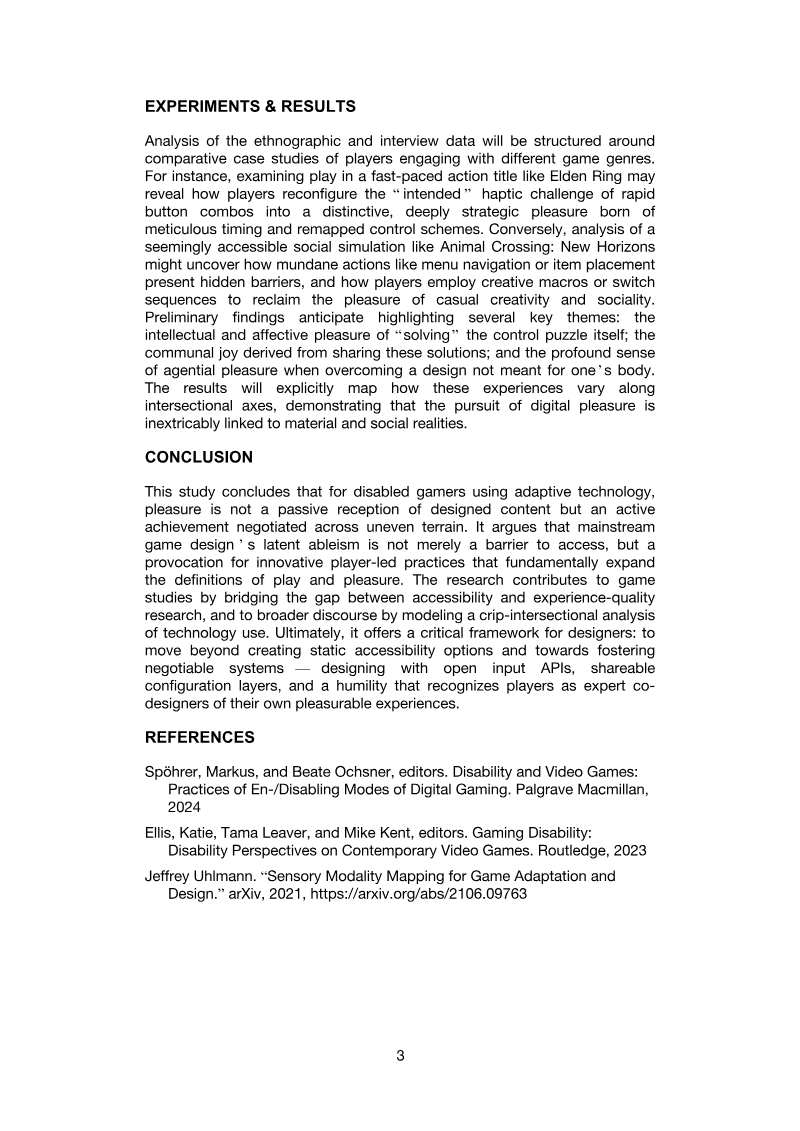
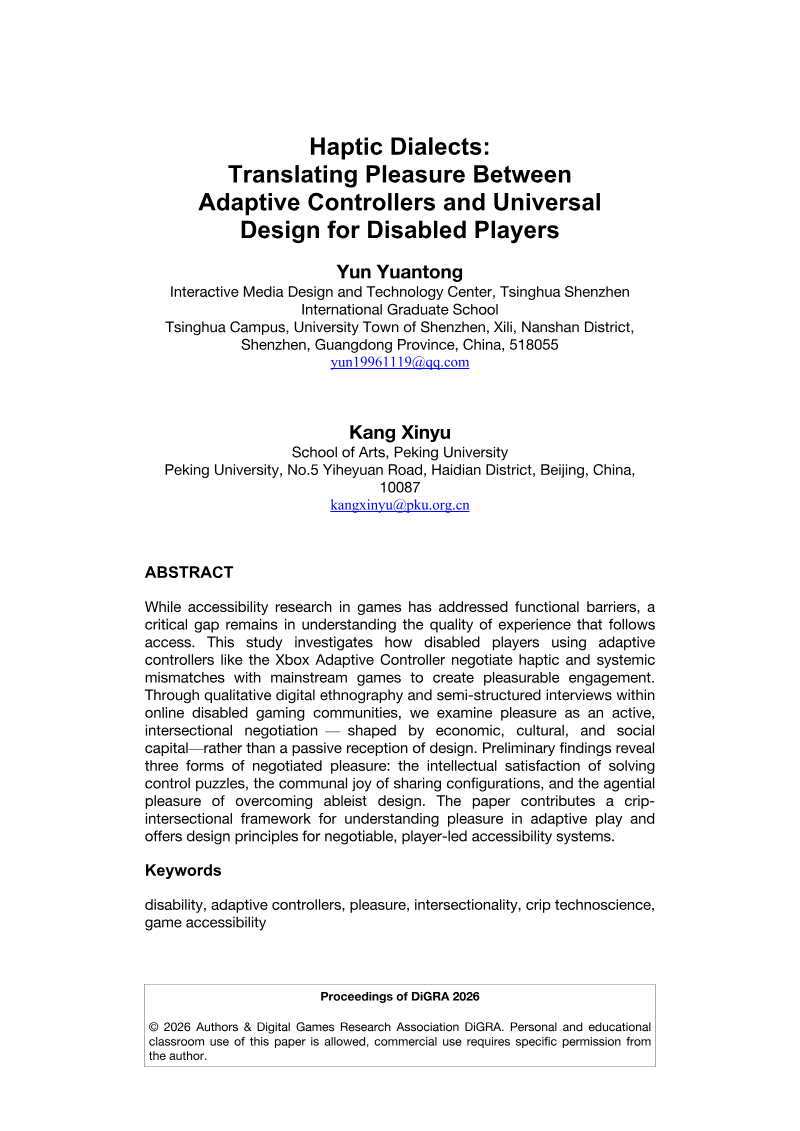
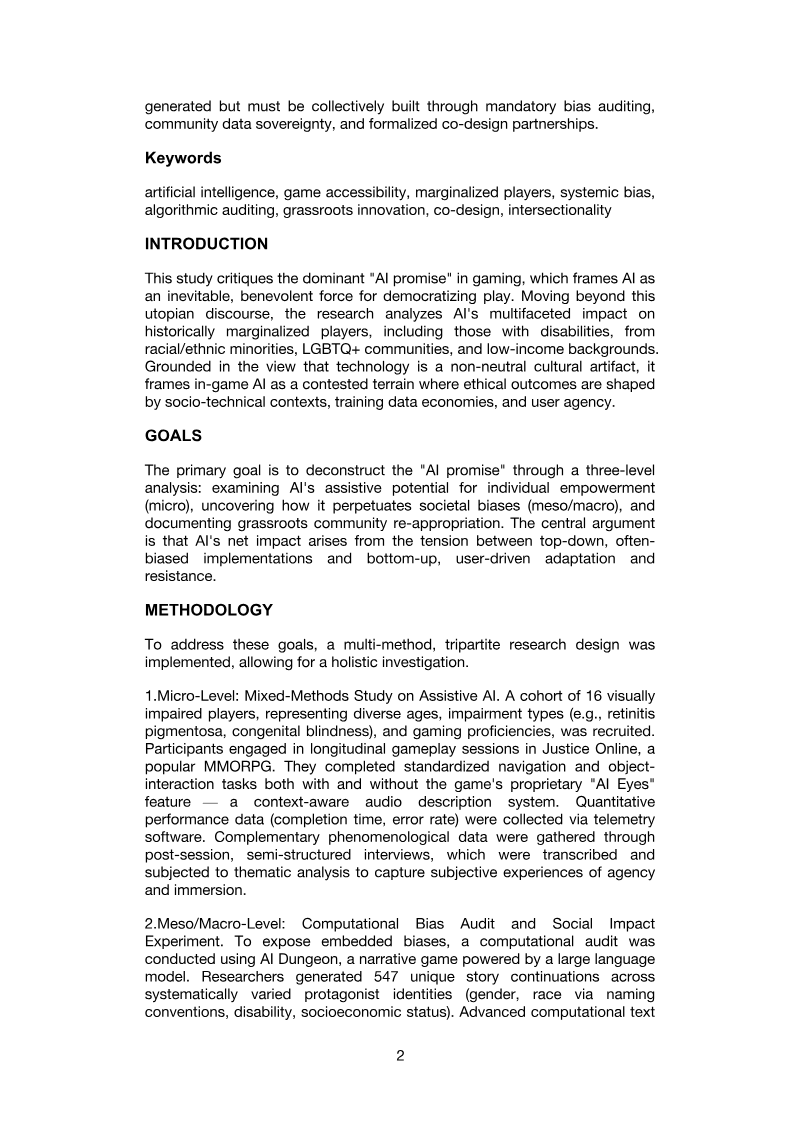
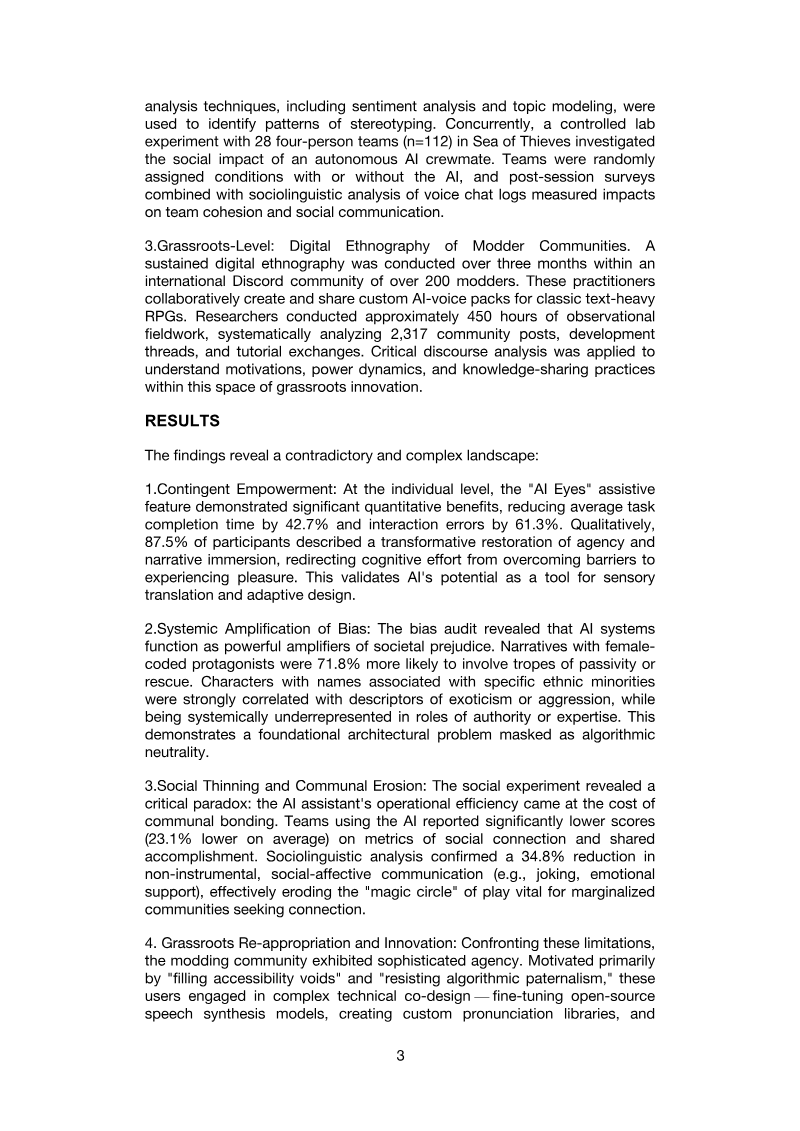
Game controllers grew steadily more complex, moving from the Magnavox Odyssey's 2 dimensions to the Nintendo Switch Joy-Con's 17.
Dalgleish's 2018 paper contends that game controllers have grown steadily more complex, and that this complexity can abruptly exclude players with motor impairments. The author traces control dimensionality from 2 in the Magnavox Odyssey (1972) to 17 in the Nintendo Switch Joy-Con (2017), and argues that accessibility for disabled players is often precarious, arising by accident when a standard controller happens to suit a particular body. Framed through the medical and social models of disability and the human-machine interaction loop, the work situates these barriers within broader questions about how design shapes who can play.
The central proposal is the "asymmetrical roles and asymmetrical controllers" (ARAC) model, which builds diversity of roles and input devices into game design rather than producing segregated or simplified versions for disabled players. The paper reviews prior accessibility efforts, including software remapping, modified controllers, and third-party designs, and finds them informal, costly, or difficult to scale. It illustrates the approach with multiplayer examples such as Keep Talking and Nobody Explodes and Artemis Spaceship Bridge Commander, where distinct roles and devices allow players with differing abilities to contribute meaningfully. Gestural controllers like the Wii Nunchuck and Kinect are likewise identified as having inadvertently excluded players with motor impairments.
The paper acknowledges important limits. The ARAC model has not yet been formally tested with disabled players, and the relationship between bodily characteristics and suitable controllers remains poorly understood, so trial and error continues to play a large role. The discussion therefore stresses forward-looking agendas: longitudinal in-the-wild case studies, a framework for assessing controller-to-user fit, adaptive interfaces that respond to changing disability effects, and education of industry staff so accessibility can be designed in from the outset. The work offers conceptual argument and recommendations rather than new empirical or quantitative findings.
Each row is a game or company this document names, each column a document, oldest first. A mark means that document names it. Select a row to see those documents.
G|A|M|E – The Italian Journal of Game Studies · 2026
G|A|M|E – The Italian Journal of Game Studies · 2026
G|A|M|E – The Italian Journal of Game Studies · 2026
G|A|M|E – The Italian Journal of Game Studies · 2026
G|A|M|E – The Italian Journal of Game Studies · 2026
G|A|M|E – The Italian Journal of Game Studies · 2026
G|A|M|E – The Italian Journal of Game Studies · 2026
G|A|M|E – The Italian Journal of Game Studies · 2026
G|A|M|E – The Italian Journal of Game Studies · 2026
G|A|M|E – The Italian Journal of Game Studies · 2026
G|A|M|E – The Italian Journal of Game Studies · 2026
G|A|M|E – The Italian Journal of Game Studies · 2026
DiGRA · 2026