Creative
Company
Documents about Creative
This Is How We Actually Build Ads: A Creative Designer Tool Guide
Modern advertising production has undergone a fundamental shift, moving away from traditional, labor-intensive motion graphics toward AI-augmented workflows.
- Integrating AI into creative workflows reduces production time for complex advertising assets from one week to under ten minutes per element.
- The shift toward AI-augmented production allows creative teams to move away from manual, frame-by-frame animation toward automated asset generation.
- AI serves as a leverage tool for operational efficiency, enabling designers to prioritize high-level creative strategy over repetitive manual tasks.

The Team Is Everything: Assembling, Nurturing and Retaining a World-Class Creative Team
The success of independent game studios relies fundamentally on the deliberate construction of cohesive teams rather than the mere aggregation of individual talent.
- Psychological safety is the most critical factor for team performance, as it enables members to take interpersonal risks, admit uncertainty, and surface problems before they escalate into systemic failures.
- Effective indie studio hiring should prioritize 'range'—the ability to operate outside one's primary discipline—and 'collaborative instinct' over prestigious employment history, which is often a weak signal for indie success.
- Leaders must actively build psychological safety by modeling vulnerability, such as admitting mistakes, and by responding to bad news with collaborative problem-solving rather than frustration.
Never Ending Creative Trends #2
The gaming industry faces a constant evolution in user acquisition strategies, necessitating a structured approach to identifying high-performing advertising creative.
- Mobile game developers must adopt a structured, data-driven framework to analyze ad creative performance across strategy, idle clicker, hybrid-casual, and puzzle genres to optimize return on ad spend.
- Successful marketing strategies require bridging the gap between raw performance metrics and the specific visual or narrative elements that drive audience engagement.
- Continuous monitoring of live ad performance is necessary to identify shifting player preferences and adapt creative assets to evolving platform-specific requirements.
Never Ending Creative Trends #1
The primary objective of this initiative is to provide a structured, data-driven analysis of current advertising performance across the mobile gaming sector.
- The initiative provides a structured, data-driven analysis of mobile gaming advertising performance across strategy, idle clicker, hybrid-casual, and puzzle genres.
- Performance metrics are tracked and categorized using a proprietary database to identify recurring patterns in user engagement.
- The analysis focuses on the underlying factors driving high-performing advertisements to facilitate evidence-based user acquisition decisions.
The Future of AI Creative Tools
The future of AI creative tools lies in shifting from simple, novelty-driven generative models toward professional-grade, node-based interfaces that prioritize granular control and repeatable workflows.
- Professional creative tools are shifting from simple generative models toward node-based, modular interfaces that support complex, repeatable production workflows.
- FLORA secured $42 million in Series A funding in early 2026, signaling a market pivot toward enterprise-grade AI creative platforms.
- Major organizations including Nike, Pentagram, and Lionsgate are adopting AI systems to compress tasks like brand sprints and 3D visualization from weeks of manual effort into accelerated timelines.
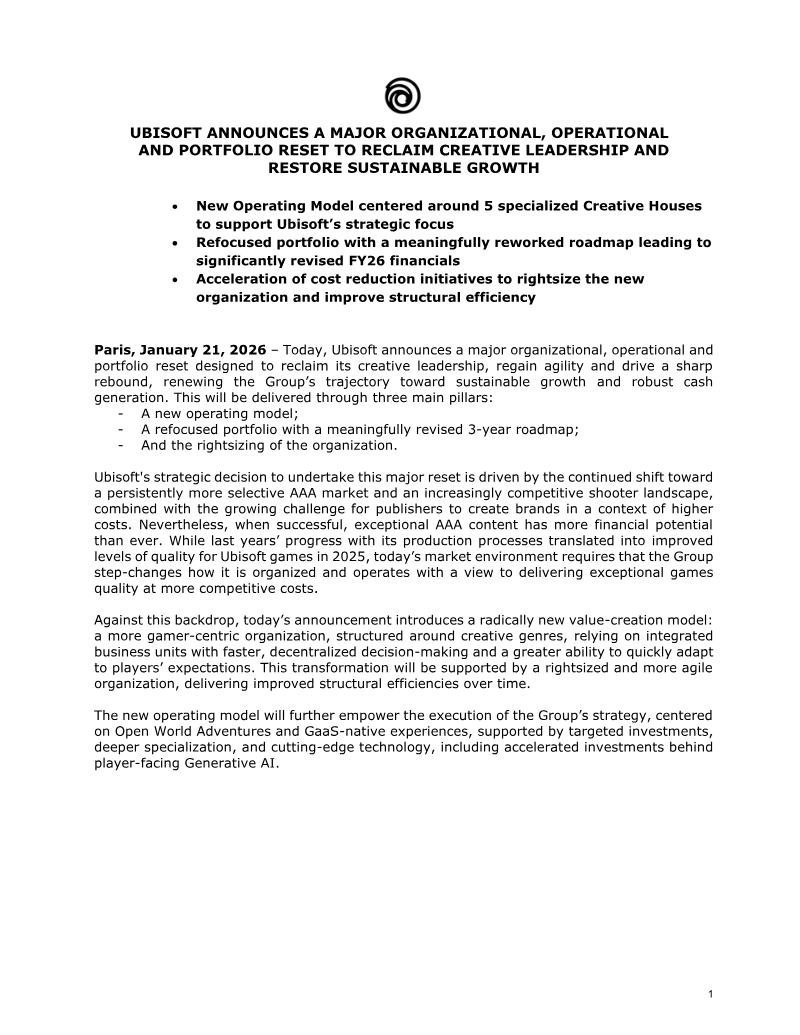
Ubisoft Announces a Major Organizational, Operational and Portfolio Reset
Ubisoft has announced a comprehensive organizational and portfolio reset aimed at reclaiming creative leadership and restoring sustainable growth.
- Ubisoft is restructuring into five specialized Creative Houses—Vantage Studios, competitive shooters, live-service, immersive fantasy, and casual/family—to grant units full financial and creative ownership over their genres.
- The company is targeting a total fixed cost reduction of €500 million since FY2023, aiming for a run-rate of €1.25 billion in total fixed costs by March 2028.
- Financial outlooks for FY2026 project net bookings of approximately €1.5 billion and a non-IFRS EBIT loss of roughly €1 billion, driven by a €650 million one-off accelerated depreciation.
User Acquisition & Creative Learnings: 2025
The mobile gaming landscape in 2025 is defined by a shift away from simple media buying toward a holistic, data-driven strategy that integrates creative production, game design, and sophisticated analytics.
- Profitability is now measured by the alignment of acquisition costs with long-term retention and lifetime value, rendering low cost-per-install metrics obsolete as vanity indicators.
- AppLovin is the primary user acquisition channel, requiring high in-app purchase volume and a high-velocity supply of creative assets to fuel its optimization algorithms.
- Developers must maintain a multi-channel presence across platforms like Facebook and TikTok to mitigate platform-specific volatility in the post-IDFA environment.
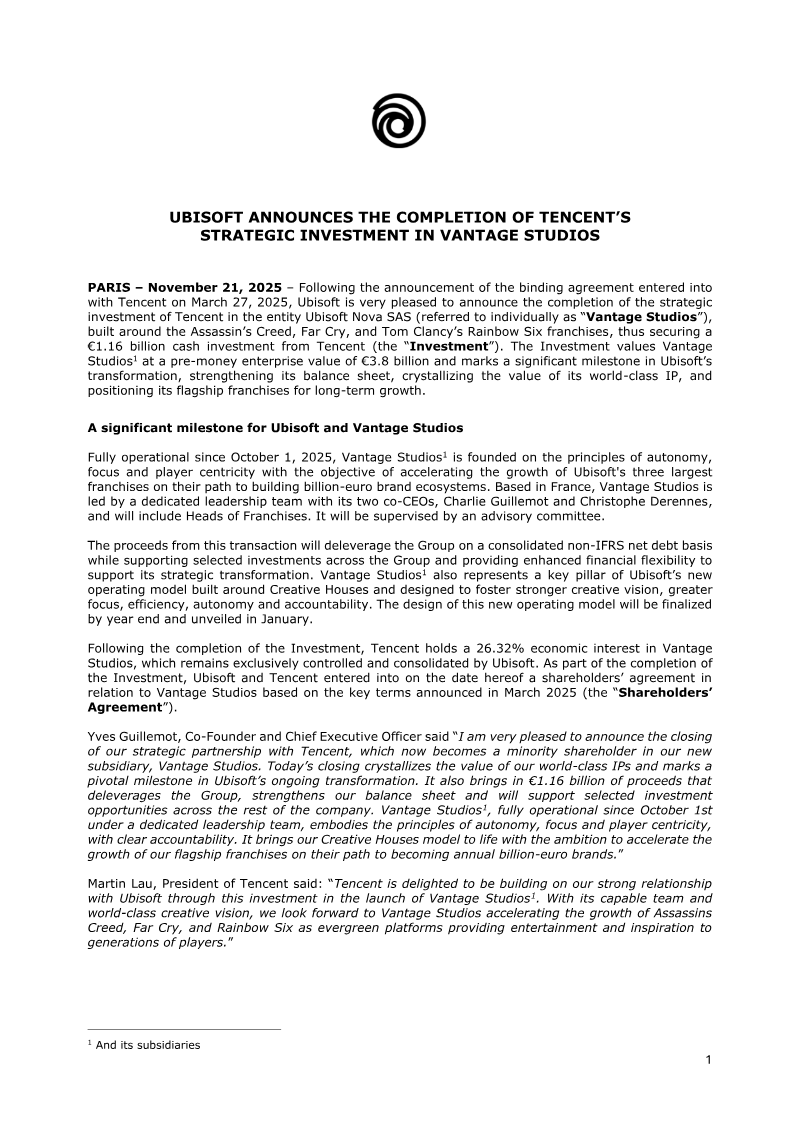
Ubisoft Announces the Completion of Tencent’s Strategic Investment in Vantage Studios
Ubisoft has finalized a strategic investment from Tencent into Ubisoft Nova SAS, a newly established subsidiary known as Vantage Studios.
- Tencent has invested €1.16 billion into Ubisoft’s new subsidiary, Vantage Studios, valuing the entity at €3.8 billion pre-money.
- Tencent holds a 26.32% economic interest in Vantage Studios, while Ubisoft retains exclusive operational control and consolidation rights.
- Vantage Studios is built around Ubisoft’s three primary intellectual properties: Assassin’s Creed, Far Cry, and Tom Clancy’s Rainbow Six.
Creative Brief Template: 7 Creative Trends to Boost Your UA
The primary objective of this analysis is to provide mobile game developers and marketers with a strategic framework for optimizing user acquisition (UA) performance in 2026.
- Seven specific creative trends currently account for 53% of total ad spend in the mobile gaming sector.
- Aligning creative production with these seven trends is a strategic requirement for maintaining competitive advantage and maximizing advertising budget efficiency in 2026.
- The mobile gaming industry is shifting away from generic advertising toward targeted visual and narrative styles that improve audience conversion rates.

How a MidJourney Prompt Turned into a UA Money Printer
Creative optimization serves as the primary driver for scaling user acquisition performance when traditional bid strategies and channel adjustments reach a plateau.
- Sustainable user acquisition growth requires shifting from speculative creative production to a systematic framework that deconstructs successful ads into repeatable, data-driven elements.
- Marketers must audit high-performing assets to isolate specific variables—such as hooks, pacing, and emotional triggers—to inform the development of new static, video, and playable formats.
- Institutionalizing creative intelligence replaces reliance on luck with a predictable pipeline, ensuring every new asset is a deliberate iteration of proven performance metrics.
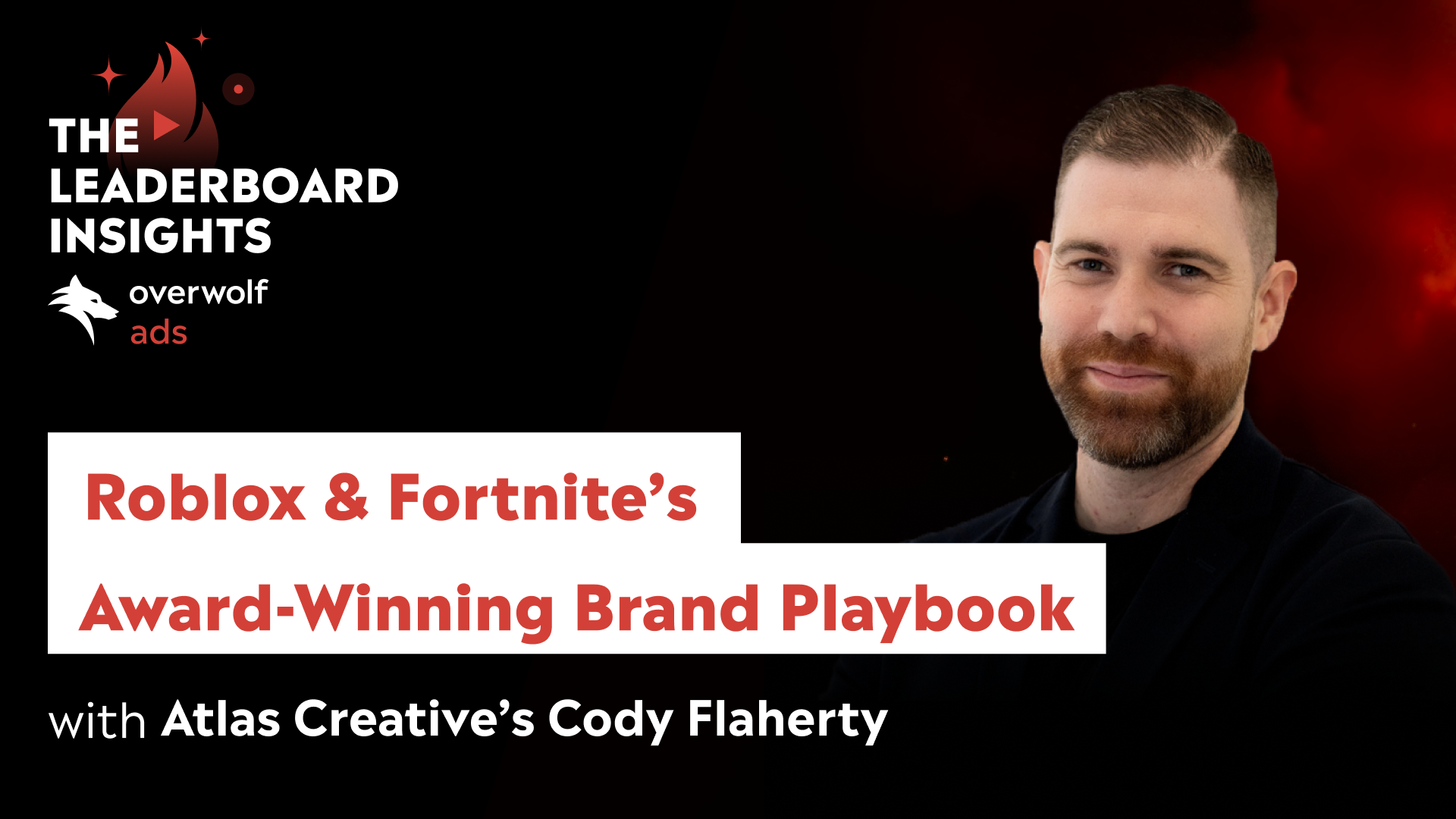
The Leaderboard Insights Podcast: Roblox & Fortnite’s Award-Winning Brand Playbook
The Leaderboard Insights Podcast provides a strategic overview of effective brand integration within user-generated content (UGC) environments, specifically focusing on Roblox and Fortnite.
- Atlas Creative has successfully executed brand activations for major partners including Paramount, Puma, and MrBeast within the Roblox and Fortnite ecosystems.
- Recent viral Roblox experiences, specifically 'Steal a Brainrot' and 'Grow a Garden,' have achieved significant scale by reaching 20 million concurrent players.
- Successful in-game brand campaigns, such as the Bush’s Beans obstacle course, leverage familiar gameplay mechanics like those found in Fall Guys to drive engagement.

State of the Brutally Honest UA 2025: Benchmarks, Creative Chaos, and the AI Takeover
The mobile gaming industry in 2025 is defined by a fundamental shift in user acquisition strategies, characterized by an intense creative volume arms race and the pervasive integration of artificial intelligence.
- Mobile gaming user acquisition in 2025 is defined by an intense creative volume arms race, where the sheer quantity of assets required to sustain performance has become a primary operational hurdle.
- Artificial intelligence has become a transformative force in UA, enabling teams to scale creative production while simultaneously complicating traditional performance measurement metrics.
- Success in the current market requires a rigorous, evidence-based approach to creative testing and channel optimization to navigate an increasingly complex digital advertising landscape.