Commodore
Company
7 documents in the library are about Commodore, from writers such as Game Developers Conference, PocketGamer.biz and Push to Talk. Each has a summary and key insights with the page they come from.
Connections
The documents about Commodore on the inner ring, the other games and companies they name on the outer one. Select a cover to see it up close and open it in a new tab; drag to move, pinch or Ctrl + scroll to zoom.
On Steam
Steam estimates as of 9 Oct 2026. Revenue is premium revenue on Steam only: game sales, without DLC.
- Revenue as publisher
- $27K
- 1 games
- Revenue as developer
- $0
- 1 games
- Units sold
- 1,677
- as publisher or developer
Commodore’s best-selling games on Steam
| Game | Released | Share of the best seller | Revenue | Units |
|---|---|---|---|---|
| Alien Breed 35th Anniversary CollectionPublisher | 2026 | $27K | 1,677 | |
| Grisù Tales from DragontownDeveloper | 2024 | — | — |
Documents about Commodore

How one Star Wars actor became the CEO of Commodore
Commodore, under the leadership of CEO Christian Simpson, is executing a dual-track business strategy that blends retro-computing nostalgia with modern digital minimalism.
- Commodore has successfully pivoted from a niche hobbyist brand to a multifaceted publisher, selling over 27,000 Commodore 64 units since its relaunch.
- The 'Comeback 8020' flip phone, which promotes digital minimalism by excluding social media, achieved first-weekend sales volume equal to the first three months of Commodore 64 hardware sales.
- The company is executing a dual-track business strategy that balances retro-computing nostalgia with modern digital minimalism to capture a broader market beyond traditional gaming enthusiasts.
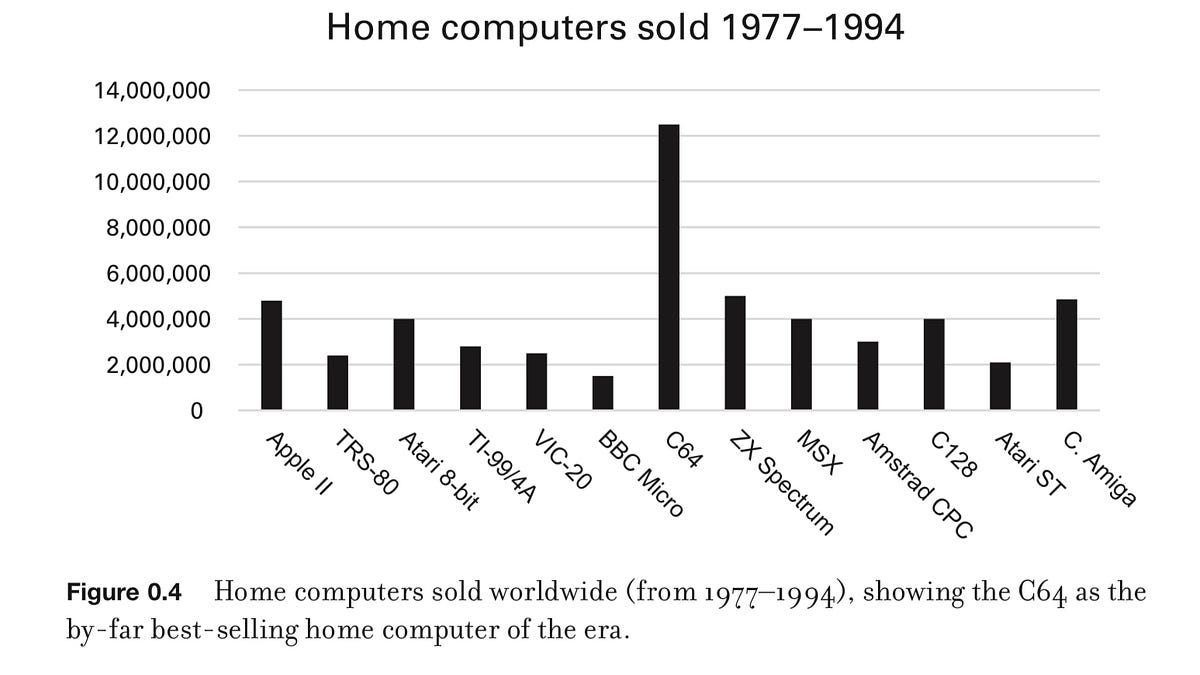
Book Review: Too Much Fun – The Five Lives of the Commodore 64 Computer
The book Too Much Fun: The Five Lives of the Commodore 64 Computer by academic and game designer Jesper Juul serves as a critical re-examination of the Commodore 64’s role in video game history.
- The Commodore 64 maintained a significant market presence throughout the 1980s, holding over 31% of the U.S. home computer market as late as 1986.
- The Commodore 64 hosted a library of over 5,000 published games, representing the largest software catalog of any platform prior to the MS-DOS era.
- Jesper Juul’s research challenges the narrative that the 1983 North American video game crash left a vacuum filled solely by the Nintendo Entertainment System.

Sir Clive Sinclair: The Trailblazer Who Invented the British Video Game Industry
The primary purpose of this analysis is to examine the foundational role of Sir Clive Sinclair and the ZX Spectrum in the development of the British video game industry.
- Sir Clive Sinclair’s ZX Spectrum, launched in 1982, is credited with founding the British video game industry by fostering a massive ecosystem of bedroom coders and entrepreneurial game companies.
- Despite Sinclair’s original intent for the ZX Spectrum to be used for programming and office applications, the 16k and 48k models sold over 5 million units globally primarily due to consumer demand for gaming.
- The rise of microcomputers like the ZX Spectrum, Commodore 64, and BBC Acorn in the early 1980s directly cannibalized the market for traditional video game arcades and the Atari 2600.

The Art of FAITH: Horror at 192x160 Pixels
The development of the horror game FAITH serves as a case study in how strict aesthetic constraints and low-fidelity visuals can effectively generate dread and compete with high-budget, next-generation horror titles.
- The horror game FAITH achieves atmospheric dread by imposing strict technical constraints, including a 192x160 resolution, a limited color palette, and a 15 frames-per-second cap.
- The developer utilized rotoscoped animations—comprising 75 to 120 hand-traced drawings per sequence—to create an uncanny, lifelike contrast against the low-fidelity pixel environment.
- By leveraging the high level of abstraction inherent in early pixel art, the design successfully exploits the 'fear of the unknown' to compete with high-budget, next-generation horror titles.

Classic Game Postmortem - Raid On Bungeling Bay
The development of Raid on Bungeling Bay, released in 1984, serves as a pivotal case study in the technical ingenuity required during the early 8-bit computing era.
- The financial success of Raid on Bungeling Bay, which sold 800,000 units on the Nintendo platform in Japan, provided the essential capital required to launch Maxis.
- The project achieved unprecedented smooth-scrolling graphics on the Commodore 64 by utilizing manual, byte-level memory management and custom development interfaces.
- The game introduced a dynamic, clockwork resource-management system where enemy defenses escalated based on player progress, establishing early foundations for the simulation genre.

Classic Game Postmortem: Maniac Mansion
Maniac Mansion, released in 1987 by Lucasfilm Games, represents a foundational shift in the adventure game genre.
- The 1987 release of Maniac Mansion by Lucasfilm Games revolutionized the adventure genre by replacing text parsers with a visual, verb-based interface and introducing the cinematic cutscene.
- The development of the SCUMM (Script Creation Utility for Maniac Mansion) engine provided a multitasking scripting language that enabled efficient memory management on the Commodore 64 and served as the technical foundation for future adventure titles.
- The game introduced high replayability through a character-selection system, allowing players to choose three out of seven available characters, each with unique abilities that required different puzzle-solving strategies.

Finnish mobile games history: part 2
The Finnish mobile gaming industry underwent a transformative shift following the introduction of the iPhone and the subsequent launch of the App Store.
- The 2008 launch of the Apple App Store ended operator-controlled distribution, allowing Finnish developers to bypass restrictive barriers and access a global market directly.
- The introduction of in-app purchases in 2009 served as the critical catalyst for the industry's shift from premium, one-time-purchase models to the dominant freemium, free-to-play structure.
- Major companies like Rovio and Supercell have acted as industry anchors, attracting venture capital and providing a blueprint for success that inspires new generations of local developers.