Cognosphere
CompanySingapore · Founded 2021
Cognosphere Pte., Ltd. stylized as COGNOSPHERE, is a global entertainment brand and publishing company based in Singapore. The company was established in 2021 to provide virtual world experiences to global players.
Connections
Each row is a game or company named alongside Cognosphere, each column a document, oldest first. A mark means that document names it. Select a row to see those documents.
About the company
- Founded
- 2021
- Country
- Singapore
Company data from IGDB.com
Documents about Cognosphere
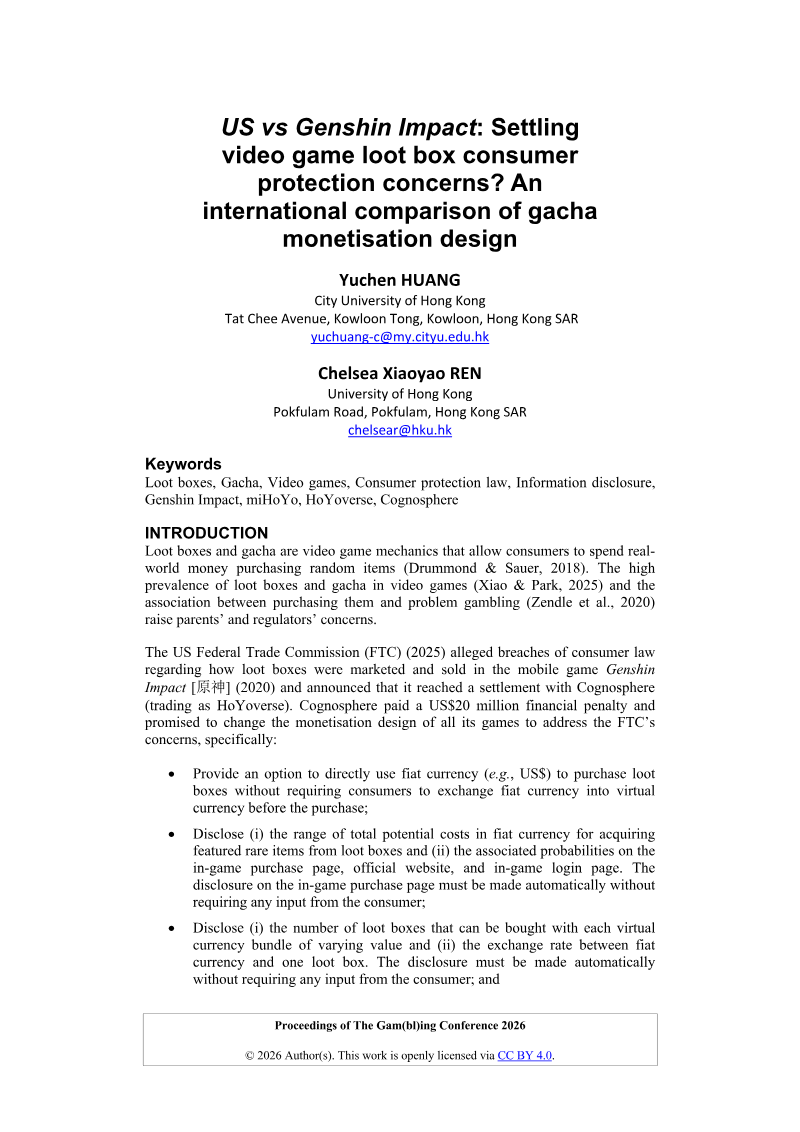
US vs Genshin Impact: Settling Video Game Loot Box Consumer Protection Concerns? An International Comparison of Gacha Monetisation Design
This study examines whether Cognosphere (trading as HoYoverse) has actually implemented the terms of its January 2025 US Federal Trade Commission settlement over loot box and gacha monetisation in Genshin Impact and its sister titles.
- Cognosphere (HoYoverse) agreed to a $20 million penalty and specific design changes in a January 2025 US Federal Trade Commission settlement over loot box and gacha monetisation in Genshin Impact and sister titles.
- A preliminary compliance test of five Cognosphere games found widespread non-compliance: all examined games still contained loot boxes, and US versions still required converting real money into virtual currency before buying most loot boxes.
- Only one currency exchange step was removed for some prominent items in US versions, and cost ranges and drop probability disclosures appeared only for prominent loot boxes rather than all of them.
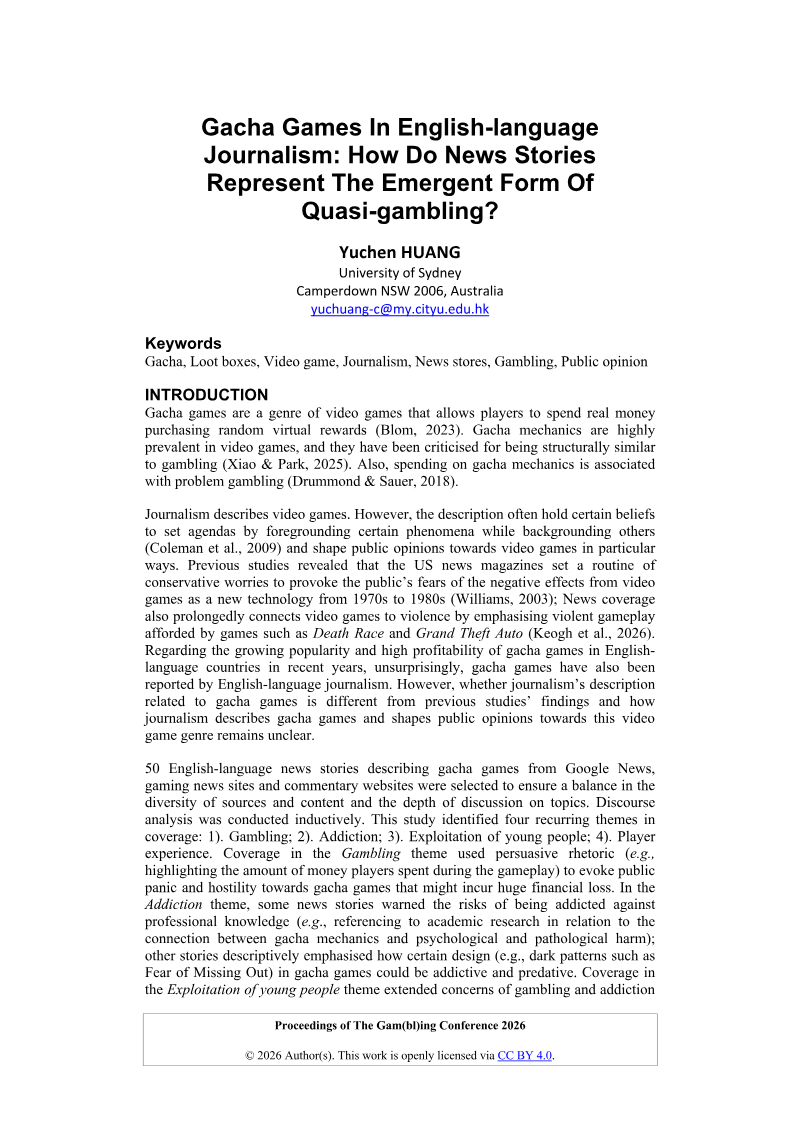
Gacha Games in English-Language Journalism: How Do News Stories Represent the Emergent Form of Quasi-Gambling?
Gacha games, a genre of free-to-play video games where players spend real money on random virtual rewards, have drawn comparisons to gambling and links to problem gambling and addiction.
- Coverage of gacha games in English-language journalism is dominated by negative framings—gambling, addiction, and exploitation of young people—which the study links to established patterns of news media portraying video games through their harms.
- The study analysed 50 English-language news stories drawn from Google News, gaming news sites, and commentary websites, using inductive discourse analysis to identify four recurring themes.
- Stories on gambling, addiction, and youth exploitation use persuasive rhetoric—emphasising money spent, citing academic research on psychological harm, and highlighting manipulative design such as fear of missing out—to evoke public alarm and hostility toward gacha games.

Zenless Zone Zero Player Count & Revenue Stats [2026]
Zenless Zone Zero, HoYoverse's urban fantasy action RPG released July 4, 2024, is profiled here as a game that moved from an enormous launch to a smaller but stable, profitable mature phase.
- Zenless Zone Zero has generated $422 million in lifetime mobile revenue since its July 2024 launch, with annual revenue reaching $182 million in 2025.
- The game has transitioned from a high-volume launch phase to a stable mature state, with monthly active users (MAU) settling at approximately 2.8 million as of mid-2026.
- Monthly revenue has declined from a peak of $65 million at launch to roughly $7 million, while monthly downloads have dropped 97% from their initial 11.3 million peak.
A Plan to Stop Video Game Industry Leaks, With the Help of AI
The video game industry is increasingly exploring advanced technological solutions to mitigate the persistent issue of unauthorized information leaks, such as internal memos, unannounced trailers, and confidential game assets.
- The firm EchoMark introduced AI-powered steganography at the 2026 Game Developers Conference to combat unauthorized leaks of game assets and internal documents.
- This technology embeds invisible digital watermarks into sensitive materials, allowing publishers to trace leaked content back to specific internal users.
- The system uses AI-driven alpha-blend overlays to create a forensic trail that is imperceptible to the human eye.
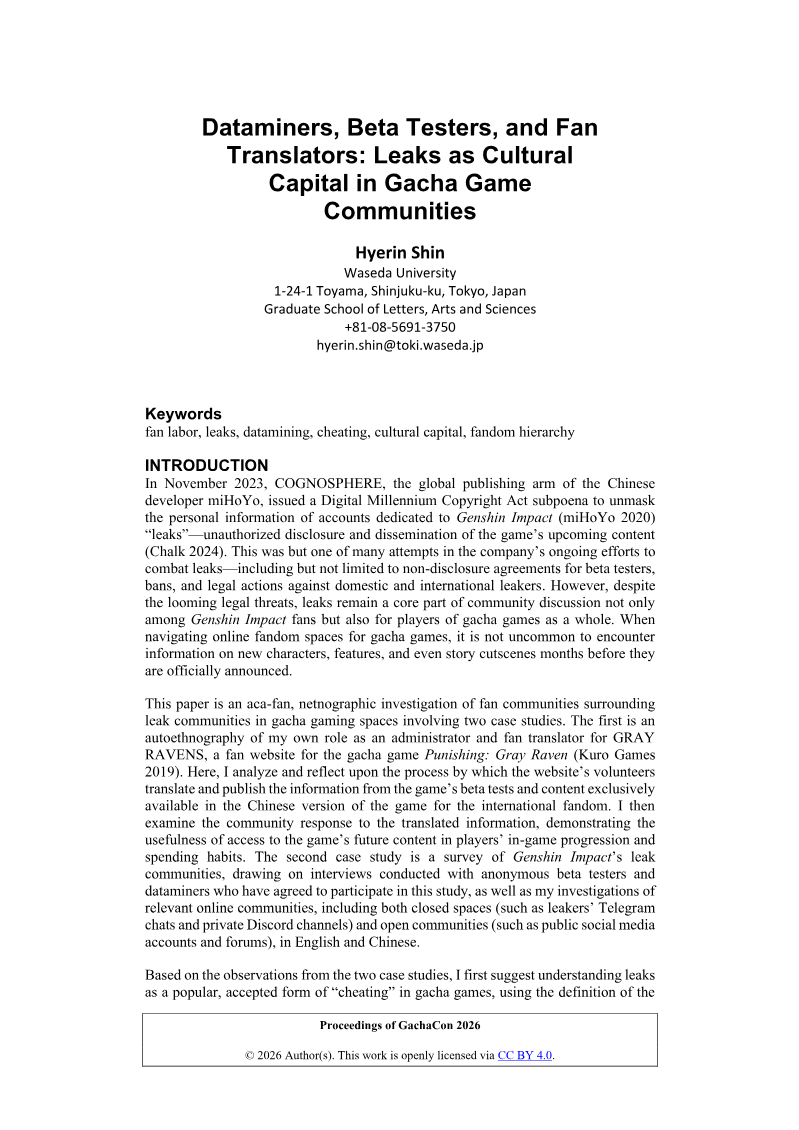
Dataminers, Beta Testers, and Fan Translators: Leaks as Cultural Capital in Gacha Game Communities
This paper, an autoethnographic and netnographic study by Hyerin Shin, examines leaks, the unauthorized circulation of unreleased gacha game content, as a form of cultural capital within gacha game fan communities.
- Leaks of unreleased gacha content are framed as a widely accepted form of 'cheating' (in Mia Consalvo's sense) that players use to counter the fear of missing out (FOMO) fostered by gacha monetization.
- Leaks simultaneously resist and stratify: advance access to information elevates certain individuals into 'fan leader' roles and, in some cases, becomes commodified.
- The study combines an autoethnography of the author's work as an administrator and fan translator for the GRAY RAVENS fan site for Punishing: Gray Raven with a survey of Genshin Impact leak communities based on interviews with anonymous beta testers and dataminers.