
AppQuantum
Company
We help talented developers around the globe focus on making mobile games they love. We publish their games and increase their revenue, so they can produce worldwide hits.
Connections
Each row is a game or company named alongside AppQuantum, each column a document, oldest first. A mark means that document names it. Select a row to see those documents.
About the company
- Links
- Official site
Company data from IGDB.com
Documents about AppQuantum

🧠 The Creative trends nobody wants to admit! (July 2026 trends)
The mobile gaming industry is currently defined by a pervasive reliance on iterative, copy-paste creative strategies that prioritize proven mechanics over innovation.
- The mobile gaming market is experiencing a disconnect between high user acquisition spending and actual engagement, with major titles like Monopoly GO! and Coin Master seeing declines in daily active users and revenue.
- Publishers are increasingly shifting focus toward direct-to-consumer web shops to bypass app store metrics, making off-platform revenue tracking the primary competitive advantage in the current market.
- Creative strategy is currently defined by a reliance on AI-generated, iterative content—such as hotel simulations and freezing family themes—to maintain market presence through rapid asset scaling.

🧠 Copy vs Execute: the creative trend everyone's chasing
The mobile gaming industry is currently defined by a strategic shift toward a copy-and-execute model, where developers prioritize the rapid adaptation of proven hyper-casual hooks to lower cost-per-install metrics.
- The mobile gaming industry has shifted toward a 'copy-and-execute' model that prioritizes rapid adaptation of proven hyper-casual hooks to lower cost-per-install metrics.
- Publishers are utilizing AI to generate thousands of unique ad variations monthly, focusing on high-intensity or humorous 30-to-60-second video formats to drive global downloads.
- The reliance on misleading gameplay elements in onboarding flows creates a fundamental tension between short-term user acquisition and long-term player retention.

🧠 Playrix just went All-In on AI Creatives: 100+ AI Ads Reviewed
Playrix has fundamentally transformed its marketing operations by adopting an all-in strategy for AI-generated creative assets across flagship titles such as Township, Gardenscapes, and Homescapes.
- Playrix has transitioned from experimental AI testing to a full-scale production model for flagship titles like Township, Gardenscapes, and Homescapes.
- The integration of AI tools has reduced creative production timelines from weeks to a single day, enabling rapid localization and scaling of assets.
- Playrix uses AI to aggressively iterate on proven narrative tropes, such as slapstick humor and character-driven drama, while testing new aesthetics like anime-inspired visuals.

🎯 Creative Trends April 2026: Volume + 80/20 Creative Strategy FTW!
The mobile gaming industry is currently defined by a high-stakes volume race, where market dominance is contingent upon the rapid, consistent deployment of thousands of creative assets each month.
- Leading mobile studios are adopting an 80/20 creative strategy, allocating 80% of resources to iterating on proven concepts and 20% to exploratory innovation to maintain market dominance.
- Aggressive use of divergent hooks, such as mini-games and onboarding mechanics, has enabled 4X strategy games to reduce cost-per-install figures from $80 down to $15–$20.
- Market competitiveness is currently driven by a high-stakes volume race that requires the rapid, consistent deployment of thousands of creative assets every month.

AppQuantum’s Victoria Beliaeva and Alexey Gavrilov On How To Identify And Build A Hit Game
The mobile gaming industry is characterized by increasing competition and rising user acquisition costs, necessitating a structural, data-driven approach to game development.
- Success in the free-to-play market requires integrating marketing and analytics from the earliest stages of production to mitigate risk and ensure alignment with market demand.
- Developers should adopt a 'fail fast and cheap' strategy, using early prototype testing to validate core mechanics before committing significant resources to full-scale development.
- Marketing metrics like cost-per-install are primary indicators for hyper-casual titles, while RPGs and strategy games require a focus on long-term retention and monetization mechanics.
Merge Games: To Do or Not to Do?
This article, published July 22, 2022 by Olga Sobolevskaya and Max Samorukov (AppMagic/Sensor Tower), examines the Merge game genre.
- Merge-3 games show higher iAP revenue per download than Merge-2 games, with iAP RpD of 7.4 versus 1.4 worldwide.
- The authors describe the Merge Dragons!-like sub-genre as approaching a dead-end, with aggregate downloads falling over recent years.
- Three EverMerge-like games account for 99% of revenue in that sub-genre, according to the article.

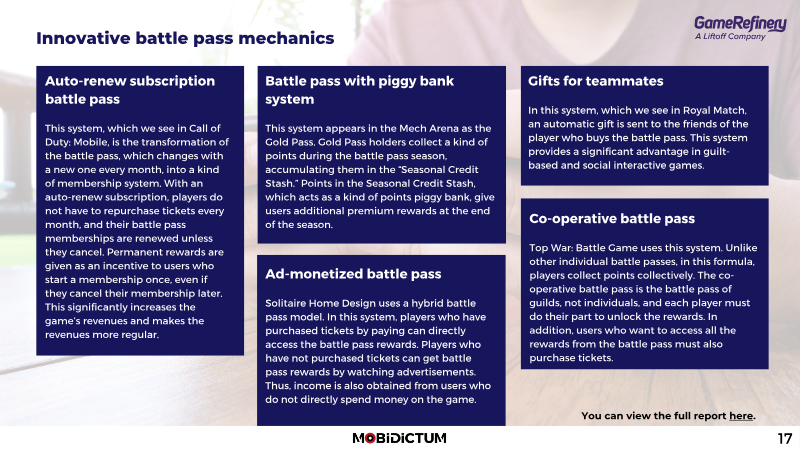

Monthly Game Industry Report: July 2022
The document is a July 2022 monthly mobile game industry report compiled from several sources, including Tenjin, GameRefinery, SensorTower, McKinsey & Company, Entertainment Software Association, Google, Oyunfor and AppQuantum.
- Seventy-five percent of advertisers surveyed by Tenjin said their iOS revenue was negatively impacted after Apple's IDFA protocol.
- Tenjin reports that 59% of surveyed advertisers moved their ad budgets from iOS to Android, though not necessarily leaving iOS completely.
- Sixty-six percent of Americans play video games every week, according to the Entertainment Software Association study.

Idle Tycoon Games: Market Overview
Idle tycoon games have become an attractive segment for mobile developers, particularly those leaving hypercasual in search of higher revenue per download to offset rising CPIs.
- The idle tycoon genre reached a cumulative monthly net in-app purchase revenue exceeding $21 million by early 2022, with total revenue including advertising estimated at $30 million.
- Market strategy has shifted from ad-heavy monetization to robust in-app purchase models, resulting in surging revenue despite stable download volumes.
- Leading titles such as Gold & Goblins, Idle Mafia, and Idle Lumber Empire demonstrate that small teams can achieve scale through aggressive creative testing, publishing partnerships, and deep live-ops integration.

Publishing, Partnership & Problems
The publishing landscape in the mobile game industry is often characterized by a disconnect between the idealized, optimistic narratives presented by publishers and the pragmatic, often difficult realities faced by developers.
- Successful mobile game partnerships require abandoning optimistic 'fairy tale' expectations in favor of transparent, proactive communication regarding potential failures and operational risks.
- Developers should conduct multiple small-scale market tests with various publishers and share those results openly to gain an accurate, data-driven understanding of a game’s true market potential.
- Initial partnership discussions must explicitly address fundamental studio drivers, specifically whether the developer’s primary goal is long-term sustainability or a quick exit.
Curated Panel: IDFA Effect' on UA Performance & New Changes for ASO
The mobile gaming industry is undergoing a fundamental transition from granular, device-level user acquisition to an aggregated, privacy-centric model following the implementation of Apple’s App Tracking Transparency framework.
- The implementation of Apple's App Tracking Transparency (ATT) and IDFA deprecation forced a shift toward probabilistic attribution and the use of Apple's SKAdNetwork (SKAN) to maintain user acquisition measurement.
- To address limited data visibility, advertisers are utilizing Conversion Studio tools to measure flexible activity ranges (e.g., levels 1-3) and sequences of events rather than relying on a single 24-hour window.
- Game developers are increasingly shifting UA budgets toward Android and exploring alternative acquisition methods, such as web-to-app flows using landing pages and smart banners to bypass iOS tracking limitations.