
AppQuantum
Company
Documents about AppQuantum

🧠 The Creative trends nobody wants to admit! (July 2026 trends)
The mobile gaming industry is currently defined by a pervasive reliance on iterative, copy-paste creative strategies that prioritize proven mechanics over innovation.
- The mobile gaming market is experiencing a disconnect between high user acquisition spending and actual engagement, with major titles like Monopoly GO! and Coin Master seeing declines in daily active users and revenue.
- Publishers are increasingly shifting focus toward direct-to-consumer web shops to bypass app store metrics, making off-platform revenue tracking the primary competitive advantage in the current market.
- Creative strategy is currently defined by a reliance on AI-generated, iterative content—such as hotel simulations and freezing family themes—to maintain market presence through rapid asset scaling.
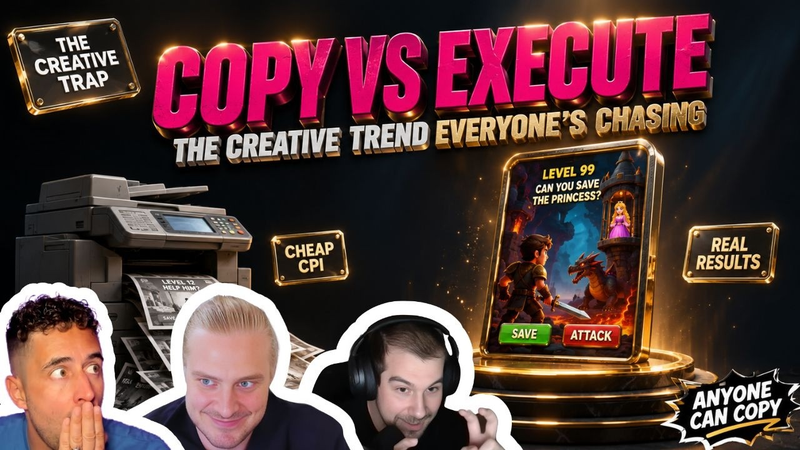
🧠 Copy vs Execute: the creative trend everyone's chasing
The mobile gaming industry is currently defined by a strategic shift toward a copy-and-execute model, where developers prioritize the rapid adaptation of proven hyper-casual hooks to lower cost-per-install metrics.
- The mobile gaming industry has shifted toward a 'copy-and-execute' model that prioritizes rapid adaptation of proven hyper-casual hooks to lower cost-per-install metrics.
- Publishers are utilizing AI to generate thousands of unique ad variations monthly, focusing on high-intensity or humorous 30-to-60-second video formats to drive global downloads.
- The reliance on misleading gameplay elements in onboarding flows creates a fundamental tension between short-term user acquisition and long-term player retention.

🧠 Playrix just went All-In on AI Creatives: 100+ AI Ads Reviewed
Playrix has fundamentally transformed its marketing operations by adopting an all-in strategy for AI-generated creative assets across flagship titles such as Township, Gardenscapes, and Homescapes.
- Playrix has transitioned from experimental AI testing to a full-scale production model for flagship titles like Township, Gardenscapes, and Homescapes.
- The integration of AI tools has reduced creative production timelines from weeks to a single day, enabling rapid localization and scaling of assets.
- Playrix uses AI to aggressively iterate on proven narrative tropes, such as slapstick humor and character-driven drama, while testing new aesthetics like anime-inspired visuals.
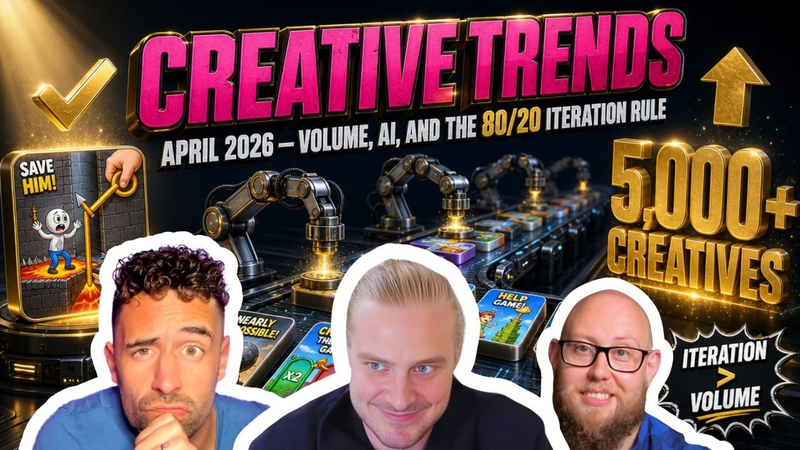
🎯 Creative Trends April 2026: Volume + 80/20 Creative Strategy FTW!
The mobile gaming industry is currently defined by a high-stakes volume race, where market dominance is contingent upon the rapid, consistent deployment of thousands of creative assets each month.
- Leading mobile studios are adopting an 80/20 creative strategy, allocating 80% of resources to iterating on proven concepts and 20% to exploratory innovation to maintain market dominance.
- Aggressive use of divergent hooks, such as mini-games and onboarding mechanics, has enabled 4X strategy games to reduce cost-per-install figures from $80 down to $15–$20.
- Market competitiveness is currently driven by a high-stakes volume race that requires the rapid, consistent deployment of thousands of creative assets every month.

AppQuantum’s Victoria Beliaeva and Alexey Gavrilov On How To Identify And Build A Hit Game
The mobile gaming industry is characterized by increasing competition and rising user acquisition costs, necessitating a structural, data-driven approach to game development.
- Success in the free-to-play market requires integrating marketing and analytics from the earliest stages of production to mitigate risk and ensure alignment with market demand.
- Developers should adopt a 'fail fast and cheap' strategy, using early prototype testing to validate core mechanics before committing significant resources to full-scale development.
- Marketing metrics like cost-per-install are primary indicators for hyper-casual titles, while RPGs and strategy games require a focus on long-term retention and monetization mechanics.

Publishing, Partnership & Problems
The publishing landscape in the mobile game industry is often characterized by a disconnect between the idealized, optimistic narratives presented by publishers and the pragmatic, often difficult realities faced by developers.
- Successful mobile game partnerships require abandoning optimistic 'fairy tale' expectations in favor of transparent, proactive communication regarding potential failures and operational risks.
- Developers should conduct multiple small-scale market tests with various publishers and share those results openly to gain an accurate, data-driven understanding of a game’s true market potential.
- Initial partnership discussions must explicitly address fundamental studio drivers, specifically whether the developer’s primary goal is long-term sustainability or a quick exit.
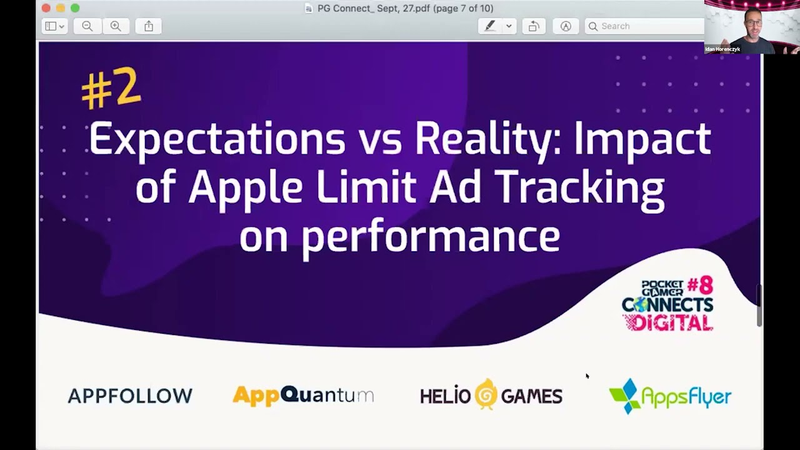
Curated Panel: IDFA Effect' on UA Performance & New Changes for ASO
The mobile gaming industry is undergoing a fundamental transition from granular, device-level user acquisition to an aggregated, privacy-centric model following the implementation of Apple’s App Tracking Transparency framework.
- The implementation of Apple's App Tracking Transparency (ATT) and IDFA deprecation forced a shift toward probabilistic attribution and the use of Apple's SKAdNetwork (SKAN) to maintain user acquisition measurement.
- To address limited data visibility, advertisers are utilizing Conversion Studio tools to measure flexible activity ranges (e.g., levels 1-3) and sequences of events rather than relying on a single 24-hour window.
- Game developers are increasingly shifting UA budgets toward Android and exploring alternative acquisition methods, such as web-to-app flows using landing pages and smart banners to bypass iOS tracking limitations.