Newzoo
Research100 documents
Documents
Report18 pages
Key Insights Into French Gamers
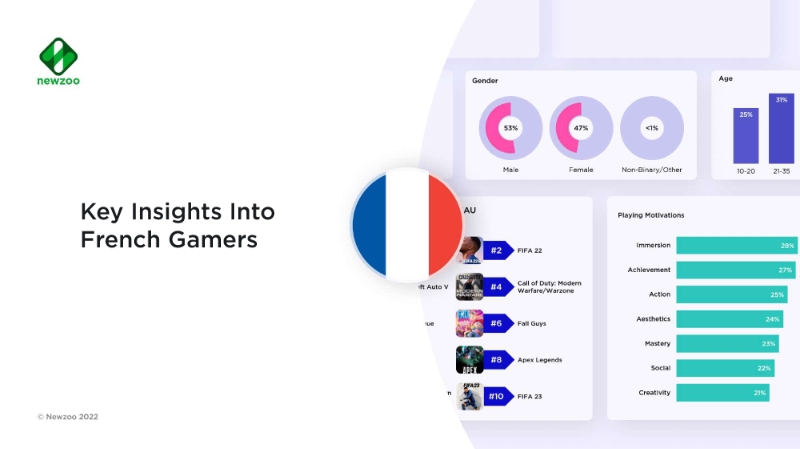
France represents a significant gaming market, ranking seventh globally in terms of revenue and fifteenth in total player count as of 2022. The French gaming population is highly engaged, with 71% of the online population aged 10 to 65 identifying as game enthusiasts. While 38% of this group only plays games, a substantial 34% also views gaming video content, and 15% are classified as esports enthusiasts who watch professional competitive gaming at least once a month.
The demographic profile of French players is nearly balanced by gender, consisting of 52% men and 48% women. The largest age cohort is the 21-35 bracket, representing 31% of the player base. In terms of behavior, Time Fillers and Mainstream Gamers are the most common personas. Time Fillers use games primarily to pass the time and show less interest in viewing content, whereas Mainstream Gamers are deeply invested in both playing and watching gaming media. Mobile is the most popular platform, utilized by 44% of the online population, followed by console at 41% and PC at 30%. Despite mobile's reach, PC players record the highest average weekly playtime at four hours and forty minutes.
Monetization data indicates that 56% of French players are payers, driven primarily by value-based incentives such as sales or special offers. Other significant spending motivators include unlocking exclusive content and the desire to play with friends or family, underscoring the social nature of the market. This analysis is based on a 2022 survey of 2,080 online consumers in France, part of a broader global study covering 36 markets and over 75,000 respondents.
- France is a top-tier global gaming market, ranking seventh in revenue and fifteenth in player count as of 2022.
- The French gaming population is highly engaged, with 71% of online users aged 10–65 identifying as enthusiasts, including 15% who follow esports monthly.
- Mobile is the leading platform with 44% reach, followed by console at 41% and PC at 30%, though PC users record the highest average weekly playtime at four hours and forty minutes.
- The player base is gender-balanced at 52% men and 48% women, with the 21–35 age bracket serving as the largest demographic segment at 31%.
- 56% of French players are payers, with spending primarily motivated by value-based incentives, exclusive content, and social play with friends or family.
NewzooJan 2022
Report11 pages
Key Insights Into Spanish Gamers
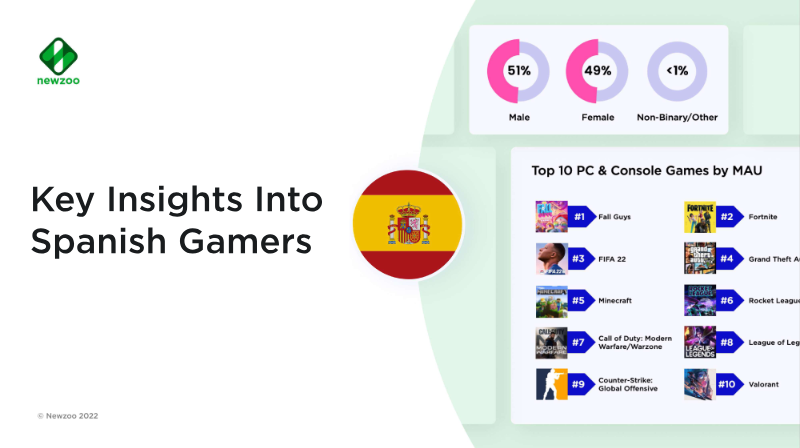
Spain represents a significant global gaming market, ranking 13th in the world with an annual revenue of $2.38 billion. The industry maintains a massive reach within the country, as 83% of the online population aged 10 to 65 are classified as game enthusiasts. Engagement is multifaceted, with 82% of the population playing games and 45% viewing gaming content. Notably, there is a high degree of overlap between these behaviors; 38% of the population both plays and watches games, while only 7% are exclusive viewers.
The demographic profile of Spanish gamers is nearly evenly split between genders, with 51% female and 49% male. Participation remains strong across age groups, though it peaks among those aged 21 to 50. Achievement, action, and mastery serve as the primary motivations for play. While mobile is the most popular platform by reach, utilized by 60% of the population, PC and console players demonstrate higher engagement depth, averaging four hours of play per week compared to three hours on mobile.
Market behavior indicates a strong propensity for spending, with 48% of the online population identified as payers. The primary drivers for monetization include sales or special offers and the desire to play with friends or family. In terms of content, the market is dominated by major global franchises such as Fall Guys, Fortnite, and FIFA 22, with adventure and sports ranking as the top genres by monthly active users. These findings are based on a 2022 consumer study involving a sample of 2,086 online respondents in Spain, forming part of a broader global research initiative covering 36 markets.
- Spain is the 13th largest global gaming market, generating $2.38 billion in annual revenue with 83% of the online population aged 10 to 65 identified as enthusiasts.
- The Spanish gaming audience is gender-balanced at 51% female and 49% male, with peak participation occurring between the ages of 21 and 50.
- While mobile is the most popular platform with 60% reach, PC and console users exhibit higher engagement, averaging four hours of weekly play compared to three hours for mobile users.
- Gaming engagement is highly integrated, as 38% of the population both plays and watches gaming content, while only 7% are exclusive viewers.
- 48% of the online population are payers, primarily motivated by sales, special offers, and the desire to play with friends or family.
+1
NewzooJan 2022
Report11 pages
Key Insights Into South Korean Gamers
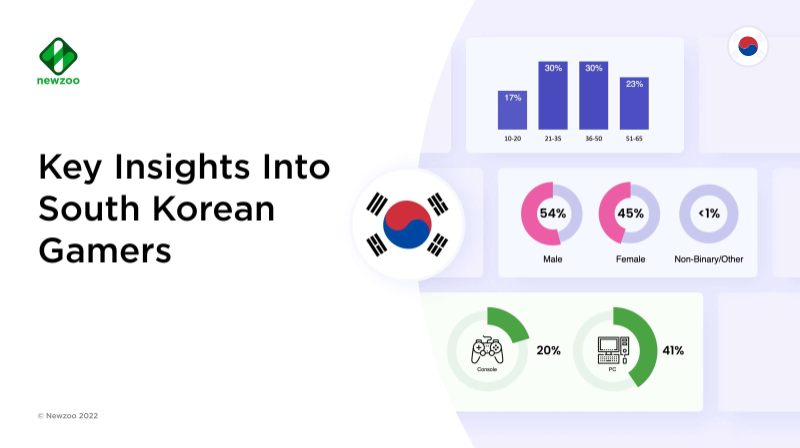
South Korea represents the fourth largest gaming market globally by revenue, valued at $8.3 billion, with a highly engaged population of 33 million gamers. Research conducted in 2022 indicates that 76% of the online population are game enthusiasts who engage with the medium through playing, viewing, or social interaction. While 72% of the population plays games, there is a significant overlap with viewership; 48% of South Koreans both play and watch gaming content, while 22% specifically engage with esports.
The demographic profile of South Korean gamers is diverse, with a nearly even split between males (54%) and females (45%) and broad representation across age groups, particularly those between 21 and 50. Socializing is the primary motivator for play, followed by action and achievement. Despite the high engagement levels, player personas vary; the most common types are Time Fillers, who play casually to pass the time, and Mainstream Gamers, who invest heavily in both playing and viewing.
Mobile is the dominant platform, utilized by 59% of the online population, though PC players record the highest average weekly engagement at five hours. In terms of software, League of Legends and Shooter genres lead in monthly active users. Monetization is also robust, with 38% of the population spending money on games. The primary drivers for spending include the desire to advance more quickly or easily in-game, followed by responding to sales or special offers.
The findings are based on a 2022 consumer insights survey of 2,094 respondents from the South Korean online population. The data highlights a mature market where gaming is a mainstream social activity integrated into daily life across all demographics, supported by a strong esports culture and a high propensity for in-game spending.
- South Korea is the world's fourth-largest gaming market, generating $8.3 billion in annual revenue from a highly engaged base of 33 million gamers.
- Gaming is a deeply integrated social activity, with 76% of the online population participating, 48% both playing and watching content, and 22% specifically following esports.
- Mobile is the primary platform for 59% of the online population, though PC gamers demonstrate higher engagement with an average of five hours of play per week.
- The player base is demographically balanced, with a 54% male and 45% female split and strong representation across the 21–50 age range.
- Monetization is robust, with 38% of the population spending money on games, primarily driven by the desire for faster progression or to capitalize on special offers.
+1
NewzooJan 2022
Report18 pages
Consumer Insights: Games & Esports 2022
Gaming has evolved into a multi-dimensional entertainment ecosystem where traditional play is no longer the sole driver of engagement. Findings indicate that 79% of the global online population are game enthusiasts, participating through playing, viewing content, or socializing in virtual worlds. This shift is most pronounced among younger generations; for Gen Alpha, gaming has surpassed social media and streaming video as the primary source of entertainment.
The research highlights a significant trend toward the "metaverse," with 75% of players and 44% of non-players engaging in game worlds for social interaction without playing the core game. This high level of engagement translates into substantial economic impact, with consumer spending in the sector projected to exceed $200 billion in 2023. Approximately half of Gen Alpha, Gen Z, and Millennial gamers are already classified as payers, a figure expected to rise as younger cohorts gain independent purchasing power.
Data suggests that gamers are a highly receptive audience for brands, exhibiting 36% more positive attitudes toward brand messaging compared to non-players. However, the diversity of the audience necessitates a nuanced approach. Using proprietary segmentation, the analysis shows that while older generations often act as "Time Fillers," younger audiences are more likely to be "Ultimate Gamers" or "All-Round Enthusiasts." Even within the same genre, such as Battle Royale, player demographics and motivations vary significantly between titles like Fortnite and Apex Legends, affecting their preferences for products like energy drinks or alcohol.
The findings are based on a 2022 study utilizing Computer Assisted Web Interviewing (CAWI) with a representative sample of 75,930 respondents. The scope covers 36 global markets across North America, Europe, Latin America, and Asia-Pacific, targeting the online population aged 10 to 65. Additional sentiment studies on the metaverse and blockchain gaming supplement the core consumer data.
- Gaming has become a primary entertainment ecosystem for 79% of the global online population, with Gen Alpha prioritizing gaming over social media and streaming video.
- Consumer spending in the gaming sector is projected to exceed $200 billion in 2023, driven by a payer base that includes approximately 50% of Gen Alpha, Gen Z, and Millennial gamers.
- Game worlds are increasingly used for social interaction rather than gameplay, with 75% of players and 44% of non-players utilizing these environments for non-gaming social engagement.
- Gamers are a highly receptive audience for advertising, demonstrating a 36% more positive attitude toward brand messaging compared to non-players.
- Audience motivations vary significantly by demographic, with older users often acting as 'Time Fillers' while younger cohorts are more likely to be 'Ultimate Gamers' or 'All-Round Enthusiasts'.
+1
NewzooJan 2022
Report61 pages
The New Destination to Reach Global Gamers: The 2021 Global Mobile Gamers Whitepaper
Mobile gaming represents the largest and fastest-growing segment of the global entertainment industry, generating $93.2 billion in 2021 with a projected trajectory toward $126.1 billion by 2024. Within this landscape, a distinct synergy has emerged between mobile gaming and social media platforms, particularly TikTok, where nearly half of all mobile gamers are active. These users demonstrate significantly higher value than non-users, installing 50% more games, playing 36% longer, and showing a 66% higher likelihood of making in-game purchases. This demographic functions as a highly social and evangelical audience that consumes an average of seven different genres and responds more favorably to innovative advertising formats like sponsored livestreams and user-generated content.
Global player behavior reveals a consistent preference for realistic art styles and fantasy or mystery settings, though regional nuances remain critical for market penetration. While Southeast Asian markets are dominated by MOBA titles, Japanese and South Korean audiences show a marked preference for immersive RPGs and Puzzle RPGs. Across all regions, the primary motivation for gameplay is relaxation or passing time, yet monetization is driven by progression-based incentives, such as the desire to unlock content or bypass difficult levels. This suggests that while the initial draw of a game is often casual, long-term financial viability depends on structured advancement and consistent content updates.
Retention and re-engagement strategies must address the primary drivers of player churn, which are identified as technical bugs and slow leveling speeds. Conversely, the introduction of new missions, story-driven updates, and technical optimizations are the most effective methods for reclaiming lapsed players. To maximize impact, advertisers and developers should prioritize action-packed, narrative-driven creative content that leverages the social metaverse. By focusing on regional aesthetic preferences—such as "cute" or anime styles in Asia versus cartoonish realism in Western markets—and addressing the specific progression needs of players, stakeholders can better navigate the increasingly competitive global mobile gaming ecosystem.
- The global mobile gaming market generated $93.2 billion in 2021 and is projected to reach $126.1 billion by 2024.
- Mobile gamers active on TikTok install 50% more games, play 36% longer, and are 66% more likely to make in-game purchases than non-users.
- While players primarily game to relax or pass time, long-term monetization is driven by progression-based incentives like unlocking content and bypassing difficult levels.
- Technical bugs and slow leveling speeds are the primary drivers of player churn, while new missions and story-driven updates are the most effective methods for re-engagement.
- Regional preferences vary significantly, with MOBA titles dominating Southeast Asia, while Japan and South Korea favor immersive RPGs and Puzzle RPGs.
+2
NewzooJan 2022
Report3 pages
India Market Update: September 2021
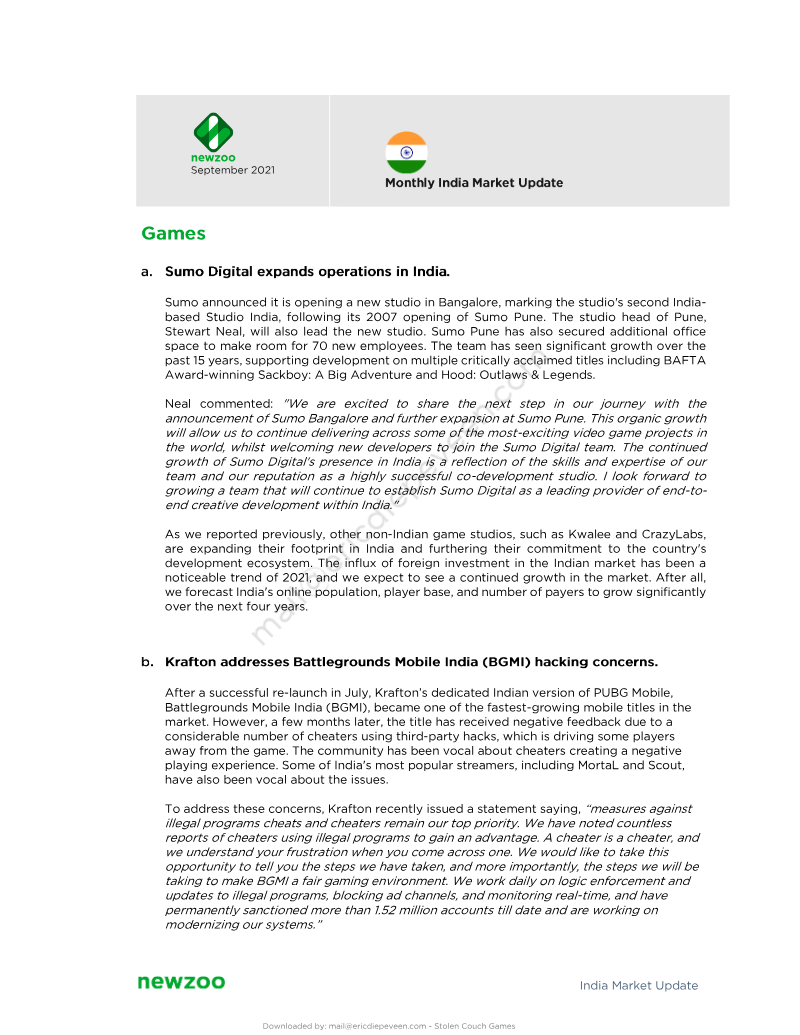
The Indian gaming and esports landscape is undergoing a period of rapid institutional growth and diversification, characterized by significant foreign investment and the expansion of domestic infrastructure. During the 2021 period, international developers such as Sumo Digital, Kwalee, and CrazyLabs have deepened their commitment to the region. Sumo Digital’s establishment of a second studio in Bangalore and the expansion of its Pune facility highlight a strategic shift toward utilizing India as a hub for end-to-end creative development rather than just a support center. This trend aligns with forecasts predicting substantial increases in India’s online population, player base, and total number of paying users over the next four years.
The mobile gaming sector remains a primary driver of market activity, though it faces operational hurdles. Krafton’s Battlegrounds Mobile India has seen explosive growth but must navigate the technical challenge of maintaining competitive integrity. The company has permanently sanctioned over 1.52 million accounts to combat cheating, illustrating the friction between accessibility in free-to-play titles and the necessity of robust anti-cheat measures. Simultaneously, the real-money and fantasy gaming segments are accelerating, evidenced by Mobile Premier League reaching a $2.3 billion valuation following a $150 million Series E funding round intended to fuel global expansion into markets like the United States.
The esports ecosystem is maturing through consolidation and the convergence of gaming with broader entertainment sectors. Market leader NODWIN Gaming has expanded its reach into the casual and mid-core demographics by acquiring OML Entertainment’s IP business and partnering with PVR Cinemas to pilot in-theater esports viewing. These moves signify a transition toward a more integrated media model where gaming, music, and comedy intersect to drive brand engagement. Overall, the Indian market is evolving into a sophisticated environment defined by high-value capital raises, localized content strategies, and the professionalization of the broader creator economy.
- India is transitioning from a support-focused hub to a center for end-to-end creative development, evidenced by Sumo Digital expanding its Bangalore and Pune facilities.
- Mobile Premier League achieved a $2.3 billion valuation following a $150 million Series E funding round, signaling significant investor confidence in the real-money and fantasy gaming segments.
- Krafton’s Battlegrounds Mobile India has permanently banned over 1.52 million accounts to address cheating, highlighting the operational challenges of maintaining competitive integrity in high-growth free-to-play titles.
- NODWIN Gaming is diversifying its esports model by acquiring OML Entertainment’s IP business and partnering with PVR Cinemas to bring esports content into theater environments.
- International developers including Sumo Digital, Kwalee, and CrazyLabs are deepening their strategic commitments to the Indian market in anticipation of growth in the online population and paying user base.
NewzooSept 2021
Report34 pages
Global Mobile Market Report 2021
The 2021 global mobile market analysis underscores a rapidly expanding ecosystem in which smartphone ubiquity, rising active‑device counts, and the early rollout of 5G networks are driving unprecedented growth in mobile gaming. By integrating socio‑economic indicators, device‑usage data from more than 400 million monthly active devices, and revenue tracking from major app‑store partners, the study projects that mobile‑game spending will climb from $90.7 billion in 2021 to $116.4 billion by 2024, reflecting an 11.2 % compound annual growth rate. Smartphone penetration reached 3.9 billion users in 2021, a 6 % year‑over‑year increase, while 5G‑ready devices are beginning to reshape gameplay experiences and monetisation models.
Regulatory shifts, notably Apple’s App‑Tracking Transparency and Google’s parallel privacy policies, together with the high‑profile Apple‑Epic litigation, are redefining user‑acquisition strategies and prompting developers to explore platform‑driven revenue streams such as in‑game advertising, subscriptions, and direct storefronts. Revenue distribution remains heavily skewed: the top 20 % of spenders—players who spend $25 or more per month—account for roughly 80 % of total income, favouring socially rich, competitive titles and showing greater openness to ads and subscription offers.
A consumer survey of 5,400 gamers aged 10‑50 across the United States, China, Germany, and Japan reveals modest regional variation in intellectual‑property preferences, suggesting that aligning established entertainment IPs—books, comics, movies, and TV series—with appropriate game genres can enhance engagement. Overall, the findings highlight a market poised for continued expansion, driven by technological adoption, evolving privacy landscapes, and a concentrated core of high‑value players.
- Mobile game spending is projected to grow from $90.7 billion in 2021 to $116.4 billion by 2024, representing an 11.2% compound annual growth rate.
- The top 20% of players, defined as those spending $25 or more per month, generate approximately 80% of total mobile gaming revenue.
- Smartphone penetration reached 3.9 billion users in 2021, marking a 6% year-over-year increase that continues to drive market expansion.
- Regulatory changes, including Apple’s App-Tracking Transparency and Google’s privacy policies, are forcing developers to pivot toward in-game advertising, subscriptions, and direct storefronts for user acquisition.
- The rollout of 5G-ready devices is actively reshaping mobile gameplay experiences and monetization models.
NewzooSept 2021
Report39 pages
Global Cloud Gaming Report: The Infrastructure Edition 2021
This analysis provides a comprehensive overview of the cloud gaming sector in 2021, focusing on how network infrastructure and global economic conditions have accelerated industry adoption. The primary thesis asserts that while the COVID-19 pandemic provided an initial surge in engagement, the market is now transitioning toward sustainable growth driven by technological maturity, strategic business partnerships, and a global semiconductor shortage that has made cloud streaming a viable alternative to expensive, unavailable local hardware.
The scope of the research is global, with specific emphasis on ten subregions and thirty-three individual markets, including deep dives into China, North America, and Western Europe. Data was gathered through a proprietary model incorporating internet connection speeds, urbanization rates, and service availability, supplemented by a July 2021 survey of 6,788 gamers across China, Germany, Japan, and the United States. The methodology utilizes three forecasting scenarios—base, optimistic, and pessimistic—to account for the inherent volatility of a nascent technology market.
Key findings indicate that the global cloud gaming market reached $1.6 billion in revenues and 23.7 million paying users in 2021. Projections suggest significant expansion, with revenues expected to exceed $6.5 billion and paying users reaching 60.7 million by 2024. While North America and Europe currently account for 59% of consumer spending, emerging markets in Asia-Pacific, Latin America, and the Middle East are poised for rapid growth due to the rollout of 5G infrastructure and high consumer interest in regions where gaming hardware is prohibitively expensive.
The analysis concludes that the industry is moving toward a more frictionless user experience through edge computing and B2B partnerships between service providers and telecommunications companies. Despite the closure of some first-party studios, investment remains high among stakeholders like NVIDIA, Haima Cloud, and now.gg. Consumer sentiment remains positive, characterized by high satisfaction levels and low churn, though long-term success depends on overcoming hardware ownership preferences and continuing to improve global network stability.
- The global cloud gaming market reached $1.6 billion in revenue and 23.7 million paying users in 2021, with projections estimating growth to over $6.5 billion and 60.7 million users by 2024.
- North America and Europe currently dominate the sector, accounting for 59% of total consumer spending.
- The global semiconductor shortage has acted as a catalyst for cloud gaming adoption by positioning streaming services as a viable alternative to scarce and expensive local hardware.
- Rapid growth is expected in Asia-Pacific, Latin America, and the Middle East, driven by the rollout of 5G infrastructure and high demand in regions where local gaming hardware is cost-prohibitive.
- Industry stakeholders, including NVIDIA, Haima Cloud, and now.gg, are prioritizing edge computing and B2B partnerships with telecommunications companies to improve service stability and user experience.
+1
NewzooSept 2021
Report26 pages
Mobile Game Genre Report: Puzzle Games
This analysis examines the mobile puzzle game market, contrasting dynamics between Western and Eastern regions with a focus on the United States, United Kingdom, Japan, and South Korea. In 2021, mobile emerged as the primary gaming platform globally, with puzzle games representing a significant 8% of total mobile game revenues, totaling $6.9 billion in 2020. The United States leads as the largest market for the genre ($2.0 billion), followed by Japan ($1.2 billion) and China ($0.9 billion).
While puzzle games are the most popular genre across all surveyed markets, regional player behaviors and monetization preferences vary significantly. In the West, players favor casual experiences and show a higher tolerance for in-app advertising (IAA). Conversely, Eastern markets, particularly Japan, demonstrate a higher propensity for in-app purchases (IAP) and deeper engagement with character collection, progression mechanics, and "gacha" systems. Demographically, puzzle gamers worldwide skew female and hold mid-to-high incomes, though players in the East tend to be younger and more highly educated than their Western counterparts.
The findings highlight a shift toward hybrid monetization models that combine IAP, IAA, and subscription-based "Battle Passes." While classic Match-3 remains the dominant subgenre, developers are increasingly integrating "meta" elements such as narrative, decoration, and RPG mechanics to drive retention. Successful global expansion requires localized user acquisition strategies; for instance, Japanese players respond better to longer intervals between ads and collaborative events with popular anime IPs, whereas U.S. marketing often benefits from performance-based ads and localized creative content. The data suggests that while the core appeal of puzzle solving is universal, long-term commercial success depends on tailoring the in-game economy and social engagement tools to specific regional expectations.
- The global mobile puzzle game market generated $6.9 billion in 2020, with the United States leading at $2.0 billion, followed by Japan at $1.2 billion and China at $0.9 billion.
- Puzzle games account for 8% of total mobile game revenue and represent the most popular genre across the United States, United Kingdom, Japan, and South Korea.
- Western markets favor casual experiences and in-app advertising (IAA), whereas Eastern markets demonstrate a higher propensity for in-app purchases (IAP) and complex mechanics like gacha systems.
- Developers are increasingly integrating 'meta' elements—such as narrative, decoration, and RPG mechanics—into classic Match-3 gameplay to improve player retention.
- Successful monetization is shifting toward hybrid models that combine IAP, IAA, and subscription-based 'Battle Passes' to maximize revenue.
+3
Newzoo & PangleAug 2021
Report25 pages
A Rising Market: Southeast Asia
Southeast Asia represents a rapidly accelerating segment of the global esports market, characterized by high growth rates in both viewership and revenue. Between 2019 and 2024, the region is projected to see a compound annual growth rate (CAGR) in audience size that significantly outpaces global averages, with year-over-year increases reaching as high as 18.2%. This expansion is driven by a mobile-first gaming culture where 82% of the online population plays mobile games and 39% of players identify mobile as their primary platform. Key markets fueling this trend include Indonesia, Vietnam, the Philippines, Thailand, Malaysia, and Singapore.
The regional ecosystem is heavily influenced by mobile-centric titles, specifically Mobile Legends: Bang Bang, Garena Free Fire, and PUBG Mobile. These three games accounted for roughly half of all global esports hours watched for those titles on Twitch and YouTube Live during the first half of 2021. Revenue streams in the region mirror global trends, with sponsorship serving as the primary contributor, supported by media rights, publisher fees, and digital goods. Government intervention also plays a critical role in market maturation, with initiatives like the Youth Esports Program in the Philippines and the integration of esports into the 30th SEA Games as a medal event.
Data for these findings was sourced from Newzoo’s 2021 Global Esports and Live Streaming Market Report and Consumer Insights. The methodology utilized a Major City Approach for most Southeast Asian nations to represent active internet users aged 10-50, while Singapore data covered the general online population within that age bracket. The findings conclude that improved internet infrastructure and the accessibility of mobile devices are the primary catalysts for long-term engagement and the continued attraction of non-endemic brand sponsorships to the region.
- Southeast Asia's esports audience is experiencing rapid expansion, with year-over-year growth reaching as high as 18.2% between 2019 and 2024.
- The market is defined by a mobile-first culture where 82% of the online population plays mobile games and 39% identify mobile as their primary gaming platform.
- Three mobile titles—Mobile Legends: Bang Bang, Garena Free Fire, and PUBG Mobile—accounted for approximately 50% of all global esports hours watched for those specific games on Twitch and YouTube Live in the first half of 2021.
- Key growth markets in the region include Indonesia, Vietnam, the Philippines, Thailand, Malaysia, and Singapore.
- Revenue generation in the region is primarily driven by sponsorships, supplemented by media rights, publisher fees, and digital goods.
+1
NewzooJul 2021
Report16 pages
Esports Rising: State of the Global Esports Market
The global esports market is experiencing a period of robust expansion, characterized by double-digit growth in both viewership and revenue. Total industry revenues are projected to reach $1.08 billion by the end of 2021, representing a 14.5% year-over-year increase. This financial growth is primarily driven by sponsorships and media rights, which remain the dominant revenue streams. China has solidified its position as the primary market leader, maintaining the largest share of both global esports revenues and the highest concentration of esports enthusiasts.
Audience engagement has surged significantly, with total hours watched on major streaming platforms like Twitch and YouTube increasing by 76% in 2020. While general live-streaming saw the most dramatic rise, dedicated esports viewership also grew by 12.6% during the same period. The global audience is on a trajectory to exceed 577 million viewers by 2024, split between occasional viewers and dedicated enthusiasts. Regional growth is particularly strong in emerging markets, with the Rest of World category seeing a 10% year-over-year increase in enthusiasts, outpacing the growth rates of North America and Europe.
The sponsorship landscape is undergoing a structural shift from short-term, one-year experimental deals to multi-year strategic partnerships. This evolution reflects increased confidence from brands in the long-term stability of the industry. There is a notable influx of non-endemic sponsors, particularly from the financial services sector, including banks and insurance companies seeking to reach younger demographics. Additionally, the furniture industry has accelerated its involvement, with 32 sponsorship deals closed by manufacturers in a twelve-month period as remote work and home-based gaming increased.
Despite the logistical challenges posed by the transition to online-only formats during global lockdowns, the industry demonstrated resilience. While traditional sports faced total shutdowns, esports leagues successfully migrated to digital play, though issues like internet latency persisted. Major publishers like Riot Games have seen significant returns on new titles, with Valorant emerging as a major driver of live esports hours. As the industry moves forward, a return to in-person LAN events is anticipated, though the timeline for the return of live audiences remains contingent on global health conditions.
- The global esports market is projected to reach $1.08 billion in revenue by the end of 2021, marking a 14.5% year-over-year increase driven primarily by sponsorships and media rights.
- Total hours watched on major streaming platforms like Twitch and YouTube surged by 76% in 2020, with the global audience expected to exceed 577 million viewers by 2024.
- China remains the dominant market leader, holding the largest share of global esports revenue and the highest concentration of enthusiasts.
- Sponsorship models are shifting from short-term experimental deals to multi-year strategic partnerships, with non-endemic sectors like financial services and furniture manufacturers increasingly entering the space.
- Emerging markets categorized as 'Rest of World' are currently outpacing North America and Europe in growth, recording a 10% year-over-year increase in enthusiasts.
+1
NewzooMay 2021
Report21 pages
Newzoo's Generations Report: How Different Generations Engage with Games 2021
This analysis examines how different generations engage with video games, highlighting the medium’s evolution from a simple pastime into a multifaceted social and entertainment ecosystem. The research, based on a survey of 72,068 respondents across 33 global markets conducted in early 2021, reveals that while gaming is a universal form of entertainment, engagement patterns vary significantly by age. Younger cohorts, specifically Gen Z and Millennials, increasingly view gaming as a primary leisure activity that encompasses not just playing, but also watching content, socializing, and participating in virtual communities.
Key findings indicate that the share of leisure time dedicated to gaming increases with each younger generation. Gen Z and Millennials report spending more time on gaming than on social media or streaming movies and television. While relaxing and unwinding remain the top motivations for playing across all demographics, younger players are uniquely driven by competition, social interaction, and creative achievement. Consequently, these groups favor multiplayer modes and genres that offer sandbox or social elements, such as Fortnite and Roblox. In contrast, older generations, including Gen X and Baby Boomers, primarily utilize games for casual relaxation, often preferring single-player experiences on mobile devices.
The research also identifies a growing trend toward the metaverse, where virtual worlds serve as platforms for non-gaming activities like social gatherings and digital events. Younger consumers show high interest in avatar customization and content creation, signaling a shift toward digital identity and persistent virtual spaces. While older gamers are less likely to engage with gaming-related video content, those who do often prioritize practical information, such as reviews and tutorials, to inform their purchasing decisions. Ultimately, the data suggests that gaming has become a foundational pillar of modern entertainment, offering brands and developers diverse opportunities to reach audiences through increasingly immersive and social digital experiences.
- Gaming has become the primary leisure activity for Gen Z and Millennials, who spend more time playing games than engaging with social media or streaming video content.
- The 2021 survey of 72,068 respondents across 33 global markets confirms that the share of leisure time dedicated to gaming increases progressively with each younger generation.
- Younger players are primarily motivated by competition, social interaction, and creative achievement, driving high engagement with multiplayer, sandbox, and social platforms like Fortnite and Roblox.
- Older demographics, specifically Gen X and Baby Boomers, primarily utilize gaming for casual relaxation and show a distinct preference for single-player mobile experiences.
- Younger consumers are driving the shift toward the metaverse by prioritizing avatar customization and content creation as core components of their digital identity.
+1
NewzooJan 2021