International Journal of Role-Playing
Open-access peer-reviewed journal on role-playing games, larp and related play forms, now hosted by Uppsala University.
Documents
Between Game Facilitation and Performance: Interactive Actors and Non-Player Characters in Larps
Stenros's study examines interactive actors, or "ractors," who perform non-player characters in live action role-playing games (larps), with a focus on the pervasive larp The Company P's Conspiracy For Good (CFG).
- The study centers on interactive actors, or 'ractors,' who perform non-player characters in live action role-playing games (larps), focusing on the pervasive larp The Company P's Conspiracy For Good, and examines how they balance player agency against narrative coherence.
- The core of ractors' work is runtime game mastering: managing pacing, responding to unforeseen player actions, and mentoring players through example, with the physical co-presence and improvisation of live events setting it apart from online play.
- Ractors trained in theatre tended to see the character as a functional tool serving the game, while role-players typically built the character as a complete inner life grounded in their own personality.
Edu-Larp as Revision of Subject-Matter Knowledge
Michał Mochocki's paper argues that educational live-action role-plays, or edu-larps, should be designed as tightly structured, game-like tools for revising a single school subject, such as a final review of a high-school history unit, rather than as vehicles for cross-disciplinary, artistic, or soft-skills goals.
- Mochocki argues edu-larps should be tightly structured, game-like tools for revising a single school subject, such as a final review of a high-school history unit, rather than vehicles for cross-disciplinary, artistic, or soft-skills goals.
- The model is proposed as a practical alternative to traditional drama education in Poland, which saw a 1998–2001 school experiment with positive outcomes but little subsequent uptake due to heavy teacher workloads, low pay, and a mismatch with subject-specific exam requirements.
- Effectiveness is framed as depending on three factors: embedded subject matter, learner willingness, and out-of-game reflection, with entertainment treated as nonessential, supported by a meta-analysis finding no correlation between a simulation game's entertainment value and its learning outcomes.
Cultural Languages of Role-Playing
"Cultural Languages of Role-Playing" argues that live action role-playing games, or larps, operate as cultural languages in which participants draw on shared codes, collective memory, literary references, folklore, and stereotypes to generate meaning that goes beyond ordinary speech.
- The report argues that live action role-playing games (larps) function as cultural languages, where participants draw on shared codes, collective memory, literary references, folklore, and stereotypes to generate meaning beyond ordinary speech.
- Its central claim is that role-playing is a space of cultural bricolage in which participants construct and recognize identities in real time, using semiotic theory from Lotman, Barthes, and Fine and memory studies associated with the Assmanns.
- The most significant finding is a "creolisation of semiotic structures": high-culture references, including the European literary canon and Bulgakov's novel, are absorbed into popular interactive culture and recombined with fantasy literature and folklore.
Self Arcana: A Self-Reflective, Story-Based Tarot Game
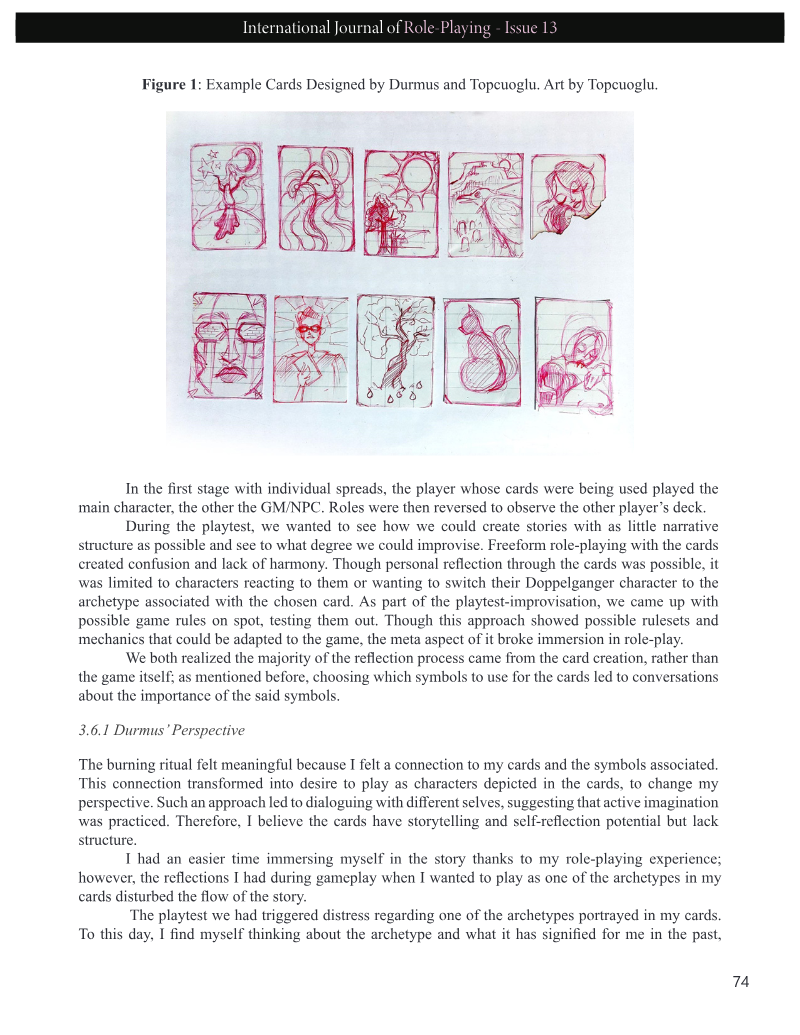
Self Arcana is a design-research paper presenting a collaborative two-player storytelling and self-reflection card game in which players create personalized tarot decks rather than using traditional imagery.
- Self Arcana is a two-player collaborative storytelling and self-reflection card game in which players build personalized tarot decks from their own life symbols instead of traditional tarot imagery, grounded in Jungian psychology and archetype theory.
- The design uses a five-card personal deck drawn from the Rider-Waite-Smith Major Arcana, regrouped into clusters such as Self, Creation, Transformation, and Enlightenment, with reversed cards representing shadow aspects.
- Gameplay proceeds in two stages: individual role-play with a character type from a nine-type taxonomy and a chosen location, followed by a joint ten-card spread combining both players' decks, with end-game rituals of burning, keeping, or changing cards.
A Coin with Two Sides: Role-Playing Games as Symbolic Devices
This paper argues that role-playing games (RPGs) function as symbolic devices, combining the mythic narrative and ritual enactment that the author treats as the two possible exegeses of the symbol.
- The paper argues that role-playing games are symbolic devices that combine mythic narrative and ritual enactment, and cannot be reduced to either alone.
- Drawing on Schelling's philosophy of the romantic symbol, the author defines symbols by three properties: autonomy, syntheticism (reuniting opposites), and tautegoricity (the identity of meaning and being).
- Three ritual features are analysed: the magic circle, which must be permeable enough for metagame information yet closed enough to keep player and character distinct; liminality, where players temporarily step outside ordinary social roles; and collective effervescence, tied to immersion and co-participants as witnesses.
Player Category Research on Murder Mystery Games
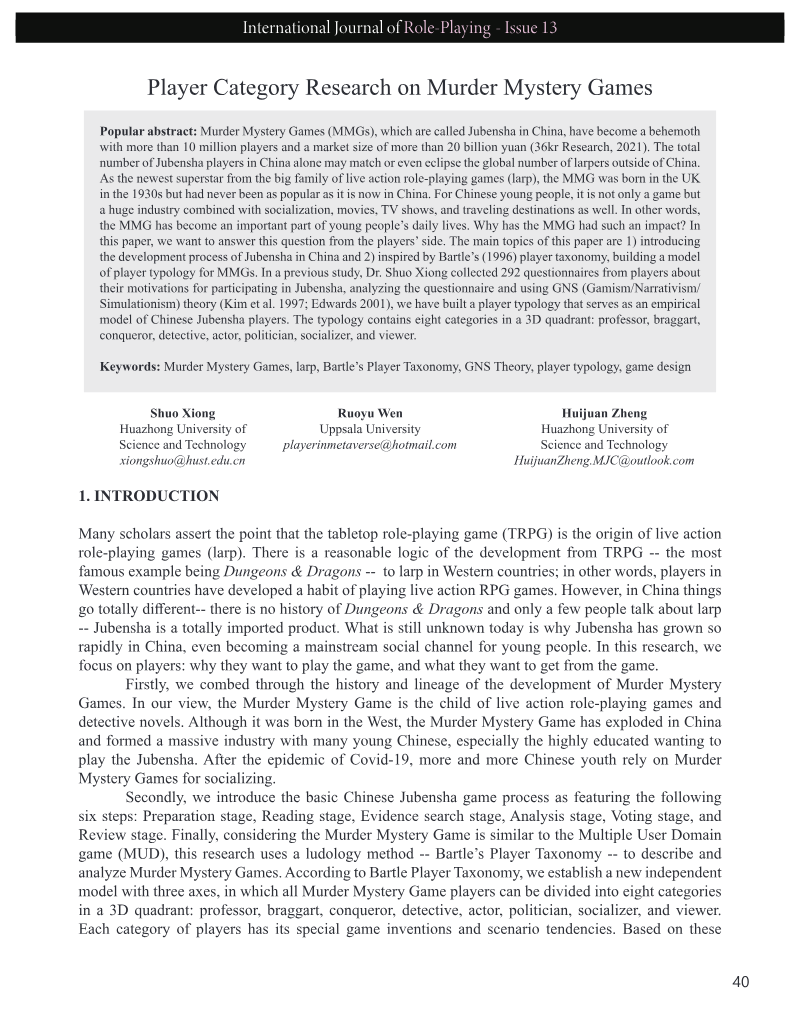
Murder mystery games, known in China as Jubensha, have grown into a major entertainment phenomenon with more than ten million players and a market exceeding 20 billion yuan, according to 36kr Research (2021).
- Jubensha (Chinese murder mystery games) has over 10 million players and a market exceeding 20 billion yuan, according to 36kr Research (2021).
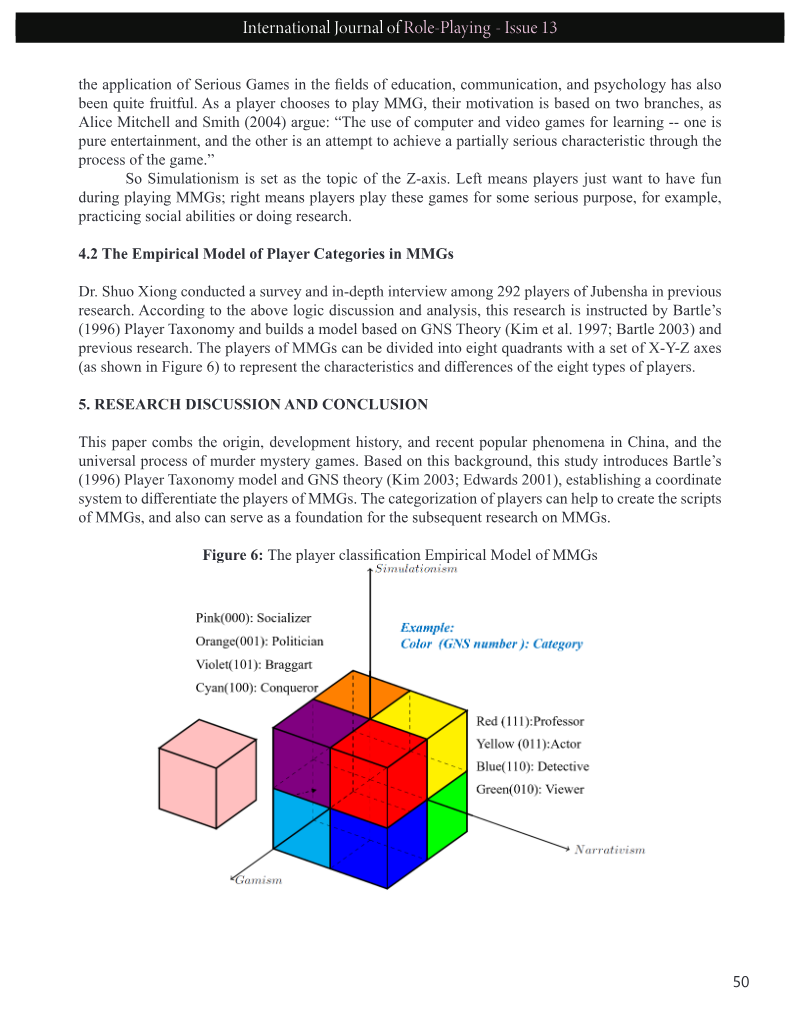
- The paper proposes an eight-type player typology (professor, braggart, conqueror, detective, actor, politician, socializer, viewer) based on a survey and interviews with 292 players, most holding a bachelor's degree or higher.
- The typology adapts Bartle's Player Taxonomy and GNS theory (gamism, narrativism, simulationism), justified by the genre's resemblance to MUD games, its social and competitive character, and its roots in live-action role-playing and detective fiction.
The Educational Role-Playing Game Design Matrix: Mapping Design Components onto Types of Education
Josefin Westborg's paper proposes the Educational Role-playing Game Design Matrix, a conceptual framework intended to give game designers and educators a shared vocabulary for analog role-playing games and larps used for learning.
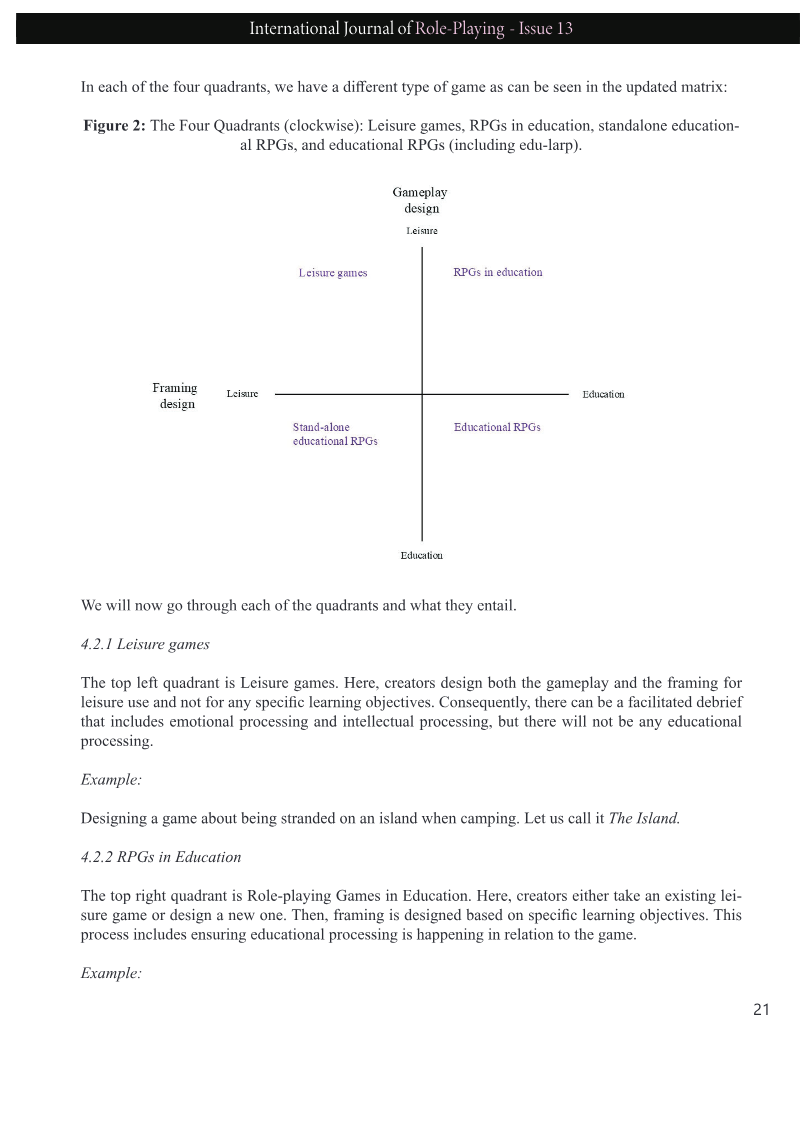
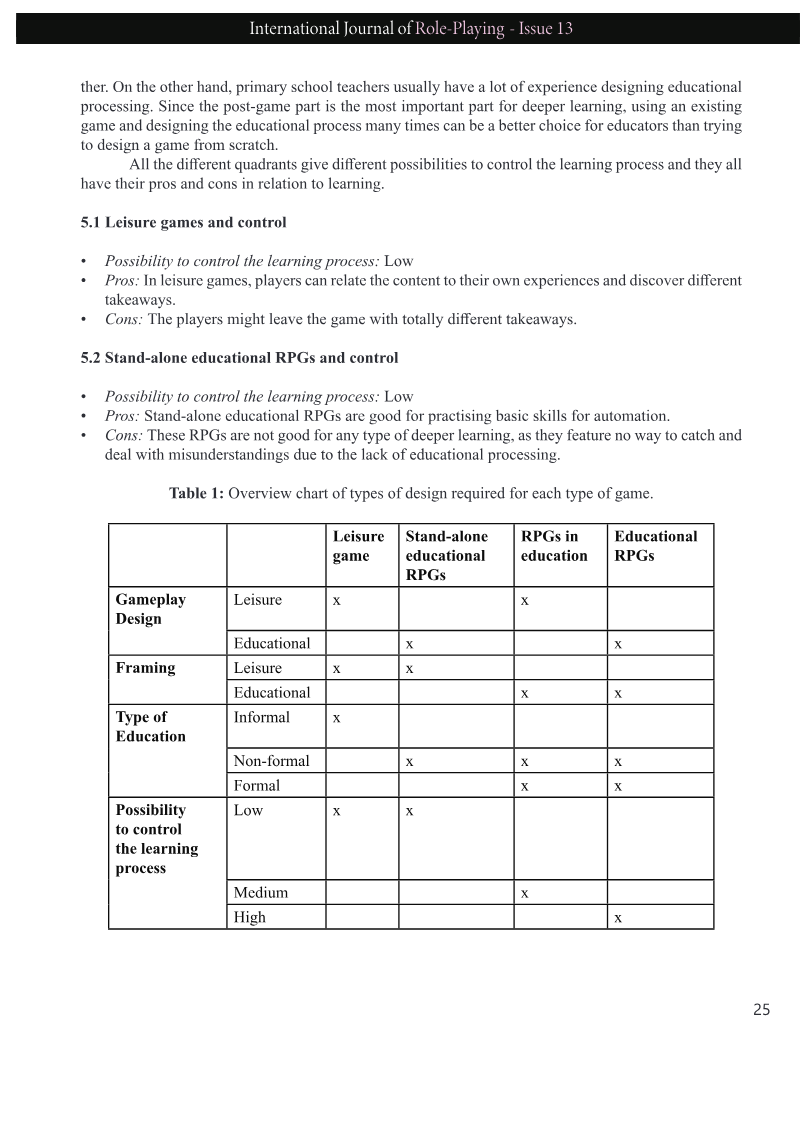
- The Educational Role-playing Game Design Matrix splits game design into gameplay (system, characters, scenes) and framing (pre-, mid-, and post-game activities), with each component designable for either leisure or educational purposes, yielding four quadrants.
- The author argues that post-game educational processing is especially important for deeper learning, and that games lacking it tend to transmit system knowledge while losing more lasting understanding.
- The matrix maps leisure games mainly to informal learning, stand-alone educational RPGs to non-formal learning, and framed educational RPGs and edu-larps to both formal and non-formal learning.
Gaming the Systems: A Component Analysis Framework for the Classroom Use of RPGs
The paper "Gaming the Systems: A Component Analysis Framework for the Classroom Use of RPGs" argues that the effectiveness of role-playing games in education has been difficult to measure because both "RPG" and "learning" are too broad as terms.
- The paper argues that RPG effectiveness in education has been hard to measure because both "RPG" and "learning" are too broad, and proposes a component schema plus a conceptual matrix to address this.
- The matrix links specific learning objectives (content knowledge, social-emotional skills, executive functioning, math fluency, reading comprehension) to game elements, pairing desired outcomes with rule examples, material supports, and contextual questions about students' background and classroom norms.
- Game features are organized into material, structural, and contextual categories, and RPGs are defined as collaborative storytelling games with an imaginary world, power structure, and player-embodied characters.
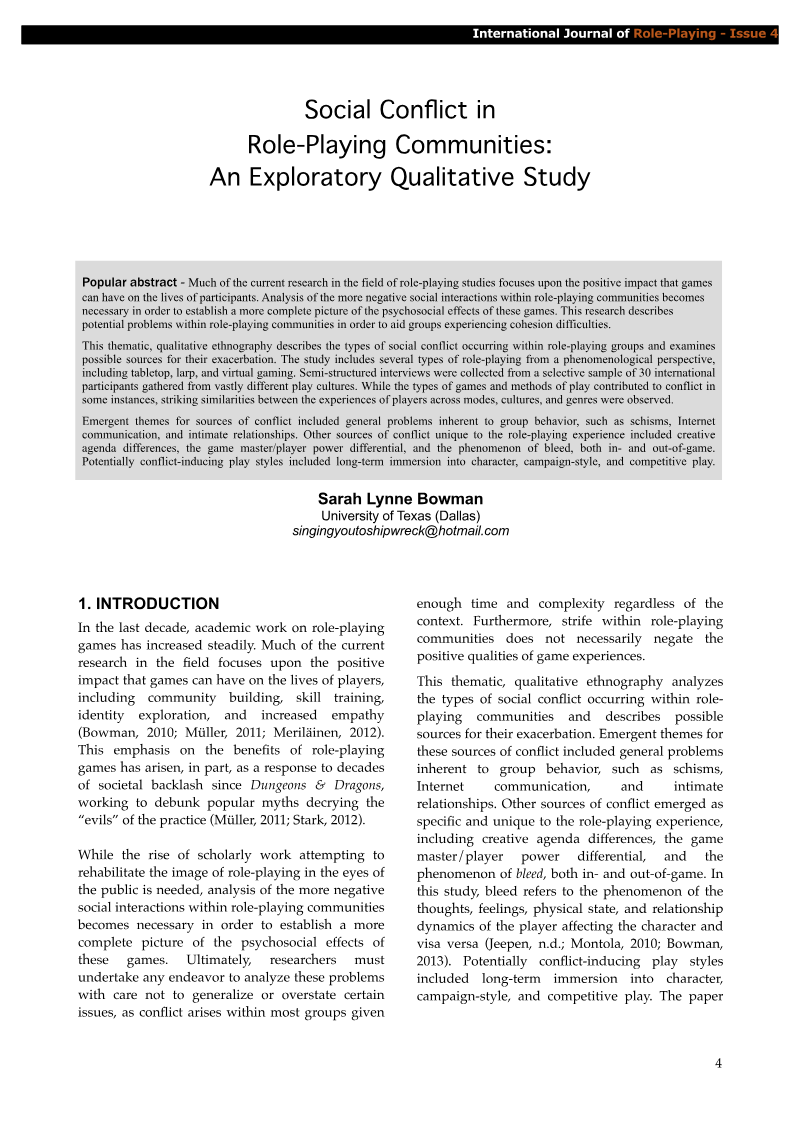
Social Conflict in Role-Playing Communities: An Exploratory Qualitative Study
Sarah Lynne Bowman's exploratory qualitative study argues that research on role-playing games has concentrated on their benefits, leaving their negative social dynamics underexamined.
- Research on role-playing games has focused mainly on their benefits, leaving negative social dynamics underexamined; this study addresses that gap through a descriptive inventory of conflict based on 30 semi-structured interviews (20 from the US, 10 from Europe).
- Community schisms, often triggered by elitism, cliques, and unresolved grudges, were the central source of conflict, with participants describing battle lines being drawn and games dissolving entirely.
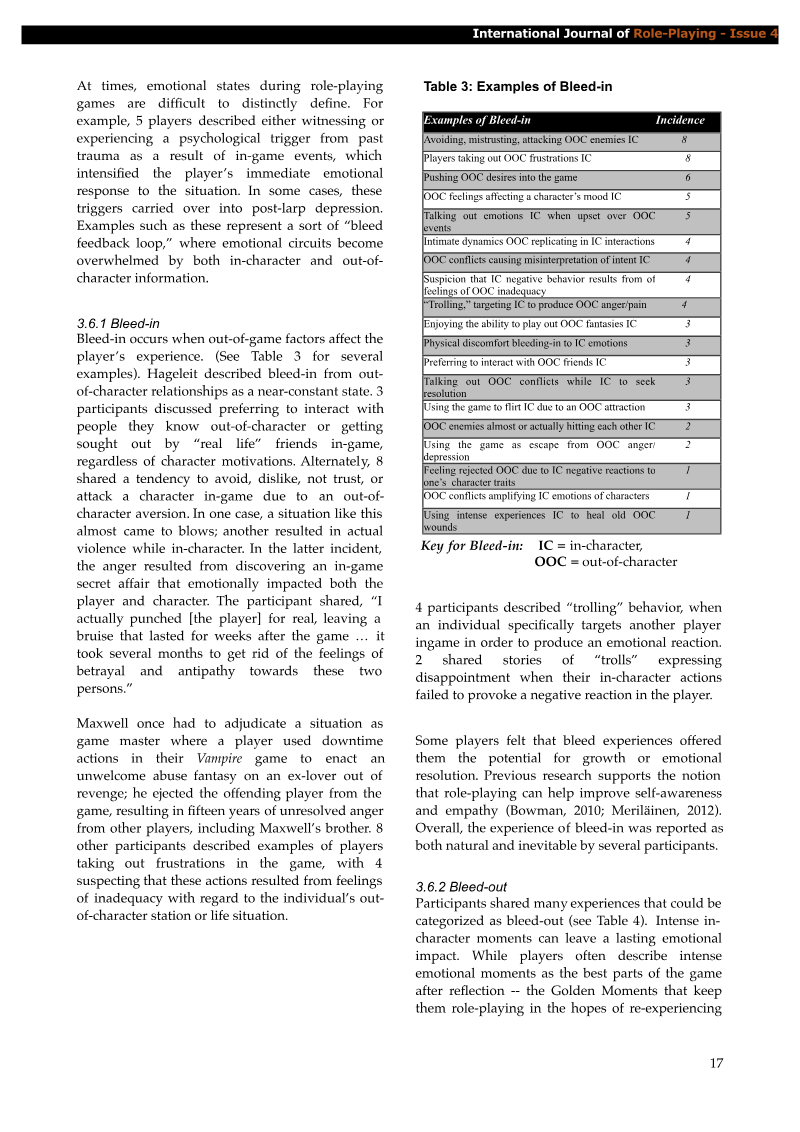
- "Bleed," the blurring of emotion between players' real lives and their characters, was linked to conflict, trolling, depression, and lasting psychological distress, though participants also valued it for self-reflection.
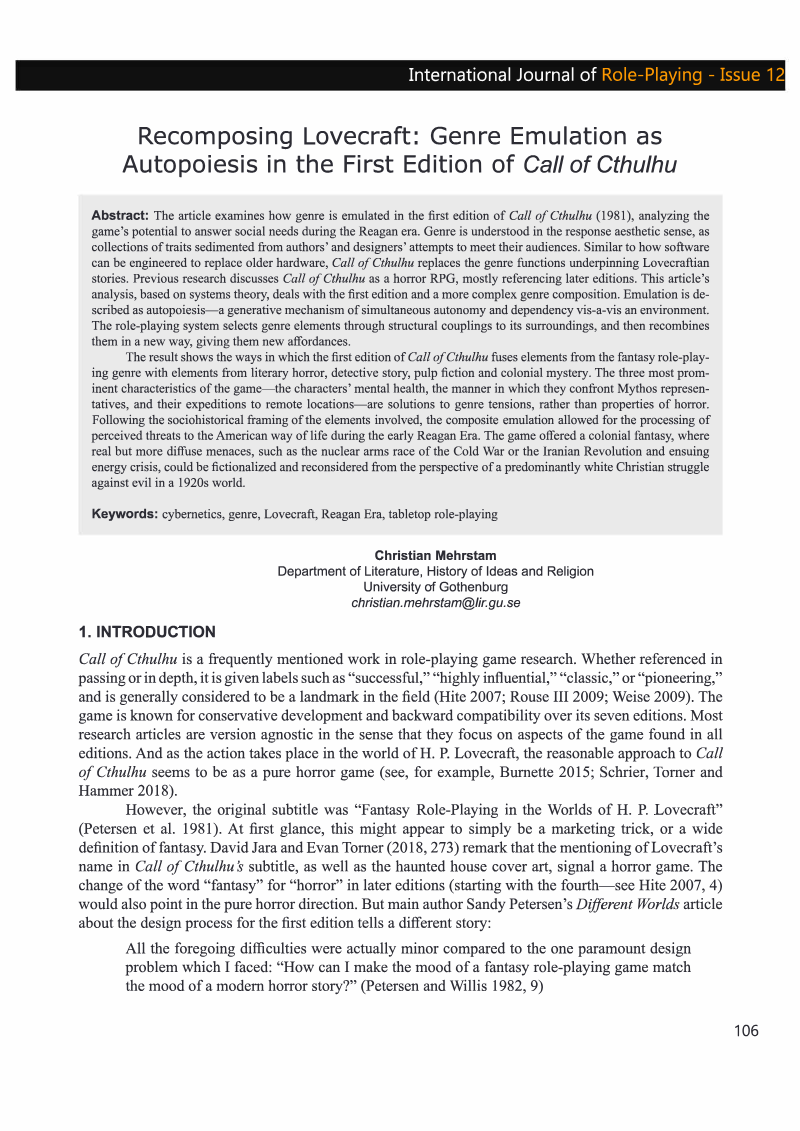
Recomposing Lovecraft: Genre Emulation as Autopoiesis in the First Edition of Call of Cthulhu
Recomposing Lovecraft argues that the first edition of Call of Cthulhu (1981) is best understood as a composite of genre emulation rather than a pure horror game.
- The first edition of Call of Cthulhu (1981) is framed as a composite of genre emulation rather than pure horror, with Sandy Petersen calling the matching of fantasy RPG mechanics to modern horror "the one paramount design problem."
- A central tension arises between the serious Lovecraftian tone and the dungeon-crawling expectations players brought from Dungeons & Dragons, most visible in the sanity mechanic that Petersen described as producing a "fatalistic or depressing" experience.
- Combat disparities highlight the genre clash: player characters average about 11 hit points while Great Cthulhu has over 150, and the rulebook's firearm emphasis contrasts with Lovecraft's sparse references (18 across his collected works, 8 in the rulebook's listed stories).
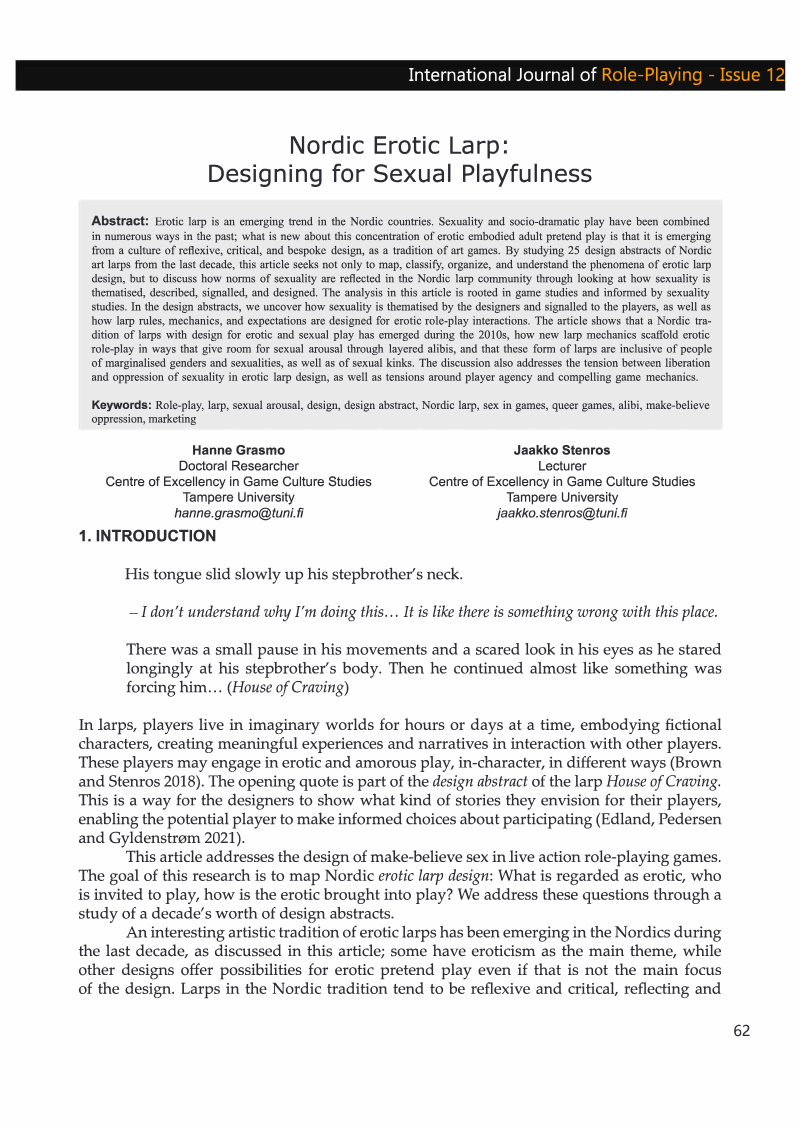
Nordic Erotic Larp: Designing for Sexual Playfulness
This article examines how Nordic erotic larps, participatory role-playing games with explicit or transgressive sexual content, are designed to balance erotic exploration with safety, consent, and player autonomy.
- Nordic erotic larps, participatory role-playing games with explicit or transgressive sexual content, balance erotic exploration against structures of safety, consent, and player autonomy such as explicit rules, safety teams, pre-play negotiation, safe words, and the "Law of Two Feet" opt-out.
- Design abstracts act as both recruitment tools and expectation-setting documents, signaling sexual content through explicit descriptions, imagery, ingredient lists flagging themes like nudity or abuse, and character descriptions, with transparency as the prevailing norm so players can self-select.
- The study's typology identifies five erotic role-play mechanics: abstracting sexual content, adjusting intensity, calibrating player dynamics, compelling erotic engagement, and agreeing on diegetic narrative.
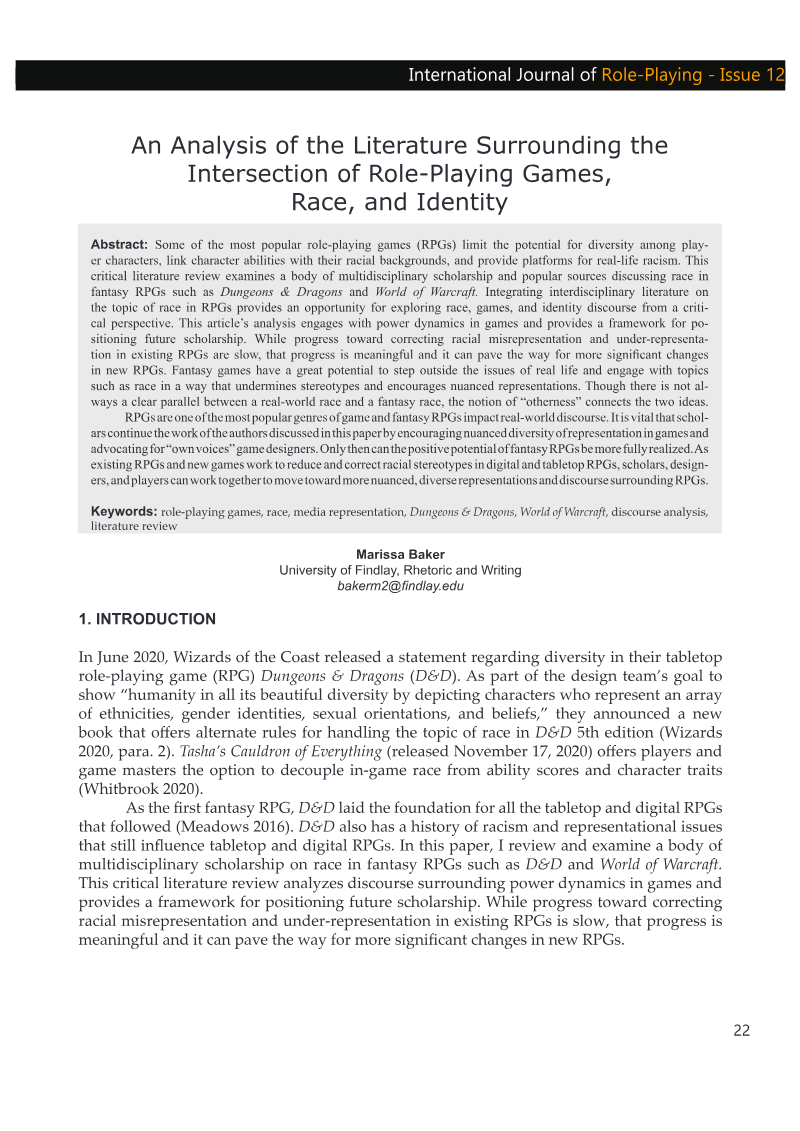
An Analysis of the Literature Surrounding the Intersection of Role-Playing Games, Race, and Identity
This literature analysis examines how race and identity intersect with role-playing games, focusing principally on fantasy titles such as Dungeons & Dragons and World of Warcraft.
- Developer choices in character design, artwork, and game mechanics carry substantial rhetorical weight, shaping how players perceive race and which identities they can inhabit, with these patterns traced back to colonial and Orientalist traditions in fantasy literature.
- Dietrich's 2013 analysis found that none of the roughly ten million World of Warcraft players active in 2012 could create a non-white character.
- Long's 2016 study of Dungeons & Dragons artwork found that first-edition illustrations effectively excluded racial minorities.