1 free read left. Create a free account for unlimited reading + AI research.
Create free accountWhitepaperInternational Journal of Role-Playing
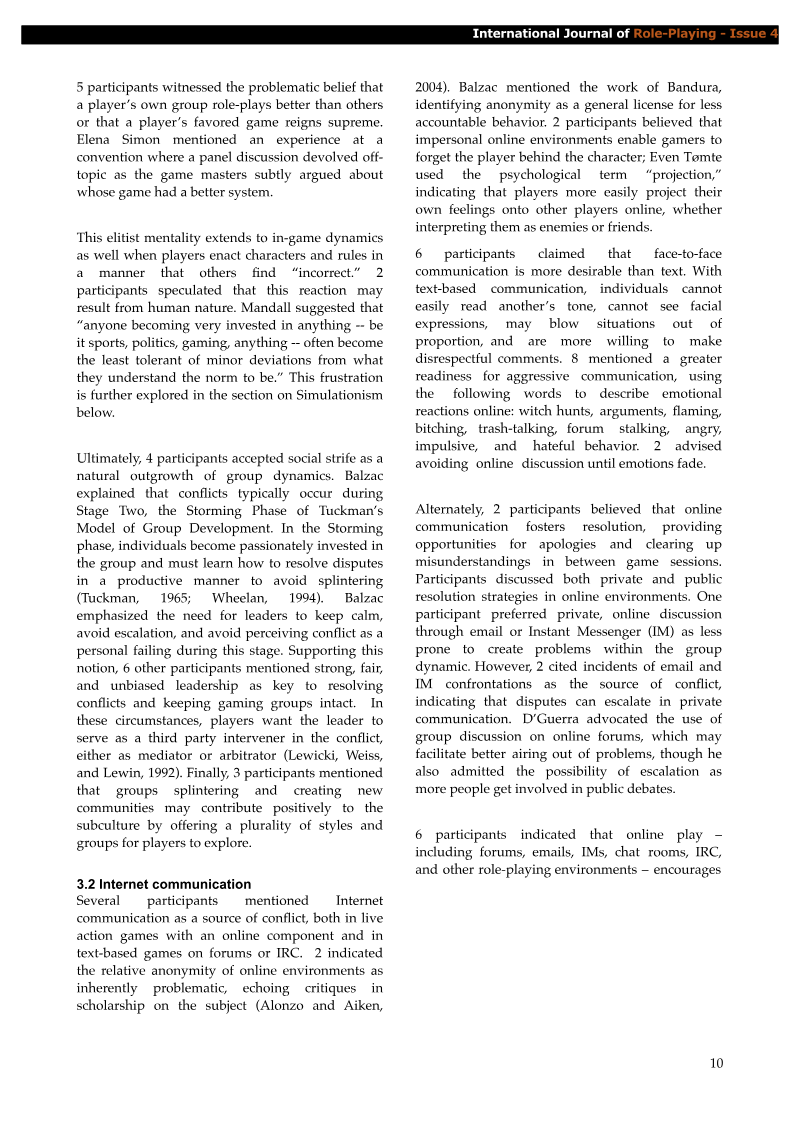
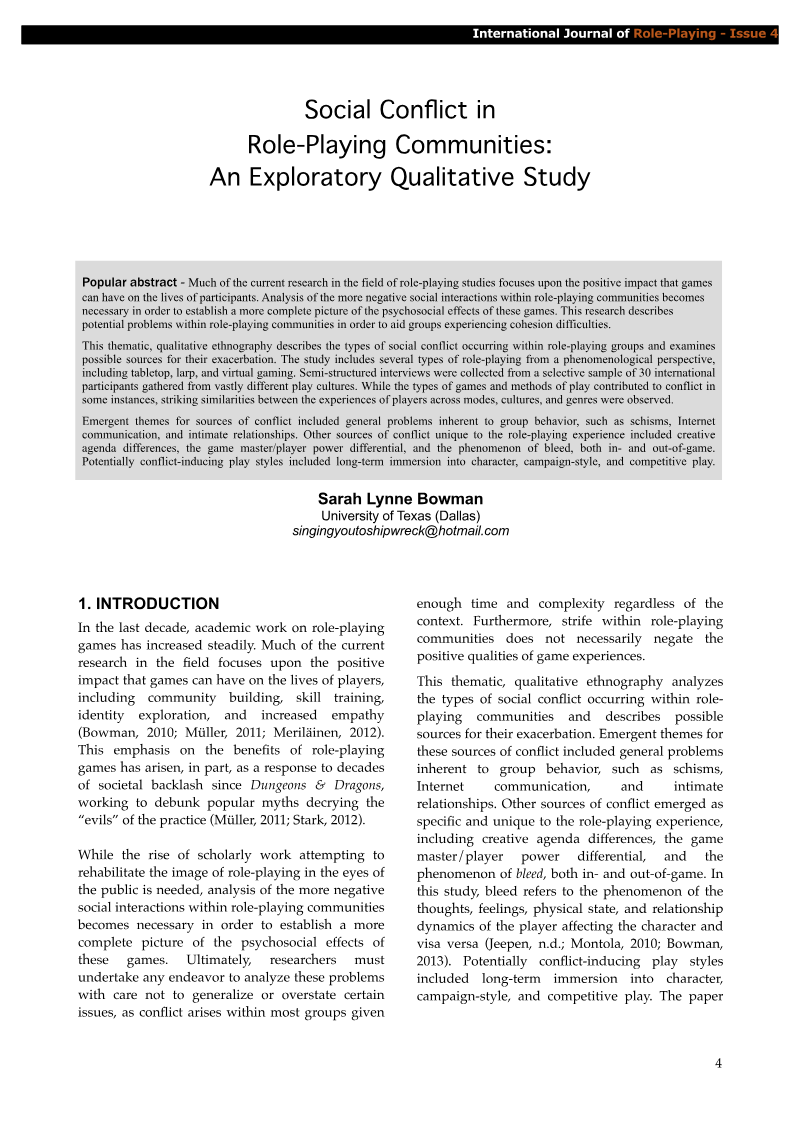
Negative social dynamics in role-playing games have been comparatively underexamined. This study addresses that gap with a descriptive inventory of conflict.
Sarah Lynne Bowman's exploratory qualitative study argues that research on role-playing games has concentrated on their benefits, leaving their negative social dynamics underexamined. Drawing on semi-structured interviews with 30 participants (20 from the United States and 10 from Europe) across tabletop, live-action (larp), and virtual gaming, the work offers a descriptive inventory of conflict rather than a generalizable explanatory model, a choice reflecting its small and selective sample.
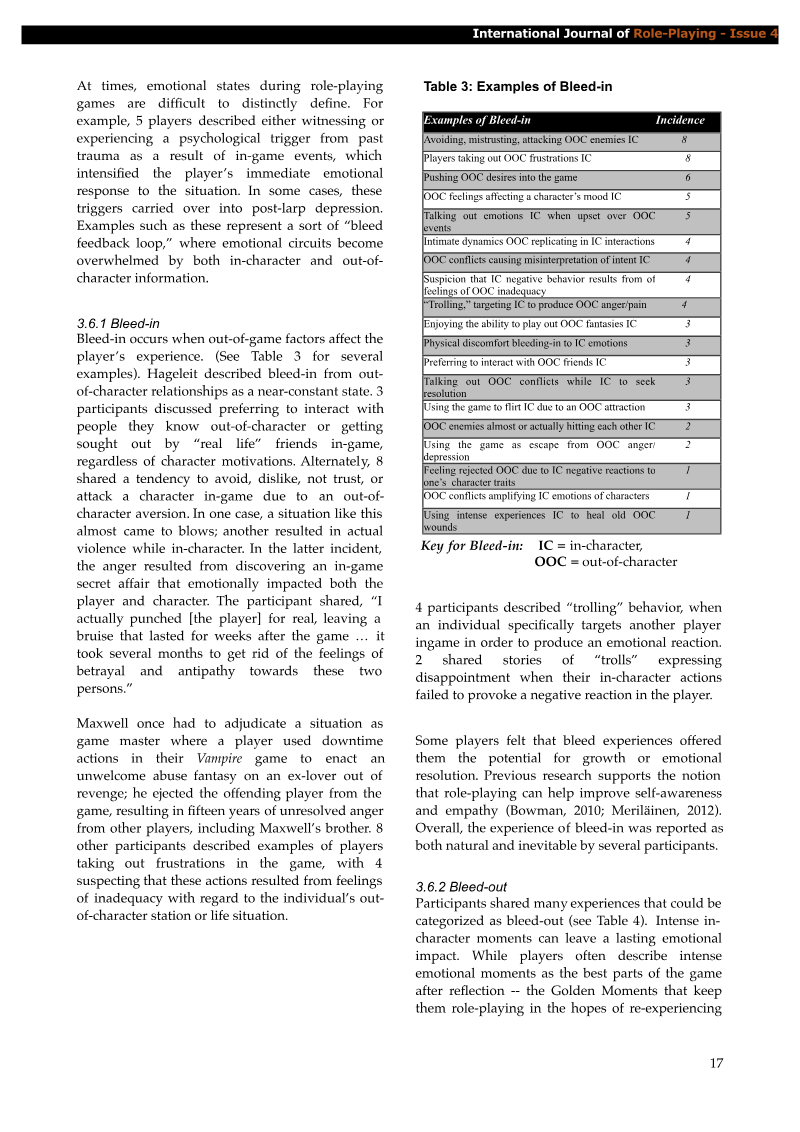
The study identifies several recurring sources of tension. Community schisms, often triggered by elitism, cliques, and unresolved grudges, emerged as a central theme, with participants describing battle lines being drawn and games dissolving entirely. Online communication, intimate relationships, and clashing creative agendas (narrativism, gamism, simulationism, and immersionism) were also prominent, as were game master overreach and mishandled rules or boundaries. Particular attention is given to "bleed," the blurring of emotion between players' real lives and their characters. Bleed-in and bleed-out were linked to conflict, trolling, depression, and lasting psychological distress, though participants also valued it for self-reflection.
Participants generally identified strong, fair leadership, third-party mediation, ongoing communication, out-of-character socializing, and taking breaks as effective means of managing conflict. The author cautions that the frequency counts reflect rough prevalence rather than statistical significance. Despite the negatives, the study concludes that the positive experiences of role-playing generally outweigh the pitfalls. Its scope is limited to these three gaming formats and two regions, with forthcoming work planned to catalogue management strategies and a multinational survey to measure how prevalent these conflicts are.
The Game Business · 2026















Comments