International Journal of Role-Playing
Open-access peer-reviewed journal on role-playing games, larp and related play forms, now hosted by Uppsala University.
Documents
The Use of the Role-Playing Technique STARS in Formal Didactic Contexts
This study presents STARS (Student Activating Role-playing GameS), a low-threshold form of live action role-playing adapted for formal German school settings.
- STARS (Student Activating Role-playing GameS) is a low-threshold live action role-playing format adapted for formal German school settings, showing that larp-style learning can work within institutional constraints.
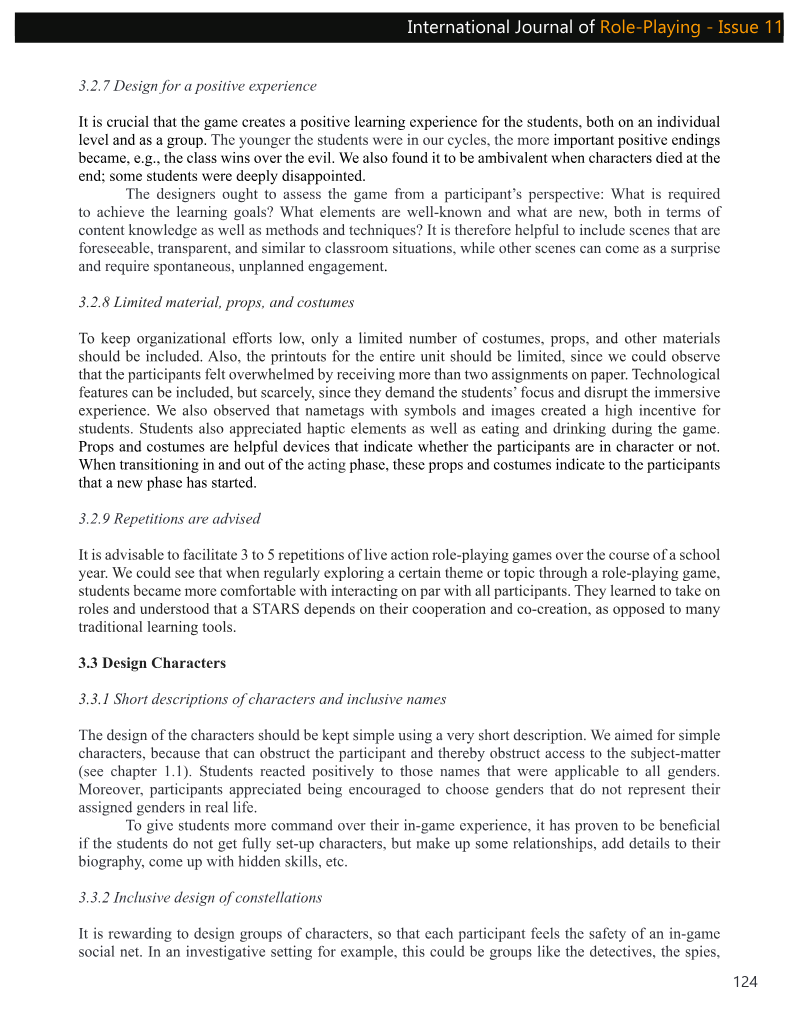
- The findings rest on 16 games and 53 Design-based Research cycles conducted over five years across more than 20 schools in Bavaria and Southern Germany.
- The authors synthesize 17 design principles, seven of them guiding principles, including no uninvolved audience, mandatory inclusion paired with opt-out mechanisms, and never grading the role-play itself.
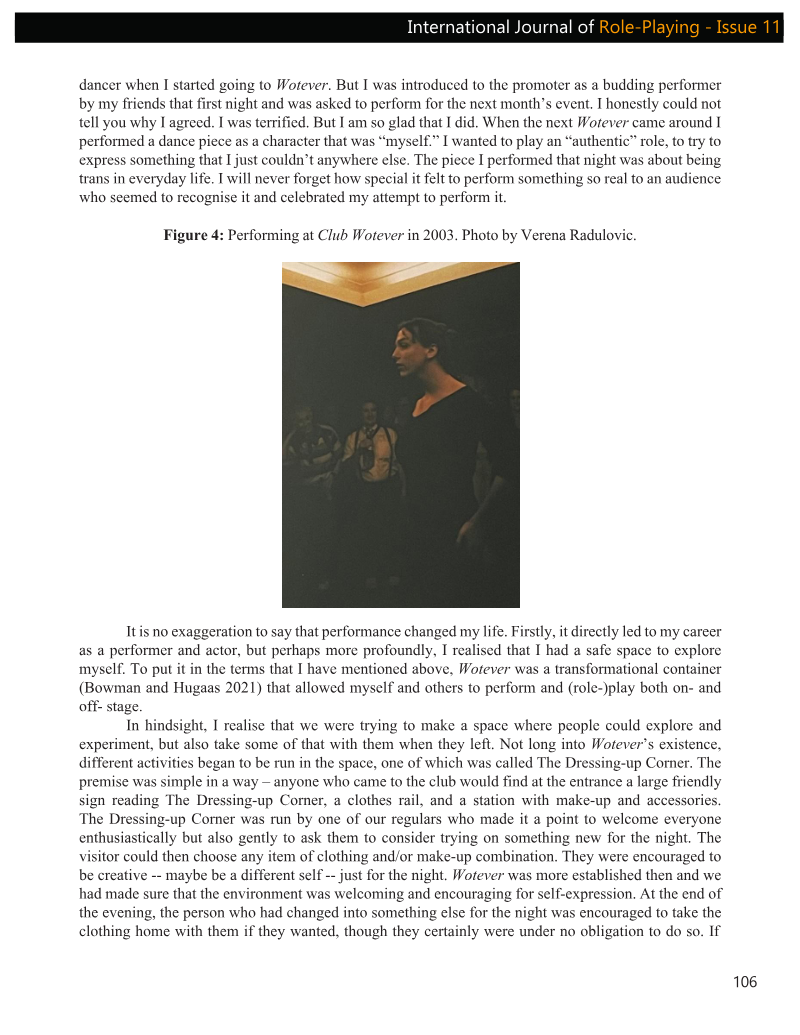
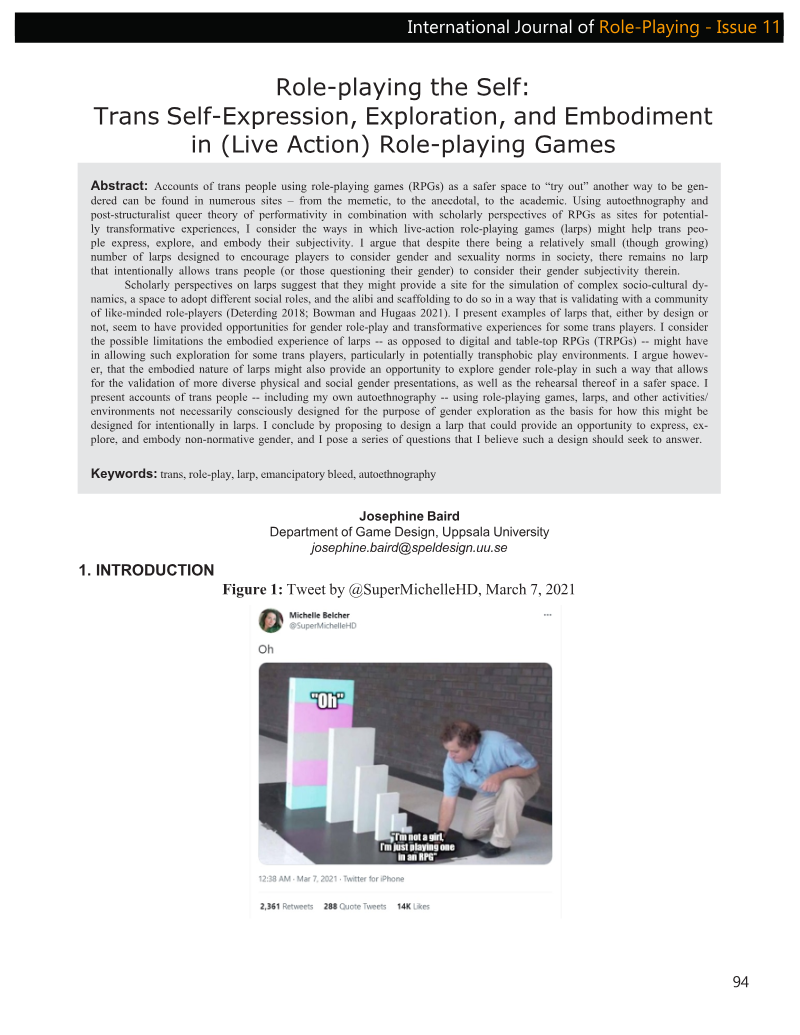
Role-Playing the Self: Trans Self-Expression, Exploration, and Embodiment in Live Action Role-Playing Games
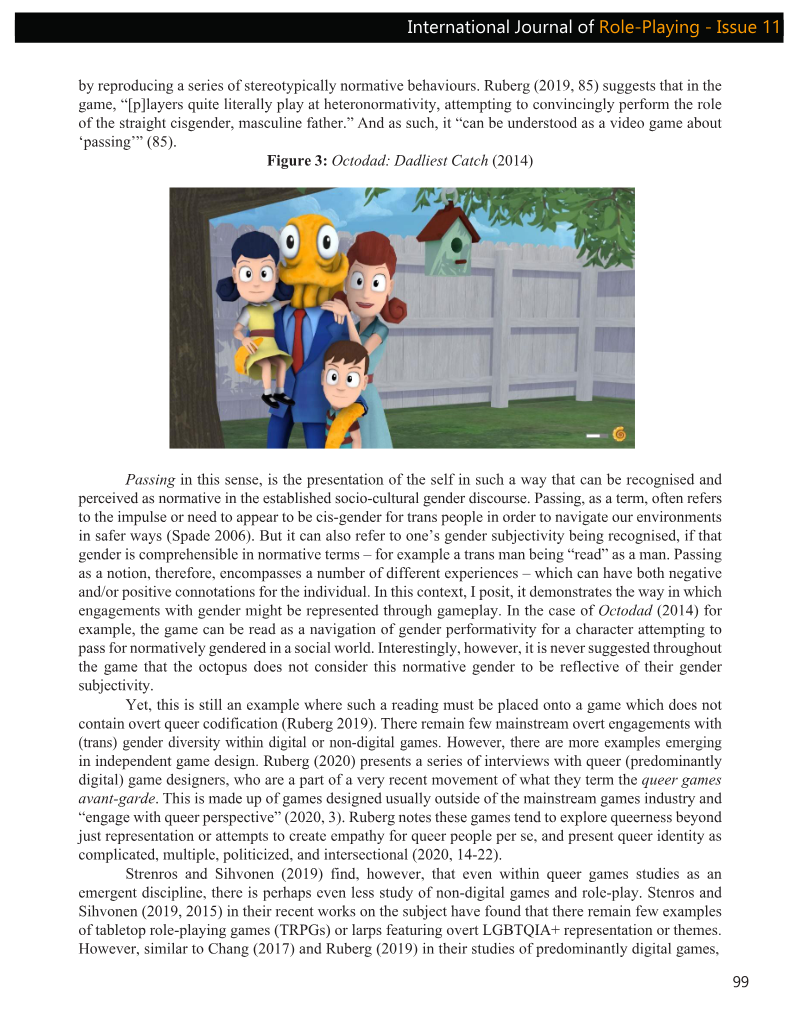
Trans people have long used role-playing games, from digital RPGs and tabletop campaigns to live-action role-play (larp), as spaces to explore and embody gender identities they may not be able to express in everyday life.
- Trans people have long used role-playing games, including digital RPGs, tabletop campaigns, and live-action role-play (larp), to explore and embody gender identities they may not be able to express in everyday life.
- The paper argues that gender performance does not negate trans subjectivity, drawing on Judith Butler's theory of gender performativity, Erving Goffman's social role theory, and the author's autoethnographic experience.
- Larp is presented as an especially promising site for gender exploration because of its embodied, physical nature, though it can also reproduce transphobic social structures.
Role-Playing Games and Well-Being
Role-playing games (RPGs) are a young, interdisciplinary field whose relationship to well-being remains under-theorized, though existing evidence indicates that RPGs do affect well-being.
- Role-playing games affect well-being, yet the mechanisms behind these effects remain poorly understood and the field is young and interdisciplinary.
- Existing studies, concentrated on live action role-play and online RPGs with little attention to tabletop games, report gains in social capital, life satisfaction, and general well-being among groups such as Parkinson's patients in virtual worlds and autistic participants in larp.
- Psychological research has found no RPG-specific dangers, and interest in using RPGs in therapy and health education has grown.
Fantasy in Real Life: Making Meaning from Vicarious Experiences with a Tabletop Role-Playing Game Live-Play Internet Stream
This study explores how fans of Critical Role, a live-streamed Dungeons & Dragons web series, attribute personal meaning, growth, and well-being to watching tabletop role-playing games.
- The study introduces 'parasocial gaming,' a vicarious experience in which viewers feel connected to the cast of a live-streamed tabletop role-playing game, extending a literature that has focused mainly on video games.
- Interviews with seven self-identified fans of Critical Role, a live-streamed Dungeons & Dragons web series, were analysed, with one in-depth narrative case study of a participant, Megan, who credited the show with aiding her recovery from PTSD.
- Cross-case analysis identified four learning elements (parasocial transference, critical reflection, social learning, and self-determination) and three recurring features (storytelling, role-playing, and parasocial interaction).
Playing to Experience Marginalization: Benefits and Drawbacks of "Dark Tourism" in Larp
Larp (live action role-playing) offers players a chance to inhabit marginalized characters, and this paper argues that such play can generate real empathy and psychological growth while also carrying risks analogous to those raised in critiques of dark tourism.
- Larp can build empathy and reduce prejudice through perspective-taking, but these benefits depend on character portrayals that avoid stereotypes and on organizers who actively manage interpersonal dynamics and emotional bleed.
- The paper warns that without safeguards, marginalized players may carry heavy emotional labor, face microaggressions, or leave the hobby due to a chilly climate.
- The authors map three motivations for engaging with marginalized experience (learning, catharsis, and immersion in the "Other") onto player types via the Threefold Model, noting these motivations overlap and are shaped by players' intersecting identities.
The Killing Roll: The Prevalence of Violence in Dungeons & Dragons
"The Killing Roll" examines how the structure of Dungeons & Dragons, specifically the fifth edition Player's Handbook, facilitates and encourages violence.
- The report argues that the fifth edition Player's Handbook of Dungeons & Dragons structurally encourages violence, with violence-related terms vastly outnumbering non-violent ones ("attack" appears 827 times versus "adventure" at 209).
- Of the Handbook's 361 spells, 62.4% are oriented toward violence, rising to 87.5% at 9th level, where only two of sixteen spells are nonviolent.
- The paladin class is especially combat-focused, with 73% of its spells being combat-based.
Not Only Play: Experiences of Playing a Professor Character at College of Wizardry with a Professional Background in Teaching
Playing a Professor Character: Professional Teachers at College of Wizardry This study examines how nine professional educators experienced playing a professor character in College of Wizardry, a sandbox Nordic larp.
- Nine professional educators (averaging 6.5 years of teaching and 14 years of larp experience) playing professor characters in the Nordic sandbox larp College of Wizardry were studied through guideline-structured interviews conducted in February and March 2017 across six countries.
- All interviewees reported spillover of real-world teaching methods, relational approaches, and attention to student needs into their in-game lessons, and several described emotional bleed between the teaching and play contexts.
- Participants' motivational states fell mostly in a mixed zone between playful and serious activity, with no discernible pattern linked to their teaching or larping experience.
A Qualitative Exploration of the Perceived Social Benefits of Playing Tabletop Role-Playing Games
This qualitative study examines the perceived social benefits that young adults associate with playing tabletop role-playing games (TRPGs).
- The study is a small qualitative exploration of six self-selected young adult players in Nova Scotia, so its findings are descriptive and preliminary rather than population-level estimates.
- Interviews revealed four recurring themes in why players value tabletop role-playing games: Content Focus, Social Focus, Identity Focus, and Creativity Focus.
- All participants reported perceived social benefits, such as becoming less shy and strengthening friendships, though these are self-reported impressions rather than measured outcomes.
Live Action Role-Playing: Transcending the Magic Circle through Play in Dagorhir
This study examines Dagorhir, a combat-oriented live action role-playing game founded in 1977, to test whether the "magic circle" that supposedly separates play from everyday life holds in a larp where fighting dominates.
- Dagorhir, a combat-oriented live action role-playing game founded in 1977, was studied through a six-month ethnography with the Las Vegas realm Barad'Dun, using participant observation and 18 semi-structured interviews.
- The author argues that the 'magic circle' separating play from everyday life does not hold in Dagorhir: in-game character choices shape players' sense of self and carry over into their lives outside the game.
- Players split into 'stick jocks,' who prioritize combat, and 'flurbs,' who emphasize role-play, and this segregation structured how people engaged with the game.
Indie Gaming Meets the Nordic Scene: A Dramatistic Analysis
William J. White's analysis examines a 2010 panel at the InterNosCon convention in Italy, where American indie tabletop role-playing game designer Ron Edwards and Swedish freeform designer Tobias Wrigstad debated the hobby's development.
- The analysis examines a 2010 debate at the InterNosCon convention in Italy between American indie RPG designer Ron Edwards and Swedish freeform designer Tobias Wrigstad, using it as a window into cross-cultural dynamics in the indie role-playing scene.
- Edwards adopts a conciliatory 'sublimation' posture, seeking consensus around his claim that 'System Does Matter,' the idea that game mechanics meaningfully shape play.
- Wrigstad presents jeepform as a communal evolution rooted in Scandinavian freeform and larp traditions, which emphasized psychological dynamics between players.
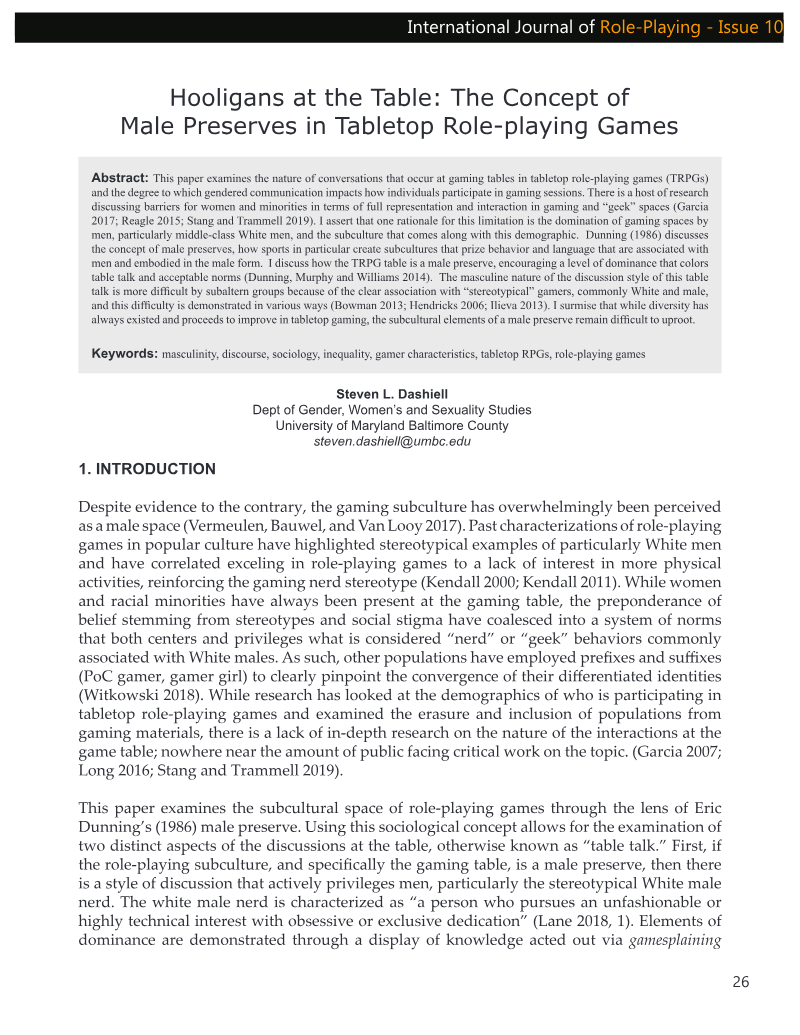
Hooligans at the Table: The Concept of Male Preserves in Tabletop Role-Playing Games
Tabletop role-playing games are analyzed in this work as a "male preserve," a social space where dominant masculine conversational norms shape who is heard, who is respected, and who is merely tolerated.
- Tabletop role-playing games are framed as a 'male preserve,' where dominant masculine conversational norms determine who is heard, respected, or merely tolerated, even as women and minority participants grow in number.
- The author identifies 'scaffolding discourse,' the step-by-step communication between players and game masters, as favoring report talk, a style associated with male socialization and status that advantages male players.
- Gamesplaining and rules-lawyering are presented as assertions of dominance that can extend beyond rules disputes into other table interactions, while women and minority players face heavier criticism.
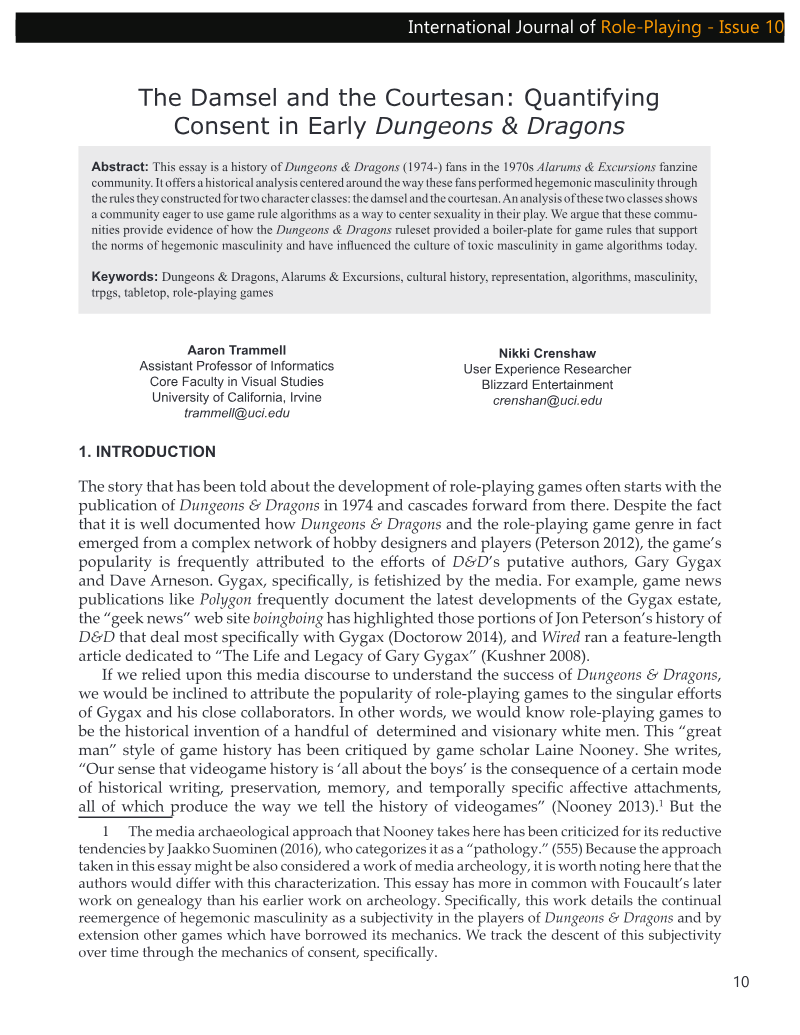
The Damsel and the Courtesan: Quantifying Consent in Early Dungeons & Dragons
Early Dungeons & Dragons fan culture, as documented in the 1975–76 fanzine Alarums & Excursions, offers a window into how gendered assumptions were built into the earliest tabletop role-playing mechanics.
- The report argues that fan-authored 'Damsel' and 'Courtesan' classes in early Dungeons & Dragons, published in the 1975–76 fanzine Alarums & Excursions, encoded hegemonic masculinity into game mechanics and helped normalize it within the community.
- Dick Eney's Courtesan rules, including sexualized level titles and mechanics for earning money through misrepresentation, are presented as a leading example of objectifying design, under the slogan 'making Love as well as War.'
- Both the Courtesan and Samuel Konkin III's Damsel class treated consent as a random dice-based outcome rather than an expression of agency, using charisma-modified saving throws and a six-point 'encounter intensity' table to quantify intimacy.