1 free read left. Create a free account for unlimited reading + AI research.
Create free accountWhitepaperInternational Journal of Role-Playing
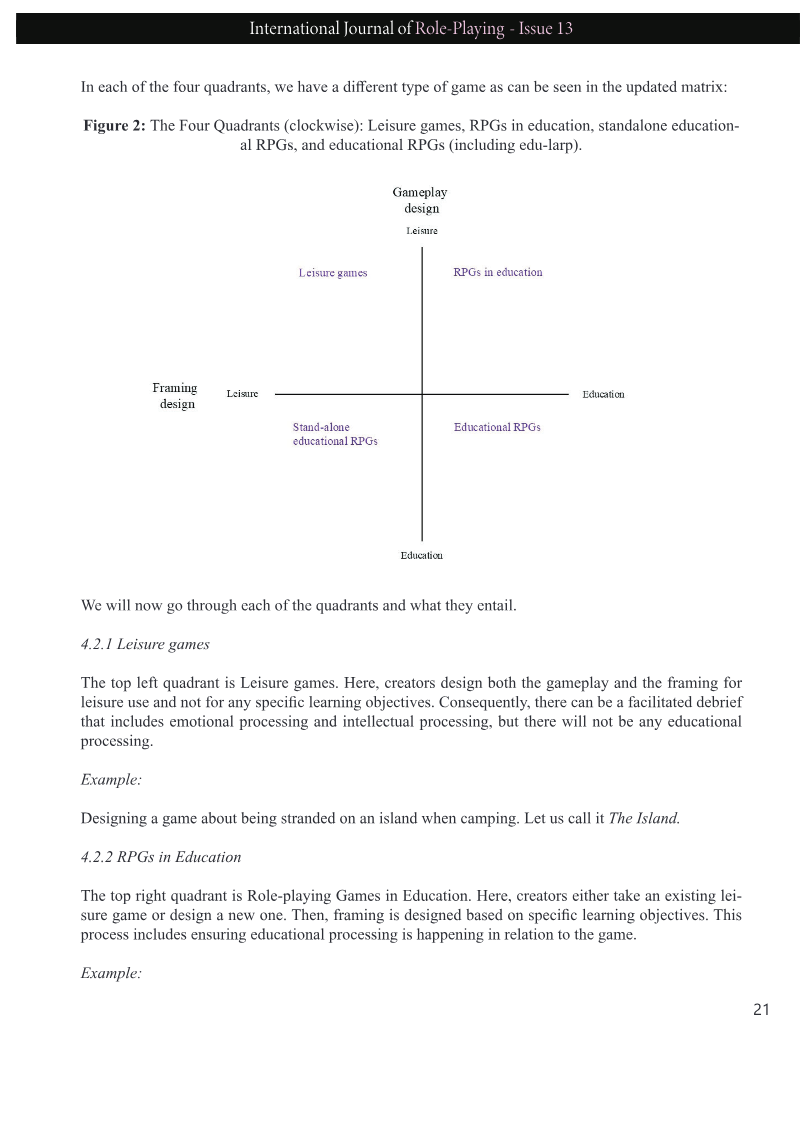
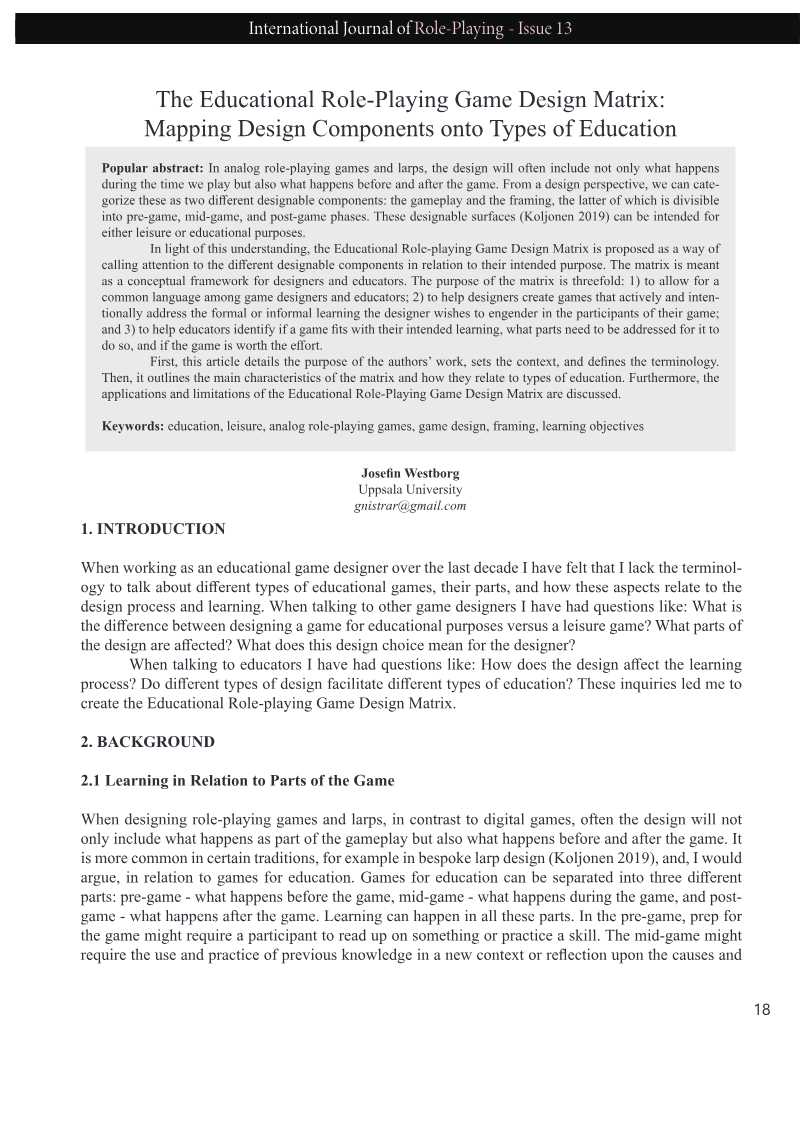
Gameplay covers the system, characters, and scenes, while framing covers pre-, mid-, and post-game activities. Each component can serve leisure or educational purposes.
Josefin Westborg's paper proposes the Educational Role-playing Game Design Matrix, a conceptual framework intended to give game designers and educators a shared vocabulary for analog role-playing games and larps used for learning. The framework rests on the distinction between gameplay, meaning the in-play system, characters, and scenes, and framing, meaning the pre-game, mid-game, and post-game activities surrounding play. Each of these components can be designed for either leisure or educational purposes, producing four quadrants: leisure games, RPGs in education, stand-alone educational RPGs, and educational RPGs including edu-larps. The author argues that post-game educational processing is especially important for deeper learning, and that games without it tend to transmit system knowledge while losing more lasting understanding.
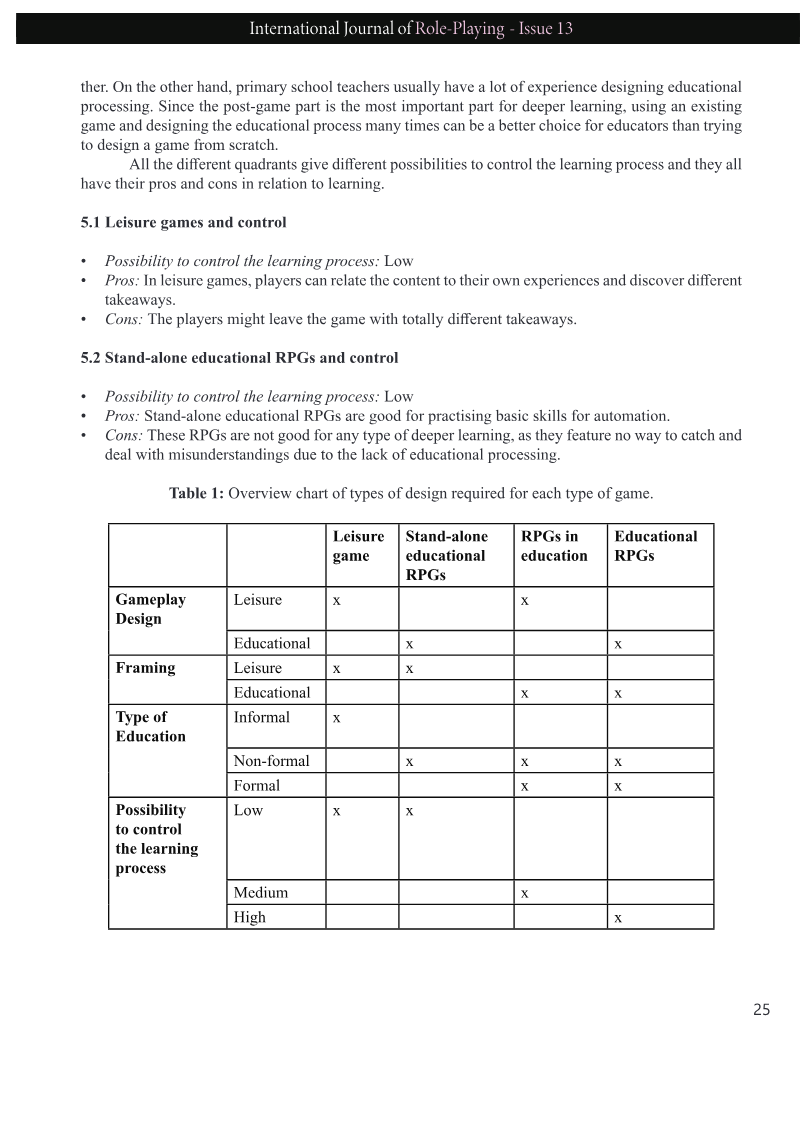
The matrix is then mapped onto formal, non-formal, and informal education. Leisure games are associated mainly with informal learning, stand-alone educational RPGs with non-formal learning, and the two framed educational categories with both formal and non-formal learning. The paper also offers a practical assessment of control over the learning process, rating leisure games and stand-alone educational RPGs as low, RPGs in education as medium, and educational RPGs as high, while noting trade-offs in flexibility, skill requirements, and the risk that design elements may work against intended outcomes.
The framework is explicitly presented as untested. The author acknowledges that it has not been validated through quantitative or qualitative research and identifies several unaddressed factors, including setting, the quality of games from a learning perspective, and the influence of facilitation. The framework is grounded primarily in the author's practitioner experience and in discussions with designers and teachers, then refined with existing theory.
European Conference on Games Based Learning (ECGBL) · 2026



European Conference on Games Based Learning (ECGBL) · 2026
European Conference on Games Based Learning (ECGBL) · 2026















Comments