International Journal of Role-Playing
Open-access peer-reviewed journal on role-playing games, larp and related play forms, now hosted by Uppsala University.
Documents
Developing a Framework of Larp Counseling
This paper proposes a standardized framework for larp counseling, the practice of assigning a staff member to oversee participant well-being at live-action role-playing events.
- The paper argues larp counseling has grown in use without shared terminology, liabilities, or ethical standards, and proposes a standardized training guide to give organizers, scholars, players, and caregivers a common reference.
- The authors position the larp counselor as a supervisory figure akin to a camp counselor rather than a therapist, responsible for keeping players engaged with the event's intended fun and addressing out-of-game distress such as a lost medication or a panic attack.
- Embedded counselors gain rapport and familiarity with in-game events, enabling insightful responses and sometimes resolving problems through diegetic action, but the role carries risks including burnout, compassion fatigue, "helper syndrome," misuse of diegetic power, and incompetent care that could leave players worse off.
Documenting Larp as an Art of Experience
Jason Cox's paper argues that documentation of live-action role-playing games (larps) should foreground player experience rather than the designers' narrative.
- Jason Cox argues that larp documentation should foreground player experience rather than designers' narratives, because larps are embodied, co-creative, subjective, and ephemeral, which makes written testimony and linear video inadequate.
- Cox proposes an assemblage of player-created artifacts (props, costumes, planning notes, reflective works) as documentation that better approximates what a larp felt like, framing these objects as social objects drawing on praxis, poiesis, and aisthesis.
- To test the approach, Cox built The Magischola Museum, a website housing player-made artifacts from Learn Larp LLC's New World Magischola series, organized into wands, apparel, accessories, and ephemera, with entries combining in-game history, out-of-game history, and contributor-supplied personal meaning.
Bleed-Out on the Brain: The Neuroscience of Character-to-Player Spillover in Larp
This paper examines "bleed-out," the spillover of in-character dynamics into players' out-of-character thoughts, feelings, and actions in live action role-playing (larp).
- Bleed-out, the spillover of in-character dynamics into players' out-of-character thoughts, feelings, and actions in larp, is argued to rest on largely automatic neuropsychological processes that are hard to control, so managing it requires deliberate design and self-regulation rather than willpower alone.
- The authors propose that oxytocin, linked to trust and social bonding, is released during shared stressful or high-stakes in-character experiences, which may foster prosocial feelings between players.
- In-character social rejection may activate neural pain responses, which can trigger defensive aggression or withdrawal that carries over into community tensions.
Case Studies as Tabletop RPGs
Susan Weiner's article proposes a method for implementing case studies in college science courses by borrowing the structure of tabletop role-playing games.
- Susan Weiner proposes adapting tabletop role-playing game structure to college science case studies, giving students specialist roles, decision-making power, and consequences that shape the unfolding narrative while keeping a subject-specific focus.
- In a medical physiology case on digestive system disease, groups of four or five students adopt medical specialties, research their topics, and collectively decide on diagnostic tests and treatments, with the instructor acting as a game master who supplies outcomes and adjusts the case.
- About 80 percent of students rated the case studies as "very effective," and 74 percent said the course helped them think independently about the material more than other courses.
Wonder Cards Storytelling: Imagination, Storytelling, and Role-playing in the Creation of Objects, Spaces, and Experiences
This article presents Wonder Cards, a card-based "imagination instrument" designed to help designers and students create objects, spaces, and experiences through storytelling and role-playing.
- Wonder Cards is a card-based 'imagination instrument' that uses blind-picked cards across categories such as Imagination, Sense, Emotion, Object, and Space to help designers and students create objects, spaces, and experiences through storytelling and role-playing.
- The design rests on the idea of distant analogies (Hélen de Cruz and Jóhan de Smedt), with the authors arguing that random card draws force unexpected conceptual connections that push participants beyond their habitual repertoires.
- The deck is extended by expansion modules for Genre, Characters, and Events, and by 'Sheets of Imagination' that structure different play modes, including a main role-playing mode.
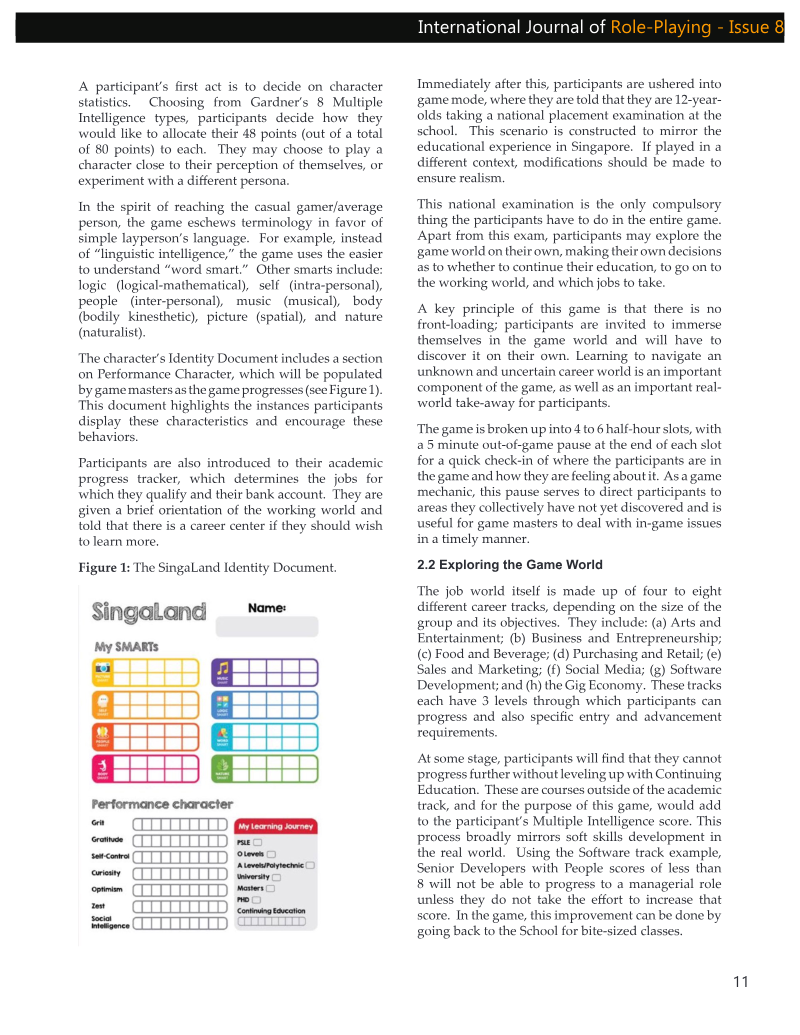
Edu-Larping for Career Design
The document presents the Career Design Life Game, an educational live-action role-play ("edu-larp") designed to teach career design through experiential learning and gamification.
- The Career Design Life Game is an educational live-action role-play (edu-larp) that teaches career design through experiential learning, built on a central thesis that career success rests on three elements: "Wit, Grit and Fit" (interests and skills, persistence and growth mindset, and alignment between personal values and work environment).
- The game was piloted with 216 participants in Singapore aged 12 to 65, and the author reports positive qualitative feedback, especially that it sparked discussion among students and mature workers who are typically the targets of career services.
- The game's theoretical foundations draw on Howard Gardner's Multiple Intelligences, Paul Tough's Performance Character traits, research on grit and growth mindset, Richard Bolles' "petals" framework, and Edgar Schein's career anchors.
Year Zero Economics: Using Edu-Larping to Explore Economic Systems in the Ninth Grade
This paper examines the design and classroom implementation of an educational live-action role-playing unit, or edu-larp, teaching basic economics to grade nine students in Alberta, Canada.
- The paper describes an edu-larp teaching basic economics to grade nine students in Alberta, Canada, adapting the economic mechanics of the tabletop game Mutant: Year Zero to compare US and Canadian economic systems.
- The unit ran across three grade nine classes (about eighty players) during a practicum, all sharing one post-apocalyptic Edmonton setting, with students exploring a constructed map for resources and completing quests on the Rezzly platform to earn experience points.
- Quests tied academic assignments to in-game progress, while students negotiated across classes, designed colony innovations like sanitation systems and defenses, specialized skills for cost-efficiency, and debated competing government systems (one class adopted an oligarchic dictatorship, another direct democracy).
Actual Play at the Forge: A Rhetorical Approach
This paper offers a rhetorical analysis of a 2006 "actual play" discussion thread from the Forge, an influential and controversial online forum for tabletop role-playing game design that operated from roughly 2001 to 2012.
- The paper argues that a 2006 Forge "actual play" thread functions as a skilled discursive performance, in which participants apply the Forge's "Big Model" to diagnose player dissatisfaction and propose solutions grounded in individual aesthetic preferences.
- The analysis covers a single thread running April 18 to May 14, 2006, with nine participants producing 66 posts across 53 turns, and three participants accounting for the vast majority of contributions.
- The author proposes that this phenomenological, dialogic approach can complement the frame-analytic methods that dominate scholarly study of tabletop play by foregrounding players' lived experience at the table.
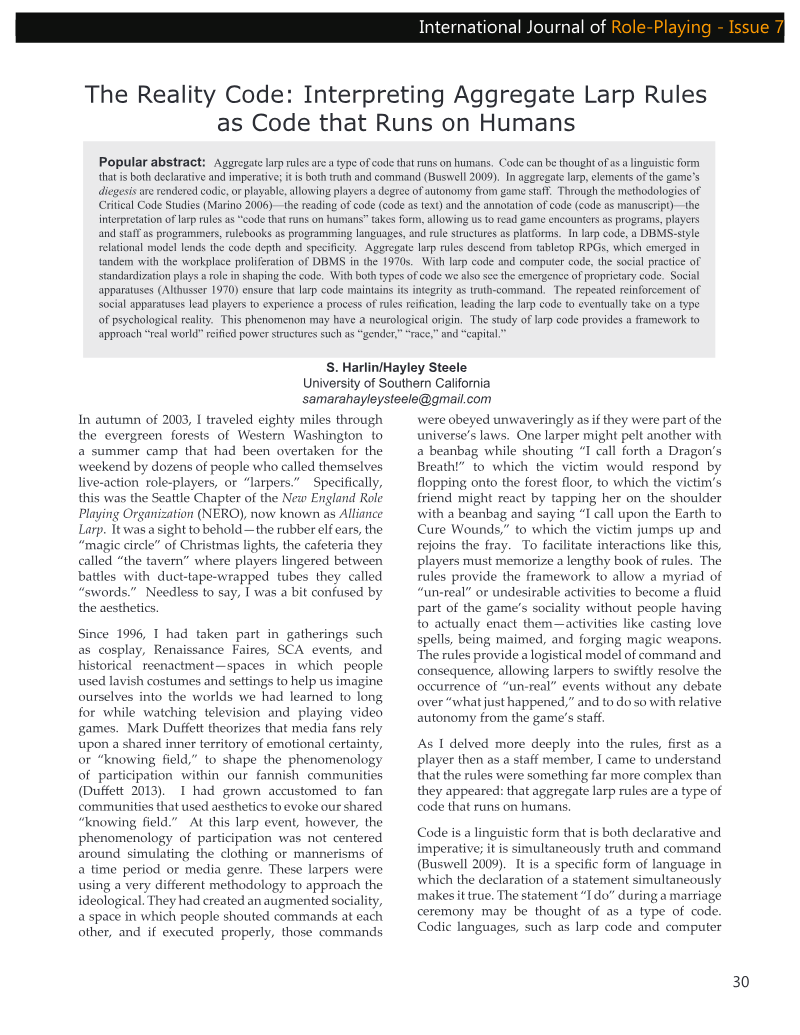
The Reality Code: Interpreting Aggregate Larp Rules as Code that Runs on Humans
This document argues that aggregate live-action role-playing (larp) rules function as a form of code that "runs on humans," meaning that rules are both declarative and imperative, shaping how players collectively enact a shared fictional reality.
- The report treats aggregate larp rules as code that 'runs on humans': rulebooks act as programming languages, players and staff as programmers, and rule structures as platforms, analysed through Critical Code Studies methods.
- The central claim is that the Alliance LARP rule set operates through a relational, database-style structure in which attributes are organized under entities, encouraging players to experience the rules with psychological reality over time.
- The analysis rests on an annotated reading of a roughly 2009 troll battle, showing that a single spoken phrase paired with a foam-weapon strike splits into at least five interlocking rule subsystems requiring shared knowledge of timing, documentation, target validity, and body-point tracking.
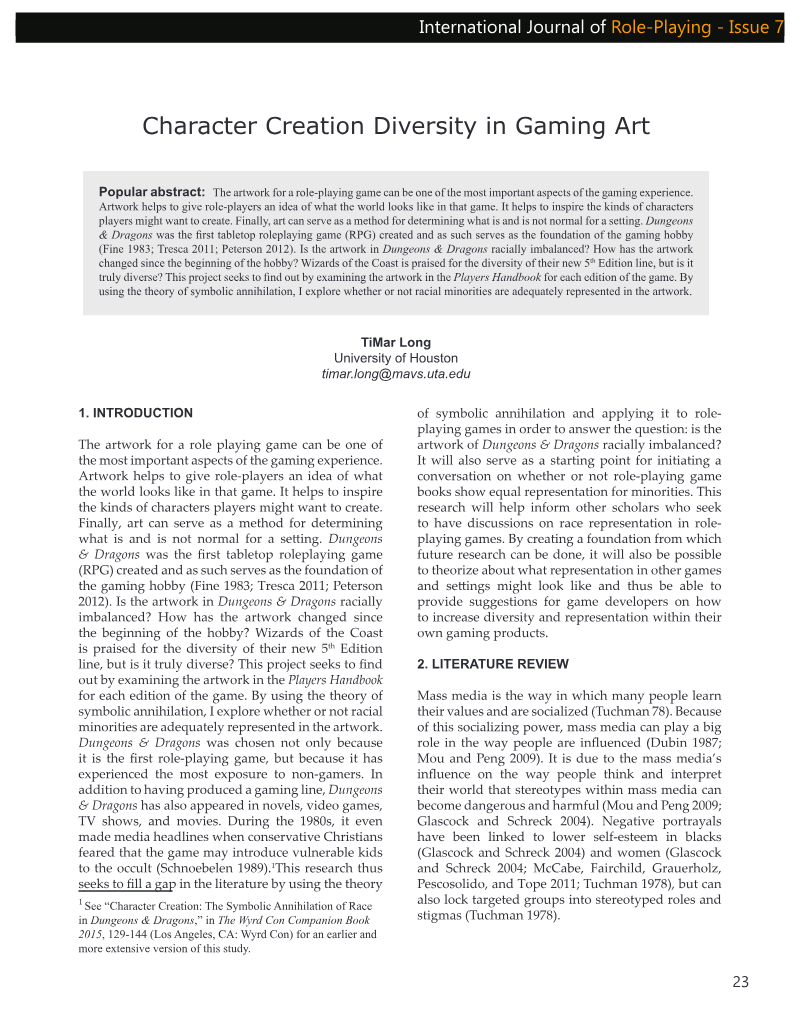
Character Creation Diversity in Gaming Art
TiMar Long's study examines whether racial minorities are adequately represented in the artwork of Dungeons & Dragons, using the Players Handbook (or core book) from each edition of the game as its data.
- People of color appeared in only about 4 percent of human and demi-human character depictions across the history of Dungeons & Dragons core books, while white humans made up 38 percent.
- Using a threshold of prevalence below one quarter of census share to define symbolic annihilation, the study found that Black, Arab, and Native American characters were symbolically annihilated in several D&D editions, and Asian characters in some.
- Minority characters who did appear were portrayed in stereotyped fashion 43 percent of the time, and men of color were depicted more often than women of color.
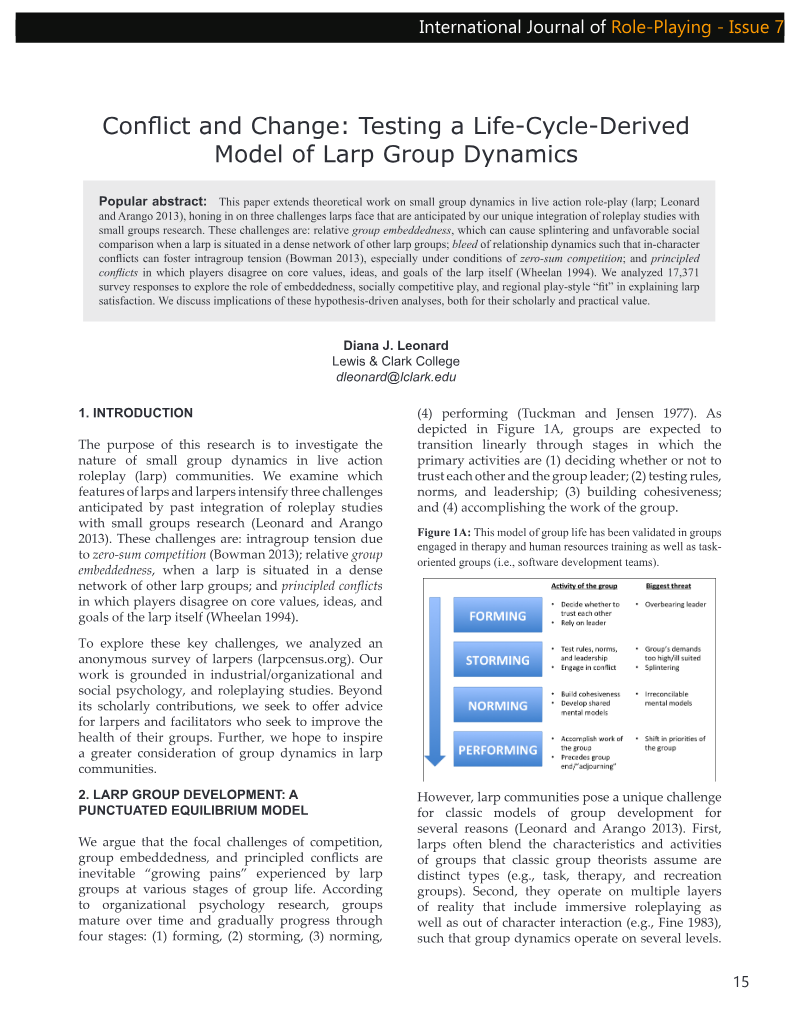
Conflict and Change: Testing a Life-Cycle-Derived Model of Larp Group Dynamics
This study tests a life-cycle-derived model of small group dynamics applied to live action role-play (larp) communities, examining three challenges that larp groups face: embeddedness within dense networks of other larp groups, intragroup tension arising from zero-sum competitive play, and principled conflicts over the values…
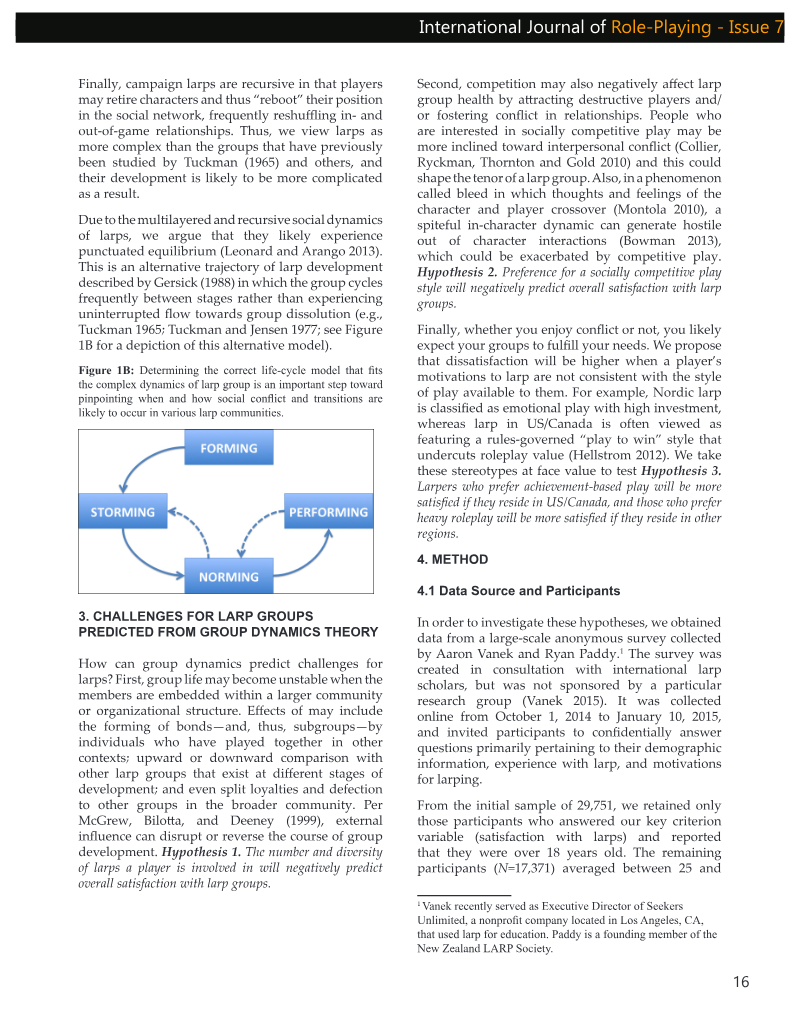
- The study proposes that larp groups follow a punctuated equilibrium trajectory rather than the linear stages of classic group development theory, because they blend task, therapy, and recreational characteristics and operate across in-character and out-of-character layers.
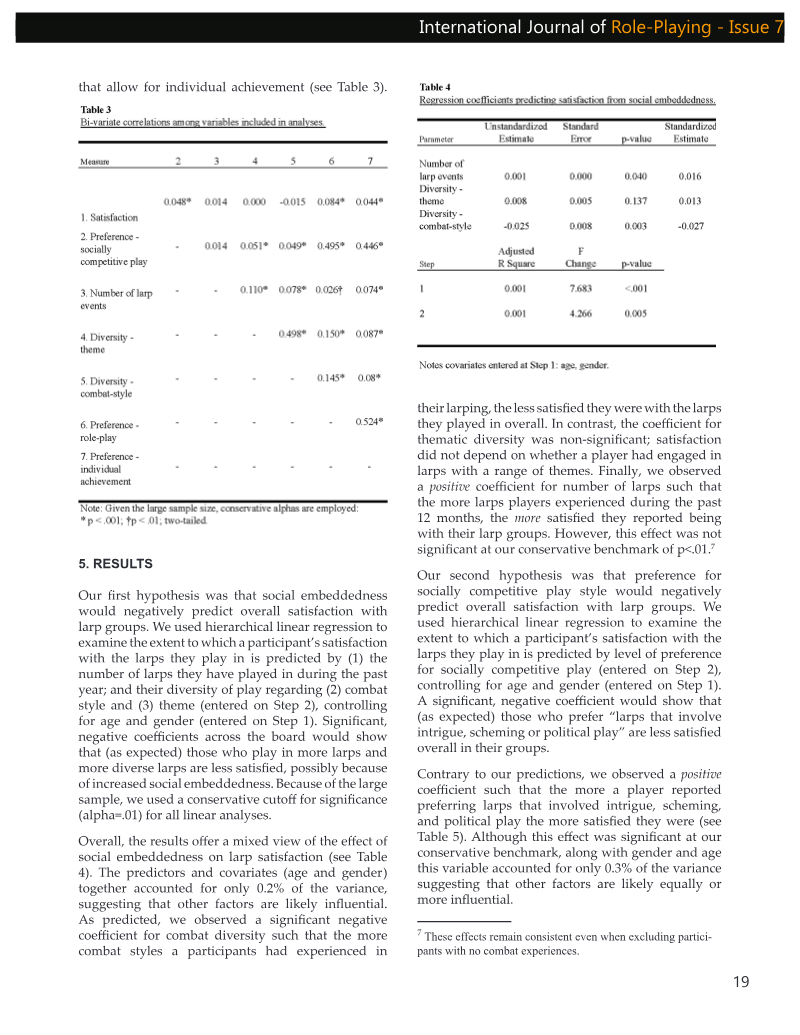
- Analysis of an anonymous online survey of 17,371 adult larpers (October 2014 to January 2015) used hierarchical regression and two-way ANCOVA, finding only mixed support for the hypotheses.
- The strongest finding was regional: achievement-oriented players reported greater satisfaction when living in the United States or Canada, while the expected regional advantage for role-play-oriented players did not appear.
Foucault's Heterotopias as Play Spaces
This paper applies Michel Foucault's concept of heterotopias, real spaces that embody an "otherness" distinct from everyday society, to the study of play spaces in larp and tabletop role-playing.
- The paper applies Michel Foucault's concept of heterotopias, real spaces embodying an 'otherness' distinct from everyday society, to larp and tabletop role-playing, arguing it offers a more useful analytical toolset than Johan Huizinga's Magic Circle for games engaging with social and political realities.
- Foucault's six principles of heterotopias, including the distinction between heterotopias of crisis and deviation, the juxtaposition of incompatible spaces, links to slices of time, and systems of entry and exit, are used as the framework for testing play spaces.
- Dungeons & Dragons is judged a partial fit: it meets most principles but falls short on the second because players tend to colonize rather than reflect on the wider society around them.