1 free read left. Create a free account for unlimited reading + AI research.
Create free accountArticleInternational Journal of Role-Playing
A school experiment ran from 1998 to 2001 and was reported as having positive outcomes.
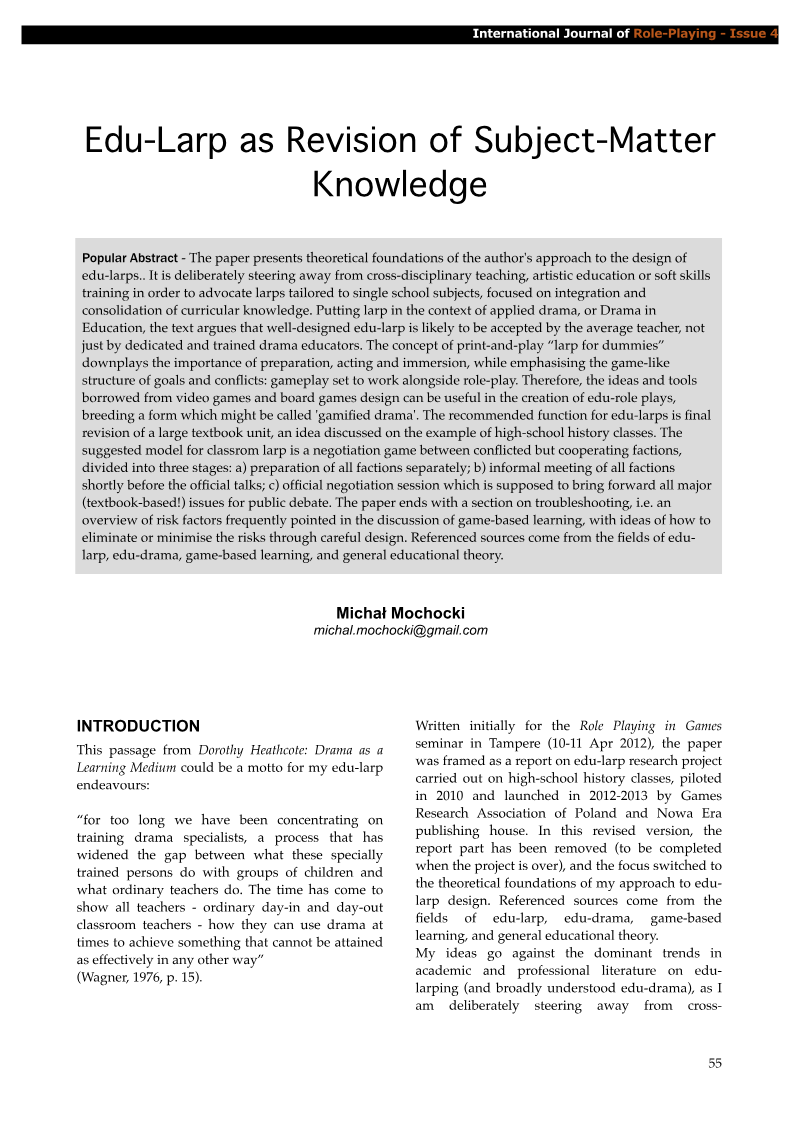
Michał Mochocki's paper argues that educational live-action role-plays, or edu-larps, should be designed as tightly structured, game-like tools for revising a single school subject, such as a final review of a high-school history unit, rather than as vehicles for cross-disciplinary, artistic, or soft-skills goals. The author proposes this subject-focused "larp for dummies" model as a practical alternative to traditional drama education in Poland, which, despite a 1998–2001 school experiment with positive outcomes, has seen little uptake because of heavy teacher workloads, low pay, and a mismatch between drama's broad aims and subject-specific exam requirements. The central claim that this design can overcome these systemic obstacles is argued rather than empirically tested.
The paper's core position is that edu-larp is best suited to final review of large content units, particularly in the social sciences and humanities, with learning supported by simulation, drama, and constructivist theory. Its effectiveness is framed as depending on three factors: embedded subject matter, learner willingness, and out-of-game reflection. Entertainment is treated as nonessential; the author draws on a meta-analysis reporting no correlation between a simulation game's entertainment value and its learning outcomes, and argues that explicit tasks, numerical incentives, and goal-oriented motivation can drive participation. Pre-, post-, and in-game reflection, including teacher-prepared lesson plans, is presented as central to maximizing learning.
The paper offers the author's experience as evidence of feasibility. Its design examples include a three-phase classroom larp built around negotiation and a full history unit on 17th–18th century Poland, along with risk mitigations for historical content such as phased structures with whole-group debriefing, fictional or semifictional characters, and correction of counter-historical outcomes. Reported practice spans more than 20 games in 18 schools and a civic education project reaching over 1,100 middle-school students, though the paper provides no quantitative learning-outcome data. The author acknowledges that a single game is unlikely to yield observable learning gains without repetition, and concludes that a two-stage approach, beginning with low-demand, print-and-play adoption before moving to more immersive larping, offers the most practical route to mainstream classroom use.
International Journal of Role-Playing · 2023
International Journal of Role-Playing · 2023
International Journal of Role-Playing · 2023
International Journal of Role-Playing · 2023
International Journal of Role-Playing · 2023
International Journal of Role-Playing · 2023
International Journal of Role-Playing · 2023
International Journal of Role-Playing · 2023
International Journal of Role-Playing · 2023
International Journal of Role-Playing · 2023
International Journal of Role-Playing · 2023
International Journal of Role-Playing · 2023
European Conference on Games Based Learning (ECGBL) · 2026



European Conference on Games Based Learning (ECGBL) · 2026



European Conference on Games Based Learning (ECGBL) · 2026
























Comments