
International Journal of Esports
Open-access peer-reviewed journal dedicated to esports research: business, health, education and player performance.
Documents
Microsoft's Mixer Mystery: Was Poaching Twitch's Biggest Streamers Always Doomed to Fail?
Microsoft's Mixer platform failed because its strategy of poaching top Twitch streamers, such as "Ninja" and "Shroud," for millions of dollars did not result in audiences reliably following these individuals to the new platform.
- The study tests whether Twitch streamer income follows a power law, the signature of preferential attachment, using leaked revenue data for roughly 2.2 million streamers from August 2019 through October 2021.
- The evidence is generally unfavorable to a power-law account: income typically fits a lognormal distribution better, and a power law is supported only in the extreme tail (roughly the top 648 or fewer earners, closest fit at N = 345).
- Results are sensitive to the minimum income cutoff, and the power law is never robustly accepted over its lognormal alternative, weakening the claim that preferential attachment drives Twitch income.
Validation Analysis to Integrate Esports into Existing Tourism Education
This analysis investigates the strategic integration of an "Esports Fundamentals" course into existing tourism education curricula, specifically at Kyoto University of Foreign Studies.
- The study proposes integrating esports into tourism education through a new "Esports Fundamentals" course, arguing that hybrid online and in-person esports events offer low-cost destination marketing and a way for less-developed MICE destinations to host events.
- Esports education grew rapidly, reaching 95 programs across 74 institutions by early 2021, with roughly 80 percent oriented toward business rather than purely competitive or technical training.
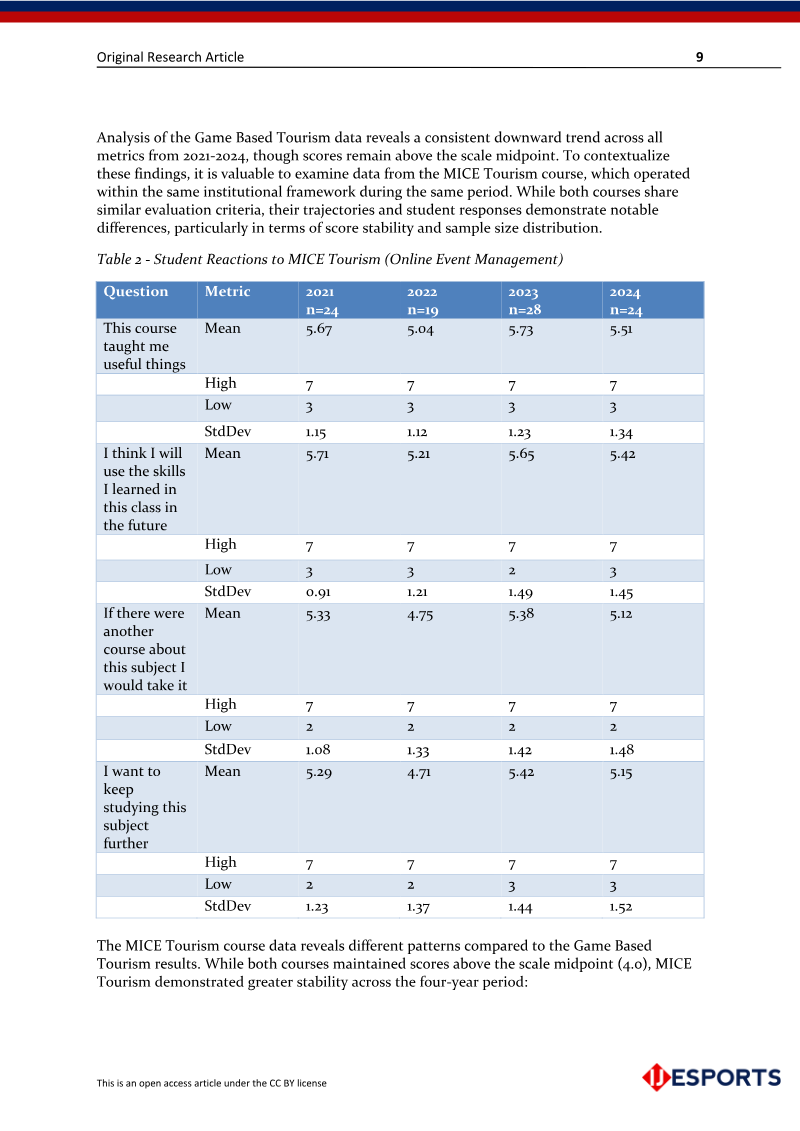
- Student ratings for the Game Based Tourism course declined steadily across all measured dimensions, with perceived usefulness falling from 5.60 to 4.86, and the steepest drop occurring in 2024.
Entering Cheat Codes or to Play True: Where Is Anti-Doping Going Within Esports?
The esports industry is at a critical juncture regarding anti-doping, facing significant hurdles in establishing robust and unified measures despite the International Olympic Committee's interest in an Esports Games.
- Esports lacks a common governing body, a unified sanctions database, and any mention in WADA's 2020–2024 strategic plan, leaving it outside the WADA-governed clean-sport system despite the IOC announcing its Esports Games in October 2023.
- The review argues esports cannot be integrated into the WADA framework until it establishes a unified regulatory body that meets the requirements of the WADA Code.
- Anti-doping policy varies widely across major organizations such as ESL, ESIC, IESF, GEF, and WESA; ESIC stands out for its public sanctions database and betting-integrity work, while IESF is the only one that is a WADA Code Signatory.
The Overrepresentation of Cisgender Men in Esports Research
This perspective article examines the gender diversity of participants in empirical esports research, aiming to identify and address the overrepresentation of cisgender men.
- Cisgender men make up 81.27% of participants across 120 esports research articles (85,765 participants, 2005–2022), while cisgender women account for 16.22%, transgender participants for just 0.11%, and 2.41% have unknown sex or gender.
- Studies featuring only cisgender men (16.67%) far outnumber those featuring only cisgender women (1.67%), and no study in the sample included exclusively transgender participants.
- The authors argue the imbalance matters because findings from one sex or gender may not generalize, and because sex-linked factors such as cognition and sleep patterns may affect esports performance.
Experiences of Choke Among Professional and Amateur Esports Players: A Qualitative Investigation
This qualitative investigation explores the phenomenon of "choke" in esports, differentiating experiences between professional and amateur players.
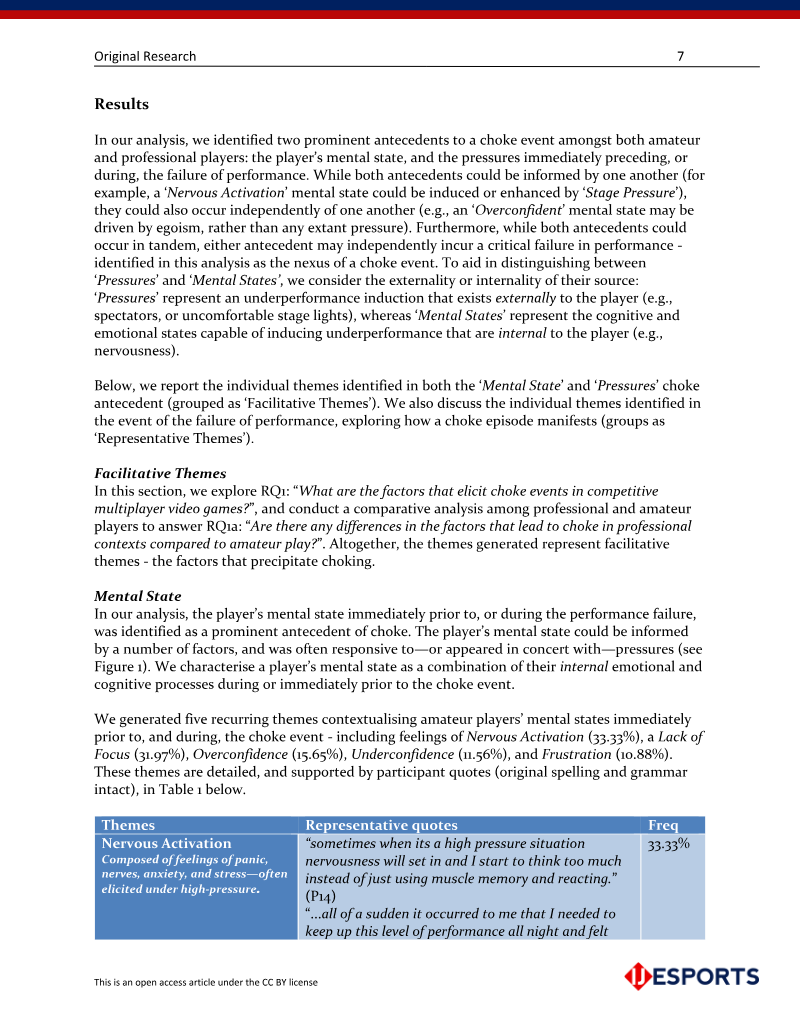
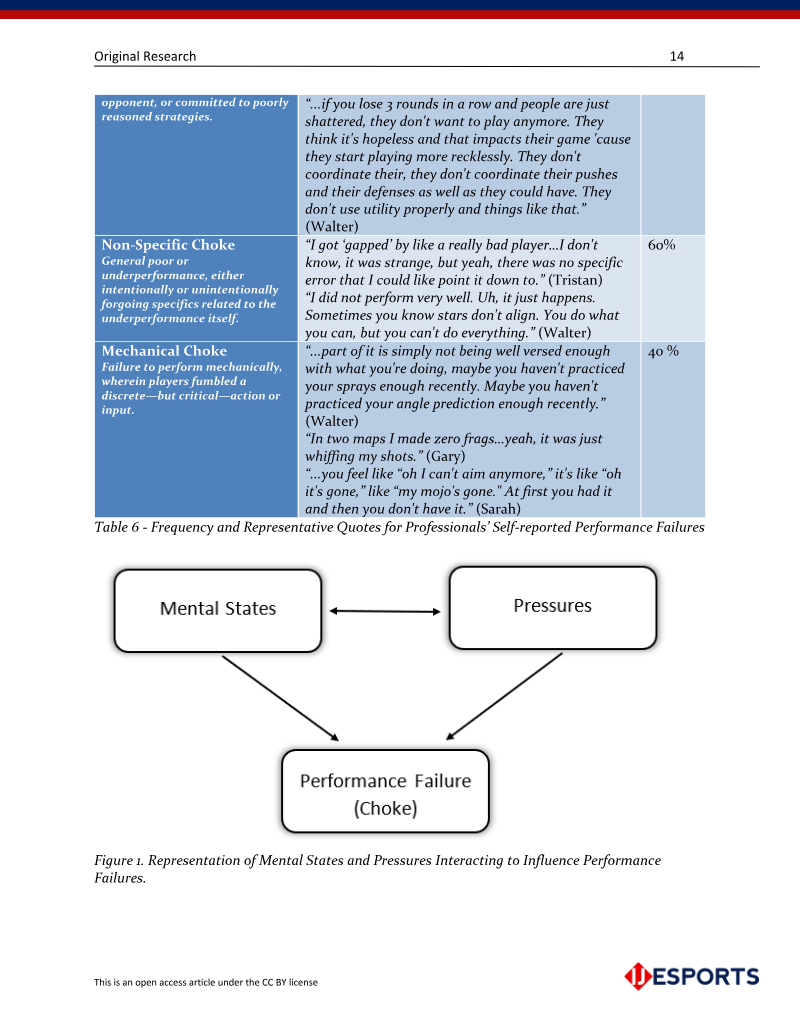
- The study, based on reflexive thematic analysis of surveys and interviews with 147 participants aged 18 to 59, finds that nervous activation and overconfidence are shared internal states behind choking in both professional and amateur esports players, while stakes and spectator pressure are shared external triggers.
- Professionals uniquely report team, stage, reputation, rival, and sexism pressures, whereas amateurs more often cite lack of focus, frustration, underconfidence, social pressure, and distractions.
- Failure modes diverge by skill level: amateurs more often suffer mechanical failures, including non-specific underperformance, while professionals more often suffer strategic failures, which make up roughly 80 percent of their reported choke cases.
Neurocognitive Capabilities and Physiological Responses to Cognitive Stress in Fitness-Matched Competitive Gamers Versus Non-Gamers
This study aimed to discern neurocognitive and physiological distinctions between competitive gamers and non-gamers, specifically controlling for physical fitness levels.
- The study compared 24 fitness-matched participants (12 competitive gamers playing at least five hours per week versus 12 non-gamers, all aged 18 to 28), so the sample is small and predominantly male, which the authors acknowledge limits generalizability.
- Gamers showed significantly better psychomotor speed on the Finger Tapping Test, the study's only statistically significant cognitive difference, which the authors link to the rapid eye-hand coordination competitive gaming demands.
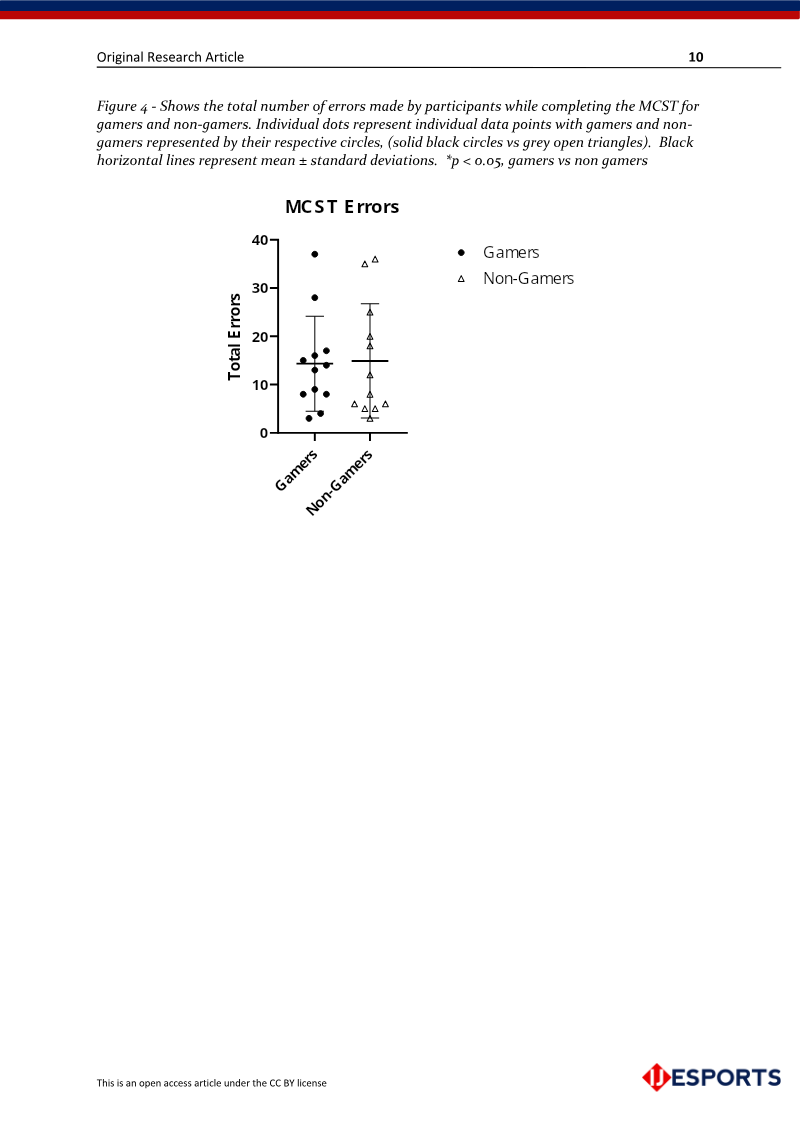
- Performance on the other five neurocognitive tests did not differ between groups, and neither did physiological stress responses (changes in mean arterial pressure and heart rate during cognitive testing) or baseline fitness levels.
Individuals, Representatives, and Racers: Instagram Images of F1 and F1 Esports Series Drivers
This analysis examines the Instagram presence of F1 and F1 Esports drivers to discern differences in their public image construction and the underlying industry dynamics.
- F1 drivers enjoy greater posting volume, production quality, content variety, and visible team and sponsor backing on Instagram than F1 Esports drivers, who post mainly about their gaming work with little explicit team involvement.
- The audience gap is stark: Max Verstappen has roughly 9.4 million Instagram followers compared with about 136,000 for esports driver Jarno Opmeer.
- The authors attribute these disparities mainly to differences in resources and institutional support rather than posting activity alone, concluding that posting volume does not guarantee popularity.
Toxic Behaviours in Esport: A Review of Data-Collection Methods Applied in Studying Toxic In-Gaming Behaviours
Research into toxic behaviors within esports predominantly relies on self-reported accounts, such as surveys and interviews, which offer valuable insights into player experiences and coping mechanisms but are limited by recall bias and an inability to capture real-time, naturalistic behaviors.
- Across 54 empirical studies, research on toxic in-game behaviour relies predominantly on self-reports such as surveys, interviews, and diaries, while naturalistic observational methods, especially video-based analysis, are markedly underused.
- Survey evidence shows roughly 80% of players have witnessed prejudiced comments, 52% to 74% report direct victimisation, and about one in ten describe depressive or suicidal thoughts linked to harassment.
- Each data-collection method involves trade-offs: self-reports capture experiences and coping strategies but cannot reconstruct how toxic encounters unfold, while online log data reveal patterns (e.g., about 63% of toxic messages followed an in-game death) but miss non-textual context.
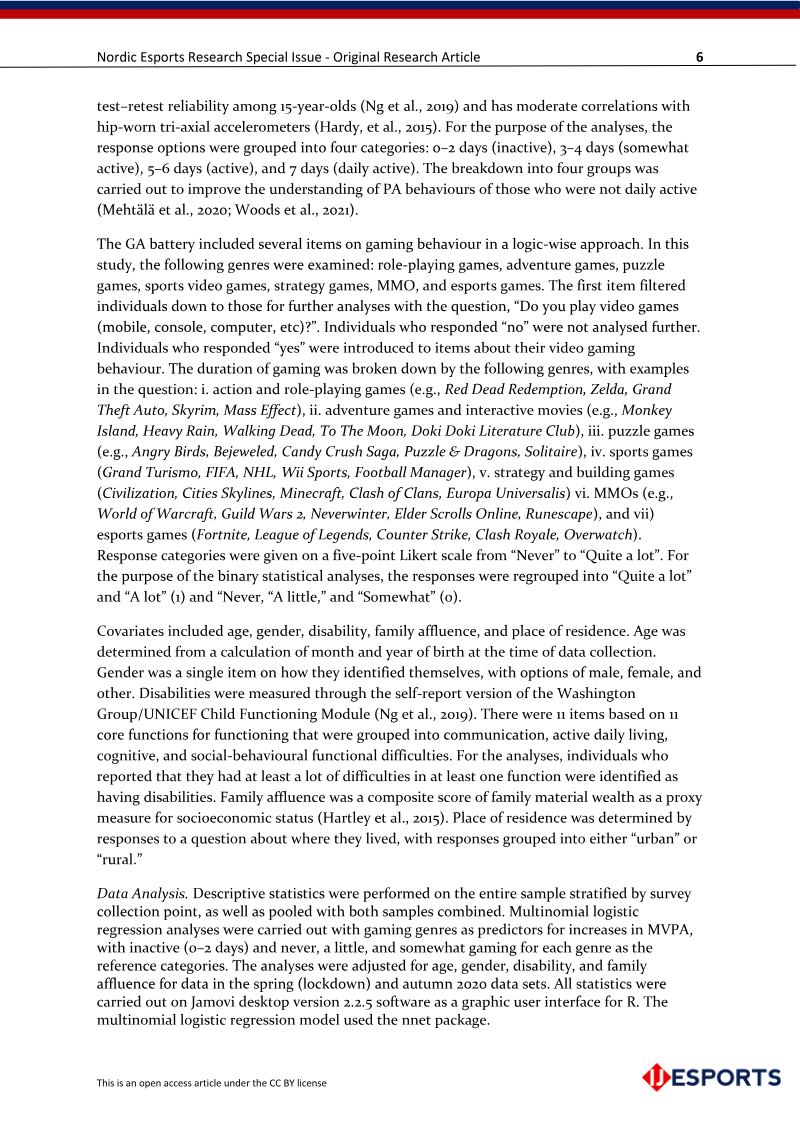
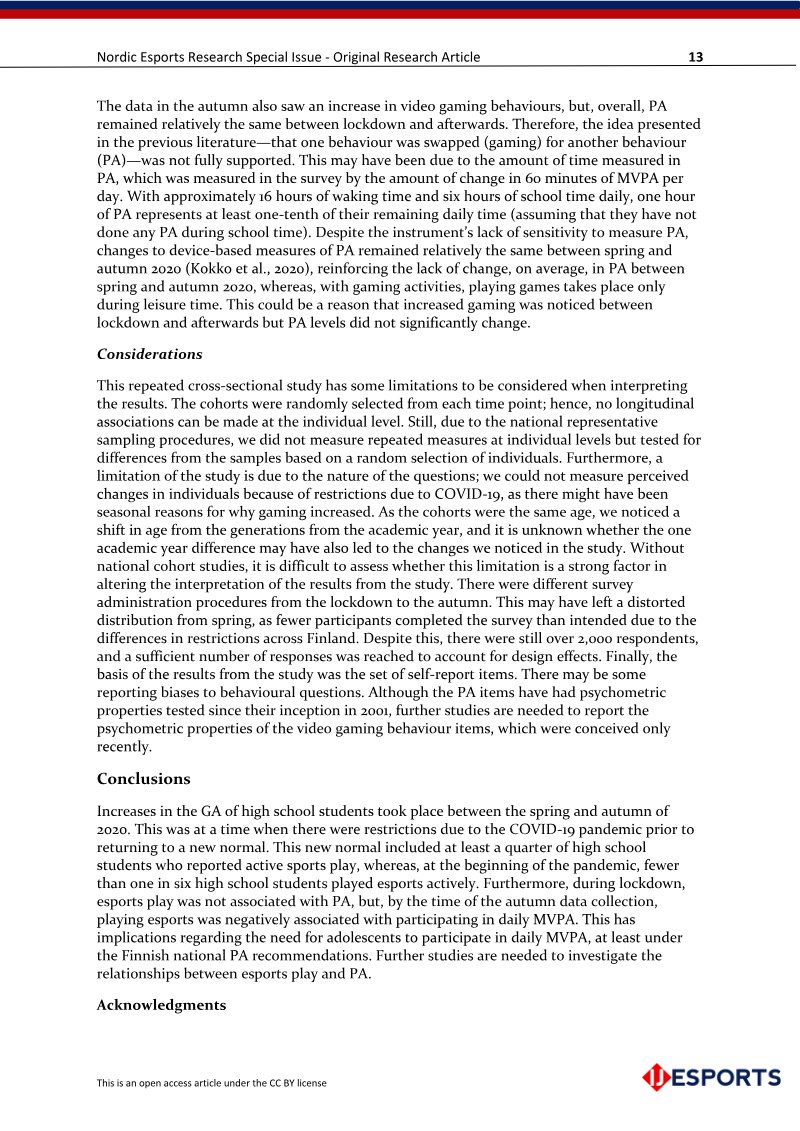
Associations Between Gaming and Physical Activity Among Finnish Adolescents During and After the Spring 2020 COVID-19 Lockdown
This study examines the associations between video gaming and physical activity among Finnish high-school students during and after the Spring 2020 COVID-19 lockdown.
- Gaming rose markedly among Finnish late-adolescent students after the spring 2020 COVID-19 lockdown, with increases across all genres and especially large rises in esports play, based on surveys of 2,459 students in spring 2020 and 4,781 in autumn 2020.
- Overall physical activity remained relatively stable between the two periods, and the authors do not interpret this as evidence that gaming directly displaced movement.
- The gaming–activity relationship depended on genre: roleplaying and strategy games were linked to lower odds of meeting higher physical activity thresholds during lockdown.
Between Sports and Business: National Esports Associations in Europe
National esports associations across Europe are actively working to legitimize and advance their respective national esports scenes, demonstrating both common objectives and significant operational divergences.
- Eight national esports associations (Austria, Denmark, Finland, France, North Macedonia, the Netherlands, Sweden, and the UK) share similar aims, namely establishing legitimacy, shaping legislation, and supporting grassroots development, despite operating in very different national contexts.
- The associations differ mainly in their approach to commercial esports and in how much influence they hold within their domestic scenes and wider societies, which the study maps using Witkowski's public, substitute, industry, and mixed operational models.
- Witkowski's four-model framework loses analytical value as the number of associations grows, and commercial engagement is not a prerequisite for success, though it tends to follow once an association gains legitimacy.
Cognitive Styles Are Poor Predictors of Esports Player Performance in League of Legends
This research investigates the predictive power of specific cognitive styles on player performance in League of Legends, measured by in-game rank.
- Cognitive styles (field dependence-independence, reflectivity-impulsivity, rigidity-flexibility of cognitive control) did not significantly predict in-game rank among 41 League of Legends players in either regression model.
- Game experience was the sole consistent predictor of rank, with ranked match count (p = .0002) and the alternative model (p = .0008) both significant, and the models explaining roughly 39–41% of variance.
- The authors conclude that cognitive styles should not be relied upon to forecast esports performance, and that accumulated in-game experience is a more informative factor.
Effects of Mouse Sensitivity: Performance and Injury Prevention
This document explores the multifaceted impact of mouse sensitivity on performance and injury prevention in esports, particularly within First Person Shooter (FPS) and Third Person Shooter (TPS) games.
- Optimal mouse sensitivity is personal rather than universal, depending on grip style, motor preferences, game genre, equipment, and fitness, and it has been largely unexplored in scientific research, with optimization relying mainly on professional players' experience.
- Mouse sensitivity, equipment ergonomics, posture, and physical conditioning interact to shape both aiming accuracy and musculoskeletal injury risk in esports players.
- Esports players reportedly average about 5.28 hours of play per day, which the paper links to chronic physical and mental fatigue.
Do you work at International Journal of Esports? Get a free report of how these documents are read and cited here.