
International Journal of Esports
Open-access peer-reviewed journal dedicated to esports research: business, health, education and player performance.
Documents
Perceived Stressors Experienced by Competitive Esports Athletes
Competitive esports athletes face a distinctive but structured set of psychological stressors, according to a study of 270 top-40% players across five games.
- Teammate-related and performance-related stressors together account for roughly 79% of all reported stressors among competitive esports athletes, a pattern the authors say closely mirrors traditional sport.
- Four stressor themes are particular to esports: technical issues, balancing life commitments, anti-social behaviour, and performance during critical moments.
- Anti-social behaviour, including in-game toxicity, was the most frequently reported second-order stressor, accounting for 21.6% of reports.
The Protection of Esports Players against the Use of Doping Substances and Methods under the European Convention on Human Rights: The Swiss Example
This document examines whether players in Swiss esports are adequately protected against doping-related proceedings under the European Convention on Human Rights, using Switzerland as a case study.
- The current anti-doping framework for esports rests on the ESIC Prohibited List 2016 and the ESIC Anti-Doping Policy, but lacks clear procedures, sanctioning mechanisms, and dispute resolution bodies.
- In Switzerland, the Swiss Esports Federation (SESF) Standard Article 14 merely references the ESIC list without incorporating the full policy, leaving significant gaps in player protection.
- Esports players cannot bring claims directly before the European Court of Human Rights against private federations, so their protection depends on whether federations voluntarily adopt human rights standards.
Methodology for Emotional Analysis of Video Game Footage
This study proposes and demonstrates a methodology for quantifying the emotional expression of esports players using publicly available livestream footage rather than laboratory measurement.
- The study proposes a low-cost method for measuring esports players' emotions by applying facial coding software (Affectiva's AFFDEX via iMotions) to publicly available Twitch livestream footage instead of laboratory measurement.
- Analysis of seven Rocket League streamers (four male, three female) recorded in summer 2020 found average engagement declining by roughly 1.51 percent per game, which the authors attribute either to fatigue or to improved decision-making efficiency.
- Emotional expression was judged to track gameplay outcomes, but correlations between specific emotions and score differential were weak.
Unpacking Nuance Among Esports Consumers: Market Partitions Within Esports Based on Social Media Analytics
Esports audiences appear to be highly specialized, with consumers tending to follow individual titles rather than the broader competitive gaming landscape.
- 81% of the 33+ million Twitter followers across 16 esports title accounts follow only one title, indicating highly specialized audiences rather than a shared competitive-gaming fanbase.
- Audience overlap is driven more by publisher affiliation and development history than by genre; Blizzard's Hearthstone, StarCraft, and Overwatch show the strongest shared-audience patterns, with a lift of 15.94 between Hearthstone and StarCraft.
- Exclusivity correlates strongly with audience size (r = .71), and large titles such as Fortnite and FIFA show the highest exclusivity, likely because mastering complex mechanics and tactics takes substantial time.
Upper Limb Injuries Secondary to Overuse in the Esports Community: Is This a Rising Epidemic?
Esports has grown rapidly in viewership, revenue, and professional participation, and this perspective argues that the rise in competitive play is likely to bring a corresponding increase in upper limb overuse injuries.
- The authors argue that rapid growth in esports viewership, revenue, and professional participation is likely to produce a corresponding rise in upper limb overuse injuries, framing it as a possible emerging epidemic.
- Professional players reportedly perform more than 400 fine motor movements per minute and may train over 10 hours daily, repetitively loading the hand, wrist, elbow, and shoulder.
- The most common conditions of concern are carpal tunnel syndrome, lateral epicondylitis, and tendinopathies, with De Quervain's tenosynovitis, cubital tunnel syndrome, and medial epicondylitis also flagged though with limited prevalence data.
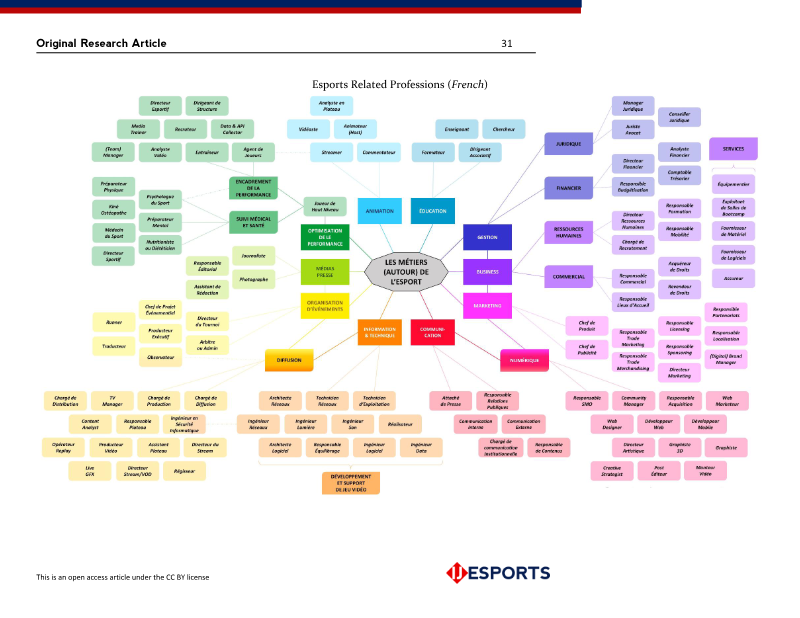
Esports.edu: An Inventory and Analysis of Global Higher Education Esports Academic Programming and Curricula
The Esports.edu study inventories and analyzes higher education esports programming worldwide, applying Rogers' Diffusion of Innovations Theory to treat esports degree programs as an emerging educational innovation.
- Esports academic programming has expanded rapidly, with 95 programs (bachelor's, master's, certificate, diploma, and minor) offered by 74 institutions, concentrated in North America and Western Europe.
- Business and management dominate the field, accounting for roughly 80% of programs and 83% of bachelor's offerings, while broadcasting, coaching, and performance remain comparatively underserved.
- The study catalogs 404 esports-specific courses, with programs averaging 5.7 such courses (7.3 for bachelor's degrees and 3.2 for minors), led by business/management, introduction/history, and media production.
Metagaming and Metagames in Esports
The paper argues for a unified definition of the metagame in esports as the perceived optimal or dominant playing strategy at a given moment, with metagaming describing the use of information external to the game to shape play.
- The paper proposes a unified definition of the esports metagame as the perceived optimal or dominant playing strategy at a given moment, with metagaming meaning the use of information external to the game to shape play.
- Accurate esports analytics, casting, and machine learning depend on understanding the prevailing metagame, because the same character or statistic can carry different meanings as dominant strategies shift.
- Win rates alone can mislead: Dota 2's Death Prophet shows a 68% win rate despite a pick rate of only about 5.6%.
Sleep Quality of Professional Electronic-Sport Athletes (Counter-Strike: Global Offensive)
This study examines the sleep quality of professional Counter-Strike: Global Offensive (CS:GO) players, motivated by the concern that prolonged screen exposure may disrupt sleep and, in turn, impair the performance that competitive play demands.
- A small study of 12 professional CS:GO players (mean age about 21.6, all from one Brazilian gaming house) found poor subjective sleep quality, with a mean Pittsburgh Sleep Quality Index score of 9.25, well above the threshold of 5 that signals sleep difficulties.
- Mean sleep latency was 38.75 minutes and mean sleep efficiency was 83.89 percent, both outside recommended reference values.
- Most players (58 percent) were evening chronotypes, and borderline excessive daytime sleepiness was recorded on average.
Variables Related to the Outcome of an Esports Professional Tournament: Case Study of 2019 League of Legends World Championship Series
This study examines which in-game variables distinguish winning from losing teams in the 2019 League of Legends World Championship Series finals, drawing on 77 games analyzed through t-tests, Mann-Whitney U tests, chi-square tests, and a classification and regression tree model.
- Securing the first Baron Nashor kill was strongly associated with winning in the 2019 LoL World Championship Series finals (χ²(2) = 43.44, p < .001, Cramér's V = .751), and teams that took the first Baron or destroyed more than six main structures had a markedly higher probability of victory.
- Red-side turret destruction was the strongest single predictor in the classification tree, achieving 96.1% correct classification: six or fewer red-side turret kills favored a blue-side win, while seven favored a red-side win.
- Turrets destroyed, inhibitors, kills, deaths, and gold earned all differed significantly between winning and losing sides, with large effect sizes, across 77 games analyzed.
A Parallel Approach to Performance and Sport Psychology Work in Esports Teams
This perspective paper argues that esports teams should employ two distinct staff roles, a sport psychologist and a performance coach, working in parallel rather than combining these responsibilities in one person.
- The paper proposes that esports teams employ two separate staff roles, a sport psychologist and a performance coach, working in parallel rather than combining both responsibilities in one person.
- Separating the roles is argued to reduce ethical problems, particularly around confidentiality and conflicts of interest, that arise when one staff member both counsels players and takes part in coaching or selection decisions.
- The sport psychologist should provide individual, confidential consultations, ideally held by practitioners with credentials from a recognised representative body and bound by an ethical code, and should remain neutral during player trials.
Sportification of Esports: A Systematization of Sport-Teams Entering the Esports Ecosystem
Traditional sports organizations have increasingly entered the esports ecosystem, and this study systematizes that movement by cataloguing 418 sports teams and individual sports investors active in esports through the end of 2019.
- The study catalogues 418 sports teams and individual sports investors active in esports through the end of 2019, with entries peaking in 2018 before slowing in 2019, and identifies eight entry types, adding a category for individual investors to a prior seven-type framework.
- Dedicated esports leagues (45%) and individual players (24%) account for most sports-industry entrants, while brand-driven strategies such as single-game team sponsorship (12%) and sports franchise purchases (6%) make up a smaller share.
- The United States, Japan, and Germany lead by team count but follow distinct models: franchising in North America, top-down association mandates in Germany, and development-oriented approaches in Japan, with football heavily driving the most common team-based and league-linked forms.
Blood Glucose Levels in Response to 1 Hour of Esports Training: A Pilot Study
A pilot study of ten college esports players examined whether consuming a glucose-rich snack before an hour of esports training would improve gaming performance, mental fatigue, and enjoyment.
- A pilot study of ten college esports players found that a Cliff bar (about 21 grams of glucose) consumed 60 minutes before an hour of training significantly raised blood glucose at pre-session, 30-minute, and post-session timepoints compared with fasted sessions.
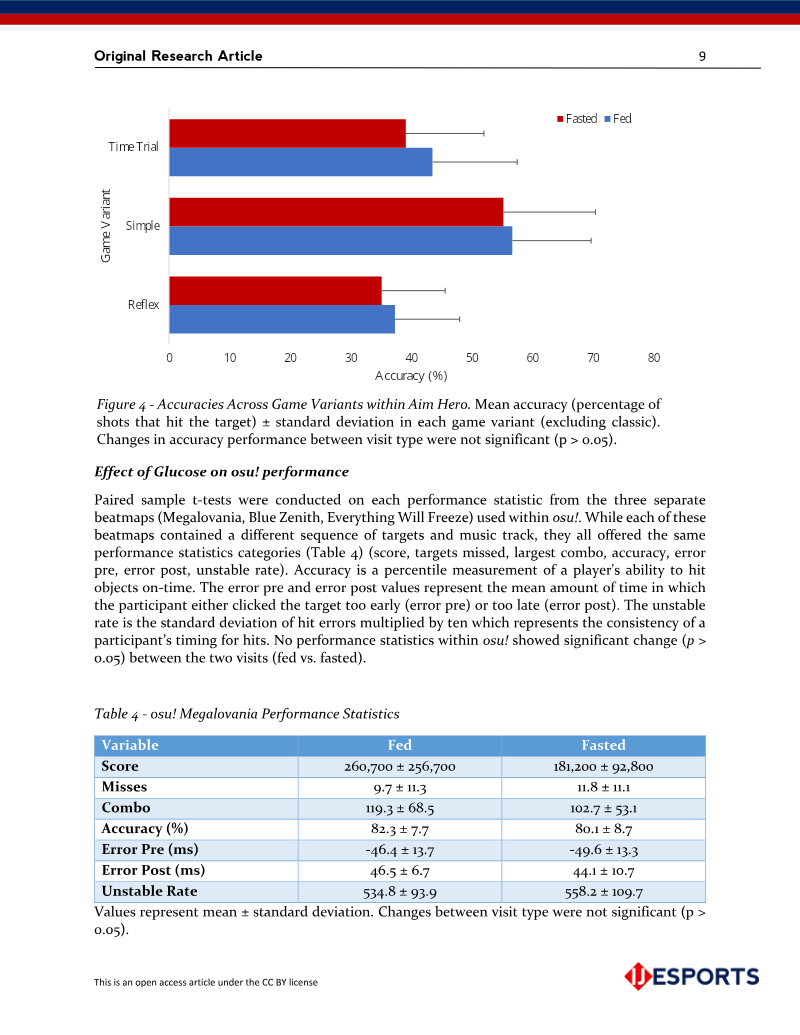
- Despite the clear metabolic difference, the fed and fasted conditions showed no statistically significant differences in gaming performance, mental fatigue, or enjoyment.
- Blood glucose declined significantly from pre- to post-session in both fed and fasted conditions, indicating that gameplay itself draws down circulating glucose.