1 free read left. Create a free account for unlimited reading + AI research.
Create free accountArticle International Journal of Esports
1 free read left. Create a free account for unlimited reading + AI research.
Create free accountArticleInternational Journal of Esports
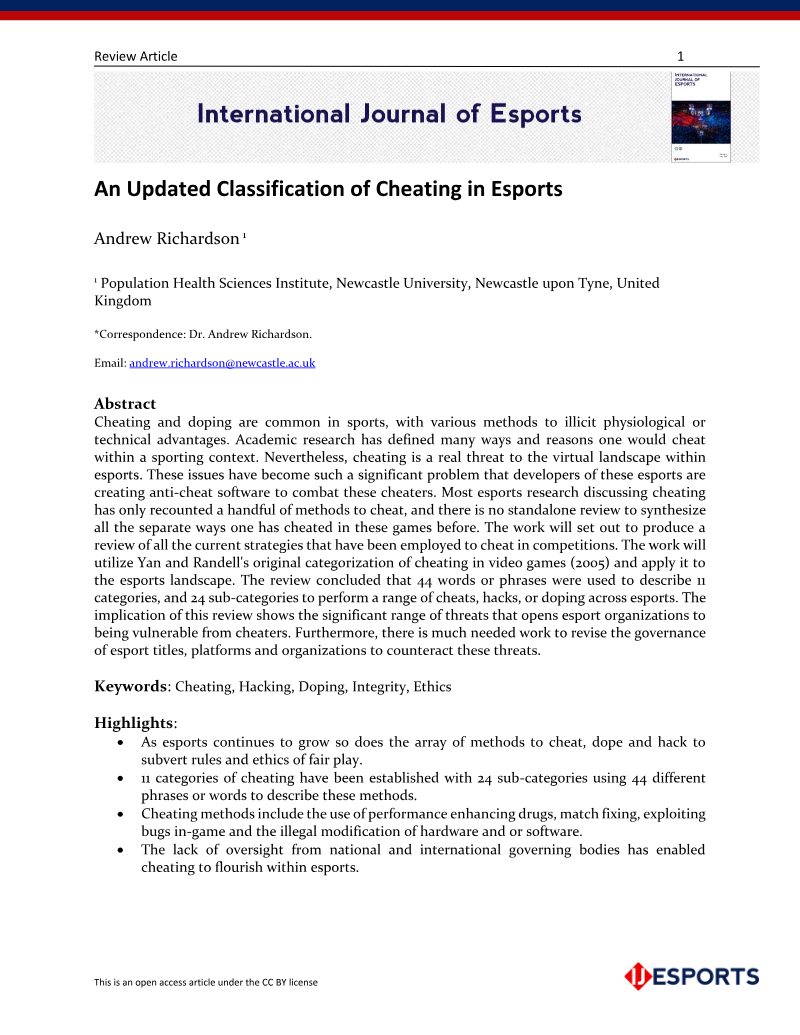
Esports has no common governing body, no unified sanctions database, and no mention in WADA's 2020–2024 strategic plan.
Outside the system. Esports sits outside the established clean-sport system, according to the review.
The esports industry is at a critical juncture regarding anti-doping, facing significant hurdles in establishing robust and unified measures despite the International Olympic Committee's interest in an Esports Games. A central problem is the absence of a single, overarching governing body for esports, which leads to fragmented anti-doping efforts, inconsistent enforcement, and a lack of a centralized database for digital-doping rule violations. The World Anti-Doping Agency currently lacks a specific strategy for esports, leaving a critical gap in global anti-doping frameworks for this rapidly expanding sector.
Current anti-doping initiatives within esports are disparate, with organizations like ESL, WESA, IESF, GEF, and ESIC demonstrating varying levels of commitment and policy implementation. While the International Esports Federation (IESF) is the sole WADA Code Signatory, the Esports Integrity Commission (ESIC) is notable for its comprehensive integrity work, including a public sanctions list and collaboration with betting agencies, though it operates independently of WADA. This fragmentation means that many potential violations may go undetected, particularly outside the purview of major organizations.
To address these challenges, a multi-faceted approach is recommended. Key proposals include establishing shared databases for banned athletes and a public integrity database with detailed player information, alongside standardizing punishment criteria across all esports platforms. Furthermore, widespread anti-doping education is crucial, as is the implementation of "digital passports" through anti-cheat software to monitor player performance anomalies. Finally, active support from game developers for anti-doping policies is deemed essential for effective enforcement. The growing academic and industry discourse on these issues underscores the increasing recognition of the need for comprehensive integrity frameworks in esports, drawing parallels with traditional sports anti-doping challenges and leveraging existing anti-cheat technologies.

International Journal of Esports · 2026
International Journal of Esports · 2026

International Journal of Esports · 2026
International Journal of Esports · 2026

International Journal of Esports · 2026

International Journal of Esports · 2026
International Journal of Esports · 2025
International Journal of Esports · 2025
International Journal of Esports · 2025

International Journal of Esports · 2025
International Journal of Esports · 2025
International Journal of Esports · 2025

Extra Credits · 2026












Comments