
International Journal of Esports
Open-access peer-reviewed journal dedicated to esports research: business, health, education and player performance.
Documents
Normative Performance Profiles of College Aged Esport Athletes in a Pilot Study
This pilot study examines the physical and cognitive profiles of 46 college-aged adults, aged 18 to 32, who play Overwatch at varying competitive levels.
- The study sampled 46 college-aged adults (ages 18–32) playing Overwatch, with 13 classified as high-ranked and 33 as low-ranked, using a small, convenience-based sample that was largely male and non-Hispanic white.
- Across most measures—grip strength, PROMIS-29 self-reported health, and NIH Toolbox cognitive memory—esport players resembled U.S. population norms, and high- and low-ranked players showed no meaningful differences on these measures.
- The main exception was reaction time: high-ranked players responded significantly faster on the most difficult Alienware Academy setting (p = 0.05), which the authors suggest may be a marker of esport ability.
Benefits of Recreational Gaming
A literature review examines the positive and negative effects of recreational gaming, focusing on commercially available video games played in a non-professional capacity.
- Recreational gaming can build real-life skills such as learning, reading, creativity, and problem solving, but only when played in moderation.
- Excessive gaming, which the review associates with more than about 10 hours per week, may instead contribute to emotional, physical, and social problems.
- Cooperative and prosocial gaming is linked to reduced hostility and greater helpfulness, while games can also foster positive affect, flow, and adaptive emotion-regulation strategies.
Continuous Monitoring of HRV in Esports Players
This study investigates heart rate variability (HRV) as a physiological indicator of stress and performance in competitive esports players, using continuous monitoring during live gameplay.
- HRV was measured continuously in a small cohort of ten male esports players using Hexoskin smart shirts during live gameplay, with two devices failing to record.
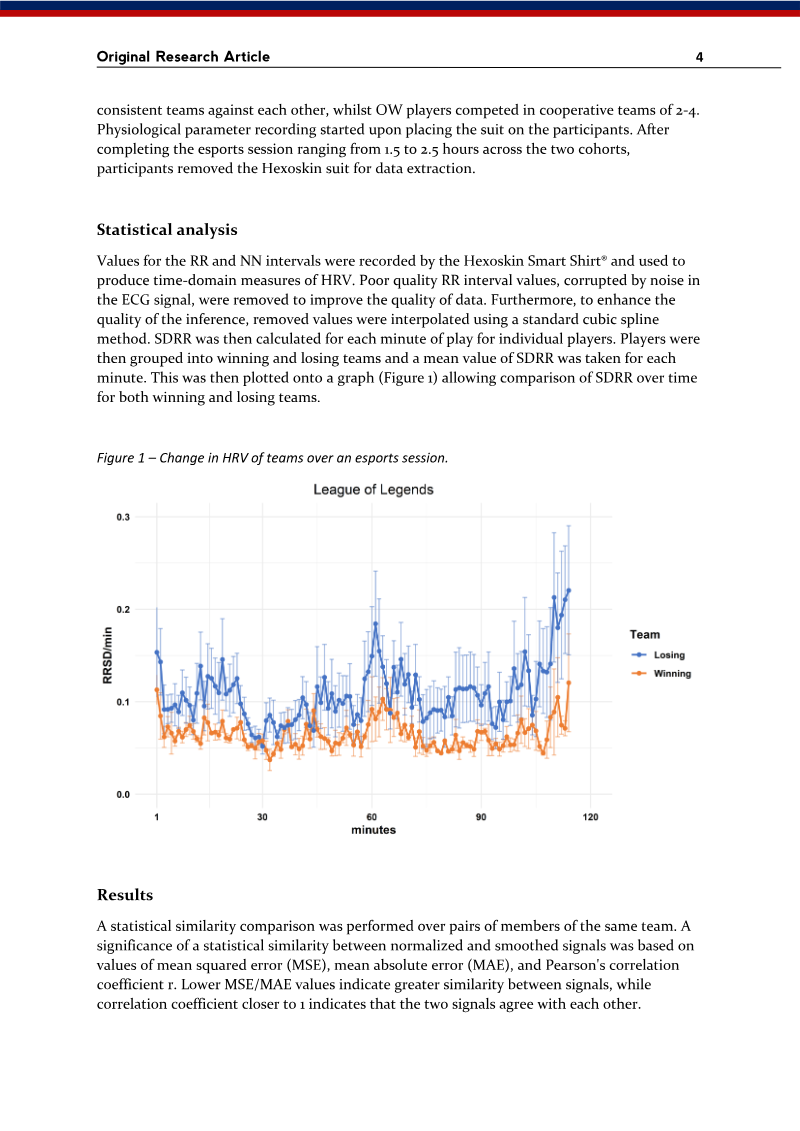
- Esports sessions produced a significant drop in RR intervals and high-frequency HRV, consistent with a stress response, and most players showed reduced SDRR near the end of games.
- At the team level, HRV correlated strongly with session activity (r = 0.78), but individual-level correlation was weak and inter-player variability was high.
A Qualitative Study on Norwegian Esports Students' Sleep, Nutritional and Physical Activity Habits and the Link to Health and Performance
This qualitative study examines the sleep, nutrition, and physical activity habits of Norwegian esports students and how these habits relate to their perceived health and performance.
- Energy levels and focus, shaped largely by diet and sleep, were the main factors participants linked to their performance and well-being in this qualitative study of 20 Norwegian esports students aged 17 to 21.
- Participants averaged about 6.8 hours of sleep on weekdays, below the recommended 7 to 10 hours for young adults, and many skipped breakfast.
- Many students consumed energy drinks even though they noticed the effect on their concentration.
High e-Performance: Esports Players' Coping Skills and Strategies
This study examines how esports players cope with the physical and mental demands of competitive gaming, drawing on semi-structured interviews with players across professional, semi-professional, amateur, and retired levels.
- Esports players rely on three main coping themes: life balance and time management (including breaks and non-gaming activities), social support, and sleep management, which the study treats as essential for handling heavy training loads and competitive pressure.
- Social support, during and after careers, acts as an emotion-focused strategy that moderates stress, with parental support being especially important for younger players.
- The study links sleep restriction to impaired reaction time, decision-making, and mental health, and notes that esports players face the same sleep-disrupting risks as traditional athletes: caffeine use, screen light exposure, and extensive competition travel.
The Dark Side of Esports: An Analysis of Cheating, Doping, Match-Fixing, and Their Countermeasures
Esports has grown into a multibillion-dollar industry, and with that growth has come a serious set of integrity problems.
- The report's core argument is that incentives to cheat in esports are strong, detection is unlikely, and current sanctions are too weak to deter misconduct, making cheating a potentially rational dominant strategy.
- In the authors' model (assuming a $1,500 prize, a $3,000 fine, and a 10% detection probability), doping is a dominant strategy; detection would need to rise to roughly 17%, or fines would need to exceed $5,000, to eliminate that incentive.
- Betting volume in 2020 reached about $13 billion, roughly 107 times the prize money distributed that year, which the authors present as evidence of strong motivation for match-fixing.
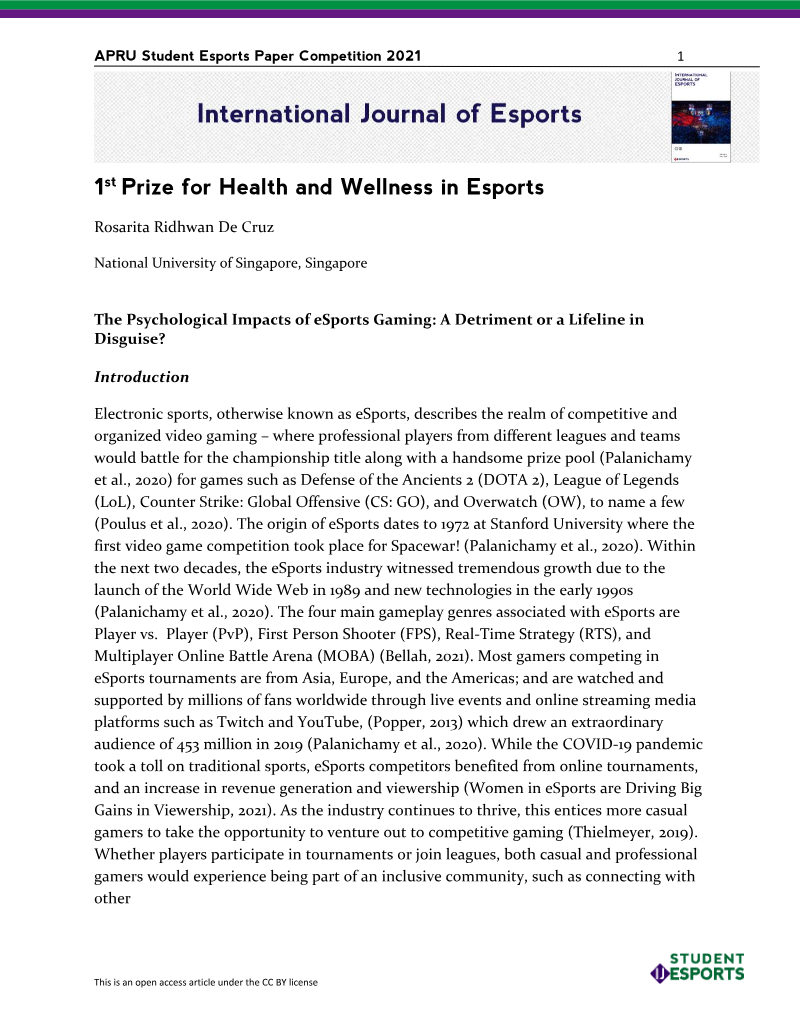
The Psychological Impacts of Esports Gaming: A Detriment or a Lifeline in Disguise?
This paper, the first-prize winner in the Health and Wellness category of the APRU Student Esports Paper Competition 2021, examines whether competitive video gaming poses psychological risks to players or offers meaningful benefits.
- The paper is a literature-based review, not an original empirical study, and it acknowledges that the evidence base on eSports-specific stressors and effective coping strategies is limited.
- eSports drew an audience of 453 million in 2019 and grew further during the COVID-19 pandemic, and the paper argues its mental demands are comparable to those of traditional athletes.
- Citing a University of Chichester study, the paper identifies 51 stress factors among eSports athletes, linking them to burnout, depression, anxiety, addiction, and aggression.
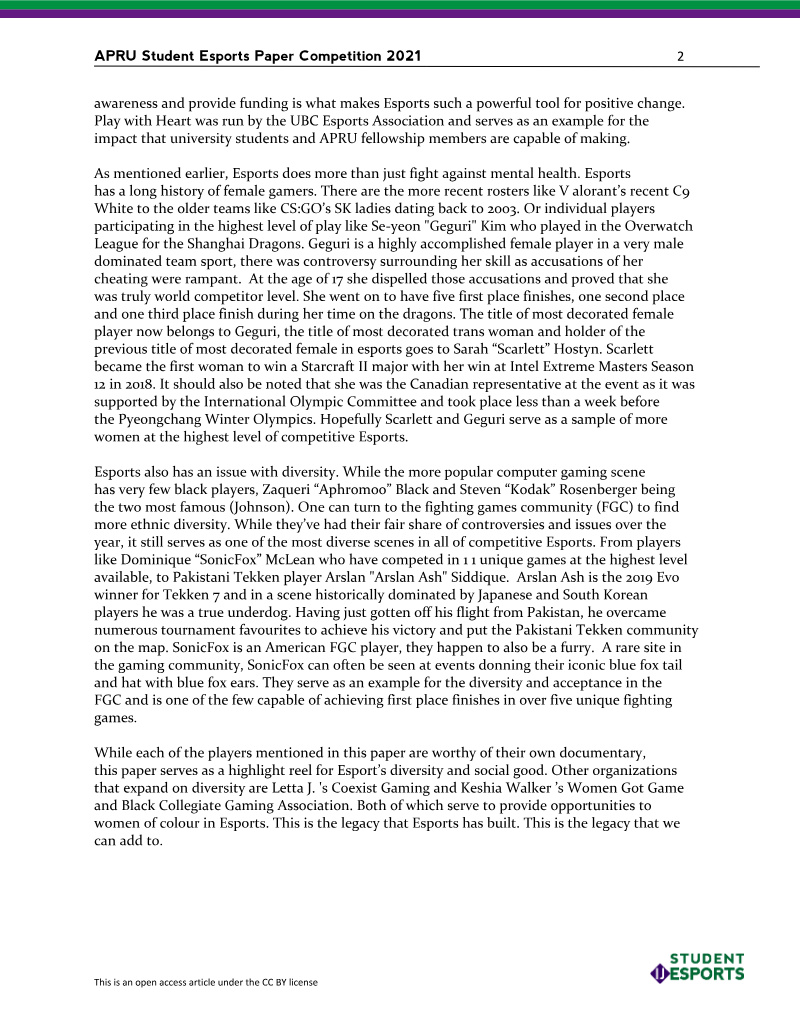
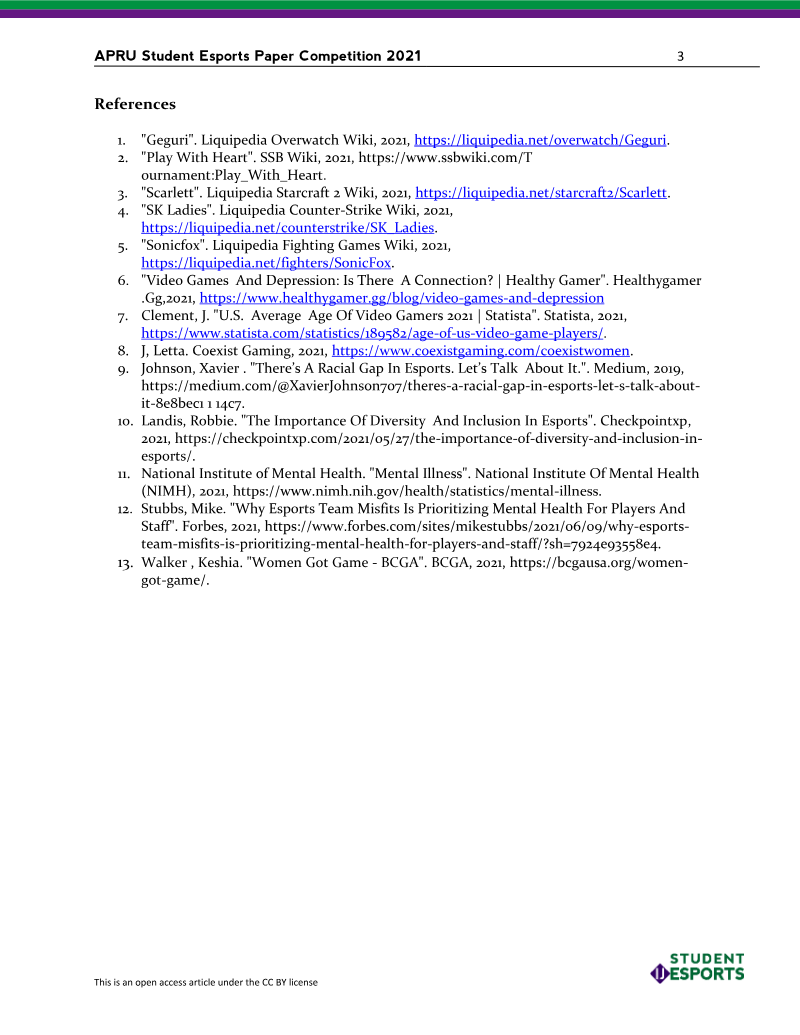
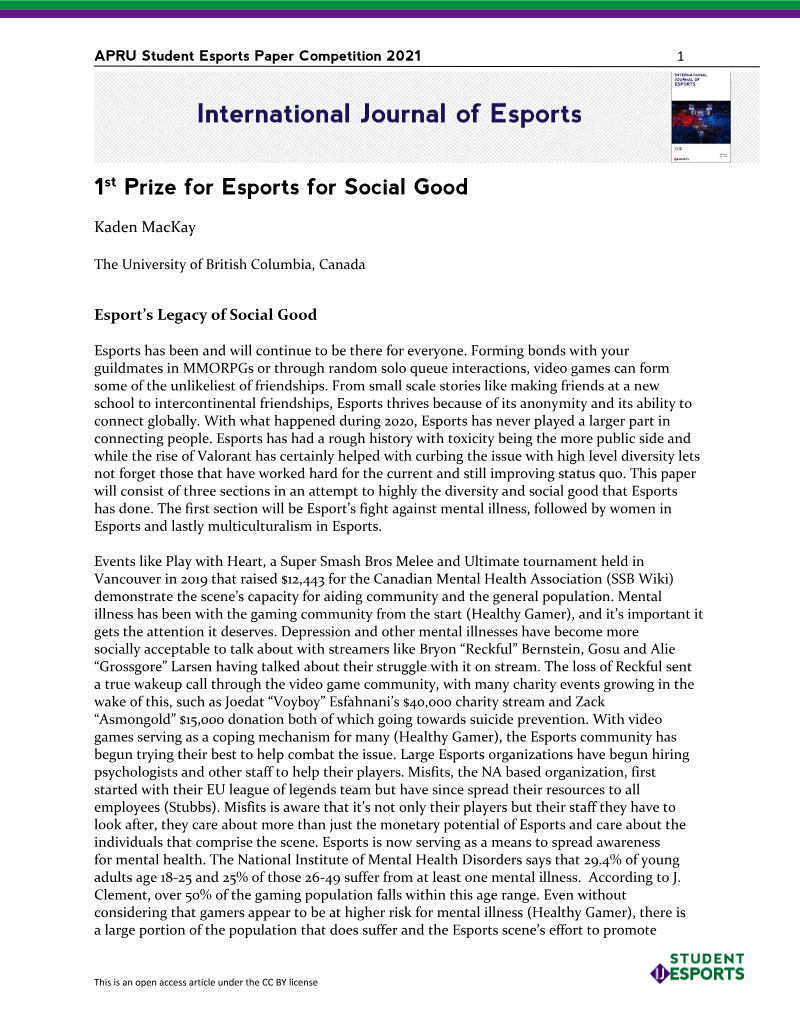
Esport's Legacy of Social Good
This paper, an award-winning entry in the APRU Student Esports Paper Competition 2021, argues that esports has built a meaningful legacy of social good, particularly through its capacity to connect people across geographic and social boundaries.
- The paper's central thesis is that competitive esports has created a meaningful legacy of social good, especially by connecting people across geographic and social boundaries, and that these efforts should be recognized and extended.
- Play with Heart, a Super Smash Bros. tournament, raised $12,443 for the Canadian Mental Health Association in 2019, and large donations were made to suicide prevention after the death of streamer Byron "Reckful" Bernstein.
- Professional organizations such as Misfits have begun employing psychologists and extending mental health support to staff as well as players.
Paving the Road: Exploring Esports Models and Marketing Opportunities in University Esports
This paper examines how university esports programs in North America function as business models and pipelines for the professional esports industry, and how they create marketing opportunities for brands seeking to reach young adult audiences.
- The paper's central thesis is that university esports programs in North America act as both a talent pipeline feeding skilled workers into the professional esports industry and a marketing channel for brands seeking to reach young adult audiences.
- Maryville University's scholarship-based competitive model is cited as a route into professional play: a student who won the university League of Legends championship in 2019 joined a North American LCS franchise in 2021.
- The UBC Esports Association, founded in 2010 and student-run without significant university funding, reports more than 3,500 Discord members and is structured with over 60 executives across nine game titles, mirroring business operations.
Zwift's Anti-Doping Policy: Is It Open to Cheating?
Zwift, the rapidly growing e-cycling platform that reached over three million accounts and 45,000 simultaneous users in 2021, is the subject of a critical examination of its anti-doping policy, introduced in 2020 and updated in 2021.
- The report's central claim is that Zwift's anti-doping policy, introduced in 2020 and updated in 2021, has not curbed cheating, as cheating incidents have risen since its implementation.
- Cheating on Zwift appears to be driven more by digital data fabrication than by pharmacological doping, with no evidence of an epidemic of performance-enhancing drug use among riders.
- Documented in-game cheating methods include manipulating body weight and height settings, switching gender for advantage, 'sticky watts' techniques, USB and controller hacks, and trainer calibration manipulation; one case showed a 75kg rider at 300W beating an 82kg rider up Alpe du Zwift by nearly five minutes.
Leveling Up Esports Health: Current Status and Call to Action
The report examines the health of esports players and argues that the field is still in its infancy, with health research, monitoring, and policy lagging far behind the competitive scene's growth.
- Esports athletes face a broad range of risks, including physical, visual, sleep, nutritional, and mental health problems, yet health research, monitoring, and policy lag far behind the competitive scene's growth.
- Players often sit for more than ten hours a day and show elevated heart rates during competition, and musculoskeletal complaints in the neck, back, wrist, and hand are widespread.
- Eye fatigue is common, with 56 percent of players in one collegiate sample reporting it, consistent with broader findings that digital eye strain affects up to half of computer users.
Stressors, Perceived Stress Responses, and Coping Strategies in Professional Esports Players: A Qualitative Study
This qualitative study, led by Leis and colleagues, examines the stressors, perceived stress responses, and coping strategies of professional esports players, focusing on League of Legends.
- Qualitative study of 12 male League of Legends professionals aged 19 to 28, most ranked in top competitive tiers, identifies stressors across five areas: performance expectations, internal self-evaluation, team dynamics, audience and social media pressures, and environmental constraints.
- Players' stress responses peak before and after competition: pre-match nervousness and physiological arousal typically subsided within the first few minutes of play, while poor outcomes triggered anger and embarrassment and strong results produced happiness.
- Coping strategies fell into six themes (social network support, attention regulation, self-regulation, increased effort, consumption strategies, and dissociation), with communication with teammates and coaches and a performance-focused mindset during play being the most frequently used supports.