
International Journal of Esports
Open-access peer-reviewed journal dedicated to esports research: business, health, education and player performance.
Documents

Promoting Passion for Esports While Standing Against Toxic Behaviour
This essay, a third-place entry in the IJESPORTS Essay Competition 2020, argues that passion and toxicity in esports are closely linked, and that the most effective way to reduce toxic behaviour is to educate rather than punish, so that players' enthusiasm for the game is preserved.
- The essay argues that passion and toxicity in esports are closely linked, and that educating players preserves their enthusiasm better than punishing them.
- It distinguishes 'trolls,' who harass others over gender, race, or simply to provoke, from 'tilters,' usually reasonable players who lash out after losses because they are genuinely invested in the game.
- The case study is Counter-Strike: Global Offensive, described as the second most-watched esport by viewership at the time.
The Health Challenges an Esport Player Faces and How They Can Be Addressed by Stakeholders
This essay, the first-place entry in the IJESPORTS Essay Competition 2020, examines the health challenges faced by competitive esports players and the measures stakeholders can take to address them.
- Esports players face physical, psychological, and sleep-related health risks that the essay argues are comparable in seriousness to those of traditional athletes, despite the absence of physical contact.
- Sedentary training schedules are a central concern: the essay cites a reported average of 5.28 training hours per day among 115 e-athletes.
- A 2018 study of 7,200 Korean adolescents found depression to be a common comorbidity of internet gaming disorder, and a neuroimaging study showed grey matter volume differences between professional and non-professional players.
Cycle E-Racing: Simulation or a New Frontier in Sports Technology?
Cycle e-racing, a sector of esports in which riders pedal stationary bicycles on static trainers to compete as avatars in virtual environments, is the subject of this analytical perspective piece by Bryce Dyer of Bournemouth University.
- Cycle e-racing, in which riders pedal stationary bikes on static trainers to compete as avatars in virtual environments, is argued by Bryce Dyer of Bournemouth University to have evolved from a simulation of road and track cycling into a distinct competitive cycling discipline.
- Official recognition came when cycling's governing body endorsed a virtual Tour de France and sanctioned the first Cycling Esports World Championships in 2020.
- A 2019 British e-racing championship disqualification involved a computerised bot used to unlock a favourable avatar, exposing cheating risks in the sport.
An Observation of Common Physiological Parameters During Esports Activity
This study investigates how common physiological stress markers, including heart rate (HR), respiratory rate (RR), and minute ventilation (MV), change during competitive esports play, an area the authors argue has received limited attention relative to traditional sports and other high-pressure activities.
- During gameplay, heart rate and respiratory rate rose significantly compared with rest across both League of Legends and Overwatch, while minute ventilation showed a slight decrease.
- Among League of Legends players, mean heart rate, respiratory rate, and minute ventilation were significantly higher (p<0.01) in the winning team than in the losing team, though the authors caution this association is observational.
- Physiological elevations were persistent across much of each session rather than confined to key moments, suggesting sustained concentration demands on players.
An Insight Into the Esports Industry in China
This paper examines the state of China's esports industry, arguing that China has become the world's largest esports consumer market and that government policy and new technology will shape its next phase of growth.
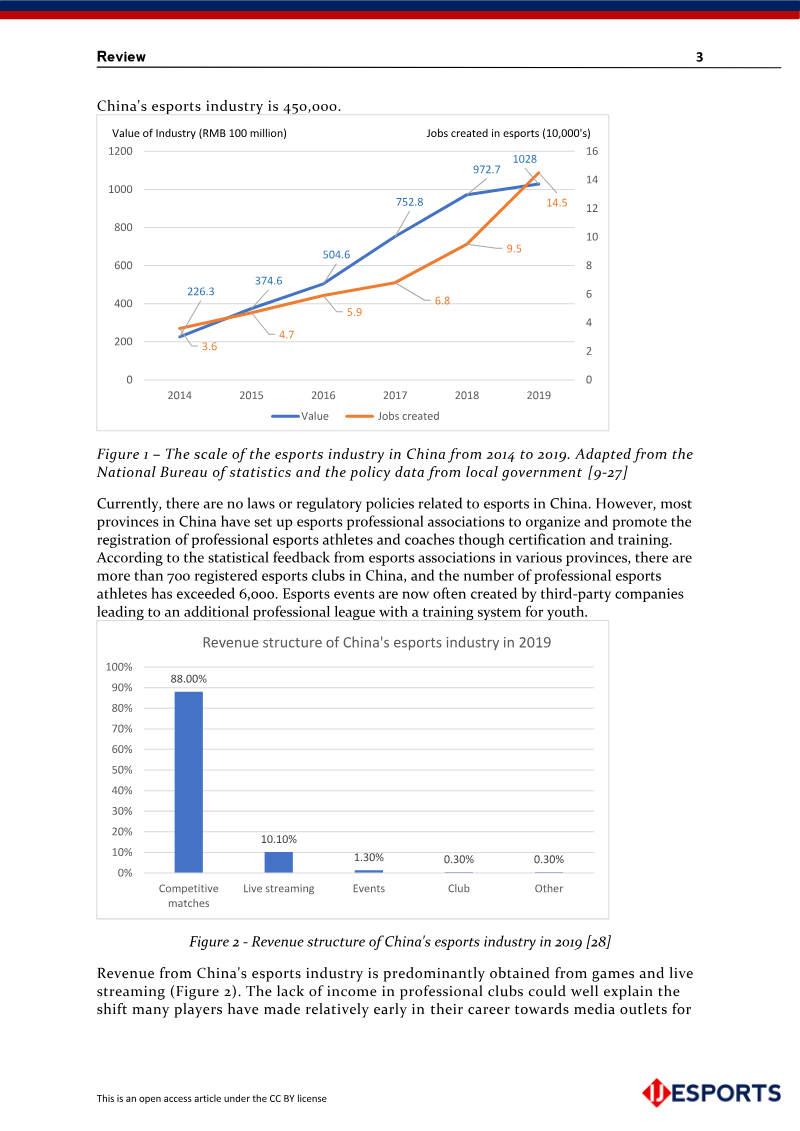
- China's esports industry was estimated at 102.8 billion yuan in 2019, with a reported annual compound growth rate of 132.2% and roughly 450,000 jobs, 145,000 of them new that year.
- By 2020, more than 400 million Chinese users were engaged with esports, and the authors argue China has become the world's largest esports consumer market.
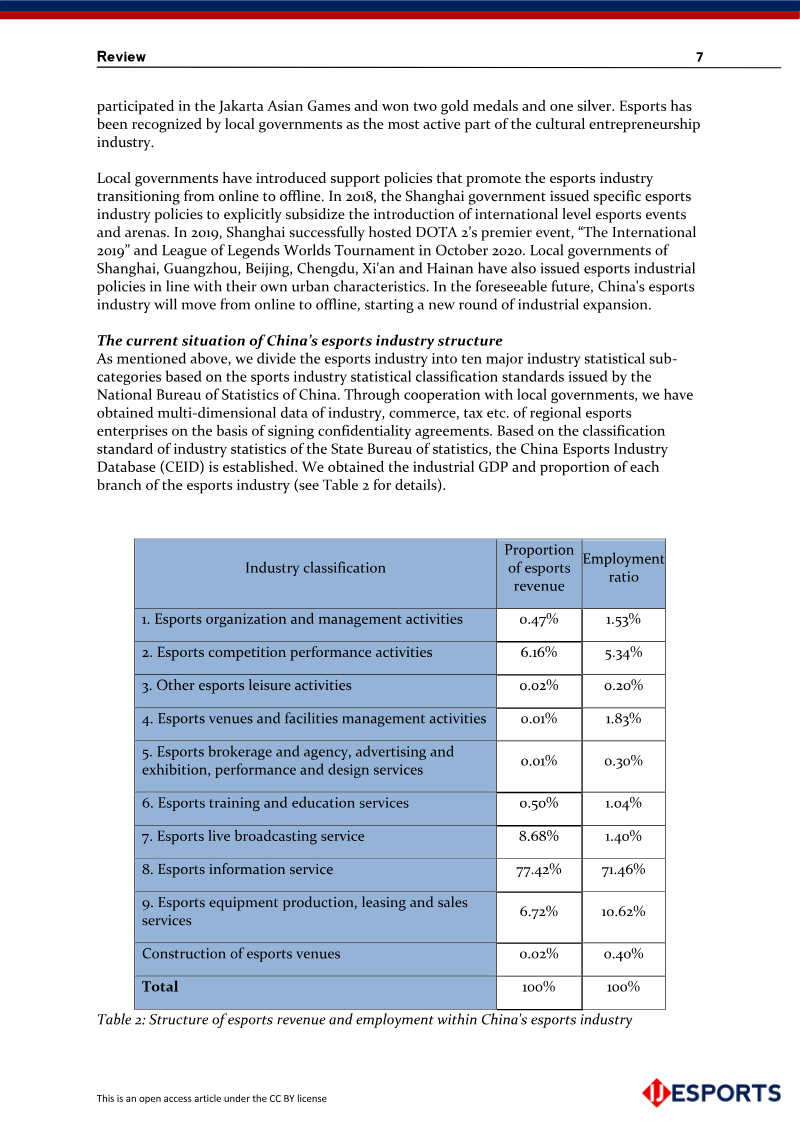
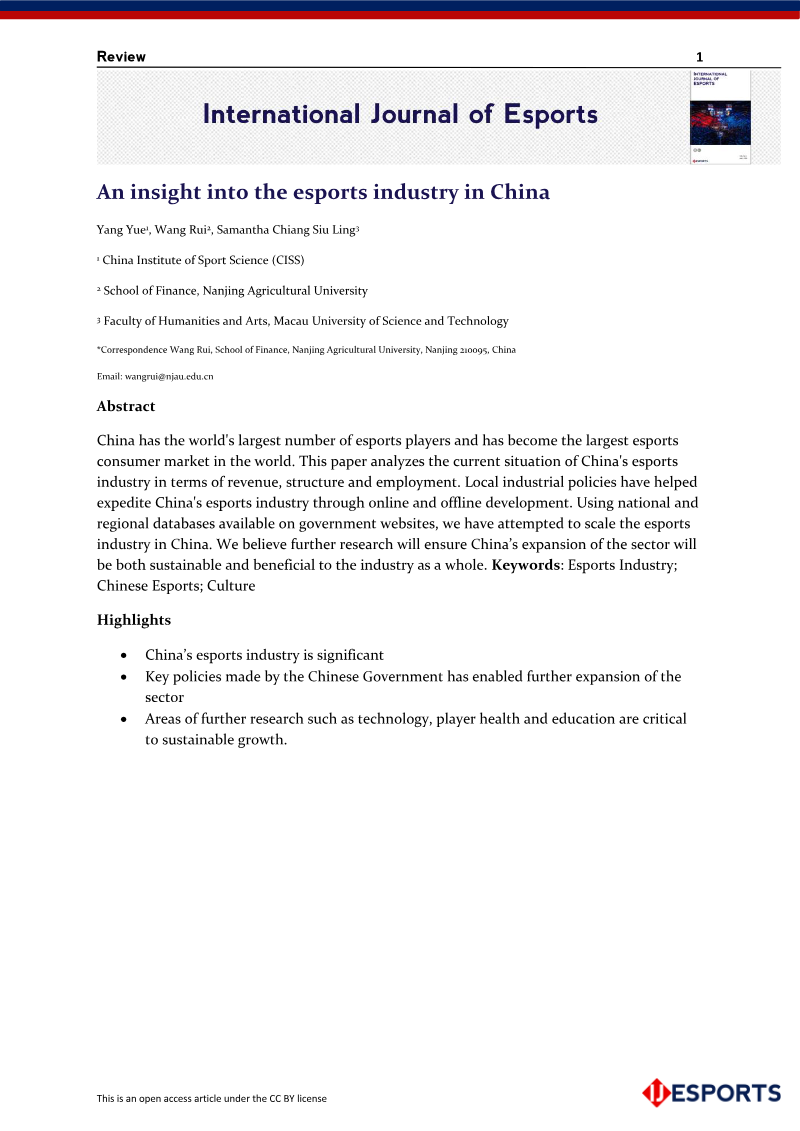
- The sector is heavily concentrated in esports information services, which account for about 77% of industry GDP and 71% of employment, while live streaming contributes around 9% of revenue and competitive matches only a small fraction.
'Smashing It': How User Entrepreneurs Drive Innovation in Esports Communities
This study examines how user entrepreneurs drive innovation in the European Super Smash Bros. esports scene, asking how user-specific attributes and environment-specific characteristics enable entrepreneurial activity among community members.
- Entrepreneurial activity in the European Super Smash Bros. Melee scene is driven mainly by personal passion for the game, a desire to give back to the community, and non-financial rewards, since most organizers lose money or break even.
- The study, based on forum content analysis and twelve interviews with community leaders and tournament organizers across seven European countries, positions Europe as an under-supported region relative to the United States.
- Insider knowledge gained from a system-of-use perspective, plus a grassroots, offline-centered, and welcoming community culture, are the main user-specific and environment-specific enablers of entrepreneurship in the scene.
The Potential of Physiological Monitoring Technologies in Esports
This scoping review examines whether physiological monitoring technologies, such as wearables and clinical-grade sensors, can be meaningfully integrated into professional esports.
- Esports revenues exceeded $1 billion in 2019, and investment in player training, coaching, and support staff is rising, yet physiological monitoring remains largely absent from routine esports practice.
- The scoping review searched PubMed, ResearchGate, Google, and Google Scholar in May 2020 (literature from 1946 onward) and retained only devices validated against gold-standard measures, commercially available, and usable during play, yielding a table of roughly a dozen wearable systems.
- The surveyed devices measure heart rate, heart rate variability, ECG, respiratory rate, oxygen saturation, blood pressure, and skin temperature, with cardiovascular and respiratory measures highlighted as indicators of cognitive and physical load during gaming.
How Do Esports Companies Support Their Community's Wellness?
This study examines how esports companies support the wellness of their communities, set against growing public concern about digital-life harms and mental health.
- Only about 41 percent of the 70 esports organisations sampled, spanning developers, game titles, platforms, streamers and tournament operators, showed any publicly disseminated wellness initiative.
- Wellness provision is uneven by category: roughly half of developers and publishers and 54 percent of game titles had a wellness policy, programme or partnership, versus only 16 percent of tournament platforms and 25 percent of gaming platforms.
- The most common measures are rudimentary, with codes of conduct or community behaviour standards appearing in around 30 percent of organisations, while initiatives specifically addressing gaming disorder are rare at about 7 percent.
The One Billion Dollar Myth: Methods for Sizing the Massively Undervalued Esports Revenue Landscape
The paper "The One Billion Dollar Myth" contends that the widely cited $1.1 billion figure for 2019 esports market size, attributed to Newzoo, substantially understates the industry because it omits publisher direct-to-consumer revenue, player salaries, and prize pools.
- The paper argues the widely cited $1.1 billion 2019 esports market figure (attributed to Newzoo) substantially understates the industry by omitting publisher direct-to-consumer revenue, player salaries, and prize pools, and proposes a broader six-sector "Entire Esports Ecosystem" framework.
- Under this broader framework, the authors estimate the 2019 esports market at roughly $24.9 billion, with Game Publishers accounting for about 64 percent of the total and Teams, Professionals, and Streamers for about 17 percent.
- Sector estimates for 2019 place Streaming Platforms at approximately $2.41 billion, physical product firms at about $1.42 billion, Digital Tools at around $840 million, and Leagues and Tournaments at only about $144 million, showing value concentrated in publishers and platforms rather than event organizers.