
International Journal of Esports
Open-access peer-reviewed journal dedicated to esports research: business, health, education and player performance.
Documents
Exploring the Relative Importance of Skill and Character Choice in Super Smash Bros
Kasumovic's study examines whether player skill or character choice more strongly determines outcomes in Super Smash Bros.
- Player skill is the dominant driver of outcomes in Super Smash Bros. Melee, with a player-level random effect (σ ≈ 2.33) that dwarfs the modest character-level effects, though character choice still matters as a secondary factor.
- The study fitted Bradley-Terry paired-comparison models to 49,141 matches from Ausmash tournament data, focused on Australian and New Zealand competition.
- Most individual character and matchup estimates are statistically weak; only Sheik and Kirby reach significance relative to Fox.
A Mixed Methods Investigation into the Social Impact of Small-Scale Esports Events
A mixed-methods investigation examines the social impact of three small-scale esports events hosted at The Hague University of Applied Sciences between 2024 and 2025.
- Survey respondents (157 attendees, mostly men aged 17–22) strongly agreed the three 2024–2025 small-scale esports events at The Hague University of Applied Sciences build community, with a mean rating of 4.04 out of 5, and broaden professional and social networks (mean 3.87 out of 5).
- Future-event interest differed sharply by gender and viewing habits: 34% of men versus 19% of women, and 48% of regular professional esports viewers versus 11% of non-viewers, indicating that the events' appeal is concentrated among an already-engaged group.
- Eight semi-structured interviews, conducted after the first event, described the events as welcoming, diverse, and focused on belonging, socialization, and networking, but these accounts reflect a single organizer's perspective and the demographic differences received limited statistical testing.
Advocating Netnography for Esports Research
This perspective article argues that netnography, a qualitative method for studying online communities, is well suited to addressing persistent challenges in esports research.
- The article argues that netnography, a qualitative method for studying online communities, is well suited to esports research because its immersive, interaction-based approach can capture social and cultural complexity that surveys and experimental designs often miss.
- It identifies three under-researched areas in esports: marketing (especially toxic behavior and its effect on engagement and consumer lifestyle choices), psychology (emotional stressors, coping strategies, and team dynamics), and gender (harassment, exclusion, and how gender identity intersects with player experience).
- The paper is a perspective piece supported mainly by conceptual reasoning and a review of prior studies, not by new empirical data; it reports no sample, data collection procedure, or measured outcomes.
The Relationship between Career Decision-Making and Parental Support in Esports Players
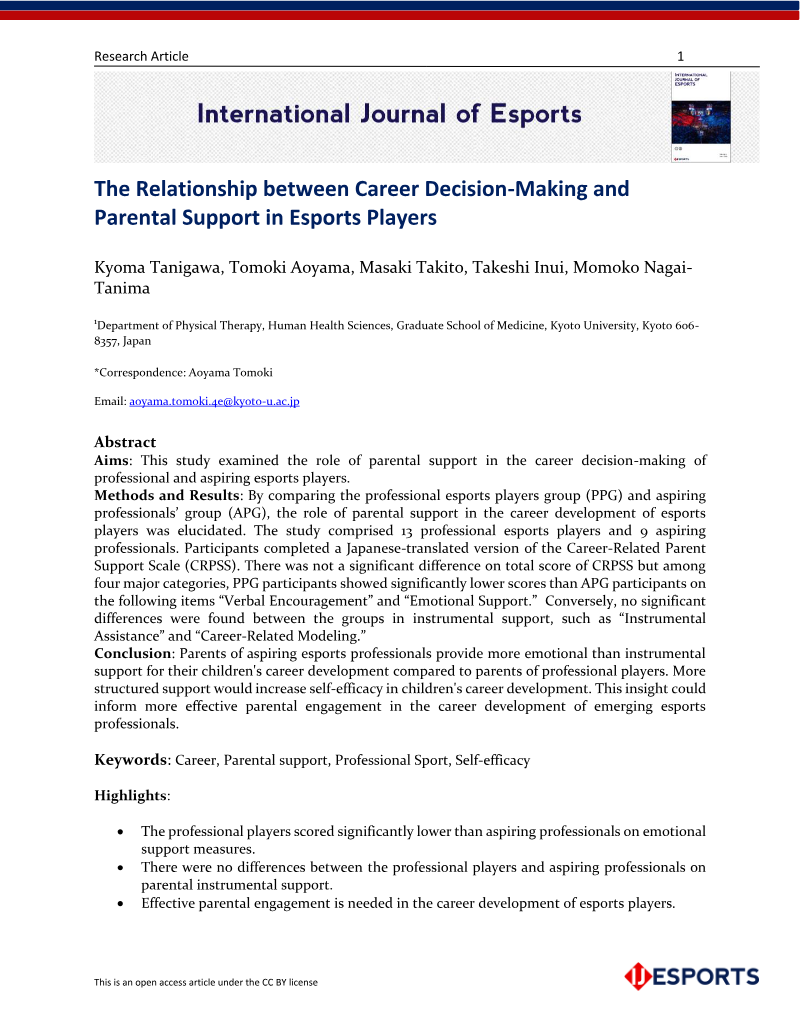
This study compares parental career-related support received by professional esports players (13 participants, PPG) with that received by aspiring professionals (9 participants, APG), all recruited in Japan and aged 16 or older.
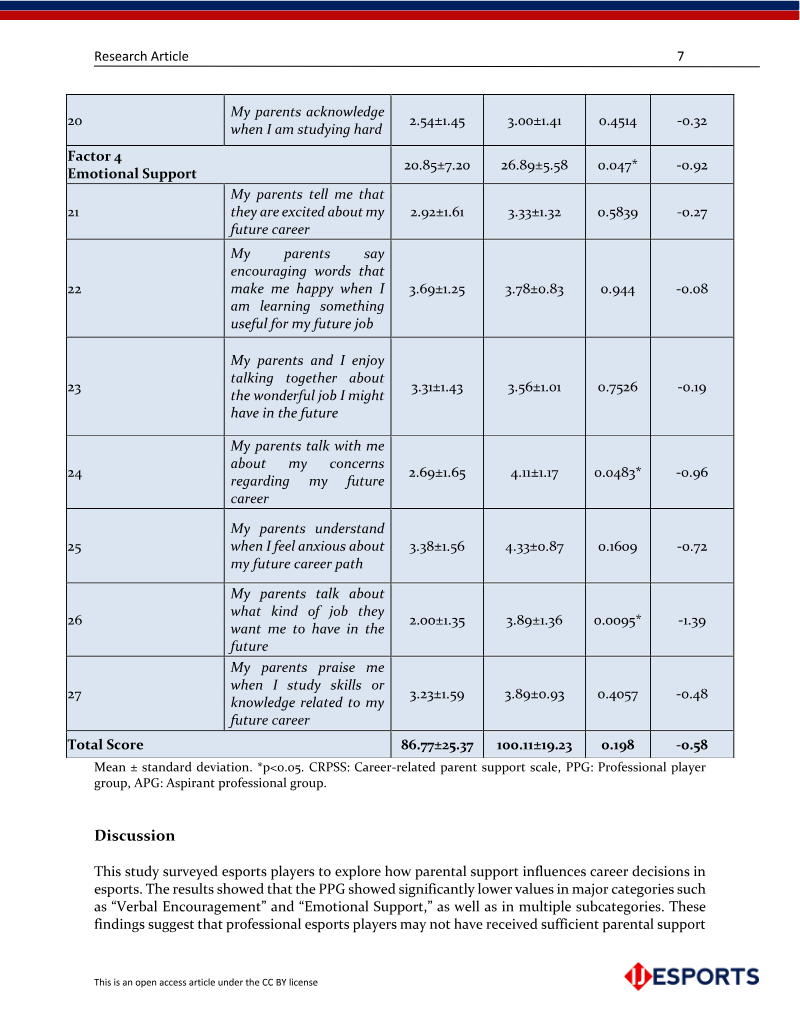
- Parental career support was studied in 22 Japanese participants (13 professional esports players and 9 aspiring players, aged 16 or older), using a 27-item Career-Related Parent Support Scale across four categories.
- Total parental support scores did not differ significantly between professional and aspiring players, but professionals scored significantly lower on verbal encouragement and emotional support.
- Instrumental support (practical assistance and career-related modeling) showed no meaningful difference between the two groups, and the authors conclude aspiring players receive more emotional than instrumental support.
A Comparison of Self-Reported Physical Activity Levels of Collegiate Esports Players with Non-Esports Students
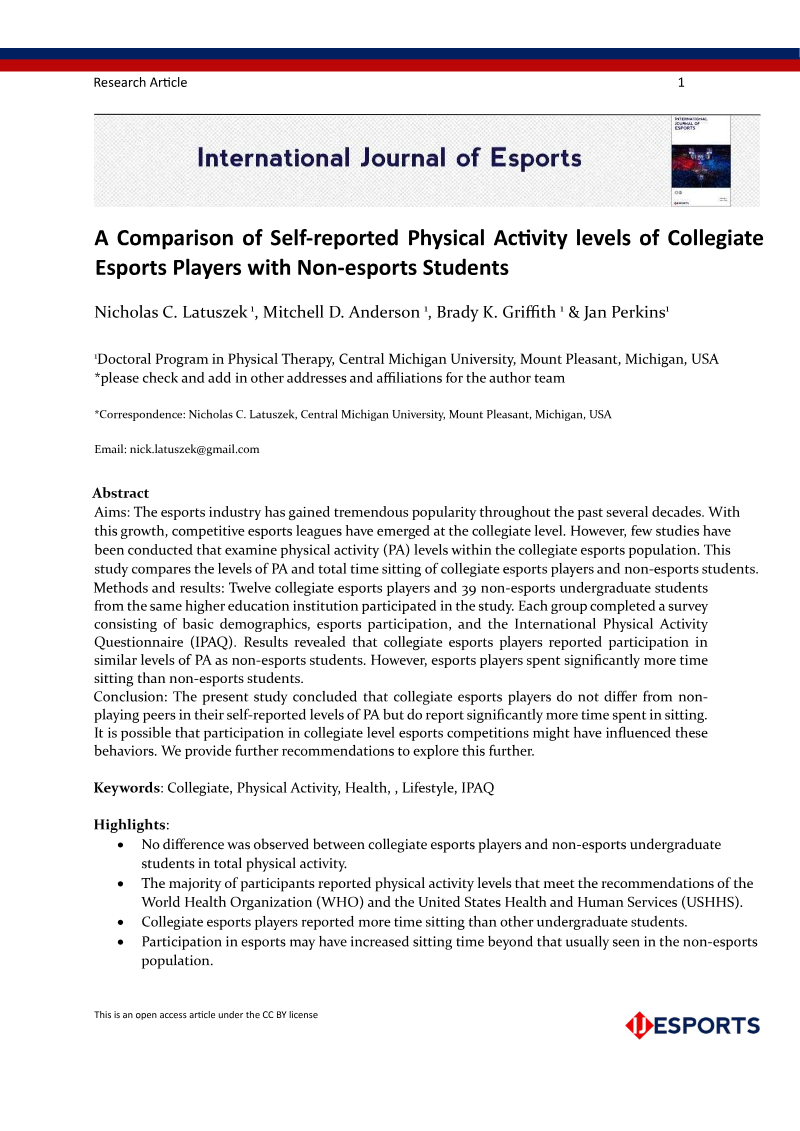
A study comparing self-reported physical activity among 12 collegiate esports players and 39 non-esports undergraduates at a Midwestern university set out to determine whether competitive gaming is associated with differences in movement and sedentary behavior.
- Collegiate esports players reported significantly more total sedentary (sitting) time than non-esports undergraduates, roughly 3,717 vs. 2,929 MET-min/week (p = 0.015).
- Total physical activity did not differ meaningfully between the groups, at about 5,275 MET-min/week for esports players versus about 5,120 for undergraduates (p = 0.594).
- Most participants in both groups met WHO and U.S. HHS activity recommendations of more than 500 MET-min/week, so esports participation did not push typical activity levels below guideline thresholds.
Dying to Be Successful? Revisiting the Goldman Dilemma in the Age of Cycling Esports
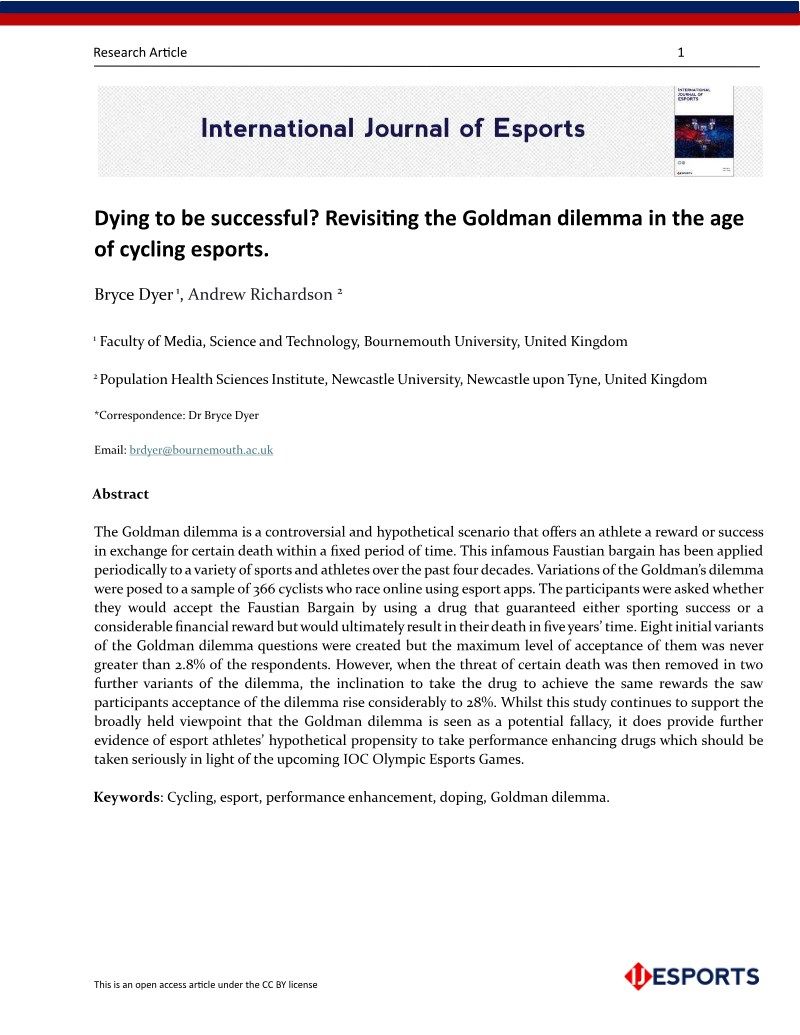
A 2025 study surveying 366 online cycling esports racers examines whether the Goldman dilemma, a hypothetical choice between guaranteed athletic success and death within five years, remains a valid gauge of willingness to dope.
- Surveying 366 online cycling esports racers, the 2025 study found acceptance of performance-enhancing drugs in the classic Goldman dilemma was only 0.8 to 2.8 percent when death was the stated consequence, far below the 52 percent reported among elite athletes in Goldman's 1984 work.
- Removing the death threat while keeping the reward raised acceptance to 9.9 percent for an Olympic medal and 28 percent for ten million dollars, suggesting the mortality framing suppresses responses and low death-scenario figures should not be read as reassurance.
- The authors conclude the Goldman dilemma is either a fallacy or outdated as a measure of actual doping willingness, since its extreme framing may produce responses unrelated to real behavioral intentions.
The Popularity of Zwift: A Sport, Training Aid, or Game?
Zwift, the online cycling platform, occupies a contested space between sport, training aid, and video game.
- Zwift and similar platforms are argued to remain integral to both cycling and digital fitness, with community engagement lending legitimacy to cycling esports as they move toward wider institutional recognition.
- A 2021 survey of 1,470 cyclists and e-cyclists (mean age 46.3, average 21.3 years of cycling experience) found 84.9% were still e-cycling at the time and nearly 90% used Zwift either exclusively or alongside other platforms.
- Respondents' perceptions of e-cycling were divided: 52.8% classed it as a mode of cycling, 27.2% as a game, and 14.8% as both, supporting the authors' view that it resists simple categorisation.
A Comparative Analysis of the Social Media Activities of the Top Male and Female Esports Players
Male esports players dominate tournament earnings, while top female players often outperform their male counterparts on social media, according to a comparative analysis of the Twitter (X) activity of the top 40 male and top 41 female tournament-earning players, drawn from a 2022 study.
- Male players earned roughly $146 million in total tournament winnings versus about $2.7 million for the top female players, and men held 499 of the top 500 Esports Earnings positions, a gap driven largely by Dota 2's high prize pools.
- The authors attribute the earnings disparity mainly to female players' limited participation in high-paying tournaments rather than to any shortfall in engagement.
- On Twitter (X), top male players averaged about 6.77 million followers versus roughly 0.61 million for top female players, showing a much larger male following.
An Updated Classification of Cheating in Esports
This document presents an updated classification of cheating in esports, building on Yan and Randell's 2005 framework.
- The authors revise Yan and Randell's 2005 esports cheating framework from 15 to 11 categories and 24 sub-categories, covering 44 associated terms across cheats, hacks, and doping.
- Cheating is defined as illegal use of performance-enhancing drugs, match-fixing, illegal software or hardware, and bug exploitation, distinguished from permitted but questionable conduct such as toxicity or running down the clock.
- The classification draws on cases from 2007 to 2024 across titles including CS:GO, StarCraft II, Fortnite, Rocket League, and Call of Duty, identifying 99 named individuals who were caught or punished, with CS:GO the most frequently cited title.
Investigating Health Behaviours in Professional and Recreational Video Gamers: The Impact of Role-Modelling in the Video Game Industry
This study examines health behaviours among professional esports players, streamers, and recreational gamers, investigating whether high-profile gamers serve as effective role models for healthy play.
- The study drew on 527 participants: 450 recreational players, 38 esports players, and 43 streamers, with behavioural observation of 20 streamers across tiers of professionalism.
- Esports players reported significantly more positive health behaviours than recreational players, including wrist protection, active desk use, and physiotherapy visits, yet also reported substantially more wrist and neck pain.
- Professional streamers reported discussing or performing health behaviours more often than recreational viewers recognised them doing, indicating a gap between intended and perceived health messaging.
Time to 'Power-Up' Esports Performance Nutrition: A Scoping Review
Esports athletes appear to have diets that fall short of recommended standards, and the evidence on whether nutrition and supplements enhance competitive performance remains thin.
- A scoping review of 14 studies (3,154 participants, 92% male, published from 2019) found esports players commonly eat fast food, energy drinks, and too few fruits, vegetables, and dairy, failing UK EatWell guidelines.
- Poor dietary patterns in esports players were linked to risks including mood disturbance, cardiovascular disease, and reduced bone mineral density, with reduced bone density being especially prevalent.
- Players widely believe diet affects their performance, yet their actual eating habits do not reflect this, revealing a gap between perception and practice.
Eight-Weeks of High Intensity Interval Training (HIIT) Improves Esport Performance Scores in Super Smash Brothers Ultimate Competitors
An eight-week randomized controlled trial with 26 competitive Super Smash Bros. Ultimate players examined whether high-intensity interval training (HIIT) and endurance work could improve esports performance.
- A single acute HIIT session following eight weeks of chronic training was linked to substantially higher odds of winning in a logistic model (exp ≈ 4.7, p < 0.001), the study's most notable finding.
- Eight weeks of chronic training alone did not produce a statistically significant improvement in esport performance (p = 0.13) among the 26 competitive Super Smash Bros. Ultimate players studied.
- The authors caution that the acute HIIT effect needs confirmation in larger samples, since the trial's small size (13 participants per group) limits how far the results can be generalised.