
DiGRA
The Digital Games Research Association: the international association of academics and professionals who study digital games. Its Digital Library holds the proceedings of the DiGRA conferences since 2002.
Documents
Exploring E-Sports: A Case Study of Gameplay in Counter-Strike
Counter-Strike, examined as a competitive e-sport, is the subject of this study, which argues that gameplay should be understood as a situated, distributed social and cultural practice rather than analyzed solely through formal game design.
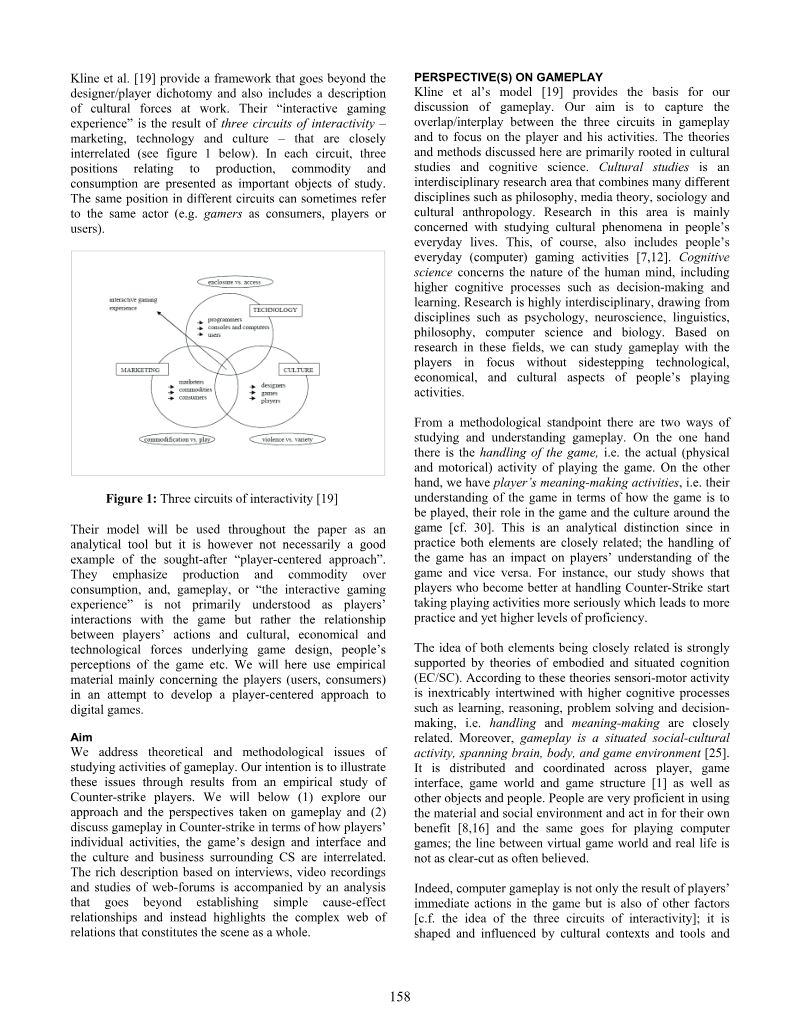
- Counter-Strike competitive play is framed as a situated, distributed social and cultural practice, not just a product of formal game design, drawing on Kline et al.'s three circuits of interactivity model and embodied and situated cognition theory.
- The study's findings rest on 34 interviews with clan members at the 2007 World Cyber Games finals, supplemented by video recordings and forum analysis.
- Strong teams depend on a combination of individual proficiency and collective coordination, while equipment proves less decisive than commonly assumed.
The Primordial Economics of Cheating: Trading Skill for Glory or Vital Steps to Evolved Play?
MacBride's DiGRA 2007 paper examines how the meaning of cheating in games has shifted over time, using Huizinga's "magic circle" and Suits' "less efficient means" as theoretical anchors.
- The meaning and acceptability of cheating in games shift with platform and culture: single-player cheats are often celebrated, while multiplayer cheating is policed through community detection tools and blacklists, leading the author to treat cheating ethics as locally situated rather than universal.
- In a survey of ten Melbourne gamers aged 18 to 35, roughly 90 percent admitted to having cheated at some point, and 80 percent believed there is a distinction between "right" and "wrong" cheating.
- Respondents generally accepted walkthroughs, bug exploitation, and guides, but condemned game-altering hacks that disrupt multiplayer balance, with most judging cheating most objectionable when it degrades other players' experience.
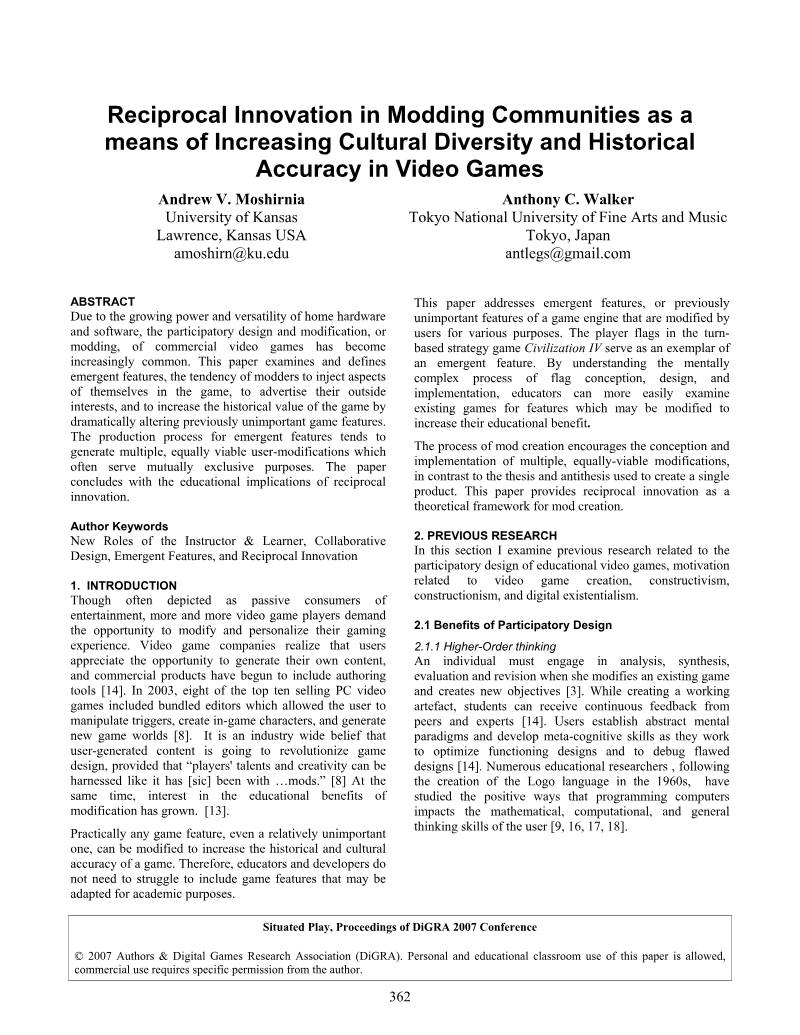
Reciprocal Innovation in Modding Communities as a Means of Increasing Cultural Diversity and Historical Accuracy in Video Games
This paper proposes "reciprocal innovation" as a theoretical framework for understanding how modding communities generate educational and cultural value from commercial video games.
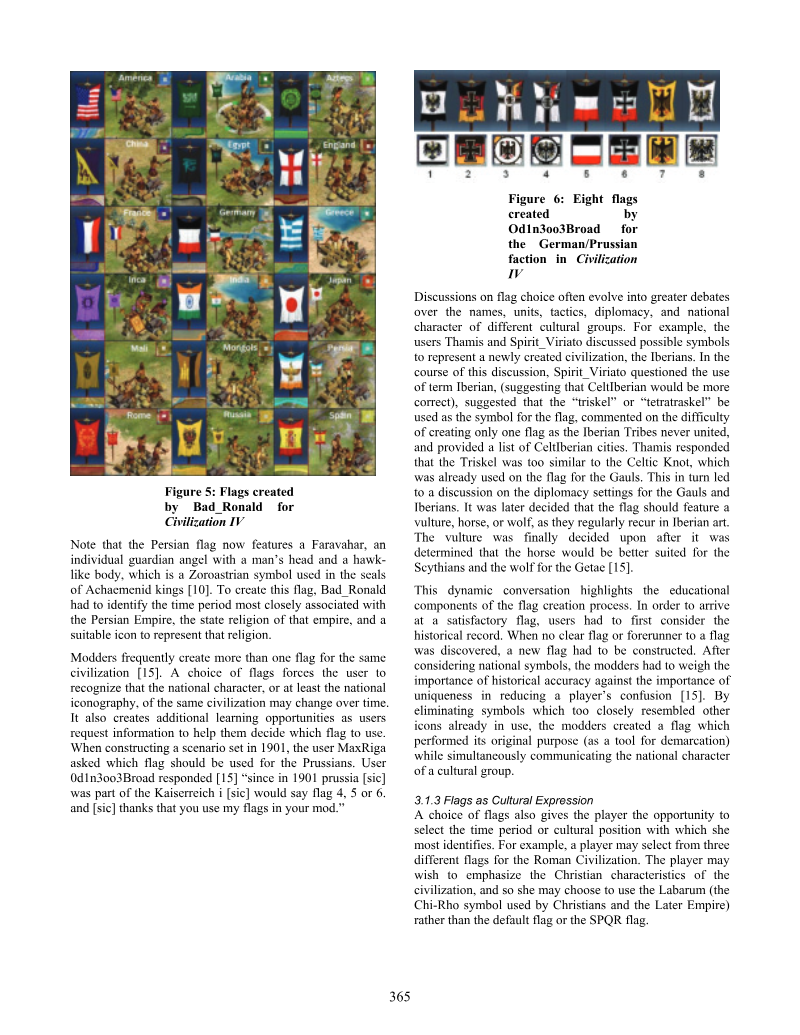
- Modders often repurpose seemingly minor 'emergent features' of a game engine, such as player-generated flags in Civilization IV, into vehicles for historical accuracy, cultural expression, and self-representation.
- The authors propose 'reciprocal innovation' as a framework in which one modification branches into multiple, sometimes contradictory uses determined by individual modders rather than a fixed hierarchy.
- Flag-redesign examples for the Persian, Roman, Chinese, American, and Iberian civilizations required modders to research imperial colors, religious iconography, and national symbols, illustrating how modding drives historical research.
Playing Another Game: Twinking in World of Warcraft
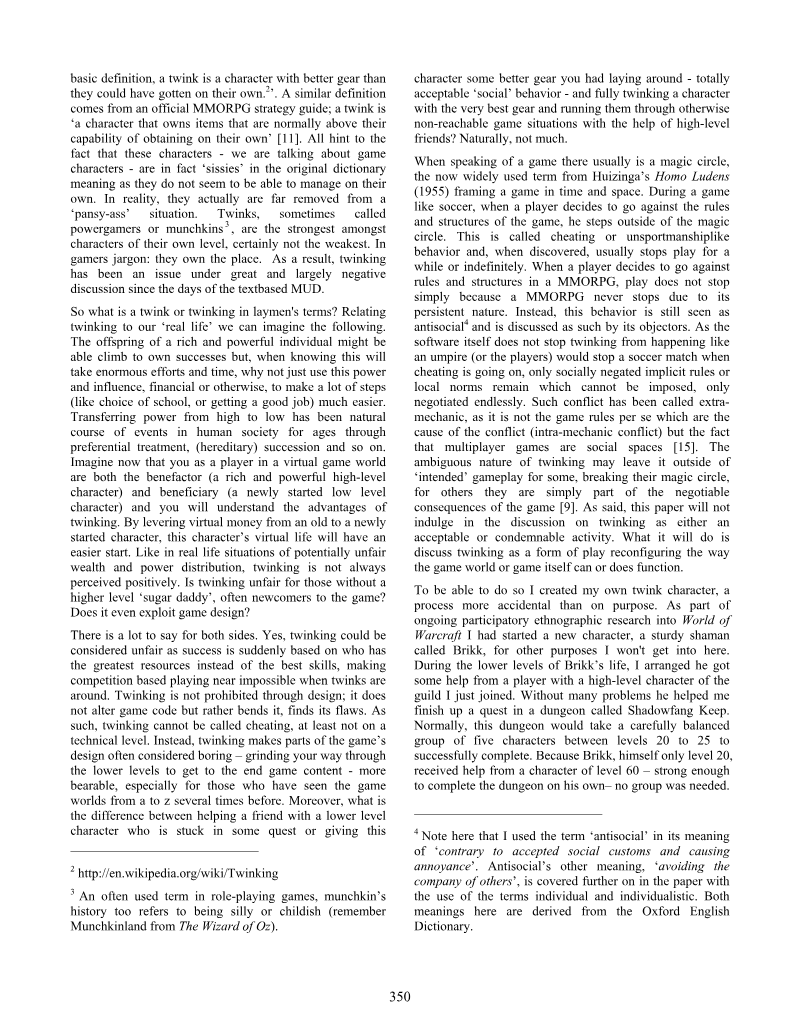
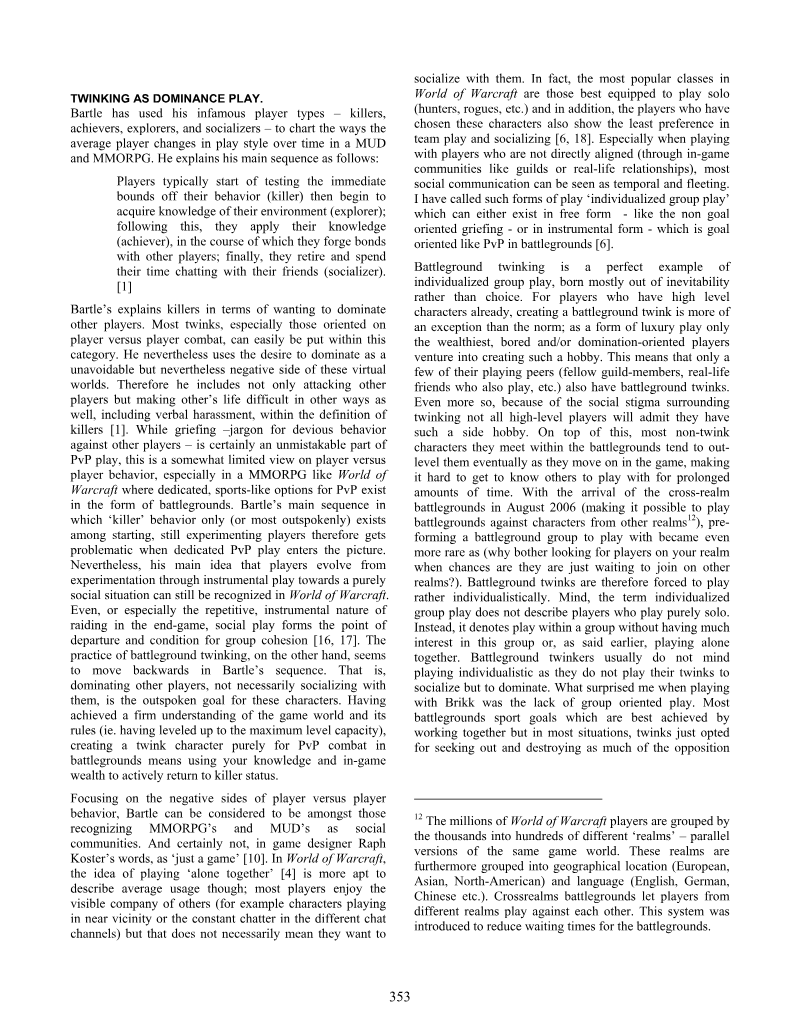
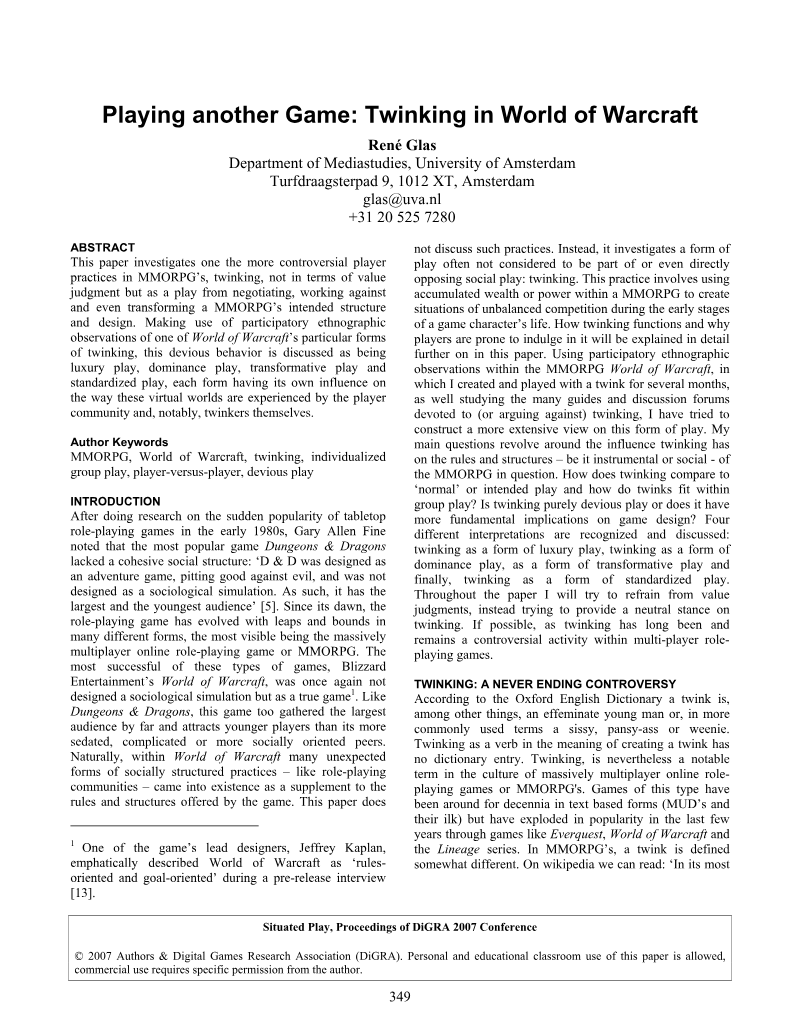
René Glas's study examines "twinking" in World of Warcraft, the practice of giving a character unearned advantages through borrowed gear, money, or assistance from high-level players, which produces unbalanced competition in the early stages of the game.
- Twinking is treated not as cheating to be judged but as a form of play, analyzed through four lenses: luxury, dominance, transformative, and standardized play.
- The study relies on participatory ethnography, in which the author created and played a twink for several months, combined with analysis of guides and forums.
- Twinking contributes to hyperinflation of in-game currency, a phenomenon intertwined with real-money trading and goldfarming.
The Ethics of Indigenous Storytelling: Using the Torque Game Engine to Support Australian Aboriginal Cultural Heritage
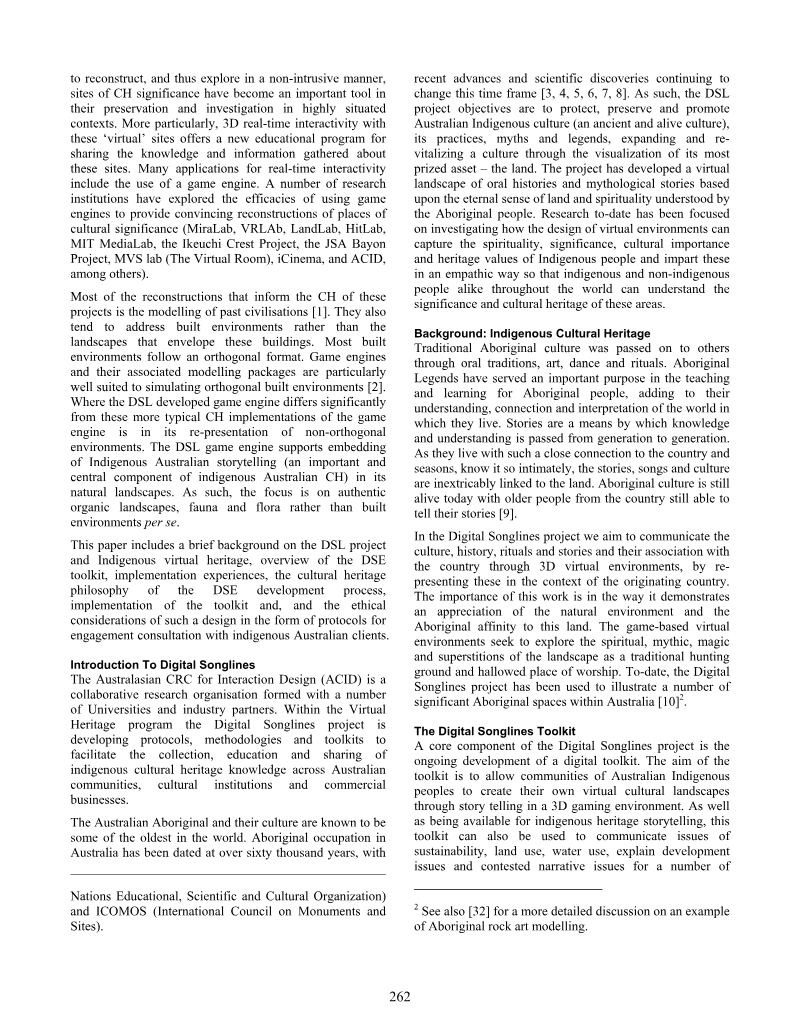
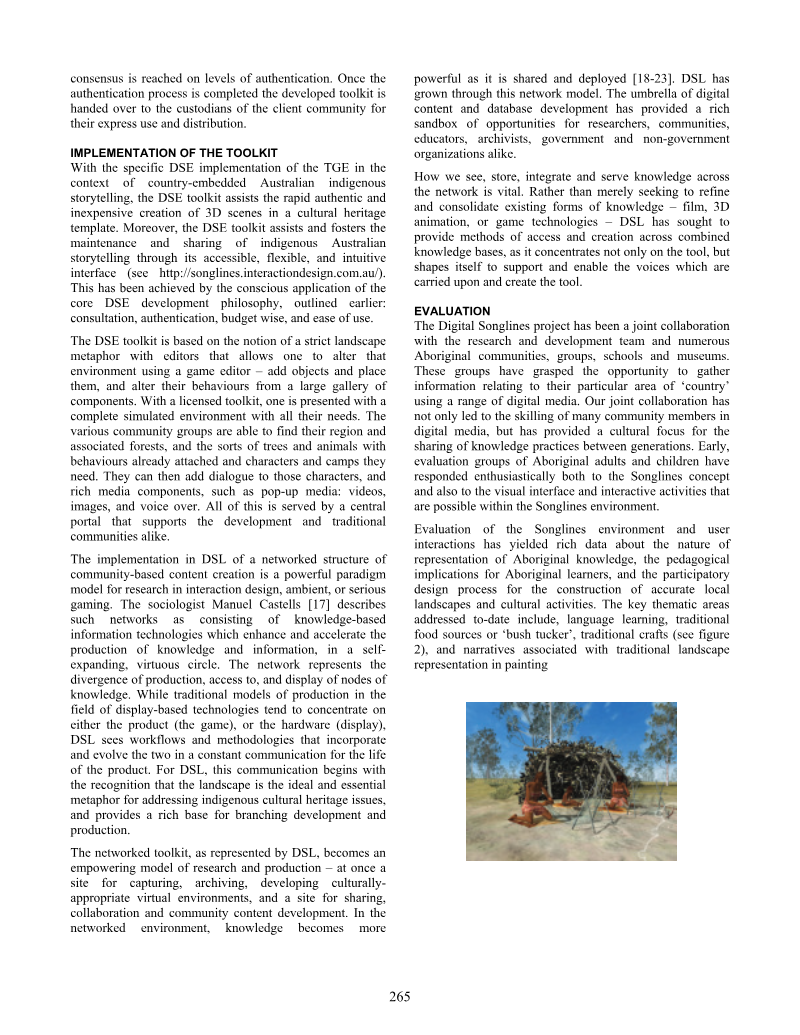
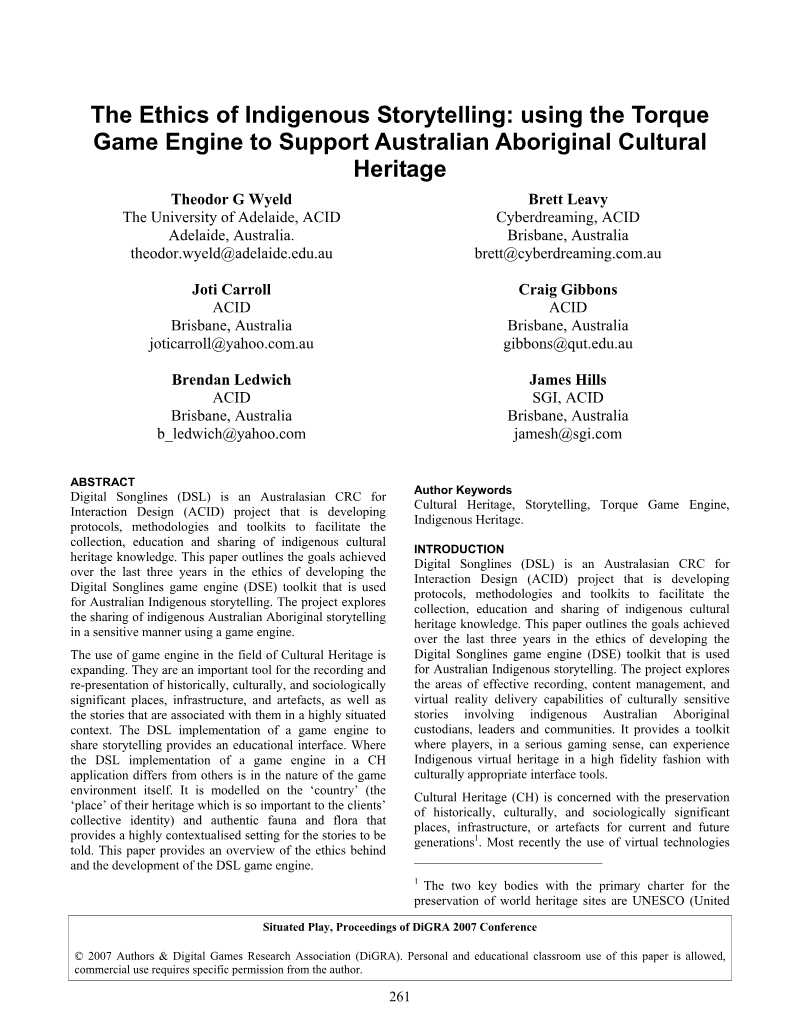
The Ethics of Indigenous Storytelling examines how the Digital Songlines (DSL) project, an ACID initiative, applies the Torque Game Engine to help Australian Aboriginal communities record, share, and teach their cultural heritage through culturally sensitive three-dimensional virtual landscapes.
- The Digital Songlines (DSL) project, an ACID initiative, uses the Torque Game Engine to help Australian Aboriginal communities record, share, and teach cultural heritage through culturally sensitive 3D virtual landscapes, with community ownership rather than external authority as its guiding principle.
- Unlike typical heritage applications that model built structures, the DSL work models organic, non-orthogonal "country" environments, and its framework rests on regional authenticity in flora, fauna, artwork, and story content, a tiered content-layering model, and cyclical consultation with custodians.
- The development process is iterative and community-led, moving through consultation, on-site fieldwork, and repeated community authentication before any project is finalised, with limited budgets and the sensitivity of sacred knowledge acknowledged as ongoing constraints.

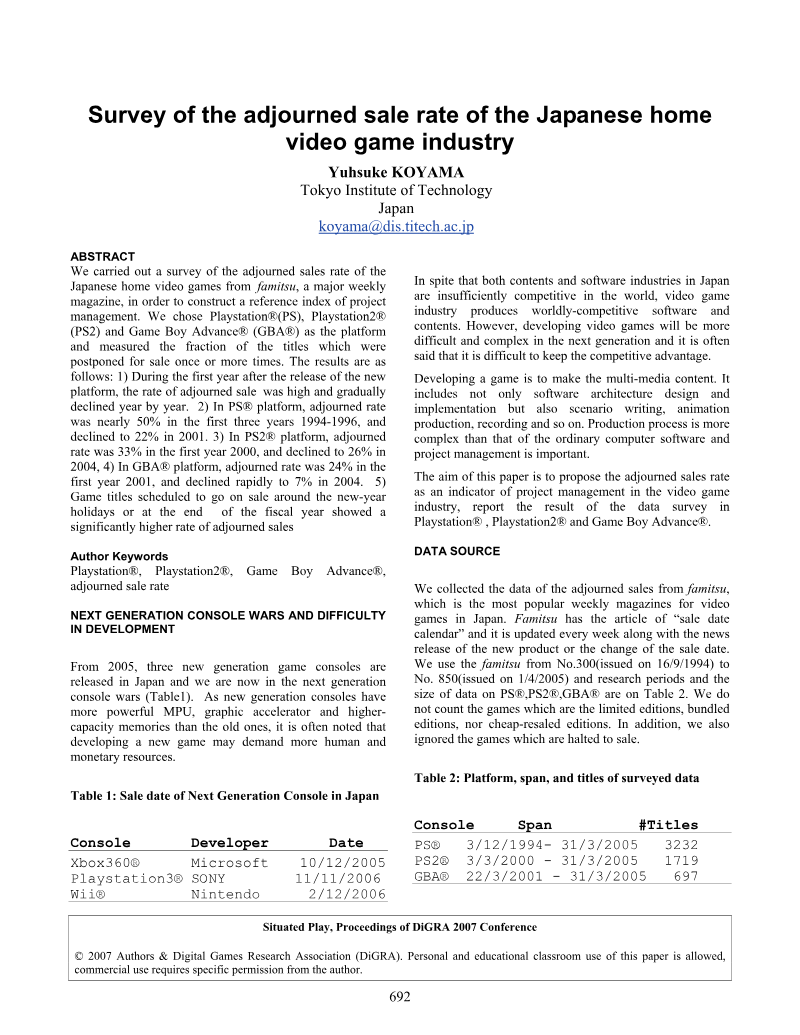
Survey of the Adjourned Sale Rate of the Japanese Home Video Game Industry
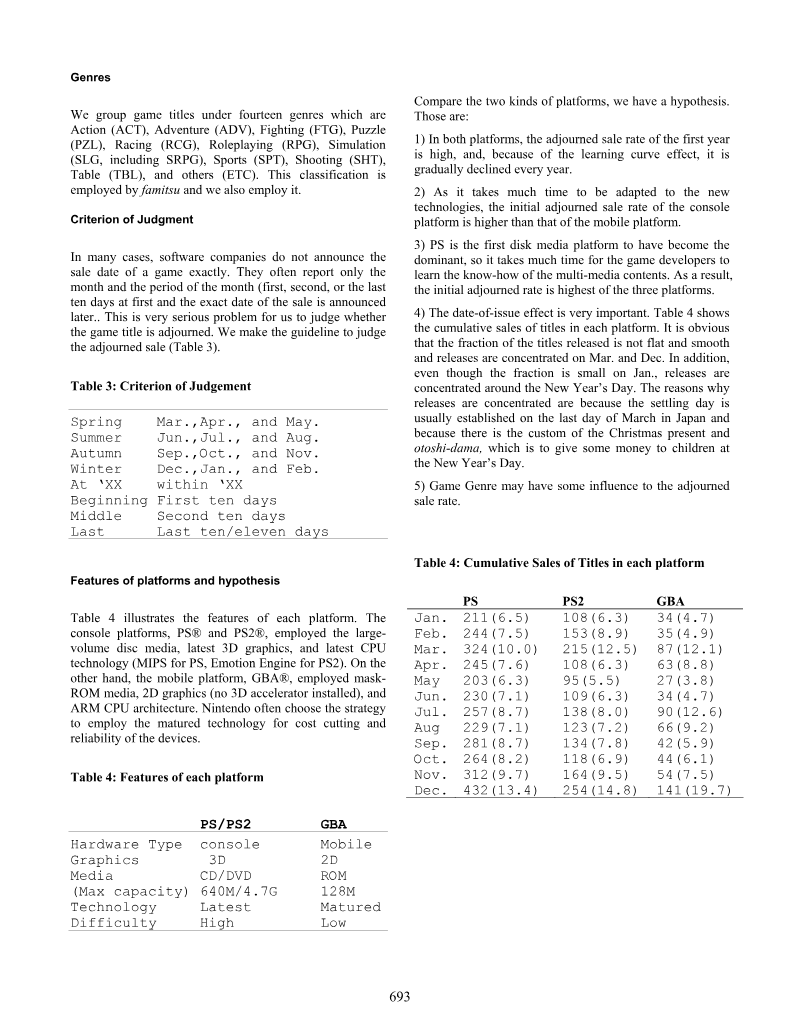
This study by Yuhsuke Koyama of the Tokyo Institute of Technology examines the adjourned sale rate of Japanese home video games, defined as the share of titles whose release was postponed at least once, with the aim of establishing it as an indicator of project management in the industry.
- Adjournment rates (titles whose release was postponed at least once) were highest in each platform's first year and declined steadily afterward, consistent with a learning-curve effect in project management.
- Sony's PlayStation started near 50% adjournment in its early years and fell to about 22% by 2001, while PlayStation 2 began at roughly 33% in 2000 and reached 26% by 2004.
- Nintendo's Game Boy Advance started at about 24% in 2001 and dropped sharply to around 7% by 2004, the steepest decline among the three platforms studied.
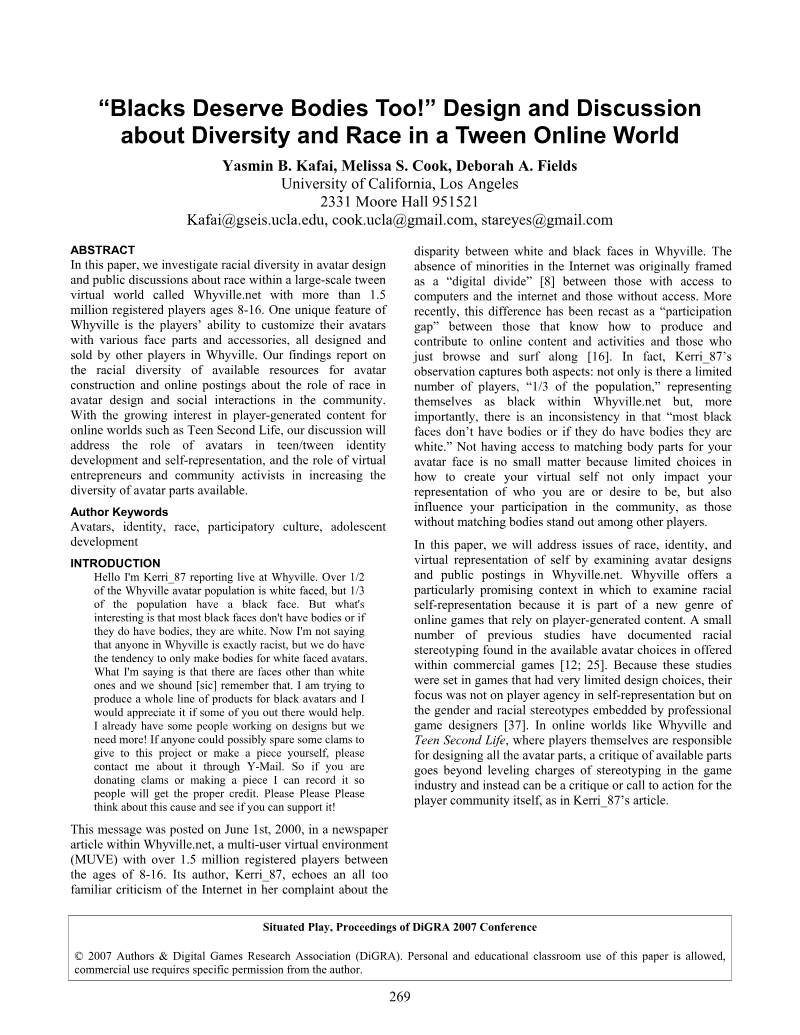
Blacks Deserve Bodies Too!: Design and Discussion About Diversity and Race in a Tween Online World
Kafai, Cook, and Fields examine how race is represented through avatar design in Whyville, a virtual world for tweens, arguing that avatars are central to identity formation and that race has been understudied in online environments relative to gender.
- Roughly one-third of Whyville's avatar faces were black-toned, but most of these faces lacked matching bodies or were paired with white bodies, revealing a persistent disparity in racial representation.
- Peach-toned parts dominated availability on the platform, with 84% of bodies for sale in 2006 in that color family, while brown, olive, and yellow options remained scarce and were largely produced by a small number of designers.
- Player discussions in Whyville's newspaper from 2000 to 2006 included recurring calls for collective action, personal accounts of racism against players using minority avatars, and growing criticism of the default peach "newbie" face.
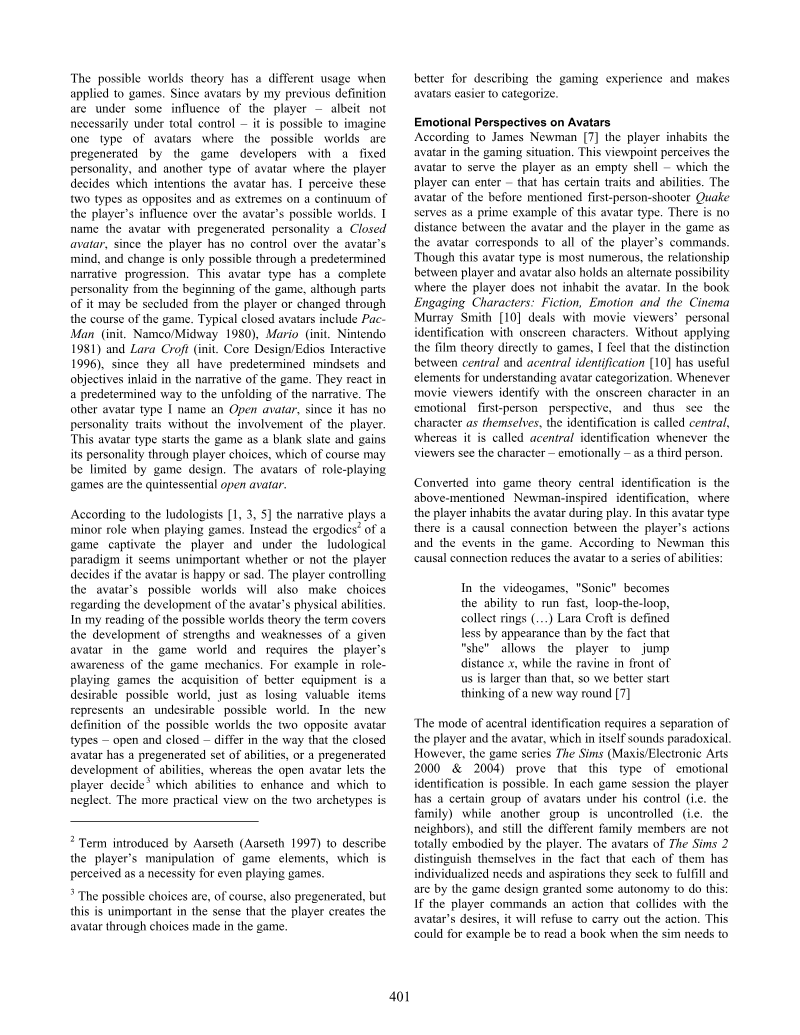
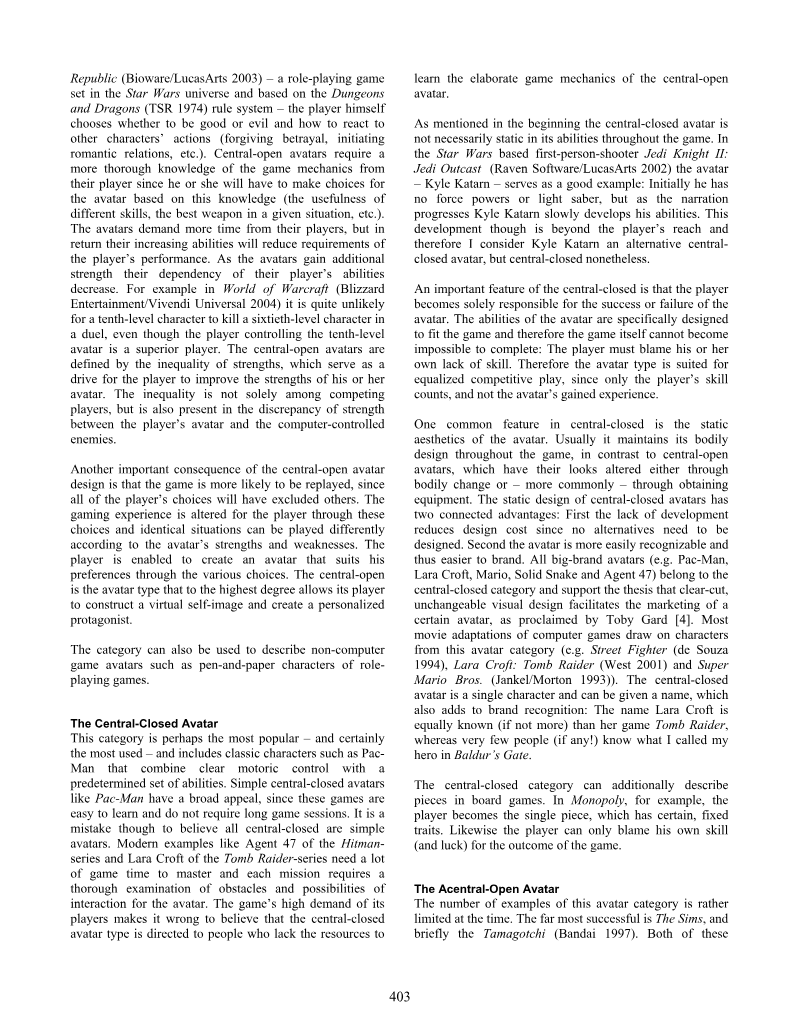
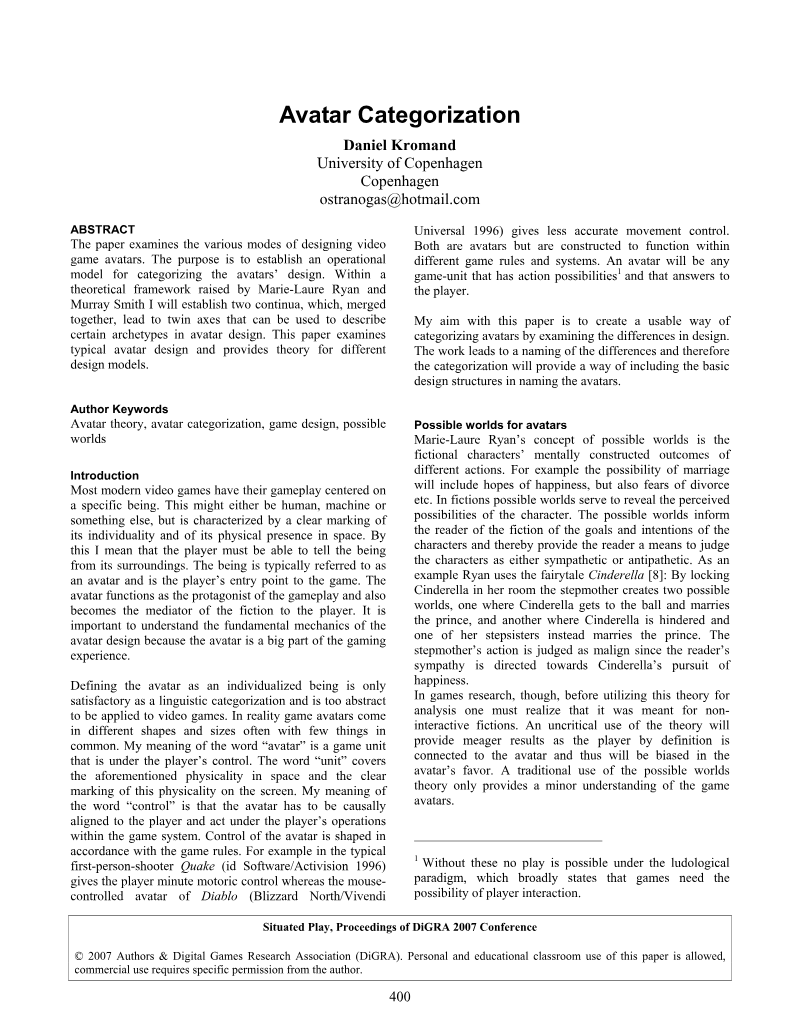
Avatar Categorization
This paper by Daniel Kromand proposes a categorization system for video game avatars, aiming to establish an operational model for describing how avatars are designed.
- Kromand's paper proposes a theoretical categorization system that places video game avatars along two continua—open versus closed (how much player choices shape traits) and central versus acentral identification (whether the player inhabits the avatar or views it as a separate third person)—yielding four archetypes: central-open, central-closed, acentral-open, and acentral-closed.
- Central-closed avatars, such as Lara Croft and Mario, support strong recognizability and marketing, while central-open avatars encourage replayability and a personalized self-image for the player.
- Acentral-open avatars, exemplified by The Sims and Tamagotchi, reward organizing sequences of actions rather than isolated skill.
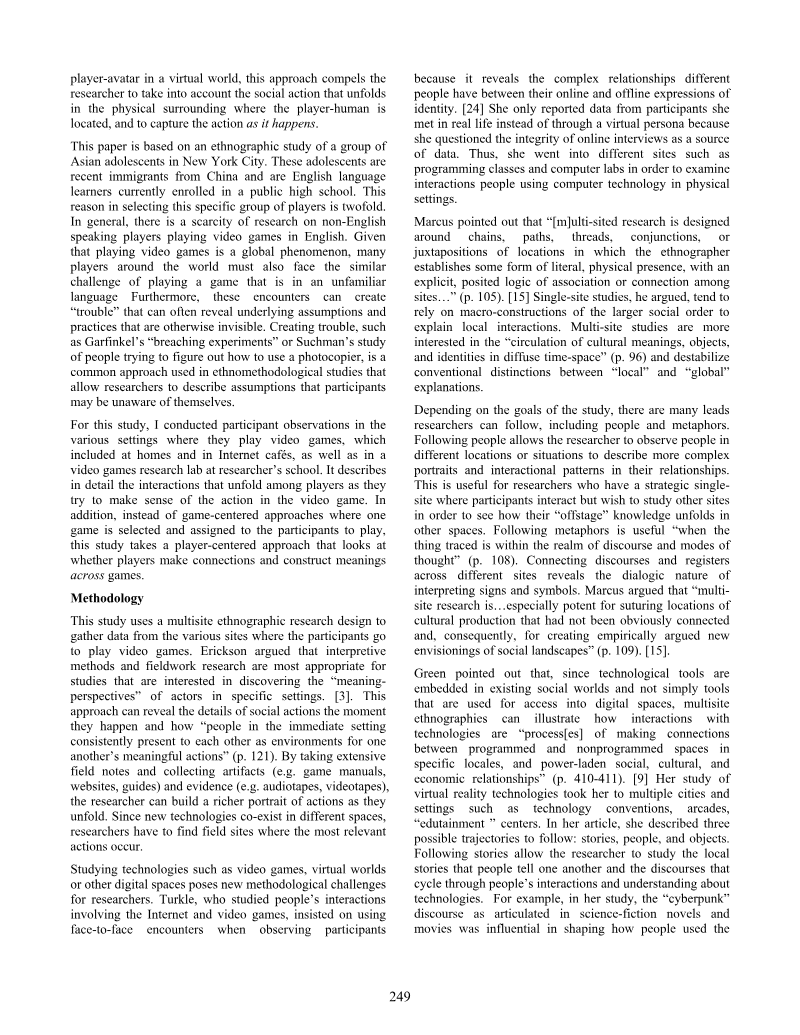
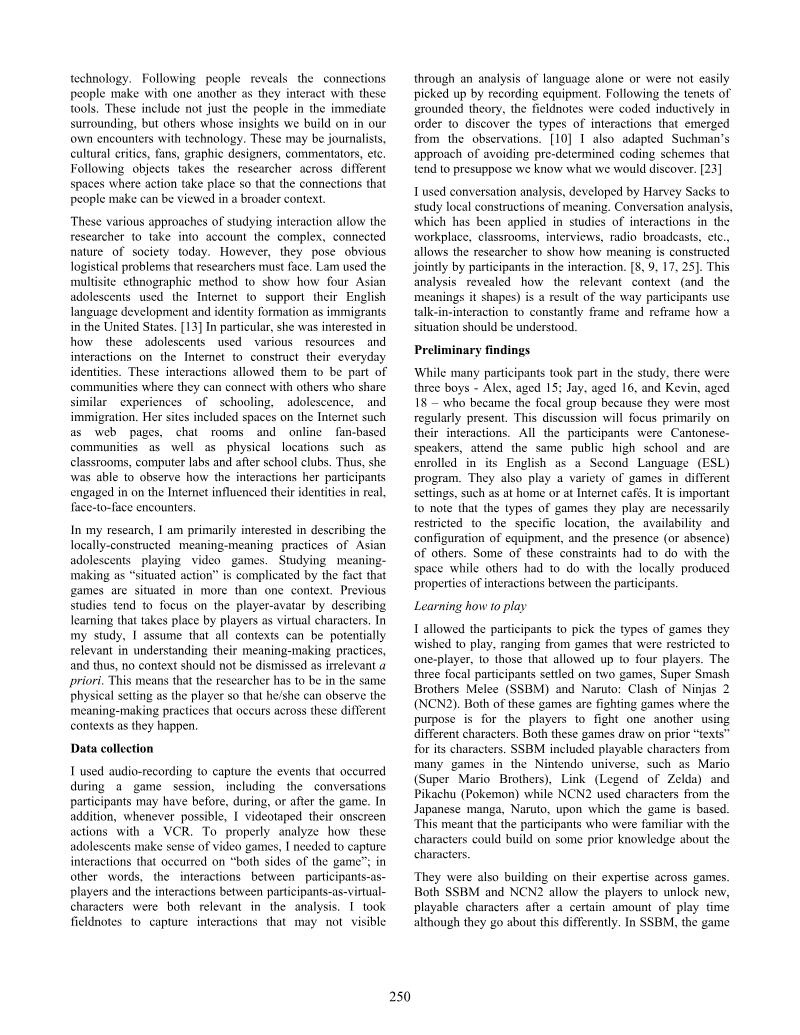
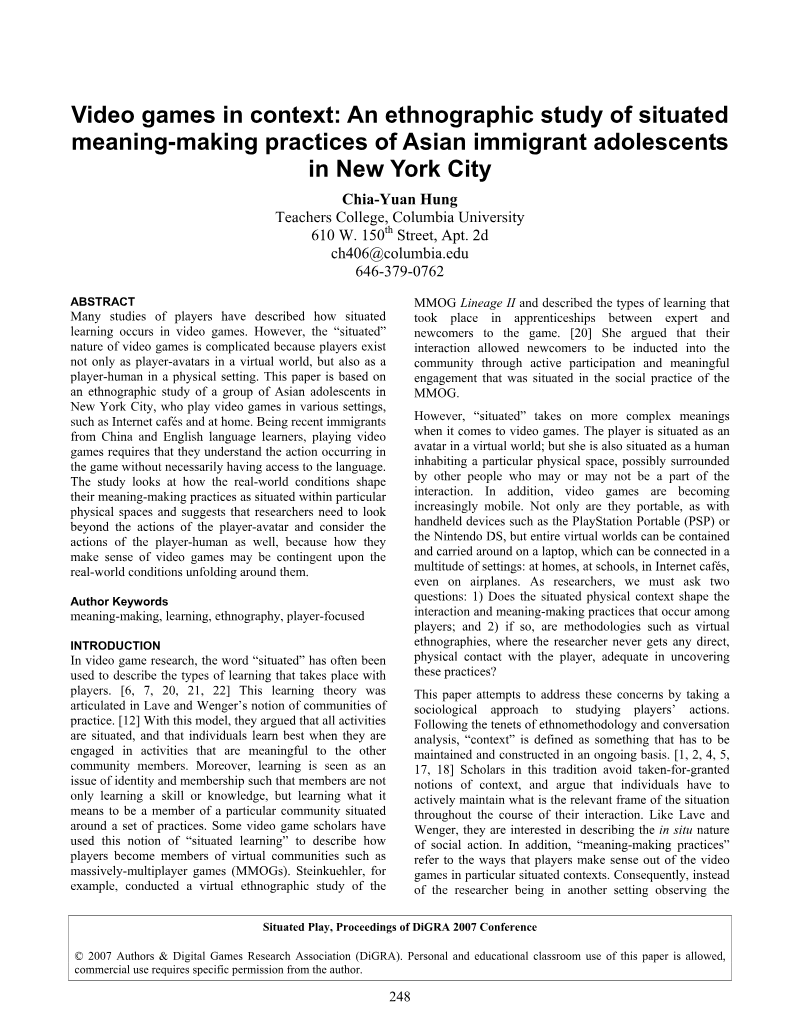
Video Games in Context: An Ethnographic Study of Situated Meaning-Making Practices of Asian Immigrant Adolescents in New York City
This study examines how Asian immigrant adolescents in New York City make sense of video games across multiple sites, including home, Internet cafés, and a university research lab.
- The meaning of video game play is shaped by real-world physical and social conditions around players, so researchers must attend to the player-human as well as the player-avatar, not just virtual-community dynamics.
- Existing 'situated learning' accounts of virtual communities omit the offline context in which play is constructed, which this multisite ethnography (home, Internet cafés, a university research lab) is designed to capture.
- Three Cantonese-speaking recent immigrant boys aged 15 to 18, from the same public high school ESL program, playing Super Smash Brothers Melee and Naruto: Clash of Ninjas 2, showed players applying one game's unlocking logic to another and misreading the second game's structure.
Piracy in the Caribbean: The Political Stakes of Videogame Piracy in Chávez's Venezuela
This paper examines how software piracy shapes participation in videogame culture in Caracas, Venezuela, arguing that piracy can extend access to a global economy for groups excluded by economic barriers.
- Software piracy in Caracas's Libertador district, documented through fieldwork from March to July 2005, was ubiquitous, with pirated games sold far below official prices.
- Distribution networks in Caracas were efficient enough for new North American releases to reach the streets within about 48 hours of launch.
- Apperley argues that piracy can extend access to the global videogame economy for groups excluded by economic barriers, offering a route to inclusion in a knowledge economy rather than a reproduction of poverty.
The Hegemony of Play
"The Hegemony of Play" argues that the digital game industry has been shaped by a narrow, male-dominated, largely white corporate and cultural elite that has marginalized women, non-gamers, and other minority players, even though these groups make up a large share of the population.
- The report argues the digital game industry is shaped by a narrow, male-dominated, largely white corporate elite that excludes women, non-gamers, and minority players, constricting the market and hindering commercial success.
- A 2005 IGDA survey found 88.5% of game developers are male, 83.3% are white, and 92% are heterosexual, while an ESA figure cited in the report shows 38% of gamers are women.
- The author contrasts the modern video game industry with the nineteenth- and early twentieth-century board game industry, which included women designers such as Anne Abbott (Mansion of Happiness) and Lizzie Magie (The Landlord Game) and reflected a broader range of themes and demographics.
I Fought the Law: Transgressive Play and The Implied Player
Espen Aarseth's paper, "I Fought the Law: Transgressive Play and The Implied Player," seeks to resolve a long-standing tension in game studies over what counts as "the player."
- Aarseth resolves the question of "the player" by arguing that the historical, real player cannot exist without a game, while a game can exist without any actual player, and he proposes the "implied player" as a role of expectations embedded in a game's structure, drawing on Wolfgang Iser's concept of the implied reader.
- Aarseth contends that transgressive play (defying intended rules through unexpected actions, bugs, or exploits) is central rather than marginal to understanding play, even though such behavior is statistically uncommon.
- The paper maps game studies along two axes: methodological (formal versus informal) and empirical (social sciences versus humanities), with social scientists studying the player as a historical, situated person and humanists treating the player as a construct of the text.