1 free read left. Create a free account for unlimited reading + AI research.
Create free accountArticle DiGRA
1 free read left. Create a free account for unlimited reading + AI research.
Create free accountArticleDiGRA
The report argues the digital game industry is shaped by a narrow, male-dominated, largely white corporate elite. It says this excludes women, non-gamers and minority players, and constricts the market.
"The Hegemony of Play" argues that the digital game industry has been shaped by a narrow, male-dominated, largely white corporate and cultural elite that has marginalized women, non-gamers, and other minority players, even though these groups make up a large share of the population. Its central claim is that this exclusion has constricted the market and hindered commercial success. The authors support this with industry data, including a 2005 IGDA survey finding that 88.5% of developers are male, 83.3% are white, and 92% are heterosexual, alongside an ESA figure that 38% of gamers are women. They call on game scholars to critically examine these exclusionary structures.
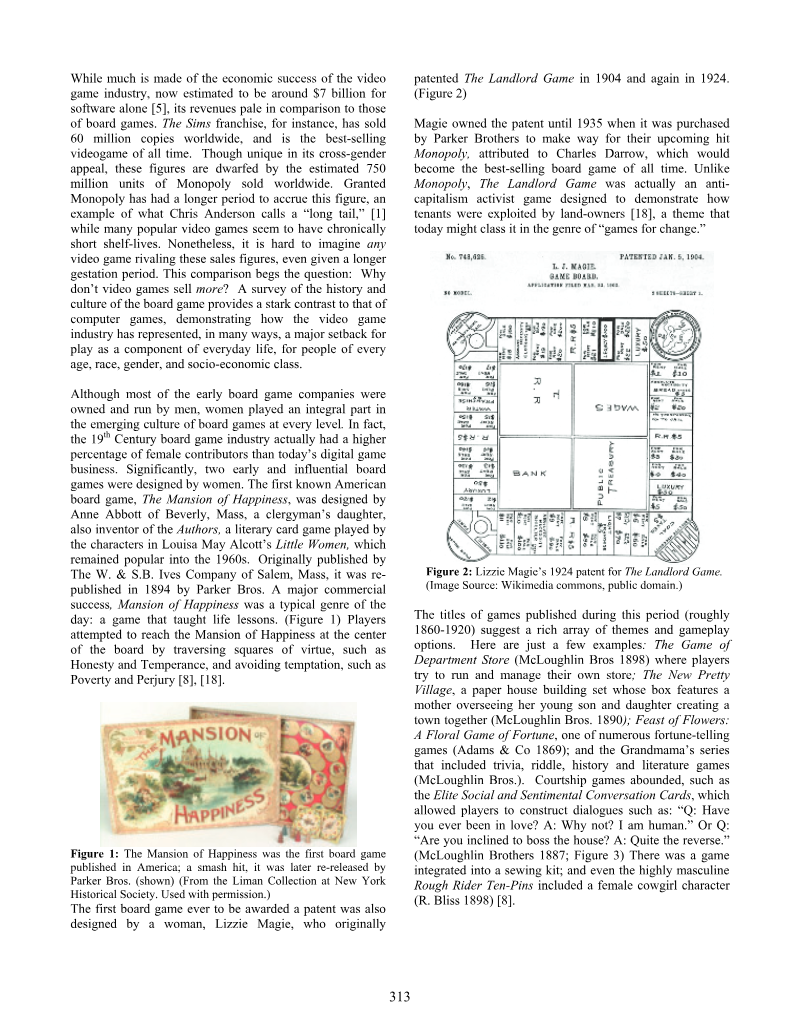
The work situates the modern video game industry against the board game industry of the nineteenth and early twentieth centuries, which it portrays as more inclusive. Women played central roles as designers, such as Anne Abbott with Mansion of Happiness and Lizzie Magie with her patented The Landlord Game, as well as in production and playtesting, and those games reflected a broader range of themes and demographics. By contrast, the author contends that video games have narrowed play into a male-oriented "hardcore gamer" identity, which the author terms "the third gender," shaping design, marketing, and testing around that core audience. Driven by commercial risk-aversion, this narrowing has limited play as an everyday activity across genders, ages, and classes.
The analysis extends to the persistence of the myth that "women don't play games," which the author links to male-skewed magazine readership, with female readers at 5% or less, and to advertising directed largely at men. Nintendo's Wii and DS strategies serve as a counterexample, targeting families, women, older adults including the roughly 70 million Baby Boomers, and casual players. The author presents these approaches as evidence of a more inclusive model that is also commercially successful, concluding that games need not serve a narrow niche to be profitable and that broadening the audience can expand the market.
Each row is a game or company this document names, each column a document, oldest first. A mark means that document names it. Select a row to see those documents.



DiGRA · 2023

DiGRA · 2023



DiGRA · 2023

DiGRA · 2023



DiGRA · 2023



DiGRA · 2023



DiGRA · 2023



DiGRA · 2023



DiGRA · 2023



DiGRA · 2023



DiGRA · 2023

DiGRA · 2023

Jason Schreier · 2026